
Have you ever seen the words competence and competency in a job advertisement, a school lesson, or a work report? Both words look almost the same, and they are closely related in meaning.
Because of this, many English learners find it difficult to decide which word to use.
The confusion is understandable. Both words are connected to a person’s ability to do something well. For example, a teacher needs the ability to explain lessons clearly, and a doctor needs the ability to care for patients.
You may hear someone describe these abilities as competence or competency.
However, the two words can have slightly different uses, especially in education, business, and professional training. Competence often refers to the general ability to perform a task successfully.
Competency often refers to a particular skill, behavior, or quality that helps someone perform a task well.
There is also an important point to remember: these words sometimes overlap. In everyday English, people may use them in similar ways, while certain workplaces and professional fields prefer one word for a specific purpose.
Understanding the difference can help you write better sentences, understand job requirements, prepare for interviews, and communicate more clearly at school or work.
By the end of this guide, you will understand the meaning of each word, learn their grammar rules, compare their uses, and practice choosing the correct word in real-life situations.
What Does “Competence” Mean?
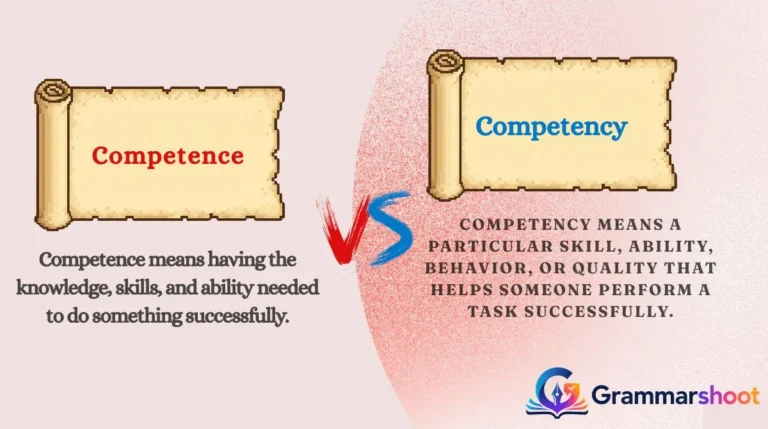
Competence means having the knowledge, skills, and ability needed to do something successfully. It shows that a person can handle a task or meet the needs of a particular situation.
For example, if a person can use a computer, solve problems, and complete office tasks correctly, you can say that the person has competence in those areas.
This word is often used when talking about a person’s overall ability to perform a job or activity. It is common in education, business, healthcare, and everyday communication.
When Should You Use Competence?
Use competence when you want to talk about someone’s general ability to do something well.
It is especially useful when discussing whether someone can perform a task to an acceptable standard. A manager may check an employee’s competence before giving them more responsibility. A teacher may assess a student’s competence in reading or writing.
Here are some common expressions:
- Professional competence
- Language competence
- Technical competence
- Basic competence
- Workplace competence
- Demonstrate competence
Grammar Rule for Competence
Competence is a noun. It usually refers to a general ability rather than one small action.
You can use it with words such as in, at, and to, depending on the sentence structure.
Common patterns include:
- Competence in + subject or skill
- Competence at + activity
- The competence to + verb
For example, you can say, “She has competence in English,” or “He has the competence to manage the team.”
In natural everyday English, however, people often prefer expressions such as “She is competent in English” or “He is competent at managing the team.”
Examples of Competence in Sentences
- The teacher showed great competence in explaining difficult topics.
- Good communication is an important part of professional competence.
- The manager checked the employee’s competence before promoting him.
- Her competence in English helped her get a better job.
- The course aims to improve students’ reading competence.
- He has the competence to lead a small team.
- The doctor demonstrated competence while treating the patient.
- Technical competence is important for this position.
Common Learner Confusion
Some learners think competence only means being very talented. That is not correct.
A person does not need to be the best at something to be competent. The word can simply mean that the person has enough ability to perform the task properly.
For example, a student who can write a clear paragraph may have writing competence, even if the student is not an expert writer.
Remember that competence focuses on the ability to do something successfully. It does not always mean exceptional skill or outstanding performance.
What Does “Competency” Mean?
Competency means a particular skill, ability, behavior, or quality that helps someone perform a task successfully.
The word is especially common in workplaces, training programs, education, and professional development. Employers may list the competencies they expect from a new employee.
For example, a company may expect its team leaders to have communication competency, problem-solving competency, and decision-making competency.
Each of these refers to a particular ability or quality that supports good performance.
When Should You Use Competency?
Use competency when you want to identify a specific ability or behavior that someone needs for a task, job, or role.
It is often used in professional settings where skills are listed, measured, or assessed separately.
For example, a school may assess several competencies in its students. These might include reading comprehension, critical thinking, teamwork, and speaking skills.
Similarly, a company may create a list of competencies for a job position. The list helps managers understand what they should look for when hiring or training employees.
Common expressions include:
- Core competency
- Leadership competency
- Communication competency
- Digital competency
- Technical competency
- Key competencies
Grammar Rule for Competency
Competency is also a noun. Its plural form is competencies.
Use the singular form when referring to one particular skill or ability. Use the plural form when referring to several skills or abilities.
For example:
- Communication is an important competency for this job.
- The training program develops several key competencies.
- Problem-solving is one of her strongest competencies.
You will often see competency used in professional documents, employee assessments, and training plans. It can sound more specialized than competence, although the two words are not limited to separate settings.
Examples of Competency in Sentences
- Communication is a key competency for a customer service worker.
- The company evaluates each employee’s core competencies.
- Problem-solving is an important competency for managers.
- The course helps students develop digital competencies.
- Teamwork is one of the main competencies required for this role.
- The interview tested her leadership competency.
- Teachers need several competencies to support their students.
- The training program focuses on building practical competencies.
Common Learner Confusion
A common mistake is to assume that competency always means one small skill and competence always means a person’s entire ability.
This is a helpful starting point, but it is not a strict rule.
For example, competence can refer to a particular area of ability, while competency can sometimes describe a broader ability. Their meanings overlap, and different organizations may define them in different ways.
The safest approach is to pay attention to the context. If you are discussing a list of specific skills for a job, competencies is often a natural choice. If you are discussing someone’s overall ability to perform a task, competence is often suitable.
Difference Between Competence and Competency (Detailed)
The main difference is the way the words are commonly used, not a completely separate meaning.
Both words describe the ability to do something successfully. However, competence often emphasizes the overall ability to perform a task, while competency often highlights a particular skill, behavior, or quality.
Consider a schoolteacher.
The teacher may have the competence to teach a class successfully. This means the teacher has the overall ability needed for the job.
The teacher may also have several competencies, such as explaining ideas, managing a classroom, asking useful questions, and giving feedback.
These competencies contribute to the teacher’s overall competence.
Comparison Table
| Feature | Competence | Competency |
|---|---|---|
| Basic meaning | Ability to perform a task successfully | A particular skill, ability, or behavior |
| Main focus | Often overall ability | Often a specific ability or quality |
| Grammar | Noun | Noun |
| Plural form | Competences | Competencies |
| Common setting | Everyday English, education, professional life | Workplace training, job descriptions, assessments |
| Example | She demonstrated competence in teaching. | Classroom management is a key competency. |
| Related adjective | Competent | Competent |
| Common phrase | Professional competence | Core competency |
Notice that both words are nouns, and both can describe ability. The distinction in the table reflects common usage rather than a rule that applies in every situation.
1. Difference in Usage
Use competence when you want to focus on whether a person can perform a task successfully.
For example:
“The new employee has the competence to handle customer complaints.”
This sentence focuses on the employee’s ability to handle the work.
Use competency when you want to identify an individual skill or quality that contributes to successful performance.
For example:
“Handling customer complaints is an important competency for this position.”
Here, the sentence identifies a particular ability required for the job.
Both sentences are correct. The difference is what each sentence emphasizes.
2. Difference in Grammar
There is no major difference in grammatical function because both words are nouns.
They can appear as the subject of a sentence, the object of a verb, or after a preposition.
Examples:
- Competence is important in teaching.
- The company values competence.
- She has competence in project management.
- Communication is a useful competency.
- The manager assessed his competencies.
- Training can improve competence.
The grammar depends on the sentence, not simply on which noun you choose.
One important point is that competence is often used as an uncountable noun when referring to ability in general. It can also be plural in some contexts, particularly when referring to separate areas of responsibility or ability.
Competency is commonly countable, especially when discussing individual skills. Its plural form, competencies, is widely used in professional English.
3. Difference in Meaning
Imagine that a company hires a new sales assistant.
The assistant must understand the products, speak politely to customers, use the payment system, and solve basic problems.
The assistant’s overall ability to perform the job can be described as competence.
The individual abilities involved can be described as competencies. These may include communication, product knowledge, teamwork, and problem-solving.
In this example, the competencies help build the person’s overall competence.
However, this distinction is not universal. Some books, workplaces, and professional standards use the two terms almost interchangeably.
4. Difference in Sentence Structure
Both words can follow similar sentence patterns.
| Sentence pattern | Example |
|---|---|
| Noun + verb | Competence matters. |
| Adjective + noun | Professional competence matters. |
| Verb + noun | The manager assessed her competence. |
| Verb + a competency | The course develops a key competency. |
| Possessive + noun | His competence impressed the team. |
| Possessive + plural noun | Her competencies include writing and research. |
You do not need to learn a completely different grammar system for each word.
Instead, learn common expressions and understand what you want to emphasize.
5. Which Word Is More Common?
Both words are established English words, but their frequency depends on the subject and the type of writing.
Competence is widely used in general discussions of ability, professional performance, and the ability to meet a standard.
Competency is particularly common in human resources, job descriptions, training frameworks, and employee assessments.
For example, a manager might write, “We need to improve staff competence.” A training document might list “five key competencies for new managers.”
Neither word is automatically more correct or more formal in every situation. Choose the one that best fits your meaning and the language used in your field.
Grammar Rules You Must Remember
The following four rules will help you use both words more confidently.
Rule 1: Use Competence for General Ability
When you want to discuss someone’s overall ability to complete a task, competence is often a good choice.
Example:
“Her competence in managing projects impressed the director.”
The sentence describes her ability to manage projects successfully.
You can use this pattern when discussing professional work, language skills, education, or everyday activities.
Rule 2: Use Competency for a Specific Skill or Quality
When you want to identify a particular ability needed for a task, competency is often suitable.
Example:
“Decision-making is an important competency for a team leader.”
The sentence names one particular ability that helps a person perform a leadership role.
This pattern is common in job advertisements, training plans, and performance reviews.
Rule 3: Remember the Correct Plural Forms
The plural form of competence is competences. The plural form of competency is competencies.
Examples:
- The job requires several areas of competence.
- The course develops important competencies.
- The manager assessed the employee’s competencies.
In everyday English, competence is often used without a plural ending when ability is discussed generally. In contrast, competencies is very common when listing individual skills.
Rule 4: Do Not Confuse the Nouns with the Adjective
The adjective related to both words is competent.
You can say:
- She is competent at her job.
- He is competent in English.
- They are competent workers.
Do not use competence or competency as an adjective in these sentences.
For example, “She is competence at her job” is incorrect. The correct sentence is “She is competent at her job.”
Remember the difference between the noun and adjective forms:
- Competence: noun
- Competency: noun
- Competent: adjective
Common Mistakes Students Make
Even advanced learners sometimes mix up these words. Most mistakes happen because the meanings overlap or because learners try to follow a strict rule that English does not always follow.
Here are some common problems and simple ways to avoid them.
Mistake 1: Thinking the Words Have Completely Different Meanings
Incorrect idea: “Competence means general ability, but competency can never mean general ability.”
Correction: The words overlap. Although competency often refers to a particular skill, it can also refer to a broader ability in some contexts.
For example:
- Her competence in communication is excellent.
- Communication is one of her key competencies.
Both sentences are correct. They simply focus on communication in slightly different ways.
Tip: Think of the general-versus-specific distinction as a useful guide, not an unbreakable rule.
Mistake 2: Using the Wrong Word Form
Incorrect: “He has many competency.”
Correct: “He has many competencies.”
The word many is used with countable plural nouns. Because competency is countable in this sentence, it needs the plural form competencies.
Another example:
Incorrect: “The company needs employees with different competencies level.”
Correct: “The company needs employees with different levels of competence.”
You could also write, “The company needs employees with different competency levels,” depending on the intended meaning.
Tip: Check whether the sentence refers to one skill or several skills.
Mistake 3: Using a Noun Instead of an Adjective
Incorrect: “She is competence in mathematics.”
Correct: “She is competent in mathematics.”
The word after is describes the person, so you need the adjective competent.
Here is another example:
Incorrect: “He is competency at his job.”
Correct: “He is competent at his job.”
Tip: If you are describing a person directly, ask yourself whether you need an adjective.
Mistake 4: Choosing a Word Just Because It Sounds More Formal
Some students believe competency is always more professional than competence. This is not true.
Both words appear in formal writing. Their suitability depends on the context.
For example:
- The assessment measures professional competence.
- The assessment identifies key professional competencies.
Both sentences are appropriate in a workplace document.
Tip: Focus on meaning and context instead of assuming one word is always more formal.
Mistake 5: Using an Unnatural Phrase
A sentence can be grammatically correct but still sound awkward.
For example, “She has competence at speaking English” may sound less natural than “She is competent at speaking English” or “She has competence in English.”
Similarly, “Communication is a competency of this job” is often less natural than “Communication is a key competency for this job.”
Tip: Learn common word combinations. Reading examples from reliable English sources can help you recognize natural phrases.
Easy Trick to Remember the Difference
Here is a simple memory trick:
Competence = overall ability.
Competency = a particular skill or ability.
Imagine that you are learning to drive a car.
To drive safely, you need to understand traffic signs, control the steering wheel, use the brakes, and watch other road users.
Your overall ability to drive safely can be described as your driving competence.
Your individual abilities, such as parking, changing gears, and observing traffic, can be described as competencies.
Competence: The whole picture
Can you drive safely and successfully?
Competencies: The individual parts
Can you park, follow road signs, and control the car?
This trick works well when you are discussing jobs, school subjects, sports, or daily tasks.
For example, a football player needs the competence to play the game well. Passing, shooting, and defending are individual competencies that help the player perform successfully.
Just remember that this is a learning aid, not a strict rule for every English sentence.
Daily Life Examples of Competence vs Competency
The best way to understand these words is to see how people might use them in normal conversations.
Example 1: At the Office
Ali: Why did the manager give Sara the new project?
Hina: She has the competence to manage the work successfully.
Here, competence describes Sara’s overall ability to handle the project.
Example 2: During a Job Interview
Interviewer: What competencies do you bring to this position?
Applicant: My main competencies are communication, teamwork, and problem-solving.
The interviewer is asking about specific skills and qualities.
Example 3: In a Classroom
Teacher: How can we tell if a student is ready for the next level?
Assistant: We need to assess the student’s competence in reading and writing.
The discussion focuses on the student’s overall ability in these areas.
Example 4: During Employee Training
Manager: What should the new training course cover?
Trainer: It should develop leadership and decision-making competencies.
The trainer identifies specific abilities that employees need to improve.
Example 5: Learning English
Student: My grammar is improving, but I still make mistakes when I speak.
Teacher: Regular practice will help improve your competence in English.
The word describes the learner’s ability to use English successfully.
Example 6: Applying for a Job
Friend A: What does this job advertisement mean by core competencies?
Friend B: It means the main skills and qualities the employer expects you to have.
The plural noun refers to particular skills and qualities.
Example 7: In a Hospital
Nurse A: Why is practical training important for new nurses?
Nurse B: It helps them build the competence needed to care for patients safely.
The sentence refers to the overall ability to perform the work properly.
Example 8: At a School Meeting
Parent: What skills should my child develop this year?
Teacher: We are working on reading, teamwork, and problem-solving competencies.
The teacher names individual skills that the students are learning.
Example 9: Discussing a Promotion
Employee A: Do you think Daniel is ready to become a supervisor?
Employee B: Yes. He has demonstrated competence in leading the team.
The sentence emphasizes Daniel’s ability to handle the responsibility.
Example 10: Planning a Course
Trainer A: How will we know whether the course is successful?
Trainer B: We will assess the key competencies the learners develop.
The trainer plans to measure particular abilities gained during the course.
These examples show that both words can be used in education, professional life, and everyday conversations. The best choice depends on whether you want to emphasize overall ability or a particular skill.
Practice Section: Choose the Correct Word
Test your understanding with these five questions. Choose competence or competency to complete each sentence. In some situations, both words may be possible, but choose the option that best matches the intended meaning.
1. The manager assessed her overall _____ in handling difficult projects.competencecompetency
2. Communication is a key _____ for a customer service role.competencecompetency
3. The course helps students develop several digital _____.competencescompetencies
4. The doctor demonstrated professional _____ while treating the patient.competencecompetency
5. Teamwork and problem-solving are important _____ for new employees.competencecompetencies
Check answers
If you made a mistake, do not worry. Review the example sentences and ask yourself whether the sentence describes overall ability or names a specific skill.
FAQs
1. What is the difference between competence and competency?
Competence often refers to the overall ability to perform a task successfully. Competency often refers to a specific skill, ability, or behavior that helps someone perform that task.
However, the meanings overlap, and some fields use the words interchangeably.
2. Can competence and competency be used interchangeably?
Yes, in some situations. Both words can refer to a person’s ability to do something successfully.
However, certain workplaces and professional training systems distinguish between overall competence and individual competencies. Follow the terminology used in your particular field when a formal distinction matters.
3. Is competency a formal or informal word?
Competency is commonly used in formal and professional English, especially in human resources, education, and workplace training.
It is often found in job descriptions and performance reviews. However, it is not restricted to formal writing, and people may use it in everyday discussions about skills.
4. What is the plural of competence and competency?
The plural of competence is competences, while the plural of competency is competencies.
For example, “The course develops several competencies.” When talking about general ability, competence is often used as an uncountable noun.
5. Is it correct to say “core competence” or “core competency”?
Both expressions are correct.
Core competence often refers to an important ability or strength, particularly one that supports overall performance. Core competency is commonly used for a key skill or ability identified in a professional or organizational framework.
The best choice depends on your intended meaning and the terminology used by your organization.
6. What is the adjective form of competence and competency?
The adjective is competent. It describes someone who has enough knowledge or ability to perform a task successfully.
For example, “She is a competent teacher.” You would not say, “She is a competence teacher,” because competence and competency are nouns, not adjectives.
Conclusion
The difference between competence and competency is easier to understand when you focus on what you want to describe. Both words are connected to ability, knowledge, and successful performance, but they often emphasize different things.
Use competence when you want to talk about someone’s general ability to perform a task. Use competency when you want to identify a particular skill, behavior, or quality that helps someone succeed.
For example, a teacher’s competence may refer to the ability to teach students effectively. Classroom management, communication, and lesson planning may be listed as separate competencies that support that ability.
Remember that this distinction is a useful guide rather than an absolute grammar rule. The words sometimes overlap, and professional fields may use them in different ways.
To improve your English, practice using both words in sentences about your studies, job, and daily activities. Pay attention to how they appear in real examples, and learn common expressions such as professional competence and core competencies.
With regular practice, you will become more confident about choosing the right word and expressing your ideas clearly.

Evan Rellmont is a writer who turns thoughtful ideas into meaningful words, creating stories and reflections that connect, inspire, and leave a lasting impression.