
English has many words that sound the same but have different meanings and spellings. These words can confuse even students who understand basic English grammar.
Cue vs queue is a good example because both words are pronounced almost exactly the same, but they are used in different situations.
Imagine you are watching a play. An actor waits for a signal before speaking. That signal is called a cue.
Now imagine you are standing outside a shop, waiting for your turn to buy something. You are standing in a queue. The two words sound alike, but their meanings are not the same.
This difference is important in everyday English. You may hear these words in conversations at school, at work, in a theater, or while waiting in line.
They also appear in books, news stories, emails, and online discussions. Using the wrong word can make your sentence confusing or change its meaning.
The good news is that you do not need to memorize complicated grammar rules to understand them. You only need to remember what each word describes and how it works in a sentence.
By the end of this guide, you will understand the meaning of each word, learn when to use it, compare their grammar rules, and explore examples from daily life.
You will also discover common mistakes, simple memory tricks, and practice questions to test your knowledge.
Whether you are a beginner, a student, or someone improving their spoken English, these explanations will help you choose the correct word with confidence.
What Does “Cue” Mean?
A cue is a signal, sign, hint, or action that tells someone when to do something. It can also mean a clue that helps a person understand what to say or do next.
People commonly use this word in acting, music, sports, conversations, presentations, and everyday situations. For example, an actor may wait for another actor to speak before delivering a line. A speaker may look at a slide as a reminder of what to discuss next.
The word cue can be used as both a noun and a verb.
Cue as a Noun
As a noun, cue refers to a signal or hint that helps someone know when to act.
Examples:
- The actor waited for his cue before speaking.
- The teacher gave me a cue to begin reading.
- Her smile was my cue to start the presentation.
- The singer missed her cue and entered late.
- The lights went out as a cue for the next scene.
- His question was a cue for everyone to pay attention.
- The coach gave the players a cue to begin the exercise.
- I took his silence as a cue to leave the room.
In these sentences, the word describes something that signals an action or helps someone decide what to do.
For example, in “The actor waited for his cue,” the actor is waiting for a signal that tells him when to speak or act.
Cue as a Verb
As a verb, cue means to give someone a signal or to prepare something to begin at the right moment.
Examples:
- The director cued the actor to enter the stage.
- The teacher cued the students to start writing.
- The technician cued the music at the right moment.
- She cued the next speaker with a small hand movement.
Notice that the verb changes according to the tense and subject.
- Present: I cue the speaker.
- Past: I cued the speaker.
- Present participle: I am cueing the speaker.
The basic spelling rule is simple: add -d to form cued, and add -ing to form cueing.
When Should You Use “Cue”?
Use cue when you are talking about a signal, hint, reminder, or action that tells someone when to do something.
Here are some common situations:
- In theater: An actor waits for a cue to speak.
- In music: A conductor gives a cue to the musicians.
- In school: A teacher gives students a cue to begin an activity.
- In conversation: Someone’s expression may be a cue to change the subject.
- At work: A manager gives a cue for a presentation to begin.
A useful expression is “take your cue from someone.” It means to follow another person’s example, behavior, or instructions.
For example, “The new employees took their cue from the manager.” This means the employees followed the manager’s example.
Another common expression is “on cue.” It means something happens at exactly the expected moment.
Example: “Just as we mentioned his name, he walked into the room on cue.”
Common Confusion About “Cue”
Some learners think cue refers only to acting or theater. However, its meaning is much wider. A look, a sound, a gesture, or even a particular event can serve as a cue.
Remember that a cue is connected to a signal or a hint. If something tells a person when to act, speak, begin, or respond, cue is usually the correct word.
What Does “Queue” Mean?
A queue is a line of people or things waiting for their turn. It is commonly used in British English, especially when people are waiting for a service or an activity.
For example, people waiting at a bank, customers waiting at a checkout counter, or passengers waiting to board a bus may form a queue.
The word queue is mainly used as a noun, but it can also be used as a verb. As a verb, it means to form a line or arrange something in a waiting order.
Queue as a Noun
As a noun, queue means a line of people or things waiting for their turn.
Examples:
- We stood in a queue outside the cinema.
- There was a long queue at the supermarket.
- She joined the queue to buy a ticket.
- The queue moved slowly because only one counter was open.
- Several people were waiting in the queue for their turn.
- I waited in a queue at the post office.
- The queue outside the restaurant reached the street.
- Please join the queue and wait patiently.
In each example, the word refers to a line of people or things.
For example, “There was a long queue at the supermarket” means many people were waiting in line to pay for their shopping.
In British English, people often say “stand in a queue” or “join the queue.” In American English, “stand in line” and “get in line” are more common.
Both varieties of English are correct. The preferred expression simply depends on the region and the speaker.
Queue as a Verb
As a verb, queue means to form a line or wait in an organized order.
Examples:
- The customers queued outside the store.
- We queued for tickets for nearly an hour.
- People were queuing to enter the museum.
- Please queue here before entering the building.
The verb can also describe arranging digital tasks, files, or messages so they are processed one after another.
For example, “I queued the songs for the party.” This means I arranged the songs in a list so they could play in order.
Similarly, “The printer has several documents queued.” This means several documents are waiting to be printed.
When Should You Use “Queue”?
Use queue when you are talking about people or things waiting for their turn or items arranged to be processed in order.
Common situations include:
- At a shop: Customers wait in a queue to pay.
- At a bus stop: Passengers queue to board the bus.
- At a bank: People wait in a queue for service.
- At an event: Visitors queue to enter the venue.
- On a computer: Files or tasks wait in a queue for processing.
The word is especially common in British English. In American English, people generally use line for a row of people waiting.
For example, a British speaker might say, “We queued for coffee,” while an American speaker might say, “We stood in line for coffee.”
Both sentences communicate the same basic idea.
Common Confusion About “Queue”
The spelling of queue can look strange because it contains five letters, but its pronunciation is usually just one syllable. The final four letters are not pronounced as separate sounds.
Another source of confusion is its use in technology. A queue does not always involve people. It can also refer to tasks, files, messages, or other items waiting to be handled in order.
The key idea remains the same: a queue involves waiting or an organized sequence, not a signal telling someone when to act.
Difference Between Cue and Queue (Detailed)
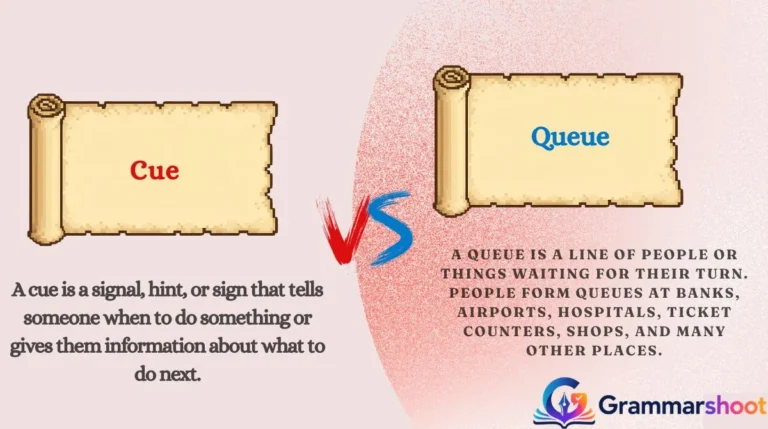
The main difference between cue and queue is their meaning. A cue is a signal or hint, while a queue is a line of people or things waiting for their turn.
Although the words sound alike, you cannot normally use one in place of the other.
Comparison Table
| Feature | Cue | Queue |
|---|---|---|
| Main meaning | A signal, hint, or reminder | A line of people or things waiting |
| Part of speech | Noun and verb | Noun and verb |
| Common situation | Acting, speaking, responding, performing | Shopping, travel, services, computing |
| Example as a noun | The bell was my cue to leave. | We joined the queue at the bank. |
| Example as a verb | She cued the singer. | They queued outside the shop. |
| Common expression | On cue | Join the queue |
| Memory idea | A signal to act | A line to wait in |
1. Difference in Meaning
A cue tells you when to do something or gives you a clue about what to do next.
A queue, on the other hand, is a line or waiting order. It does not usually tell you when to act through a signal. Instead, it describes the arrangement of people or things waiting for their turn.
Compare these examples:
- The teacher gave me a cue to start reading.
- The students formed a queue outside the classroom.
In the first sentence, the teacher gives a signal. In the second, the students form a line.
The words have different meanings even though their sounds are nearly identical.
2. Difference in Grammar
Both words can function as nouns and verbs, so grammar alone does not always tell you which spelling to use. You must look at the meaning of the sentence.
As a noun, cue can be the subject or object of a sentence.
Example: “The signal was my cue.”
Here, cue is a noun because it names a signal.
As a verb, it describes the action of giving a signal.
Example: “Please cue the next speaker.”
Similarly, queue can be a noun.
Example: “The queue was very long.”
It can also be a verb.
Example: “The customers queued outside.”
The important point is that the part of speech may be the same, but the meanings are different.
3. Difference in Sentence Structure
A sentence containing cue often includes a person who gives or receives a signal.
Common structures include:
- Someone gives someone a cue.
- Someone waits for a cue.
- Something acts as a cue.
- Someone cues another person to do something.
Examples:
- The director gave the actor a cue.
- I waited for my cue to speak.
- The bell cued the students to leave.
A sentence containing queue often describes a line or people waiting.
Common structures include:
- Someone joins a queue.
- Someone waits in a queue.
- People form a queue.
- Someone queues for something.
Examples:
- We joined the queue.
- She waited in the queue for tickets.
- The customers queued outside the shop.
These patterns can help you choose the correct word more quickly.
4. Difference in Everyday Usage
You will often hear cue when people discuss communication, performance, or instructions.
For example, a presenter might say, “That question was my cue to explain the next point.”
You will often hear queue when people discuss waiting, public services, travel, or technology.
For example, someone might say, “I spent twenty minutes in the queue at the airport.”
Think about the situation before choosing the word. Is someone receiving a signal, or is someone waiting in a line? Your answer will usually make the choice clear.
Grammar Rules You Must Remember
Learning four simple rules will help you avoid most mistakes involving these words.
Rule 1: Use “Cue” for a Signal or Hint
When something tells a person when to act, speak, or respond, use cue.
Correct: The teacher gave us a cue to begin the test.
Incorrect: The teacher gave us a queue to begin the test.
The second sentence is incorrect if you mean the teacher gave a signal. A queue is a line, not a signal.
Rule 2: Use “Queue” for a Line of People or Things
When people or things are waiting in an organized order, use queue.
Correct: We joined the queue to buy concert tickets.
Incorrect: We joined the cue to buy concert tickets.
The correct word describes a line of people waiting to purchase tickets.
Rule 3: Both Words Can Be Nouns and Verbs
Do not assume that cue is always a noun or that queue is always a noun. Both words can perform more than one grammatical role.
Cue as a verb: The director cued the actors.
Queue as a verb: The visitors queued outside the museum.
The surrounding words and the intended meaning help you understand how each word is being used.
Rule 4: Their Pronunciation Does Not Determine Their Spelling
In common English pronunciation, cue and queue sound alike. You cannot reliably identify the correct spelling by listening alone.
Correct: That was my cue to leave.
Correct: There was a queue at the entrance.
Both spellings are correct in their respective sentences. Choose the word according to the meaning, not the sound.
Common Mistakes Students Make
Many learners confuse these words because English contains homophones: words that sound the same but have different meanings and spellings.
When you hear either word in conversation, the sound does not tell you which spelling is intended. You must understand the context.
Mistake #1: Using “Cue” Instead of “Queue”
Wrong: We waited in a cue outside the restaurant.
Correct: We waited in a queue outside the restaurant.
The sentence describes people waiting for their turn, so queue is correct.
Correction tip: If you can replace the word with line, use queue in British English.
Mistake #2: Using “Queue” Instead of “Cue”
Wrong: The music was my queue to begin dancing.
Correct: The music was my cue to begin dancing.
The music gives a signal to start dancing. It does not form a line, so cue is the correct word.
Correction tip: If you can replace the word with signal or hint, use cue.
Mistake #3: Thinking “Queue” Is Only a Noun
Wrong idea: Queue can only describe a line of people.
Correct understanding: Queue can also be a verb.
Example: “We queued for tickets outside the stadium.”
Here, queued describes the action of waiting in line.
Correction tip: Learn each word in more than one sentence. Seeing it as both a noun and a verb will make its use easier to remember.
Mistake #4: Choosing the Spelling by Sound
A student may hear a sentence and write either spelling because the words sound alike.
For example, someone might write, “The bell was my queue to leave,” when the intended meaning is a signal.
Correction tip: Ask yourself what the word means in the sentence. Do not depend on pronunciation alone.
Mistake #5: Forgetting Regional Differences
British English commonly uses queue for a line of people waiting. American English more often uses line.
For example:
- British English: We are waiting in the queue.
- American English: We are waiting in line.
Both expressions are natural in their respective varieties. The word cue does not replace queue in either variety.
Correction tip: Pay attention to the English variety you are learning, especially when writing for a particular audience.
Easy Trick to Remember the Difference
A simple memory trick can help you remember the spelling without studying long grammar explanations.
Cue = Signal. Queue = Line.
Imagine that you are in a theater. The actor is waiting for a signal from the director. That signal is the actor’s cue.
Now imagine you are outside a theater waiting to buy a ticket. You are standing in a queue.
The two words describe different parts of the same situation. The cue tells someone when to act, while the queue is the line of people waiting.
Here is another useful trick:
- If the sentence is about a signal, hint, or reminder, choose cue.
- If the sentence is about waiting in line or arranging items in order, choose queue.
You can also remember the common expressions:
- “That was my cue.”
- “Join the queue.”
These short phrases show the two meanings clearly.
Do not worry about the extra letters in queue. English spelling is not always easy to predict from pronunciation. Learn the word as a complete spelling and connect it with its meaning.
With regular reading and practice, you will begin to recognize the correct word naturally.
Daily Life Examples
The easiest way to understand confusing words is to see them in ordinary conversations. The following examples show how people use cue and queue in daily life.
Example 1: In a Classroom
Teacher: Everyone, wait until I give you a cue.
Student: Okay, we will start when you tell us.
Here, cue means a signal that tells students when to begin.
Example 2: At a Supermarket
Ali: Why are you standing near the entrance?
Sara: I’m waiting in the queue to pay for my groceries.
The word queue refers to the line of customers waiting to pay.
Example 3: During a Presentation
Ayesha: When should I introduce the next topic?
Teacher: Use the next slide as your cue.
The slide acts as a reminder to move to the next topic.
Example 4: At a Bus Station
Passenger 1: Is this the queue for the next bus?
Passenger 2: Yes, please stand behind the last person.
Here, queue describes the line of passengers waiting to board.
Example 5: Before a Performance
Director: Wait for your cue before entering the stage.
Actor: Understood. I’ll enter when the music starts.
The actor must wait for a signal before moving onto the stage.
Example 6: At a Restaurant
Customer 1: There are so many people here!
Customer 2: Yes, we have been in the queue for fifteen minutes.
The customers are waiting in line for service.
Example 7: While Studying
Student 1: How do you remember what to say next?
Student 2: I use the headings as cues.
The headings are hints that help the student remember the next point.
Example 8: At a Computer
Employee: Why hasn’t the report printed yet?
Colleague: It is still in the print queue.
The report is waiting to be processed by the printer.
Example 9: In a Conversation
Hassan: She looked at the door several times.
Mariam: Maybe that was a cue that she wanted to leave.
The person’s behavior is interpreted as a signal or hint.
Example 10: Planning an Event
Organizer: Have you arranged the songs for the show?
Assistant: Yes, I have queued them in the order we need.
Here, queued means the songs have been placed in an order for later use.
These examples show that the correct word depends on the situation. A cue gives a signal, while a queue describes a line or an ordered list waiting to be processed.
Practice Section: Choose the Correct Word
Test your understanding with these five sentences. Choose either cue or queue to complete each sentence.
1. We stood in a long ______ outside the ticket office.
- A. cue
- B. queue
2. The teacher gave me a ______ to start reading.
- A. cue
- B. queue
3. The actor missed his ______ and entered the stage late.
- A. cue
- B. queue
4. Several documents are waiting in the printer’s ______.
- A. cue
- B. queue
5. The lights went out as a ______ for the next scene.
- A. cue
- B. queue
Answers and Explanations
1. B — Queue. People are waiting in a line to buy tickets.
2. A — Cue. The teacher gives a signal to begin reading.
3. A — Cue. The actor needs a signal that tells him when to enter.
4. B — Queue. The documents are waiting to be processed by the printer.
5. A — Cue. The lights provide a signal for the next scene.
If you answered all five correctly, you understand the basic difference. If you made a mistake, review the memory trick: a cue is a signal, and a queue is a line or an ordered waiting list.
FAQs About Cue vs Queue
1. What is the difference between cue and queue?
A cue is a signal, hint, or reminder that tells someone when to act or respond. A queue is a line of people or things waiting for their turn. Although the words sound the same, their meanings and spellings are different.
2. Can we use “cue” in a question?
Yes, cue can be used in questions as both a noun and a verb. For example, “Was that my cue to leave?” uses it as a noun. “Did you cue the music?” uses it as a verb.
3. Is “queue” formal or informal?
Queue is a standard English word used in both formal and informal situations. You can use it in everyday conversations, school assignments, business writing, and public announcements. It is especially common in British English.
4. Are cue and queue pronounced the same?
Yes, in standard English, cue and queue are homophones. They are generally pronounced /kjuː/, with one syllable. Their pronunciation is the same, but their spellings and meanings are different.
5. Is it correct to say “stand in a cue”?
Usually, no, if you mean a line of people waiting for their turn. In British English, the natural expression is “stand in a queue.” In American English, people generally say “stand in line.”
6. Can “queue” be used as a verb?
Yes. Queue can mean to form a line or arrange something in a waiting order. For example, “The visitors queued outside the museum.” You can also say, “I queued the songs for the event,” meaning you arranged them in a list for later use.
Conclusion
Understanding the difference between cue and queue becomes much easier when you focus on meaning rather than spelling or sound. Both words are pronounced alike in standard English, but they describe different things.
A cue is a signal, hint, or reminder that tells someone when to act, speak, or respond. You might receive a cue from a teacher, follow a cue during a performance, or use a slide as a cue during a presentation.
A queue is a line of people or things waiting for their turn. You might join a queue at a supermarket, wait in a queue at a ticket office, or find documents waiting in a computer’s print queue.
Remember this simple rule: cue means signal, and queue means line. Both words can function as nouns and verbs, so always consider the meaning of the sentence before choosing the spelling.
Try using these words in your own sentences whenever you get the chance. A little practice with everyday examples will help you remember them and write more clearly.
Keep learning, stay curious, and do not let confusing English words stop you from improving your skills.

Evan Rellmont is a writer who turns thoughtful ideas into meaningful words, creating stories and reflections that connect, inspire, and leave a lasting impression.