
Have you ever felt nervous before an exam, excited about a new job, or worried about an important decision? These feelings are all related to stress, but they do not always affect us in the same way.
Sometimes, stress pushes us to work harder and reach our goals. At other times, it makes us feel worried, tired, or unable to focus.
This is where the terms stress, distress, and eustress become important.
Although these words are closely related, they have different meanings. Understanding them helps you describe your feelings more clearly in everyday English.
Many English learners find these words confusing because they all refer to responses to pressure or difficult situations. However, the difference is easier to understand when you look at real-life examples.
For instance, feeling excited before a sports competition is not quite the same as feeling overwhelmed by too many responsibilities. Both experiences involve stress, but their effects can be very different.
These terms are also useful when talking about school, work, relationships, personal goals, and mental well-being.
You may come across them in books, online articles, classroom discussions, or conversations about health and emotions.
By understanding their meanings, grammar, and common uses, you will be able to choose the right word for the right situation. You will also learn how to use these terms in natural English sentences without mixing them up.
What Does Stress Mean?
Stress is the physical or mental response you experience when you face pressure, demands, changes, or challenges. It can happen when something important needs your attention or when you feel that a situation requires more effort than usual.
Stress is a normal part of life. Almost everyone experiences it at some point. A student may feel stress before an exam, an employee may feel stress before a meeting, and a parent may feel stress while managing family responsibilities.
Stress is not always harmful. A small amount may help you stay alert, prepare carefully, and complete tasks on time. However, stress that becomes too strong or continues for too long can affect your sleep, mood, concentration, and health.
When Should You Use Stress?
Use the word stress when you are talking about pressure, tension, or the body’s response to a demanding situation. It is a general term, so it can describe both helpful and harmful experiences.
For example, you can say that you feel stress before a competition or that work stress is making you tired. The surrounding sentence helps readers understand whether the experience is helpful, harmful, or simply demanding.
Grammar Rules for Stress
The word stress is commonly used as a noun and a verb.
As a noun, it refers to pressure or mental and physical strain.
- I feel stress before important exams.
- Too much stress can affect your sleep.
As a verb, stress can mean to experience pressure or to emphasize something.
- Many students stress about their final results.
- The teacher stressed the importance of regular practice.
Notice that the verb has different meanings depending on the sentence. In the first example, stress about means to worry about something. In the second, stressed the importance means emphasized or highlighted something.
Examples of Stress in Sentences
- I feel stress when I have too much work to do.
- Many students experience stress before their final exams.
- She is learning how to manage stress in a healthy way.
- Moving to a new city can cause stress.
- A little stress sometimes helps me prepare better.
- He feels stress because he has several deadlines.
- Exercise may help some people manage everyday stress.
- My teacher stressed the need to check our answers carefully.
Common Learner Confusion
A common mistake is thinking that stress always means something bad. In everyday English, people often use it to describe difficult experiences, but the word itself does not automatically mean harmful stress.
For example, a person may feel excited and alert before a performance. This is still a response to pressure, even if the person finds it helpful.
Another point to remember is that stress can be both a countable and an uncountable noun, depending on its meaning and context. In general expressions such as too much stress or reduce stress, it is usually uncountable. In some technical or specialized contexts, stresses can refer to separate pressures or forces.
What Does Distress Mean?
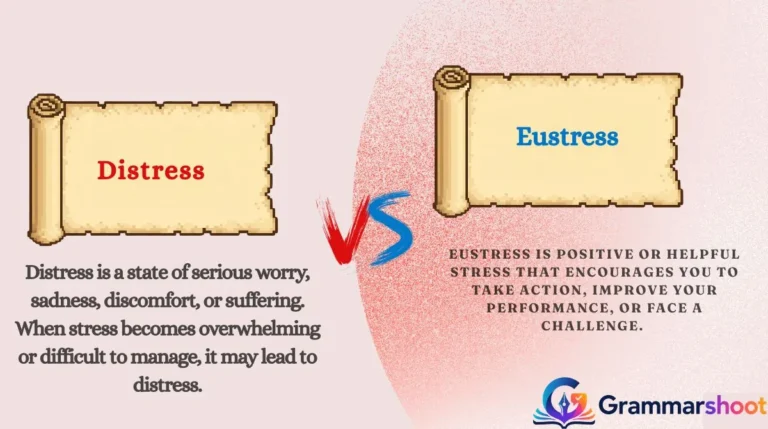
Distress is a state of serious worry, sadness, discomfort, or suffering. When stress becomes overwhelming or difficult to manage, it may lead to distress.
Distress often happens when you feel that a situation is too difficult, frightening, painful, or demanding. For example, a student who cannot sleep because of constant exam worries may be experiencing distress. A person who loses a loved one may also feel deep emotional distress.
Unlike stress in its broad sense, distress usually has a negative meaning. It suggests that someone is struggling emotionally, mentally, or physically.
Distress can be temporary, such as the fear someone feels during a frightening event. It can also continue for a longer period when difficult circumstances remain unresolved.
When Should You Use Distress?
Use distress when you want to describe serious discomfort, suffering, or emotional pain. It is especially useful when ordinary words such as worry or pressure do not fully express how difficult a situation feels.
For example, if someone is deeply upset after receiving bad news, you could say, “The news caused her great distress.”
You may also see distress used in medical, emergency, and formal settings. The phrase in distress can describe a person or animal in serious difficulty. The expression financial distress refers to serious money problems, while emotional distress describes strong emotional suffering.
Grammar Rules for Distress
The word distress is often used as a noun. It can also be used as a verb.
As a noun, it describes suffering or a state of serious difficulty.
- The child was in distress.
- The accident caused great distress.
As a verb, distress means to cause someone to feel very upset or worried.
- The news distressed her.
- It distresses me to see animals suffering.
The noun is often uncountable when referring to suffering in general. Common expressions include emotional distress, great distress, and financial distress.
The adjective distressed describes a person who is suffering or very upset.
- He looked distressed after the phone call.
- The distressed student asked for help.
Remember that distress is stronger than ordinary stress in many situations. It is usually not the best word for a small inconvenience, such as having to wait five minutes for a bus.
Examples of Distress in Sentences
- The child cried in distress when he lost his mother in the crowd.
- She felt emotional distress after a painful breakup.
- The sudden news caused great distress to the family.
- The animal appeared to be in distress.
- Financial distress made it difficult for the business to continue.
- He was visibly distressed by the unexpected result.
- The loud argument caused distress among the children.
- It distresses me when people are treated unfairly.
Common Learner Confusion
Some learners use distress whenever they feel ordinary pressure. However, distress usually suggests a more serious or harmful experience.
For instance, feeling slightly nervous before giving a speech does not necessarily mean you are in distress. If you become extremely frightened, feel overwhelmed, or struggle to function because of that fear, the word may be more suitable.
Also, do not confuse distress with distressed. Use distress as a noun when naming the suffering, but use distressed when describing the person experiencing it.
Correct: “She experienced emotional distress.”
Correct: “She was emotionally distressed.”
Both sentences are natural, but their grammatical structures are different.
What Does Eustress Mean?
Eustress is positive or helpful stress that encourages you to take action, improve your performance, or face a challenge. The word combines the Greek prefix eu-, meaning good or beneficial, with stress.
Eustress occurs when a challenge feels meaningful and manageable. You may feel excited, alert, or slightly nervous, but these feelings help you prepare rather than leave you feeling completely overwhelmed.
For example, a student may feel nervous before a spelling competition but use that energy to practise harder. An athlete may feel excited before a race and become more focused. These situations can be examples of eustress.
However, eustress does not mean that every difficult experience is good for you. The same challenge may motivate one person but overwhelm another. The effect depends on the person’s circumstances, resources, and feelings about the situation.
When Should You Use Eustress?
Use eustress when discussing the helpful side of pressure. It is especially common in psychology, education, workplace training, personal development, and discussions about performance.
For example, you might say, “The challenge gave her a sense of eustress and encouraged her to learn a new skill.”
The word is less common in casual conversation than stress or pressure. In everyday speech, people often say positive stress, helpful pressure, or nervous excitement instead.
Grammar Rules for Eustress
The word eustress is generally used as an uncountable noun.
- Eustress can motivate people to improve.
- A healthy challenge may create eustress.
- She learned to use eustress to prepare for competition.
Avoid using a eustress when you mean the general experience of positive stress. A more natural expression is a feeling of eustress or a source of eustress.
You can also use related phrases such as eustress response and positive stress. In these expressions, the word describes the helpful kind of stress being discussed.
Examples of Eustress in Sentences
- The excitement before the competition gave him eustress.
- Learning a new language can create eustress when the challenge feels manageable.
- She used her eustress to prepare for the important interview.
- A challenging project can produce eustress and encourage teamwork.
- The student felt positive stress before presenting her science project.
- Eustress helped him stay focused on his goal.
- Starting a new job can bring eustress as well as uncertainty.
- For her, training for the race was a source of eustress.
Common Learner Confusion
The biggest confusion is assuming that eustress means feeling completely relaxed or happy. It does not. Eustress can include nervousness, effort, and uncertainty.
Imagine that you are about to speak in front of your class. Your heart beats faster, and you feel nervous. However, you have practised, you believe you can do it, and the excitement helps you perform. That response may be described as eustress.
Another common mistake is using eustress as if everyone experiences the same situation positively. A new job may feel exciting to one person but overwhelming to another. Therefore, the word describes the helpful effect of stress, not simply the event itself.
Difference Between Stress, Distress, and Eustress
The main difference is the way the words describe pressure and its effects. Stress is the general term. Distress describes harmful or deeply uncomfortable stress. Eustress describes stress that feels helpful or motivating.
Although the terms are related, they are not always interchangeable. Choosing the correct one helps you explain what a person is experiencing.
Comparison Table
| Feature | Stress | Distress | Eustress |
|---|---|---|---|
| Basic meaning | A response to pressure or demands | Serious worry, discomfort, or suffering | Helpful or positive stress |
| General feeling | Can be positive or negative | Usually negative | Usually motivating or constructive |
| Common effects | Alertness, tension, or worry | Overwhelm, suffering, or difficulty coping | Focus, effort, and motivation |
| Typical example | Preparing for an exam | Feeling overwhelmed by constant exam pressure | Feeling motivated by an upcoming competition |
| Common phrases | Manage stress, work stress | Emotional distress, in distress | Positive stress, eustress response |
| Everyday use | Very common | Common, often in more serious contexts | Less common outside educational or professional contexts |
Usage Difference
The word stress is the safest choice when you are speaking generally about pressure. You do not need to decide immediately whether the pressure is helpful or harmful.
For example:
“Preparing for the final exam is causing me stress.”
This sentence tells us that the exam is creating pressure, but it does not explain exactly how that pressure affects the student.
Now consider distress:
“Preparing for the final exam is causing me serious distress.”
This version suggests that the student is suffering or struggling significantly.
Finally, consider eustress:
“Preparing for the final exam gives me eustress because it motivates me to study.”
This sentence clearly shows that the pressure is helping the student prepare.
Grammar Logic
All three words can function as nouns, but they do not have exactly the same grammatical patterns.
Stress can be a noun or a verb. Distress can also be a noun or a verb, and distressed is an adjective. Eustress is mainly an uncountable noun in modern English.
Compare these sentences:
- Noun: “Stress affects my concentration.”
- Noun: “Distress affected her sleep.”
- Noun: “Eustress can improve motivation.”
Now compare the verb forms:
- “Deadlines stress me.”
- “The news distressed him.”
There is no equally common everyday verb eustress. Instead, use phrases such as “the challenge motivated me” or “the pressure helped me focus.”
Sentence Structure Difference
The basic sentence structures are often similar, but the words around them can change.
With stress, you can use structures such as:
- “I feel stress when I have too many tasks.”
- “My job stresses me out.”
- “I am stressed about my exam.”
With distress, you can say:
- “The situation caused distress.”
- “She was in distress.”
- “The news distressed him.”
With eustress, you can say:
- “The challenge created eustress.”
- “Eustress helped me prepare.”
- “I experienced positive stress before the race.”
Notice the difference between stressed and distressed. The first commonly describes someone feeling pressure or worry. The second often suggests stronger emotional suffering. Context still matters, so these meanings are not absolute in every sentence.
Meaning Comparison Through One Situation
Imagine that three students are preparing for the same public speaking contest.
The first student says, “I feel stress because I want to do well.” This is a general statement about pressure.
The second student says, “I feel so much distress that I cannot sleep or prepare.” This shows that the pressure is causing serious difficulty.
The third student says, “I feel eustress because the contest pushes me to practise and improve.” This shows that the pressure is helping the student work toward a goal.
The event is the same, but the students experience it differently. That is why it is important to focus on the effects of pressure, rather than simply looking at the event.
Grammar Rules You Must Remember
Rule 1: Use Stress as the General Term
Use stress when the type or effect of pressure is not yet clear. It can refer to the ordinary response to challenges in life.
Example: “Moving to a new city can cause stress.”
The sentence does not tell us whether the move will be a positive or negative experience. It simply says that the change creates pressure.
Rule 2: Use Distress for Serious Suffering
Choose distress when the situation involves significant worry, emotional pain, or difficulty coping.
Example: “The sudden loss caused the family great distress.”
Here, the word expresses more than ordinary nervousness. It suggests real suffering.
Rule 3: Use Eustress for Helpful Pressure
Use eustress when pressure encourages you to prepare, learn, or perform better.
Example: “The upcoming match gave the players eustress.”
This means the pressure helped motivate the players. It does not mean they felt no nervousness.
Rule 4: Match the Word to Its Grammar Role
Pay attention to whether you need a noun, verb, or adjective.
Examples:
- Noun: “Stress is common before exams.”
- Verb: “Deadlines stress me.”
- Adjective: “I feel stressed.”
- Noun: “The event caused distress.”
- Adjective: “She looked distressed.”
- Noun: “Eustress can encourage growth.”
Remember that stressed and distressed are not the same adjective. Choose the one that best describes the person’s experience.
Common Mistakes Students Make
English learners often confuse these words because they share a common idea: pressure. The easiest way to avoid errors is to focus on the meaning of the whole sentence.
Mistake 1: Treating All Stress as Harmful
Incorrect: “Stress is always bad for your performance.”
Correct: “Too much stress can harm your performance, but some stress may help you prepare.”
Why? Stress can have different effects. A manageable challenge may improve focus, while excessive or ongoing pressure may cause problems.
Mistake 2: Using Distress for Every Small Problem
Incorrect: “I felt distress because the bus was two minutes late.”
Better: “I felt annoyed because the bus was two minutes late.”
Why? Distress usually suggests more serious suffering. For a small inconvenience, words such as annoyed, worried, or frustrated may be more natural.
Mistake 3: Using Eustress for Simple Happiness
Incorrect: “I felt eustress because I received a gift.”
Better: “I felt happy because I received a gift.”
Why? Eustress refers to helpful pressure or a challenge, not happiness by itself. If the gift is part of a meaningful challenge that motivates you, the situation might involve eustress, but the gift alone does not.
Mistake 4: Confusing Stressed and Distressed
Incorrect: “She was distressed about her busy schedule,” when you only mean she had ordinary work pressure.
Better: “She was stressed about her busy schedule.”
Why? Distressed often suggests stronger emotional suffering. If the schedule leaves her seriously overwhelmed, however, distressed may be appropriate.
Mistake 5: Using Eustress as a Countable Noun
Less natural: “I experienced a eustress before my interview.”
Better: “I experienced eustress before my interview.”
Also correct: “I experienced a feeling of eustress before my interview.”
Why? Eustress is generally uncountable when it refers to the overall experience of positive stress.
Mistake 6: Choosing a Word Without Considering Context
Incorrect for a helpful challenge: “The race caused distress,” when the speaker means that it motivated the athlete.
Better: “The race created eustress and motivated the athlete.”
Why? A word should match the person’s actual response. The same event may create excitement for one person and distress for another.
Easy Trick to Remember the Difference
Here is a simple memory trick:
- Stress = pressure.
- Distress = difficult pressure.
- Eustress = helpful pressure.
Think of stress as the umbrella term. Distress and eustress describe two possible ways pressure can affect a person.
Imagine you have an English test tomorrow. You think about the test and feel pressure. That is stress.
If you become so worried that you cannot sleep, concentrate, or prepare properly, you may be experiencing distress.
If the test encourages you to revise your notes, practise new words, and feel ready to do your best, that pressure may be eustress.
Remember that the same person can experience more than one type of stress at different times. You might feel motivated while studying and overwhelmed when the deadline gets too close.
One more useful tip: the prefix eu- appears in other words, such as euphoria, which refers to a feeling of great happiness or excitement. In eustress, it helps signal the positive or beneficial side of stress.
Do not worry about memorizing complicated definitions. Start by asking one simple question: Is the pressure general, harmful, or helpful? Your answer will usually guide you toward the right word.
Daily Life Examples
These examples show how the three words can appear in everyday conversations. Notice how the speaker’s feelings change the word they choose.
1. Before an Exam
Ali: “Are you worried about tomorrow’s exam?”
Sara: “Yes, I feel some stress, but it is helping me revise.”
Here, stress is the general term. Sara also explains that the pressure is helping her prepare, so the experience may involve eustress.
2. At Work
Manager: “How are you handling the new project?”
Employee: “The deadline is stressful, but it motivates me to organize my work.”
The employee feels pressure that encourages action. This may be a form of eustress as long as the pressure remains manageable.
3. After Bad News
Friend A: “Why does Ahmed look so upset?”
Friend B: “He is in distress because his family has received some terrible news.”
The word distress is appropriate because Ahmed is experiencing serious emotional suffering.
4. Before a Sports Match
Coach: “How do you feel about the final?”
Player: “I am nervous, but the excitement helps me focus.”
The player is describing a response that may be eustress. Nervousness does not always mean the pressure is harmful.
5. During a Busy Week
Mina: “You seem tired. Is everything okay?”
Hira: “I have too much work this week, and I am feeling stressed.”
The word stressed describes Mina’s or Hira’s response to the pressure of a busy schedule.
6. Learning a New Skill
Teacher: “Are you enjoying your coding course?”
Student: “Yes. It is difficult, but the challenge gives me eustress.”
The student sees the challenge as helpful and motivating.
7. Family Problems
Friend A: “Why has your brother been so quiet?”
Friend B: “He is under a lot of stress because of family problems.”
The speaker uses stress because it describes the general pressure. If the brother is suffering deeply, distress may be more accurate.
8. Financial Problems
Person A: “How is the small business doing?”
Person B: “It is facing financial distress because it cannot pay its bills.”
The phrase financial distress describes a serious money problem, not just ordinary pressure.
9. Starting a New Job
Friend A: “Are you nervous about your first day?”
Friend B: “A little, but I am excited to learn. The challenge feels positive.”
The speaker does not need to use the technical word eustress. In casual conversation, positive pressure or nervous excitement sounds more natural.
10. Too Many Responsibilities
Person A: “You look overwhelmed. Do you need help?”
Person B: “Yes. The pressure is causing me real distress, and I cannot manage everything alone.”
Here, distress clearly expresses a serious struggle. Asking for support may be a sensible next step.
Practice Section
Choose the correct word to complete each sentence: stress, distress, or eustress. Think about the meaning before checking the answers.
- A little helpful pressure before a competition can create ______.
- The family experienced great ______ after receiving the sad news.
- Many students feel ______ when they have several assignments due on the same day.
- Learning a challenging skill can create ______ when it motivates you to improve.
- The injured animal appeared to be in ______.
Answers and Explanations
- Eustress — The pressure is helpful and encourages better performance.
- Distress — The family is experiencing serious emotional suffering.
- Stress — This is the general term for pressure from several assignments.
- Eustress — The challenge encourages learning and improvement.
- Distress — The phrase in distress describes serious difficulty or suffering.
If you made a mistake, read the sentence again and look for clues. Words such as helpful, motivates, and improve often point toward eustress. Words such as suffering, overwhelmed, and serious difficulty may point toward distress. When the sentence simply describes pressure, stress is often the best choice.
FAQs
1. What is the difference between stress, distress, and eustress?
Stress is the general response to pressure or demands. Distress describes harmful pressure or serious suffering. Eustress is helpful stress that encourages motivation, preparation, or growth. The correct word depends on how the pressure affects the person.
2. Can stress be positive?
Yes. Stress is not always harmful. A manageable challenge may help you stay alert, focus on your goals, and prepare carefully. When stress has a helpful or motivating effect, it may be called eustress.
3. Can we use distress in questions?
Yes. You can ask, “Are you in distress?” or “Did the news cause you distress?” These questions are grammatically correct. However, distress often suggests serious suffering, so choose it carefully when talking about someone’s feelings.
4. Is eustress a formal or informal word?
Eustress is mainly used in educational, psychological, workplace, and personal development contexts. It is less common in casual conversation. In everyday English, expressions such as positive stress, helpful pressure, or nervous excitement may sound more natural.
5. Is distress stronger than stress?
In many everyday situations, yes. Stress can describe anything from ordinary pressure to a difficult response. Distress usually suggests significant emotional, physical, or mental suffering. However, the exact strength depends on the context in which the word is used.
6. Can the same situation cause eustress and distress?
Yes. The same event can affect people differently, and one person can experience both types of stress during the same period. For example, starting university may feel exciting and motivating at first but become distressing if the workload and other pressures become overwhelming.
Conclusion
Understanding the difference between stress, distress, and eustress makes it easier to describe pressure and emotions in clear English. Although the three terms are connected, each one has a different purpose.
Stress is the general response to pressure or challenges. It can be helpful or harmful, depending on the situation and how a person responds. Distress describes serious worry, discomfort, or suffering. Eustress refers to helpful pressure that can encourage motivation, preparation, and personal growth.
Remember the simple rule: stress means pressure, distress means harmful or difficult pressure, and eustress means helpful pressure. You can use this rule when discussing exams, work, family responsibilities, sports, and other daily experiences.
Pay attention to the context before choosing a word. A nervous student may simply feel stress, a deeply overwhelmed student may experience distress, and a motivated student may experience eustress. The same situation can produce different feelings for different people.
Keep practising with your own sentences and everyday conversations. The more you notice how these words are used, the more naturally you will understand and remember them. Good English grows through small steps, clear examples, and regular practice.

Evan Rellmont is a writer who turns thoughtful ideas into meaningful words, creating stories and reflections that connect, inspire, and leave a lasting impression.