
Have you ever seen the word program in an American book and programme in a British article? If so, you may have wondered whether one of these spellings is wrong.
Many English learners have the same question, especially when they read websites, study grammar, or write for an international audience.
The good news is that both program and programme are correct spellings, but their use depends mainly on the type of English you are writing.
American English usually uses program for almost everything, including computer software, television shows, and planned activities.
British English generally uses programme for television shows, radio shows, events, and organized activities, while program is the standard spelling for computer software.
This difference may look small, but it matters when you want your writing to look natural and consistent.
For example, an American student might write, “I joined a summer program,” while a British student might write, “I joined a summer programme.” Neither sentence is wrong.
Understanding this spelling difference can help you avoid common mistakes in school assignments, emails, job applications, blog posts, and other forms of writing.
It can also make it easier to understand English texts from different countries.
By the end, you will know what each word means, when to use each spelling, how regional English affects your choice, and which mistakes to avoid. You will also get practical examples, simple memory tricks, and short exercises to help you remember the rules.
What Does “Program” Mean?
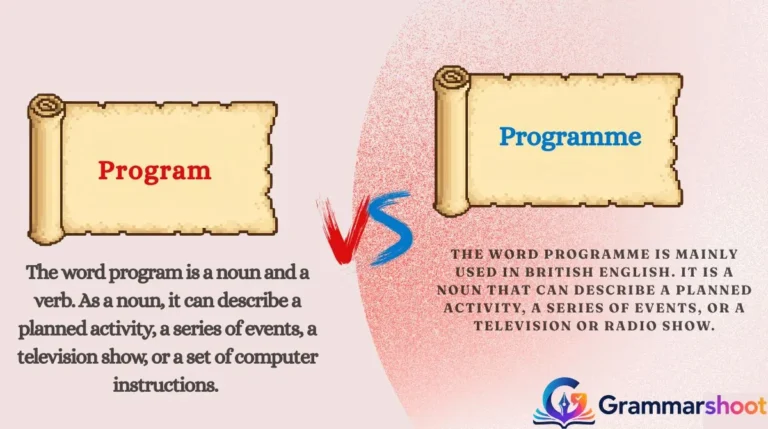
The word program is a noun and a verb. As a noun, it can describe a planned activity, a series of events, a television show, or a set of computer instructions. As a verb, it means to give a computer instructions or arrange something to work in a particular way.
In American English, program is the usual spelling in almost every context. It is also used in British English when talking about computer software.
When should you use “program”?
Use program when writing American English. You can use it when discussing education, work, computers, television, or organized activities.
Here are the most common meanings:
1. A planned activity or series of activities
A program may be designed to teach a skill, help people, or achieve a goal.
- The school started a reading program for young children.
- Our company offers a training program for new workers.
- She joined a fitness program to improve her health.
2. A television or radio show
In American English, a television or radio show is commonly called a program.
- My favorite TV program starts at eight o’clock.
- We watched an interesting science program last night.
3. Computer software or instructions
A computer program is a set of instructions that tells a computer what to do.
- I installed a new program on my laptop.
- This program helps students learn English.
- He is learning how to write a computer program.
4. To give instructions to a computer
As a verb, program means to write or enter instructions that control a computer or device.
- She wants to program video games.
- The engineer programmed the machine to stop automatically.
What is the grammar rule for “program”?
The word can be used as a countable noun or a verb.
As a countable noun, it has the plural form programs.
- Singular: The program is useful.
- Plural: These programs are useful.
As a verb, its forms include programs, programmed, and programming.
- He programs computers.
- She programmed the device yesterday.
- They are programming a new application.
Remember that program is the preferred spelling in American English, regardless of whether you are discussing a school activity, a TV show, or software.
Common confusion about “program”
Some learners believe program is only used for computers. This is not true. It is also the normal American spelling for organized activities and television shows.
For example, an American newspaper may discuss a job training program, a sports program, and a computer program using the same spelling.
What Does “Programme” Mean?
The word programme is mainly used in British English. It is a noun that can describe a planned activity, a series of events, or a television or radio show.
In British English, the spelling often depends on the meaning. Writers usually choose programme for organized activities and broadcasts, but program for computer software.
When should you use “programme”?
Use programme when writing British English and referring to an organized activity, a planned series of events, or a broadcast.
Here are the main uses.
1. An organized plan or activity
A programme may be created to improve a skill, provide help, or reach a particular goal.
- The school introduced a reading programme.
- The government launched a health programme.
- She enrolled in a language-learning programme.
2. A television or radio show
British English commonly uses programme when talking about television and radio content.
- This programme is about wildlife.
- My father watches a news programme every evening.
- We listened to an educational radio programme.
3. A schedule of events
A programme can also refer to a planned series of activities at a meeting, ceremony, or public event. In some contexts, it may also mean the printed or digital list of events.
- The concert programme lists all the performers.
- The event programme includes speeches and music.
- Please check the programme before the ceremony begins.
4. A course or training plan
In British English, an organized course of learning or training may be called a programme.
- He joined a professional development programme.
- The university offers a postgraduate training programme.
- Our company has a programme for new employees.
What is the grammar rule for “programme”?
Like program, programme is usually a countable noun when it refers to an activity, show, or planned series of events.
Its plural form is programmes.
- Singular: The programme starts tomorrow.
- Plural: The programmes start tomorrow.
In standard British usage, programme is mainly a noun. When discussing the act of writing instructions for a computer, British English normally uses program as a verb.
For example:
- Correct: She programs the computer.
- Correct: He is programming a new application.
British English therefore makes a useful distinction: programme for many non-computing nouns and program for computer-related uses.
Common confusion about “programme”
Some learners think programme is an old-fashioned spelling or an incorrect version of program. That is not true. It remains a standard spelling in British English and is also used in several other varieties of English influenced by British spelling conventions.
However, it is not normally used for computer software in standard British English. If you are writing about an application or a set of computer instructions, choose program.
Difference Between Program and Programme (Detailed)
The main difference between program and programme is regional spelling, not a major difference in meaning. Both can refer to a planned activity, but the spelling you should choose depends on the variety of English you are using and the context.
Program vs programme comparison table
| Feature | Program | Programme |
|---|---|---|
| Main spelling style | American English | British English |
| Planned activities | Standard | Standard in British English |
| Television and radio shows | Standard in American English | Standard in British English |
| Computer software | Standard | Not normally used |
| Computer-related verb | Yes | Not normally used as the verb |
| Plural form | Programs | Programmes |
| Example | A training program | A training programme |
1. Difference in regional usage
American English uses program as the standard spelling for almost all meanings. Whether someone is talking about computer software, a school activity, or a television show, program is usually the correct choice.
British English uses both spellings. The word programme is common for organized activities, broadcasts, and event schedules. The spelling program is used for computer software and in the related verb forms.
Consider these examples:
- American English: The television program was excellent.
- British English: The television programme was excellent.
- American English: I joined a training program.
- British English: I joined a training programme.
- Both varieties: I installed a computer program.
The meaning remains the same in these examples. Only the spelling convention changes.
2. Difference in meaning
In most everyday situations, the two spellings have the same basic meaning. A program in American English can describe the same activity that a British writer calls a programme.
For instance, a company may create a plan to help new workers learn their jobs. An American company might call it a training program, while a British company might call it a training programme.
Neither word automatically suggests a different length, quality, or purpose. You need to read the sentence to understand the exact meaning.
The important exception is not really a difference in meaning but a difference in convention: British English normally reserves program for computer-related uses, including the verb.
3. Difference in grammar
Both spellings can be countable nouns. You can use articles such as a and the, and you can make either noun plural according to the spelling style.
American English:
- A program
- The program
- Two programs
British English:
- A programme
- The programme
- Two programmes
The related verb is spelled program in both varieties. Its common forms are programs, programmed, and programming.
For example, “She is programming a computer” is correct in both American and British English. The spelling of the verb does not change to programme.
4. Difference in sentence structure
There is no special sentence structure for one spelling or the other. Both words fit into sentences in the same grammatical ways when they have the same function.
As a noun:
- American: The program helps students improve their writing.
- British: The programme helps students improve their writing.
As part of a noun phrase:
- American: a computer program
- British: a training programme
The choice affects spelling, not word order. You do not need to change the verb or rebuild the sentence just because you are using British rather than American English.
5. Which spelling should you choose?
Think about your audience before choosing a spelling.
If you are writing for an American school, company, newspaper, or website, use program. If you are writing for a British audience, use programme for non-computing activities and broadcasts, but use program for software.
For international websites, consistency is especially important. If your website follows American English, use program throughout your content. If it follows British English, use programme where British spelling rules call for it.
Readers can usually understand both forms, but consistent spelling makes your writing look more polished and professional.
Grammar Rules You Must Remember
Learning a few simple rules will help you choose the correct spelling without having to think too hard each time.
Rule 1: Use “program” in American English
American English normally uses program for planned activities, television shows, computer software, and other common meanings.
Example: Our school has a summer program for children.
This is the normal spelling for an American audience. You do not need to change it to programme when talking about a non-computer activity.
Rule 2: Use “programme” for many non-computer nouns in British English
British English commonly uses programme for broadcasts, training plans, public services, and organized activities.
Example: The university offers a language programme for international students.
This follows British spelling conventions. The American equivalent would usually be language program.
Rule 3: Use “program” for computer software in both varieties
When you mean a set of instructions that a computer follows, use program.
Example: I downloaded a computer program to edit my photos.
The same spelling applies when discussing computer programming.
Example: He programs websites for a living.
In both examples, program is the expected form.
Rule 4: Keep related word forms consistent
The noun’s regional spelling does not mean that every related form changes in the same way. In particular, the computer-related verb is program in both American and British English.
Examples:
- The computer program is ready.
- She programmed the machine.
- He is programming a new application.
When writing about a British training programme, keep the noun in British spelling. When writing about software, use program and its related verb forms.
Common Mistakes Students Make
Many learners make mistakes because they learn one variety of English and then see another variety online. Both spellings are valid in the right context, so the goal is not simply to label one as correct and the other as wrong.
Mistake 1: Thinking “programme” is always incorrect
Incorrect belief: “Programme” is a spelling mistake.
Correct understanding: Programme is standard British English for many non-computer meanings.
Example:
- British English: The training programme begins next week.
- American English: The training program begins next week.
Both sentences are correct for their respective spelling styles.
Correction tip: Before correcting the word, check which variety of English the writer is using.
Mistake 2: Using “programme” for computer software
In standard British English, computer software is normally called a program, not a programme.
Incorrect: I installed a new computer programme.
Correct: I installed a new computer program.
Correction tip: Remember that computer software uses the spelling program in both British and American English.
Mistake 3: Mixing American and British spelling
A learner might write “The school program starts Monday” and then write “The television programme begins at eight” in the same American-English article.
Neither spelling is necessarily wrong on its own, but the mixture may look inconsistent if there is no reason for it.
Correction tip: Choose American or British English at the start of a document and follow that style throughout, except where a proper name or official title uses a particular spelling.
Mistake 4: Writing “programme” as a verb
The spelling programme is mainly a British English noun. The computer-related verb uses program.
Incorrect: She programmes the new computer.
Correct: She programs the new computer.
Correction tip: When describing the action of giving a computer instructions, use program, programs, programmed, or programming.
Mistake 5: Assuming the words have completely different meanings
The two words usually describe the same kinds of things. The spelling depends on regional conventions rather than a different basic meaning.
Correction tip: Ask yourself two questions: “Which variety of English am I using?” and “Am I talking about computer software?” These questions will solve most spelling problems.
Easy Trick to Remember the Difference
Here is a simple memory trick:
American English = program for everything.
British English = programme for many activities and shows, but program for computers.
Imagine you are writing two versions of the same school announcement.
For an American audience, you might write:
“Our summer program begins on June 10.”
For a British audience, you might write:
“Our summer programme begins on 10 June.”
Notice that the date format and spelling may both change depending on the audience. The important point is that program and programme refer to the same kind of organized activity.
Now imagine you are explaining an app to a friend. You could say, “I installed a new program on my computer.” That spelling works in both American and British English because you are talking about software.
If you are ever unsure, remember the computer rule first: computer software is a program in both varieties of English. Then think about your audience. American readers normally expect program, while British readers commonly expect programme for non-computer activities and broadcasts.
This short rule is easier to remember than trying to memorize every possible sentence.
Daily Life Examples
Real-life sentences make spelling rules easier to understand. The examples below show how the word changes according to the situation and the variety of English.
Example 1: Talking about school
American English: Our school has a reading program for young children.
British English: Our school has a reading programme for young children.
Both sentences describe a plan that helps children improve their reading skills.
Example 2: Talking about television
American English: Did you watch that nature program last night?
British English: Did you watch that nature programme last night?
The question is the same. Only the spelling changes.
Example 3: Talking about computers
Both varieties: I need a program that can edit videos.
The word refers to computer software, so program is the usual spelling in both varieties.
Example 4: Talking about work
American English: My company offers a training program for new employees.
British English: My company offers a training programme for new employees.
The sentence describes workplace training. The choice depends on the spelling style.
Example 5: Talking about a public service
American English: The city started a recycling program.
British English: The city started a recycling programme.
Both versions describe an organized plan to encourage recycling.
Example 6: Talking about a computer task
Both varieties: She is learning to program a robot.
Here, program is a verb. The spelling stays the same in British and American English.
Example 7: Talking about a concert
American English: The concert program lists the names of all the musicians.
British English: The concert programme lists the names of all the musicians.
In this context, the word may refer to a printed or digital list of performers and events.
Example 8: Talking about university
American English: He applied for a graduate program in biology.
British English: He applied for a postgraduate programme in biology.
The wording may vary beyond spelling, but both examples describe an organized course of study.
Example 9: Talking about a mobile phone
Both varieties: This program makes it easier to organize my photos.
The sentence refers to software. Some people might say app instead, but program is also understandable.
Example 10: Talking about a future plan
American English: We are planning a summer program for local students.
British English: We are planning a summer programme for local students.
The spelling changes with the audience, but the basic meaning remains the same.
Practice Section
Test your understanding with these five short questions. Choose the correct word for each sentence based on the context given.
1. Choose the standard American English spelling:
The school has a summer ______ for children.
a) programme
b) program
2. Choose the standard British English spelling:
I watched an interesting wildlife ______ last night.
a) program
b) programme
3. Choose the usual spelling in both varieties:
I downloaded a computer ______ yesterday.
a) program
b) programme
4. Complete the sentence with the correct verb form:
He is ______ a robot to follow simple commands.
a) programme
b) programming
5. Choose the standard British English spelling:
The company introduced a training ______ for new workers.
a) program
b) programme
Answers and explanations
1. b) program. American English uses program for planned activities.
2. b) programme. British English commonly uses programme for television and other broadcasts.
3. a) program. Computer software is normally called a program in both varieties.
4. b) programming. The verb is program, and its -ing form is programming.
5. b) programme. British English normally uses programme for organized training activities.
If you missed a question, review the regional spelling rule and try again. With a little practice, the difference will become natural.
FAQs
1. What is the difference between program and programme?
Both words usually have the same meaning. Program is the standard spelling in American English, while programme is commonly used in British English for planned activities and broadcasts. British English uses program for computer software and the related verb.
2. Is “program” American or British English?
Program is the standard spelling in American English for nearly all meanings. It is also used in British English when referring to computer software or the act of writing computer instructions. Therefore, it is correct in both varieties, depending on the context.
3. Is “programme” correct English?
Yes, programme is correct English. It is a standard British spelling used for many organized activities, television shows, radio shows, and event schedules. It is not normally the spelling used for computer software in standard British English.
4. Should I write “program” or “programme” on my website?
Choose the spelling that matches your website’s main audience and style. If you use American English, write program. If you use British English, use programme for non-computer activities and broadcasts, and program for software. Consistency helps your content look professional.
5. Is “programme” more formal than “program”?
No. Neither spelling is automatically more formal than the other. The difference mainly comes from regional spelling conventions. A British business report may use programme, while an American business report may use program, and both can be equally formal.
6. Can I use “program” in a British English sentence?
Yes. In British English, program is the normal spelling for computer software and the related verb. For example, “I installed a computer program” and “She programs computers” are correct. For a television show or training activity, programme is generally preferred.
Conclusion
The difference between program and programme is easier to understand than it first appears. Both are correct English spellings, and they usually share the same meaning. The main difference is the variety of English you are using.
In American English, program is the usual spelling for school activities, training plans, television shows, computer software, and more. In British English, programme is common for organized activities, television and radio shows, and event schedules. However, program remains the standard spelling for computer software and the related verb in both varieties.
The most useful rule to remember is simple: American English generally uses program for everything, while British English often uses programme for non-computer meanings. If you are writing about software, choose program regardless of the audience.
Try to follow one spelling style in your essays, emails, and website content. Read examples from the audience you want to reach, and practise writing your own sentences. Soon, choosing the right form will feel natural, and you will be able to write with greater confidence.

Evan Rellmont is a writer who turns thoughtful ideas into meaningful words, creating stories and reflections that connect, inspire, and leave a lasting impression.