
English has many words that sound exactly the same but have completely different meanings. Raise and rays are two common examples.
When you hear them in a conversation, it can be difficult to know which word the speaker means because both are pronounced /reɪz/. The spelling, meaning, and grammar are what tell you the difference.
This confusion is especially common for beginners and English learners. You may know that sunlight has “rays,” but you may accidentally write “raise” when talking about the sun.
In another sentence, you may want to say “raise your hand,” but write “rays your hand” because the words sound alike.
The two words belong to different parts of speech and are used in very different situations. Raise is commonly used as a verb meaning to lift something, increase something, or bring something up.
It can also be a noun, especially in American English, where it means an increase in pay. Rays is the plural form of ray, usually referring to beams of light or heat.
By the end, you will know exactly when to use raise and when to use rays, how their sentence structures differ, and how to remember the difference without getting confused again.
What Does “Raise” Mean?
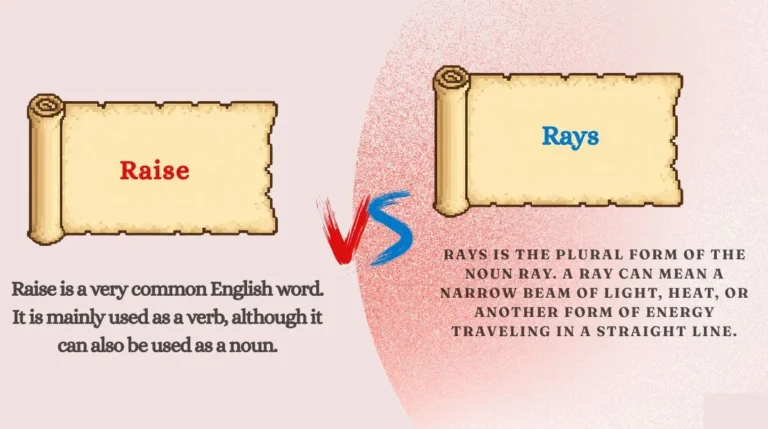
Raise is a very common English word. It is mainly used as a verb, although it can also be used as a noun.
As a verb, raise means to move something to a higher position. For example, when you lift your hand in class, you raise your hand. When you move a window upward, you raise the window. Cambridge Dictionary defines raise as a verb meaning to lift something to a higher position.
The word also has several other useful meanings. You can raise prices, raise your voice, raise a question, raise money, or raise children. In each case, the basic idea is that something is being lifted, increased, brought up, developed, or caused to exist.
Raise as a verb
The most important grammar point is that raise is normally a transitive verb. That means it usually needs an object.
The structure is:
Subject + raise + object
For example:
She raised her hand.
Here, “she” is the subject, “raised” is the verb, and “her hand” is the object.
You cannot normally say:
She raised.
The listener will naturally wonder: “Raised what?”
You need to mention the thing being raised, increased, or brought up.
Example sentences with “raise”
- Please raise your hand before you speak.
- He raised the flag early in the morning.
- The company plans to raise prices next month.
- I had to raise my voice because the room was noisy.
- The teacher raised an important question during the lesson.
- They are trying to raise money for the new school.
- She was raised by her grandparents.
- The farmer raises chickens and vegetables.
These examples show why raise is much more than simply “lift.” Depending on the sentence, it can mean increase, collect, develop, care for, or bring something to attention.
Raise as a noun
Raise can also be a noun, especially in American English. In this use, it means an increase in the money a person earns from a job. In British English, pay rise or simply rise is more common for this meaning.
For example:
I got a raise at work.
She asked her boss for a raise.
He received a small pay raise this year.
So, when you see raise in a workplace sentence, do not automatically think about lifting something. It may refer to higher pay.
Common learner confusion with “raise”
Many learners confuse raise with rise because these words have related meanings. Remember one important difference:
Raise = you cause something to go up.
Rise = something goes up by itself.
For example:
I raised my hand.
But:
The sun rises in the morning.
This distinction is different from raise vs rays, but learning it can help you understand how raise works as a verb.
What Does “Rays” Mean?
Rays is the plural form of the noun ray. A ray can mean a narrow beam of light, heat, or another form of energy traveling in a straight line. Cambridge Dictionary gives examples such as a ray of sunshine and light rays.
When we say rays, we are talking about more than one ray.
For example:
The sun’s rays are very bright.
Here, “rays” means several beams of sunlight.
The word is especially common when talking about the sun, light, photography, weather, science, and nature.
Rays in everyday English
You may hear phrases such as:
sun rays
rays of sunlight
light rays
rays of sunshine
A common expression is catch some rays, which informally means spending time outside in the sun.
For example:
We sat on the beach to catch some rays.
Example sentences with “rays”
- The sun’s rays came through the window.
- Bright rays of light filled the room.
- The clouds blocked the sun’s rays.
- Warm rays of sunshine touched her face.
- The morning rays made the garden look beautiful.
- Wear sunglasses to protect your eyes from bright rays.
- A few rays of sunlight entered through the curtains.
- The scientist studied how light rays travel.
In all these sentences, rays refers to beams of light or another physical form of energy.
Rays in geometry
There is another meaning of ray that students may see in mathematics.
In geometry, a ray is a part of a line that begins at one endpoint and continues endlessly in one direction. Therefore, rays can also refer to more than one such geometric object.
For example:
The angle is formed by two rays.
This meaning is less common in everyday conversation, but it is important for students studying geometry.
Common learner confusion with “rays”
The biggest problem is spelling. Rays sounds exactly like raise.
Think about this:
The sun’s rays are warm.
You hear “rays,” but you cannot use raise because the meaning is about sunlight.
Likewise:
Raise your hand.
You cannot write rays your hand because the sentence needs a verb meaning “lift.”
The surrounding words and the meaning of the sentence tell you which spelling is correct.
Difference Between Raise and Rays
The easiest way to understand raise vs rays is to focus on their meaning, grammar, and spelling.
| Word | Part of Speech | Main Meaning | Example |
|---|---|---|---|
| raise | Verb | Lift or increase something | Raise your hand. |
| raise | Noun | An increase in pay, mainly in American English | I got a raise. |
| rays | Plural noun | More than one beam of light or heat | Sun rays entered the room. |
| rays | Plural noun | More than one geometric ray | The angle has two rays. |
1. Usage difference
Raise is used when something is lifted, increased, collected, brought up, or developed.
Examples:
Raise your head.
Raise the price.
Raise money.
Raise a question.
Raise a child.
Rays, on the other hand, is normally used when talking about multiple beams of light or heat, or multiple rays in geometry.
Examples:
The sun’s rays are strong.
Light rays entered the room.
Two rays form the angle.
2. Grammar logic
Raise can function as a verb.
That means it can appear after a subject:
She raised her hand.
They raise prices every year.
It can also function as a noun:
He received a raise.
Rays is a plural noun. It names multiple rays.
You would normally see a noun before or after words such as the, these, sun, light, or two:
the rays
sun rays
bright rays
two rays
This grammatical difference is a strong clue.
3. Sentence structure difference
With raise, a common structure is:
Subject + raise + object
Example:
The boy raised his hand.
The boy causes his hand to move upward.
With rays, a common structure is:
Determiner/adjective + rays
or
Subject + verb + rays
Examples:
The sun’s rays are bright.
Warm rays entered the room.
I could see rays through the window.
The word does not perform the action in these sentences. It names things.
4. Meaning comparison
The words are not related in meaning.
Raise is connected with lifting, increasing, collecting, developing, or bringing something up.
Rays refers to more than one ray, such as beams of sunlight or lines in geometry.
The spelling difference is small, but the meanings are completely different.
5. Pronunciation difference?
Interestingly, there is no pronunciation difference between these two words in normal English. Raise is pronounced /reɪz/, and the plural rays is pronounced the same way. Oxford specifically lists raise and rays as homophones.
That is exactly why learners often make spelling mistakes with them.
Grammar Rules You Must Remember
Rule 1: Use “raise” when someone or something lifts something
When a person or thing actively moves another thing higher, use raise.
Example:
Please raise your hand if you know the answer.
The person is lifting the hand, so raise is correct.
More examples:
Raise the window.
He raised the box carefully.
She raised her head.
A useful question is:
“What is being lifted or moved higher?”
If the sentence answers that question, raise may be the correct word.
Rule 2: Use “raise” when you mean increase
Raise can also mean to make something greater or higher.
We use it with many things, including:
prices
taxes
salary
standards
awareness
voice
For example:
The store raised its prices.
Please raise your voice.
The school wants to raise its standards.
The idea is that something becomes higher or greater. Cambridge lists this meaning as “to cause something to increase or become bigger, better, higher, etc.”
Rule 3: Use “rays” for multiple beams of light or heat
When talking about several beams of sunlight, moonlight, or another kind of light, use rays.
Example:
The sun’s rays entered through the window.
Here, you are not talking about lifting anything. You are describing beams of sunlight.
More examples:
The clouds blocked the rays.
Bright rays filled the room.
We sat outside in the warm rays of the sun.
Rule 4: Remember that “rays” is plural
Ray = one.
Rays = more than one.
Compare:
A ray of sunshine came through the window.
Several rays of sunshine came through the window.
The -s at the end of rays makes it plural.
By contrast, raise is a completely separate spelling.
A simple visual reminder is:
RAISE = an action
RAYS = things you can see from light
Common Mistakes Students Make
The most common reason for these mistakes is pronunciation. When students hear raise and rays, they hear the same sound. They may depend too much on sound instead of looking at the meaning and grammar.
Mistake 1: Using “rays” instead of “raise”
Wrong:
Please rays your hand.
Correct:
Please raise your hand.
Why?
Because the sentence describes an action. The person needs to lift the hand.
Mistake 2: Using “raise” when talking about sunlight
Wrong:
The raise of the sun was very bright.
Correct:
The rays of the sun were very bright.
Why?
Here, you mean beams of sunlight, so the plural noun rays is required.
There is another correct expression, the rise of the sun, but that has a different meaning. Do not confuse all three words:
raise = lift or increase
rise = move upward or become higher
rays = beams of light
Mistake 3: Forgetting that “rays” is plural
Wrong:
A rays of light came through the window.
Correct:
A ray of light came through the window.
Or:
Rays of light came through the window.
You cannot use a with plural rays.
Remember:
a ray
two rays
many rays
Mistake 4: Writing “raise” because it sounds right
Imagine someone says:
“Look at those bright rays!”
If you only listen, rays and raise sound the same. The solution is not to guess from pronunciation.
Ask yourself:
Is this an action?
If yes, raise may be correct.
Is this about beams of light or multiple geometric lines?
If yes, rays is probably correct.
Easy correction tip
Before writing the word, replace it with a simple meaning.
If you can replace it with lift or increase, choose raise.
Raise your hand.
→ Lift your hand.
If you can replace it with beams of light, choose rays.
The rays were bright.
→ The beams of light were bright.
This small test can prevent many spelling mistakes.
Easy Trick to Remember the Difference
Here is a simple memory trick:
“Raise” has an “I” idea: make something higher.
Think:
Raise = rise something higher
For example:
Raise your hand.
Raise the price.
Raise your voice.
In each case, something goes up.
Now remember:
“Rays” belongs to the sun and light.
Think about:
sun rays
light rays
rays of sunshine
The word rays has the same ending sound as raise, but its meaning connects to light.
You can also remember this little sentence:
“Raise your hand under the rays of the sun.”
This sentence uses both words correctly.
Raise = lift your hand.
Rays = beams of sunlight.
Another useful trick is to look at the letter y in rays. When you see rays, imagine the y looking like a thin beam stretching down from the sun. It is not a real spelling rule, but it can help you remember the word.
The most important thing is not to memorize the spelling alone. Connect the word to its meaning.
Daily Life Examples
These examples show how raise and rays appear in natural, everyday English.
Example 1: In the classroom
Teacher: “Do you know the answer?”
Student: “Yes.”
Teacher: “Then raise your hand.”
Here, raise is a verb because the student is lifting a hand.
Example 2: Talking about sunlight
Sara: “Why is the room so bright?”
Ali: “The sun’s rays are coming through the window.”
Here, rays means beams of sunlight.
Example 3: At work
Employee: “I have been working here for three years.”
Manager: “You may receive a raise this month.”
Here, raise is a noun meaning an increase in pay.
Example 4: On a beach
Tom: “What are you doing outside?”
Mia: “I’m relaxing and catching some rays.”
Here, rays refers to sunlight. “Catch some rays” is an informal expression for spending time in the sun.
Example 5: At home
Dad: “It is getting dark.”
Son: “Should I raise the blinds?”
Dad: “Yes, please.”
Here, raise means move the blinds upward.
Example 6: Talking about weather
The clouds disappeared, and warm rays of sunshine appeared.
Here, rays describes beams of sunlight.
Example 7: Talking about prices
The shop decided to raise the price of the jacket.
The shop increases the price, so raise is correct.
Example 8: During a meeting
She raised an important question during the meeting.
Here, raise means bring a question or issue to people’s attention.
Example 9: In science class
The teacher explained how light rays travel.
Here, rays is a plural noun referring to beams of light.
Example 10: At home in the morning
The first rays of sunlight came through my curtains.
Here, rays means beams of light.
Notice how naturally the context tells you which spelling to choose. You do not need to depend on pronunciation alone.
Practice Section
Choose the correct word: raise or rays.
1. Please ___ your hand if you have a question.
Answer: raise
You are asking someone to lift their hand.
2. The sun’s ___ made the room warm.
Answer: rays
You are talking about beams of sunlight.
3. The company plans to ___ salaries next year.
Answer: raise
The company plans to increase salaries.
4. Bright ___ of sunlight came through the window.
Answer: rays
You need the plural noun for multiple beams of light.
5. She received a ___ after working hard for two years.
Answer: raise
Here, raise is a noun meaning an increase in pay, especially in American English.
A good way to check your answers is to think about meaning instead of sound. Ask whether the sentence needs an action/increase or something connected with beams of light.
FAQs
What is the difference between raise and rays?
Raise is usually a verb meaning to lift, increase, or bring something up. It can also be a noun meaning an increase in pay, especially in American English.
Rays is the plural of ray and usually refers to beams of light or heat. The two words sound the same but have different spellings and meanings.
Are raise and rays pronounced the same?
Yes. In standard English pronunciation, raise is /reɪz/, while rays, the plural of ray, has the same pronunciation. This makes them homophones: words that sound alike but have different meanings and spellings.
Can “raise” be used in a question?
Yes. Raise is often used in questions and commands.
For example:
Can you raise your hand?
Did they raise the price?
Could you raise the window?
It can be used whenever the sentence needs its meaning of lifting or increasing something.
Is “rays” formal or informal?
Rays is a normal standard English plural noun. It is used in everyday speech as well as in science and formal writing.
For example:
The sun’s rays are powerful.
Light rays change direction when they pass through different materials.
The word itself is neither specially formal nor specially informal.
Is it correct to say “sun rays” or “sun’s rays”?
Both expressions can be found, but the sun’s rays is a very natural phrase in everyday English.
For example:
The sun’s rays warmed the garden.
You can also say rays of sunlight or rays of sunshine.
Is “raise” always a verb?
No. Raise can be both a verb and a noun.
As a verb:
They raised the flag.
As a noun:
She got a raise at work.
The noun meaning “an increase in pay” is especially common in American English; British English commonly uses rise or pay rise for this meaning.
How can I remember raise and rays easily?
Use this quick memory rule:
Raise = lift or increase.
Rays = beams of light.
Think about raising your hand and sun rays. Once you connect each spelling to its meaning, the homophone problem becomes much easier.
Conclusion
Raise vs rays is a common English spelling confusion because the two words sound exactly alike. However, their meanings and grammatical roles are very different.
Raise is mainly a verb. It can mean to lift something, increase something, bring up an issue, collect money, or care for children and animals.
It can also be a noun meaning an increase in pay, particularly in American English.
Rays is the plural form of ray. It usually refers to beams of light or heat, such as the rays of the sun. It can also be used in geometry for more than one geometric ray.
The easiest rule is to remember raise = lift or increase and rays = beams of light. Because they are homophones, always use the meaning of the sentence to choose the spelling.
A little practice with everyday sentences will make this difference feel natural.

Evan Rellmont is a writer who turns thoughtful ideas into meaningful words, creating stories and reflections that connect, inspire, and leave a lasting impression.