
Separate or seperate? If you have ever stopped while writing this word and wondered which spelling is correct, you are not alone.
Many English learners write seperate because that spelling looks natural and seems to match the way the word sounds.
However, there is an important spelling difference that you need to remember.
The correct spelling is separate. The spelling seperate is a common misspelling, not a standard English word.
Dictionary.com lists seperate as a common misspelling of separate, and explains that the confusion is partly caused by the way people commonly pronounce the word.
The word separate is very common in everyday English. You may use it when talking about different rooms, people who are not together, different ideas, individual items, or actions that should happen apart.
It can work as an adjective, a verb, and part of other useful word forms such as separately, separated, and separation.
Cambridge and Oxford both list separate as a standard English word with several common uses.
Once you understand the correct spelling, the meaning, the grammar, and a simple memory trick, this confusion becomes much easier.
The key is to remember one small letter: a.
What Does “Separate” Mean?
Separate is the correct spelling.
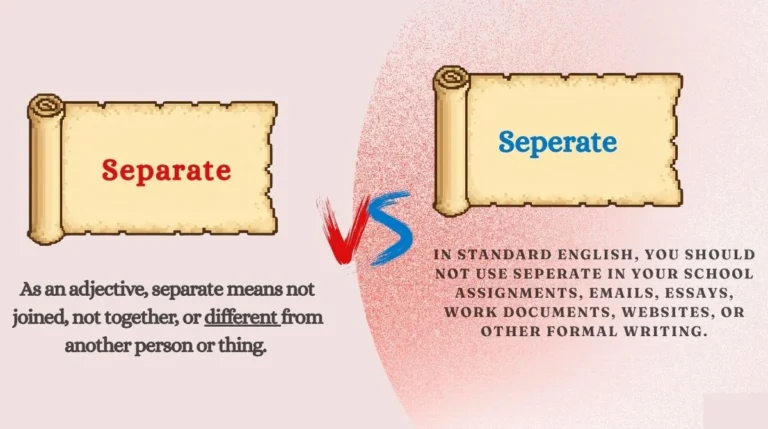
As an adjective, separate means not joined, not together, or different from another person or thing. For example, if two students sit in different rooms, they are in separate rooms. If you keep raw food away from cooked food, you keep them separate. Cambridge defines the adjective as describing things that exist independently or in different physical spaces.
Oxford gives a similar explanation: something separate can form a unit by itself, without being joined to something else. It can also mean something that is different or not connected.
When should you use “separate”?
Use separate when you want to show that people or things are apart, different, or not connected.
You can use it before a noun:
- separate rooms
- separate bags
- separate schools
- separate answers
- separate problems
You can also use separate from when comparing or dividing one thing from another:
- My office is separate from the main building.
- Keep the medicine separate from the food.
Separate can also be a verb. As a verb, it means to divide, move apart, or keep people or things apart. Cambridge gives examples such as separating facts from fiction and causing people or things to stop being near each other.
Examples of “separate”
- Please put the clean clothes in a separate bag.
- The two brothers have separate bedrooms.
- We should keep personal problems separate from work.
- The teacher gave us separate worksheets.
- These are two separate issues.
- Please separate the white clothes from the dark ones.
- A tall fence separates the two gardens.
- It is sometimes difficult to separate fact from opinion.
Notice that the same word can have different grammar roles. In “a separate room,” it is an adjective. In “separate the papers,” it is a verb.
Why do learners confuse “separate”?
The main problem is spelling. When people say the word quickly, the middle vowel sound may not be very clear. That can make seperate look reasonable even though it is incorrect in standard English.
Another reason is that English spelling is not always a perfect copy of pronunciation. Learners often try to spell words exactly as they hear them, but English does not always work that way.
The safe spelling to remember is:
s-e-p-a-r-a-t-e
There is an a in the middle: separate.
What Does “Seperate” Mean?
Seperate is a common spelling mistake for separate.
In standard English, you should not use seperate in your school assignments, emails, essays, work documents, websites, or other formal writing. Dictionary.com specifically identifies seperate as a common misspelling of separate.
So, if you type:
Please keep these documents seperate.
the spelling is wrong.
The correct sentence is:
Please keep these documents separate.
Is “seperate” ever correct?
For normal modern English writing, the answer is no. When you mean the common word describing things that are apart or different, the correct spelling is separate.
This is not like words that have two accepted spellings in different forms of English. The problem here is simply that seperate is an incorrect spelling of separate.
Examples of the mistake
Incorrect:
- ❌ The students sat in seperate rooms.
- ❌ Please send the files in seperate emails.
- ❌ Keep the two ideas seperate.
- ❌ The items should be packed seperate.
Correct:
- ✅ The students sat in separate rooms.
- ✅ Please send the files in separate emails.
- ✅ Keep the two ideas separate.
- ✅ The items should be packed separate.
For the last sentence, however, standard English may often prefer separately when you mean “individually” or “not together”:
✅ The items should be packed separately.
That difference is useful because the problem is sometimes not only spelling. Learners also need to choose the right form of the word.
A useful word family
Learning the whole word family can make spelling easier:
- separate — adjective / verb
- separately — adverb
- separated — adjective / past form of the verb
- separation — noun
Oxford lists these forms together in the word family for separate.
Difference Between Separate and Seperate
The most important difference is simple:
Separate = correct spelling
Seperate = incorrect spelling
There is no normal meaning difference between them. They are not two words that you can choose between depending on the sentence. Instead, seperate is a misspelling of separate.
| Point | Separate | Seperate |
|---|---|---|
| Spelling | ✅ Correct | ❌ Incorrect |
| Standard English | Yes | No |
| Meaning | Apart, different, or divided | No separate standard meaning |
| Use in formal writing | Yes | No |
| Example | Keep the files separate. | Keep the files seperate. ❌ |
| Common problem | Correct word | Common misspelling |
Usage difference
There is no real usage difference because only separate is the standard spelling.
You should write:
These books belong in separate boxes.
You should not write:
These books belong in seperate boxes.
The second sentence may still be understood, but the spelling mistake can make your writing look careless, especially in school, professional, or academic settings.
Grammar logic
Separate has real grammatical functions.
As an adjective:
We have separate bedrooms.
Here, separate describes the bedrooms.
As a verb:
Please separate the papers.
Here, separate shows an action.
As part of an adverb:
Please submit the forms separately.
Here, separately tells us how the forms should be submitted. Oxford defines separately as meaning as a separate person or thing, or not together.
Seperate, on the other hand, does not have these grammatical functions because it is not the standard spelling of the word.
Sentence structure
You will commonly see separate in structures such as:
separate + noun
They have separate accounts.
separate + from
The kitchen is separate from the dining room.
separate + object
Please separate the cards.
separate + object + from + object
Please separate the red cards from the blue cards.
separately
We paid separately.
These structures are useful because they show you how the correct word behaves in real English.
Meaning comparison
The meaning of separate is connected with being apart, independent, or different. Cambridge and Oxford both describe this idea in their definitions.
Seperate does not have a different meaning. It is simply a spelling error.
So there is no situation where you should think:
“This sentence needs seperate because it means something different.”
It does not. The correct form remains separate.
Grammar Rules You Must Remember
Rule 1: The correct spelling is “separate”
Always spell the word:
S-E-P-A-R-A-T-E
The middle part is -par-, not -per-.
✅ separate
❌ seperate
Example:
Please put the two documents in separate folders.
A quick spelling check can save you from a common mistake.
Rule 2: Use “separate” as an adjective before a noun
When separate describes a person or thing, it can come before a noun.
Examples:
We booked separate rooms.
She has a separate desk.
The children need separate bags.
Here, the word tells us that the things are not together or are treated as different units.
Rule 3: Use “separate” as a verb when talking about dividing or moving apart
The verb separate means to divide things or cause people or things to be apart.
Examples:
Please separate the papers.
The wall separates the two rooms.
We need to separate the good apples from the bad ones.
Cambridge lists separate as a verb meaning to divide into parts or cause people or things to stop being together or near each other.
Rule 4: Use “separately” when you mean “not together” as an adverb
Sometimes the sentence needs an adverb instead of an adjective.
Compare:
We have separate bills.
Here, separate describes the bills.
But:
We paid separately.
Here, separately describes the action of paying.
This is an important grammar difference. Changing the ending can change the job the word does in the sentence.
Common Mistakes Students Make
Many students make this mistake because they remember the sound but not the exact spelling.
Mistake 1: Writing “seperate”
❌ Please keep your shoes seperate.
✅ Please keep your shoes separate.
The easiest correction is to remember the a.
Mistake 2: Thinking “seperate” is a second English word
It is not a choice between two correct words.
❌ separate = one meaning
❌ seperate = another meaning
Instead:
✅ separate = correct word
❌ seperate = common misspelling
Mistake 3: Spelling from pronunciation
Some learners hear the word and think there is an e in the middle:
sep-er-ate
This can lead to seperate.
But spelling should not always be based only on sound. Dictionary.com notes that the pronunciation is one reason people commonly make this spelling mistake.
Mistake 4: Using “separate” when “separately” is needed
Consider:
We packed the gifts separate.
In informal speech, you may hear this kind of sentence. But in careful standard English, separately is often the better choice when the word describes the action of packing.
✅ We packed the gifts separately.
Another example:
❌ The students were checked separate.
✅ The students were checked separately.
The lesson is simple: first spell the base word correctly, then choose the form that fits the grammar.
Easy correction tip
Whenever you type seperate, stop for one second and ask:
“Where is my A?”
Then write:
sep-A-rate
That small pause can prevent the mistake.
Easy Trick to Remember the Difference
Here is a very easy spelling trick:
Remember: “There is A in separate.”
Break the word like this:
sep + a + rate
The important letter is A.
You can say to yourself:
Separate has an A.
There is also a fun memory idea mentioned by Dictionary.com: think of “separate the pirate with an A”. The idea is that the ending of separate contains an a instead of the i sound that may tempt you to write.
Another simple trick is to connect the word with par:
sep + par + ate
When you see par in the middle, you are more likely to remember the correct spelling.
Real-life memory trick
Imagine two friends standing apart.
They are separate.
Now look at the word:
separate
Think:
“They are separate, and the word has an A.”
You do not need a complicated spelling rule. One clear memory connection is usually enough.
Say it slowly
When spelling practice is difficult, do not rush.
Say:
sep – ar – ate
Then write:
s-e-p-a-r-a-t-e
After writing it several times, the correct pattern becomes familiar.
Daily Life Examples
Here are simple examples you may hear or use in normal conversations.
1. At a restaurant
A: Can we get separate bills?
B: Sure. I’ll ask the waiter.
Here, separate means each person wants an individual bill.
2. At home
A: Where should I put these dishes?
B: Keep the clean and dirty dishes separate.
The word means “not together.”
3. At school
Teacher: Please write your answers on a separate sheet of paper.
The students need another sheet, not the same one.
4. At work
Manager: These are separate projects, so please save them in different folders.
The projects are different and should not be mixed.
5. Shopping
A: Can I have these packed separately?
B: Yes, of course.
Here separately is correct because it describes the action of packing.
6. Talking about rooms
A: Do the children share a room?
B: No, they have separate bedrooms.
The bedrooms are different spaces.
7. Talking about relationships
A: Are your parents still together?
B: No, they have been separated for several years.
Separated is the past participle/adjective form of separate. Cambridge identifies separated as the past simple and past participle of separate.
8. At the airport
A: Are the bags going together?
B: No, they are on separate flights.
The flights are different from each other.
9. In an office
A: Should I send both reports in one email?
B: No, please send them separately.
The adverb separately tells us that the reports should not be sent together.
10. During an argument
A: Are these two problems connected?
B: No, they are completely separate issues.
The speaker means the problems are different and should be considered independently.
These examples show why separate is such a useful word in everyday English. You can use it for people, places, objects, ideas, tasks, problems, and actions.
Practice Section
Choose the correct option in each sentence.
1. Please keep the two documents ______.
A. seperate
B. separate
2. The teacher gave us ______ assignments.
A. separate
B. seperate
3. We packed the gifts ______.
A. separate
B. separately
4. A fence ______ the two properties.
A. separates
B. seperates
5. I have a ______ account for my business.
A. separate
B. seperate
Answers
1. B — separate
The correct spelling is separate.
2. A — separate
It describes the noun “assignments.”
3. B — separately
The adverb is needed because it describes how the gifts were packed.
4. A — separates
The verb comes from the correct base word separate.
5. A — separate
The word describes the noun “account.”
A helpful way to improve is to write the word correctly several times in your own sentences instead of only memorizing the answer.
FAQs
What is the difference between separate and seperate?
Separate is the correct English spelling. Seperate is a common misspelling of the same word. There is no normal difference in meaning because seperate is not the standard form used in English writing.
Is “seperate” a correct word?
No, not when you mean the common English word separate. In standard writing, use separate. Dictionaries and spelling references identify seperate as a common misspelling rather than a standard alternative spelling.
Why do people spell separate as “seperate”?
The spelling mistake is common because the pronunciation can make the middle vowel unclear. People may hear the word in a way that makes seperate seem logical. English spelling does not always match pronunciation perfectly.
How do you spell separate correctly?
The correct spelling is:
S-E-P-A-R-A-T-E
A simple memory trick is to remember that separate has an A in the middle. You can also break it into sep + ar + ate.
Can “separate” be used as a verb?
Yes. Separate can be a verb meaning to divide, move apart, or keep people or things apart. For example: “Please separate the white clothes from the dark clothes.” Cambridge lists this verb use clearly.
What is the difference between separate and separately?
Separate is commonly an adjective or verb, while separately is an adverb. Compare “We have separate rooms” with “We paid separately.” Oxford defines separately as meaning not together or as an individual person or thing.
Conclusion
The answer to “separate or seperate?” is easy once you remember the correct spelling: separate is right, while seperate is a common misspelling.
The word separate is useful in many parts of everyday English. It can describe things that are different or not joined, such as separate rooms or separate accounts. It can also be a verb, as in separate the papers, and it appears in useful forms such as separately, separated, and separation.
The best spelling trick is simple: remember the A in separate. When you are unsure, slow down and write sep-a-rate.
Do not worry if you have written “seperate” many times before. Spelling mistakes are part of learning a language. The important thing is to notice the pattern, practice it, and use the correct spelling next time. A few real sentences can make separate easy to remember for good.

Evan Rellmont is a writer who turns thoughtful ideas into meaningful words, creating stories and reflections that connect, inspire, and leave a lasting impression.