
Vicious and viscous are two English words that often confuse learners because they look almost the same and have a very similar pronunciation.
They both begin with vis- and end with -ous, so it is easy to type one when you mean the other.
But their meanings are completely different.
Vicious is mainly used for something cruel, violent, dangerous, hateful, or extremely unpleasant.
You can talk about a vicious dog, a vicious attack, or vicious gossip. It can also describe something severe, such as a vicious headache or a vicious cycle.
Viscous, on the other hand, is normally used for a liquid or substance that is thick, sticky, and slow to flow. Oil, syrup, honey, and some chemicals can be viscous.
That one letter c changes the meaning completely.
This difference matters because using the wrong word can make a sentence confusing or even funny. Saying “a vicious liquid” when you mean a thick liquid is not the same as saying “a viscous liquid.” Likewise, calling a dangerous animal viscous would be incorrect.
The good news is that the difference is easy once you connect each word with a clear idea.
By the end of this guide, you will understand their meanings, grammar, pronunciation, common mistakes, everyday uses, and a simple memory trick that helps you choose the right word quickly.
What Does “Vicious” Mean?
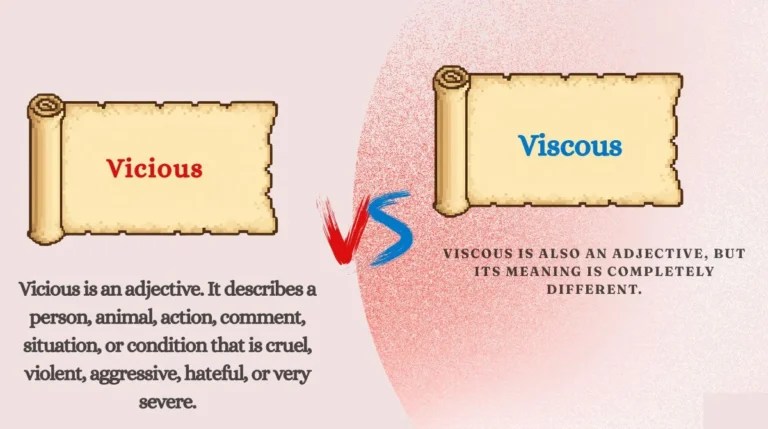
Vicious is an adjective. It describes a person, animal, action, comment, situation, or condition that is cruel, violent, aggressive, hateful, or very severe.
Cambridge describes a vicious person or action as showing an intention or wish to hurt someone or something badly. Oxford also uses the word for violent and cruel behavior, dangerous animals, hateful criticism, and very severe conditions.
Simple meaning of vicious
Think of vicious as:
cruel + dangerous + aggressive + harmful
The exact meaning depends on the noun it describes.
For example:
- A vicious dog is an aggressive and dangerous dog.
- A vicious attack is a very violent attack.
- A vicious comment is a cruel or hateful comment.
- A vicious rumor is a harmful rumor intended to hurt someone.
- A vicious headache means a very severe headache in informal use.
When do we use “vicious”?
We usually use vicious when something has a harmful, cruel, violent, or extremely severe quality.
It can describe:
People:
“He is a vicious criminal.”
Animals:
“That dog can be vicious.”
Actions:
“They launched a vicious attack.”
Words and communication:
“She made a vicious remark about her coworker.”
Problems or conditions:
“He had a vicious headache all morning.”
Cycles or patterns:
“The company became trapped in a vicious cycle of debt and falling sales.”
Grammar rule for “vicious”
Because vicious is an adjective, it normally comes before a noun or after a linking verb.
Before a noun:
- a vicious dog
- a vicious attack
- a vicious rumor
- a vicious argument
After a linking verb:
- The dog is vicious.
- His words were vicious.
- The attack was vicious.
You can also use degree words such as very, extremely, particularly, or quite with it.
- It was an extremely vicious attack.
- The animal became very vicious.
- She received a particularly vicious message.
8 examples of “vicious”
- The vicious dog scared everyone in the neighborhood.
- The two players got into a vicious fight.
- The reporter faced a vicious online attack.
- She was hurt by his vicious comments.
- The politician denied the vicious rumor about him.
- The storm brought vicious winds to the coast.
- I woke up with a vicious headache this morning.
- High costs and low sales created a vicious cycle for the business.
Common learner confusion about “vicious”
A common mistake is to connect vicious with physical things only.
That is not always correct.
You can describe something that is not physically violent as vicious when it is extremely cruel, hateful, harmful, or severe.
For example:
“She made a vicious comment.”
A comment cannot physically attack you, but it can be deliberately cruel or hurtful.
Likewise:
“The newspapers published a vicious attack on the actor.”
Here, attack may refer to harsh criticism rather than physical violence.
So remember: vicious is about harmful or aggressive qualities, not thickness.
What Does “Viscous” Mean?
Viscous is also an adjective, but its meaning is completely different.
It is mainly used to describe a liquid or substance that is thick, sticky, and slow to flow. Cambridge defines a viscous liquid as one that is thick and sticky and does not flow easily. Merriam-Webster also connects the word with a thick or sticky consistency and resistance to flow.
Simple meaning of viscous
Think of viscous as:
thick + sticky + slow-moving
Imagine pouring water into a glass. Water flows easily.
Now imagine pouring honey.
Honey moves much more slowly because it is thicker.
That thick, slow-flowing quality is what viscous describes.
Examples of viscous substances
Common examples include:
- honey
- syrup
- thick oil
- some sauces
- molasses
- glue-like liquids
- certain industrial chemicals
- some biological fluids
Not every thick substance is automatically called viscous in everyday conversation. The word is especially useful when talking about how easily a liquid flows. In science and technical writing, it is a very important term.
When do we use “viscous”?
Use viscous when you are talking about the physical property of a liquid or fluid.
For example:
- viscous oil
- viscous syrup
- viscous fluid
- viscous liquid
- viscous lava
The word is common in science, engineering, medicine, and technical writing, but it can also appear in everyday descriptions.
Grammar rule for “viscous”
Like vicious, viscous is an adjective.
It can come before a noun:
- viscous oil
- viscous syrup
- a viscous liquid
Or after a linking verb:
- The syrup is viscous.
- The oil became more viscous.
- The mixture seems viscous.
It can also be modified by words such as:
- highly viscous
- very viscous
- extremely viscous
- less viscous
- more viscous
For example:
This oil is more viscous than water.
That means the oil is thicker and resists flowing more than water does.
8 examples of “viscous”
- Honey is more viscous than water.
- The scientist tested the viscosity of the liquid.
- The machine cannot handle such a viscous fluid.
- The syrup became more viscous as it cooled.
- The thick oil has a highly viscous texture.
- The laboratory uses a viscous solution in this experiment.
- The lava was hot, heavy, and extremely viscous.
- This sauce is so viscous that it barely moves when you tilt the bowl.
Common learner confusion about “viscous”
Many students see viscous and think it is connected with bad or violent behavior because it resembles vicious.
It is not.
Viscous = a physical property of a liquid or fluid.
Vicious = cruel, aggressive, harmful, or severe.
You should never choose the word based only on spelling. Look at the meaning of the sentence.
Difference Between Vicious and Viscous
The biggest difference is simple:
Vicious describes harmful or aggressive behavior or something severe.
Viscous describes a thick liquid that does not flow easily.
Here is a clear comparison:
| Word | Part of Speech | Main Meaning | Common Uses | Example |
|---|---|---|---|---|
| Vicious | Adjective | Cruel, violent, aggressive, hateful, or severe | People, animals, attacks, comments, rumors, conditions | The dog was vicious. |
| Viscous | Adjective | Thick, sticky, and slow to flow | Liquids, fluids, oil, syrup, lava | The syrup was viscous. |
Meaning difference
Consider these two sentences:
The dog was vicious.
This means the dog was aggressive or dangerous.
The syrup was viscous.
This means the syrup was thick and did not flow easily.
The words may look similar, but the ideas are completely unrelated.
Usage difference
Vicious is often connected with people, animals, behavior, words, attacks, and unpleasant situations.
Viscous is connected with liquids and fluid movement.
A quick test is to ask:
“Am I talking about behavior or harmful qualities?”
Use vicious.
“Am I talking about the thickness and flow of a liquid?”
Use viscous.
Grammar logic
Both words are adjectives.
That means both can describe nouns and can follow linking verbs.
Compare:
- a vicious attack
- a viscous liquid
And:
- The attack was vicious.
- The liquid was viscous.
The grammar is similar. The meaning is what changes.
This is one reason learners confuse them. The sentence structure often looks exactly the same.
Sentence structure difference
The structure does not have to change just because the word changes.
Adjective + noun
- vicious attack
- viscous fluid
Subject + linking verb + adjective
- The attack was vicious.
- The fluid was viscous.
So, when you are unsure, focus on the noun.
Ask what you are describing.
A dog can be vicious.
A liquid can be viscous.
A rumor can be vicious.
A syrup can be viscous.
That simple noun connection solves many mistakes.
Grammar Rules You Must Remember
Rule 1: Use “vicious” for cruelty, aggression, violence, or severe unpleasantness
Choose vicious when the sentence describes something harmful, cruel, dangerous, or intensely severe.
Example:
The criminal made a vicious threat.
The threat is cruel or frightening, not thick.
Another example:
She received a vicious attack online.
Here, vicious describes the harsh and harmful nature of the attack.
Rule 2: Use “viscous” for liquids or fluids that flow slowly
Choose viscous when you are describing a substance that is thick and resists flowing.
Example:
The scientist poured the viscous liquid into a glass tube.
The liquid moves slowly because of its thickness.
Another example:
Cold honey becomes very viscous.
The focus is on the honey’s physical flow.
Rule 3: Both words are adjectives, so their grammar is similar
Do not expect one word to behave like a noun or verb.
Both can describe a noun:
- a vicious attack
- a viscous substance
Both can follow be, seem, become, appear, feel, depending on the sentence:
- The attack became vicious.
- The mixture became viscous.
The grammar pattern is similar even though the meaning is different.
Rule 4: Look at the noun before choosing the adjective
The noun often gives you the answer.
If the noun is something like:
dog, attack, person, rumor, criticism, fight, behavior
→ vicious
If the noun is something like:
oil, syrup, fluid, liquid, lava, mixture
→ viscous
For example:
vicious dog ✅
viscous dog ❌
viscous oil ✅
vicious oil ❌
This is one of the easiest ways for beginners to remember the difference.
Common Mistakes Students Make
These words are often confused because their spelling is so close. Learners may know both words but still choose the wrong one while writing quickly.
Mistake 1: Saying “viscous dog”
Wrong:
The viscous dog attacked the man.
Correct:
The vicious dog attacked the man.
Why?
Because the dog is being described as dangerous and aggressive. That is the meaning of vicious.
Mistake 2: Saying “vicious syrup”
Wrong:
The syrup is vicious and hard to pour.
Correct:
The syrup is viscous and hard to pour.
Why?
The sentence is about the syrup’s thickness and slow flow. That is viscous.
Mistake 3: Using “viscous” for a cruel person
Wrong:
He is a viscous person.
Correct:
He is a vicious person.
A cruel or violent person can be vicious.
A person is not normally called viscous unless the word is being used in some unusual or figurative context.
Mistake 4: Using “vicious” for a thick liquid
Wrong:
The engine oil is vicious.
Correct:
The engine oil is viscous.
The sentence is discussing a fluid property, so viscous is correct.
Mistake 5: Choosing by pronunciation
These words can sound close, especially to learners who are still developing listening skills.
Vicious is commonly pronounced approximately:
VISH-us /ˈvɪʃ.əs/
Viscous is commonly pronounced approximately:
VIS-kus /ˈvɪs.kəs/
The middle consonant is useful to notice:
vicious → “sh” sound
viscous → “sk” sound
Do not worry about making the pronunciation perfect on your first try. Hearing the difference takes practice.
Easy correction tip
When you see either word, pause and ask:
“Is this sentence about a harmful behavior or a thick liquid?”
That one question will usually lead you to the right answer.
Easy Trick to Remember the Difference
Here is a very simple memory trick:
Vicious = Violence
Notice that both vicious and violence begin with vi.
You can connect:
Vicious → violence → cruel or dangerous
So:
- vicious dog
- vicious fight
- vicious attack
- vicious criminal
Think harm.
Viscous = Syrup
Now connect viscous with something thick such as syrup.
Think:
Viscous → syrup → sticky and slow
So:
- viscous honey
- viscous oil
- viscous syrup
- viscous fluid
Think thickness.
A classroom shortcut
Imagine two pictures.
Picture 1: an angry dog.
Write:
VICIOUS
Picture 2: a bottle of honey slowly pouring.
Write:
VISCOUS
Now remember:
Vicious hurts. Viscous flows slowly.
That is not a full dictionary definition, but it is a very useful memory aid for everyday writing.
Daily Life Examples
The best way to master confusing words is to see them in normal situations.
Example 1: Talking about an animal
A: Why are you standing so far away from that dog?
B: Because it looks vicious.
Here, vicious means aggressive or dangerous.
Example 2: Talking about a news report
A: Did you hear about the attack?
B: Yes. The police called it a vicious attack.
The word describes the violent and cruel nature of the attack.
Example 3: Talking about an online comment
A: Why did she delete that post?
B: People were leaving vicious comments.
The comments were extremely cruel or hateful.
Example 4: Talking about a headache
A: You don’t look well.
B: I have a vicious headache today.
Here, vicious means very bad or severe. This is an informal use.
Example 5: Talking about honey
A: Why is the honey taking so long to pour?
B: It’s very viscous.
The honey is thick and does not flow quickly.
Example 6: Talking about cooking
A: The sauce isn’t moving at all.
B: It became more viscous after we cooled it.
The sauce became thicker and flowed less easily.
Example 7: Talking about engine oil
A: Why does this oil move so slowly?
B: It has a high viscosity, so it is more viscous than the other oil.
This is a technical use of the word.
Example 8: Talking about science
A: Why does the liquid move slowly through the tube?
B: Because it is highly viscous.
The word describes resistance to flow.
Example 9: Talking about gossip
A: Why are you upset?
B: Someone spread a vicious rumor about me.
The rumor was harmful and probably intended to hurt the person’s reputation.
Example 10: Talking about a business problem
A: Why can’t the company recover?
B: It is stuck in a vicious cycle.
Here, vicious cycle means a negative situation in which one problem makes another problem worse, which then makes the first problem worse again. Merriam-Webster includes this established sense of vicious.
Practice Section: Choose the Correct Word
Choose vicious or viscous in each sentence.
1. The _____ dog was kept behind a strong gate.
2. This syrup is too _____ to pour quickly.
3. The reporter received a _____ email from an angry reader.
4. The laboratory tested the _____ liquid.
5. The two men became involved in a _____ fight.
Answers
1. vicious ✅
The dog is aggressive and dangerous.
2. viscous ✅
The syrup is thick and slow to flow.
3. vicious ✅
The email was cruel or hateful.
4. viscous ✅
The word describes the liquid’s physical property.
5. vicious ✅
The fight was violent and severe.
Quick practice challenge
Try making two sentences of your own:
One with vicious about a person, animal, action, or comment.
One with viscous about a liquid.
For example:
The vicious dog barked at every stranger.
The viscous honey moved slowly down the spoon.
Writing your own examples is a great way to move the difference from memory into active vocabulary.
FAQs About Vicious vs Viscous
What is the difference between vicious and viscous?
Vicious means cruel, violent, aggressive, hateful, or very severe. Viscous means thick and sticky, especially when describing a liquid that does not flow easily.
A vicious dog is dangerous. A viscous liquid is thick.
Can I use “vicious” for a liquid?
Normally, no.
For a liquid that is thick, sticky, or slow-moving, use viscous. For example, “The oil is viscous.”
Vicious is generally about harmful, aggressive, cruel, or severe qualities.
Can I use “viscous” for a person?
Not in the normal sense.
A cruel or aggressive person can be vicious. For example, “He is a vicious criminal.”
Viscous is mainly used for fluids and substances that resist flowing.
Are vicious and viscous pronounced the same?
No. They are similar, but they are not pronounced exactly the same.
Vicious is commonly pronounced /ˈvɪʃ.əs/, while viscous is commonly pronounced /ˈvɪs.kəs/.
The “sh” sound in vicious and the “sk” sound in viscous can help you tell them apart.
Is “vicious” a formal or informal word?
Vicious is a standard English word and can be used in both everyday and formal writing.
It appears in news reports, academic writing, conversation, and descriptions of violent or cruel behavior. It also has informal uses such as “a vicious headache.”
Is “viscous” a formal word?
Viscous is a standard word and is especially common in scientific and technical English.
You may see it in subjects such as physics, chemistry, engineering, medicine, and food science. It can also be used in ordinary descriptions of things like syrup, oil, or honey.
Conclusion
Vicious and viscous look almost alike, but they describe two very different things.
Use vicious for something cruel, violent, aggressive, hateful, harmful, or extremely severe. You can talk about a vicious dog, vicious attack, vicious rumor, vicious comment, or vicious cycle.
Use viscous for a liquid or fluid that is thick, sticky, and slow to flow. Honey, syrup, oil, and some other fluids can be viscous.
The easiest memory trick is:
Vicious = violence and harm.
Viscous = thick liquids and slow flow.
Also remember that both words are adjectives, so their grammar can look almost identical. The noun and the meaning of the sentence tell you which word you need.
Do not worry if you mix them up at first. Confusing similar-looking words is a normal part of learning English. Read real examples, say the words aloud, and make a few sentences of your own. With regular practice, choosing between vicious and viscous will become much easier.

Evan Rellmont is a writer who turns thoughtful ideas into meaningful words, creating stories and reflections that connect, inspire, and leave a lasting impression.