
Have you ever finished a sentence and suddenly stopped because you were not sure whether to write afterward or afterwards? You are not alone.
Many English learners think these two words have different meanings, or that one of them is grammatically wrong.
The good news is that the difference is much simpler than it first appears.
Afterward and afterwards both mean at a later time, after something has happened.
For example, you can say, “We went for dinner afterward” or “We went for dinner afterwards.” The basic meaning stays the same.
The main difference is not grammar or meaning. It is mostly a matter of regional English. Afterwards is especially common in British English, while afterward is usually preferred in American English.
Cambridge and Oxford both recognize this difference in usage.
This small spelling difference can still cause problems for students because English often has words that change slightly between British and American usage.
Once you understand the pattern, however, choosing the correct form becomes easy.
By the end, you will know what each word means, where to use it, how it works in a sentence, which form is more common in different varieties of English, and how to avoid common mistakes.
What Does “Afterward” Mean?
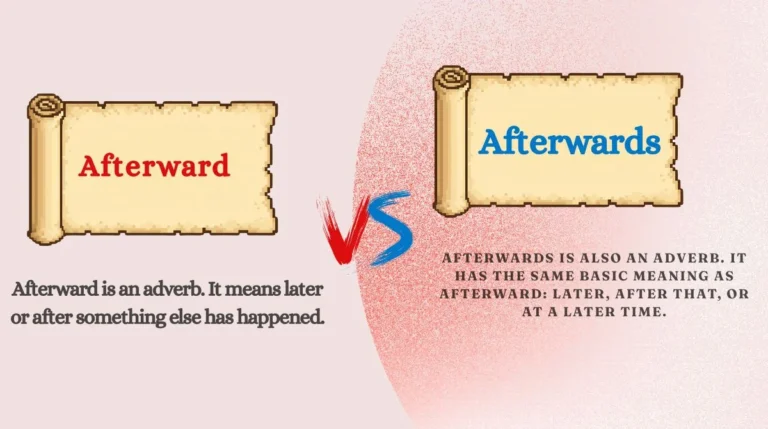
Afterward is an adverb. It means later or after something else has happened.
It is used when you are talking about an event that happens after another event. Usually, the first event has already been mentioned or is clear from the context.
For example:
We watched a movie and went home afterward.
Here, afterward means after watching the movie.
Cambridge defines afterward as “after the time mentioned,” while its American English entry also gives the meaning “later.” It identifies afterward as the usual American form.
When should you use “afterward”?
Use afterward when you want to say that something happened later, following an earlier event.
It is very common in everyday English:
- I felt tired afterward.
- We talked about it afterward.
- She called me afterward.
- They went for coffee afterward.
It can appear at different places in a sentence, although the most natural positions are often at the beginning or end.
Grammar rule for “afterward”
Because afterward is an adverb, it does not directly take a noun in the way the preposition after does.
Compare these:
- We went home afterward.
- We went home after the meeting.
In the first sentence, afterward stands alone as an adverb. In the second sentence, after is a preposition followed by the noun phrase the meeting.
You should not normally write:
- We went home afterward the meeting. ❌
Instead, write:
- We went home afterward. ✅
- We went home after the meeting. ✅
Examples with “afterward”
- We had lunch and went shopping afterward.
- I was nervous before the exam, but I felt better afterward.
- She apologized afterward.
- They discussed the problem afterward.
- I found out the truth only afterward.
- He called his parents afterward.
- We can talk about the details afterward.
- The children played outside and went home afterward.
Notice that afterward simply points back to something that happened earlier.
Common learner confusion
One common mistake is thinking that afterward means exactly the same thing as after in every sentence. It does not.
After can work as a preposition or conjunction:
- We went home after dinner.
- We went home after the movie ended.
But afterward is an adverb:
- We went home afterward.
Another mistake is thinking that the -ward ending makes the word a completely different kind of expression. It does not change the main idea. The word still refers to a later time.
What Does “Afterwards” Mean?
Afterwards is also an adverb. It has the same basic meaning as afterward: later, after that, or at a later time.
For example:
We had dinner and afterwards went for a walk.
The meaning is clear: the walk happened after dinner.
Cambridge lists afterwards as mainly British and says that American English usually uses afterward instead. Oxford similarly describes afterwards as especially British English and notes that North American English usually uses afterward.
When should you use “afterwards”?
Use afterwards when you are talking about something that happens later than an event already mentioned.
It is especially natural in British English and is very common in everyday conversation and writing in the UK.
Examples include:
- We had tea and afterwards sat in the garden.
- She felt embarrassed afterward.
- What are you doing afterwards?
- I’ll see you afterwards.
Cambridge gives examples such as “I did my homework and went swimming afterwards,” showing how naturally the word can refer back to an earlier action.
Grammar rule for “afterwards”
Like afterward, afterwards is an adverb.
It can stand by itself:
- We can discuss it afterwards.
It can also come before another clause or action:
- Afterwards, we went home.
It usually does not need another word directly after it to complete its meaning.
Compare:
- We went out afterwards. ✅
- We went out afterwards the meeting. ❌
- We went out after the meeting. ✅
The third sentence works because after is followed by a noun phrase.
Examples with “afterwards”
- I finished my homework and watched TV afterwards.
- We had dinner and went for a walk afterwards.
- Afterwards, she called her sister.
- He felt sorry about his words afterwards.
- We can clean the kitchen afterwards.
- They met for coffee shortly afterwards.
- I understood what had happened only afterwards.
- What are you doing afterwards?
Common learner confusion
Students sometimes believe afterwards is “more correct” because it has an extra s.
That is not true.
The extra s does not make the word more grammatically correct. It is simply part of the British form that is very common in British English.
Similarly, afterward is not an incomplete version of afterwards. It is a standard English word, especially in American English.
Difference Between Afterward and Afterwards
The most important thing to remember is this:
Afterward and afterwards mean the same thing.
They both refer to a time after an earlier event. The major difference is regional preference, not meaning.
Cambridge labels afterwards as mainly UK and afterward as the usual US form. Oxford makes a very similar distinction, describing afterwards as especially British and afterward as usual in North American English.
Comparison table
| Feature | Afterward | Afterwards |
|---|---|---|
| Part of speech | Adverb | Adverb |
| Basic meaning | Later; after that | Later; after that |
| Main usage | American English | British English |
| Meaning difference | None | None |
| Common in US writing | Very common | Less usual |
| Common in UK writing | Less usual | Very common |
| Refers to | A later time | A later time |
| Example | We talked afterward. | We talked afterwards. |
Usage difference
Consider these two sentences:
I went home afterward.
I went home afterwards.
Both sentences are grammatically correct. Both mean that the speaker went home after the event being discussed.
The choice depends mainly on the variety of English being used.
An American writer will often naturally choose:
We went out for dinner afterward.
A British writer may naturally choose:
We went out for dinner afterwards.
Neither speaker is making a grammar mistake.
Grammar logic
Both forms perform the same grammatical job. They are adverbs that tell us when something happened.
Look at this example:
She finished her work and called me afterward.
The word afterward tells us when she called.
Now change it:
She finished her work and called me afterwards.
Nothing important about the meaning changes.
This is why students should not waste time trying to memorize a complicated grammar rule for the difference. The real lesson is about English variety and word preference.
Sentence structure difference
Both forms can appear in similar positions.
At the end:
We talked afterwards.
We talked afterward.
At the beginning:
Afterwards, we went home.
Afterward, we went home.
In the middle:
She afterwards regretted her decision.
She afterward regretted her decision.
The final position is often especially natural in everyday speech, while a beginning position can be useful when you are clearly showing the order of events.
Meaning comparison
There is no meaningful difference in time between the two.
Both can describe:
- a few seconds later
- a few minutes later
- later that day
- a later point following an event
For example:
I felt nervous beforehand, but afterward I was relaxed.
The same idea can be written:
I felt nervous beforehand, but afterwards I was relaxed.
So, do not think that one means “immediately after” while the other means “much later.” The words themselves do not create that distinction.
Words such as shortly, soon, and immediately can provide that extra information:
- shortly afterward
- soon afterwards
- immediately afterward
- soon afterward
Cambridge specifically gives examples such as “soon afterwards” and “soon afterward.”
Grammar Rules You Must Remember
Rule #1: Both forms are correct
Do not mark either afterward or afterwards as automatically wrong.
Both are standard English adverbs.
We talked afterward. ✅
We talked afterwards. ✅
Your choice should mainly depend on whether you are following American or British English.
Rule #2: Use “after” when a noun or clause follows
This is an important difference between after and these two adverbs.
Use after + noun phrase:
We left after dinner.
Use after + clause:
We left after the movie ended.
But use afterward/afterwards when you want the adverb to stand on its own:
We left afterward.
We left afterwards.
Cambridge explains that after can function as a preposition before a noun phrase and as a conjunction before a clause.
Rule #3: “Afterward” and “afterwards” refer back to an event
These words are easiest to understand when an earlier event is known or mentioned.
We had an exam. Afterwards, we went for lunch.
The word points back to the exam.
You can also say:
I will explain everything afterward.
Here, the exact earlier event is understood from the conversation.
Rule #4: Match the form to your English variety when possible
There is no universal rule saying that every English speaker must use one form.
For American English, afterward is usually the better natural choice.
For British English, afterwards is especially common.
Oxford and Cambridge both support this regional distinction.
For international writing, either form is understandable and standard. The most important thing is to use one consistently.
Common Mistakes Students Make
Many errors happen because learners are trying to find a difference that does not really exist.
Mistake 1: Thinking “afterward” is wrong
Some students see afterwards in British books and assume afterward is a spelling mistake.
That is incorrect.
Afterward is a standard word and is especially common in American English.
Wrong belief:
“Afterward” is incomplete. ❌
Better understanding:
“Afterward” is a standard American English form. ✅
Mistake 2: Thinking “afterwards” is wrong in American English
The opposite mistake also happens.
A learner may see:
We talked afterwards.
and think the writer has added an unnecessary s.
That is not necessarily a mistake. Afterwards is a standard English form and remains widely used, especially in British English.
Mistake 3: Using “afterward” before a noun
This happens because learners confuse afterward with the preposition after.
Incorrect:
We went home afterward the class. ❌
Correct:
We went home after the class. ✅
Or:
We went home afterward. ✅
Remember: afterward is an adverb. After can be a preposition.
Mistake 4: Believing the forms have different meanings
Some learners think:
afterward = immediately later
afterwards = much later
There is no such general rule.
Both can describe a later time. To show that something happened very soon, use words such as soon or shortly:
We spoke shortly afterward.
We spoke soon afterwards.
Mistake 5: Mixing regional styles unnecessarily
A sentence is not grammatically wrong because it uses the form preferred in another variety of English. Still, consistency can make your writing look more natural.
For example, if you are writing specifically for an American audience, afterward will usually feel more natural.
For a British audience, afterwards may be the better choice.
Easy Trick to Remember the Difference
Here is the simplest memory trick:
Same meaning, different preference.
Think of it this way:
US → afterward
UK → afterwards
You do not need to memorize two definitions. You only need to remember that English can have small regional differences in spelling and word choice.
Another useful trick is to connect both forms with the word later.
Whenever you see:
afterward
think:
later
Whenever you see:
afterwards
think:
later
For example:
We went shopping afterward.
means:
We went shopping later.
And:
We went shopping afterwards.
also means:
We went shopping later.
The meaning is the same.
There is also a helpful grammar trick:
After + something
Afterward/afterwards = after that
Compare:
We ate after the meeting.
and:
We ate afterwards.
The first sentence tells you what came after. The second sentence means after that event.
This small distinction makes many sentences much easier to understand.
Daily Life Examples
These words appear naturally in conversations, stories, emails, and everyday writing.
Example 1: After a class
Student: Are you going home now?
Teacher: Yes. I have a meeting afterward.
Here, afterward means after the meeting or activity already being discussed.
Example 2: British-style conversation
Tom: Are you free after the match?
Sam: Yes. We can get something to eat afterwards.
The sentence sounds completely natural in British English.
Example 3: Talking about dinner
We had dinner and went for a walk afterward.
The walk happened after dinner.
Example 4: Talking about a mistake
I was embarrassed at first, but I laughed about it afterward.
The laughter came later.
Example 5: Making plans
Let’s finish our work first. We can watch a movie afterwards.
The movie comes after the work.
Example 6: Talking about an exam
I was nervous before the exam, but I felt relieved afterward.
The feeling of relief came later.
Example 7: Giving advice
Think carefully before you decide. You may regret it afterward.
Here, afterward means at a later time following the decision.
Example 8: Talking about an appointment
I have a doctor’s appointment in the morning. I’ll call you afterwards.
The call will happen after the appointment.
Example 9: Describing a surprise
At first, I did not understand what was happening. Afterwards, everything became clear.
Afterwards refers to the time after the first situation.
Example 10: Talking about a movie
The movie was scary, but we joked about it afterward.
The joking happened after the movie.
These examples show that you can use either form when the meaning is simply later or after that.
Practice Section
Choose the better word for each sentence. In many cases, both forms can be grammatically correct, so think about the English variety being used.
1. We went for coffee ________.
a) afterward
b) after
2. I felt much better ________.
a) afterwards
b) afterward
3. We went home ________ dinner.
a) afterward
b) after
4. She called me ________ the meeting.
a) afterward
b) after
5. We finished the project and celebrated ________.
a) afterwards
b) after
Answers
1. afterward / afterwards — Both are correct when meaning “later.”
2. afterward / afterwards — Both are correct.
3. after — The noun dinner follows, so use the preposition after.
4. after — The noun phrase the meeting follows.
5. afterwards / afterward — Both are correct.
The key lesson is not simply to choose one spelling every time. First, ask yourself what grammatical role the word has.
FAQs
What is the difference between afterward and afterwards?
There is almost no difference in meaning. Both mean later or after something has happened.
The main difference is regional preference. Afterward is usually preferred in American English, while afterwards is especially common in British English.
Is afterward or afterwards more correct?
Both are correct standard English forms.
Neither spelling is grammatically superior. Choose afterward when following American English style and afterwards when following British English style. Oxford and Cambridge both recognize this distinction.
Is afterward American English?
Yes. Afterward is the usual form in American English.
American speakers and writers commonly use sentences such as:
We talked afterward.
Cambridge specifically labels afterward as US usage in its dictionary entry.
Is afterwards British English?
Yes. Afterwards is especially common in British English.
For example:
We had lunch and went shopping afterwards.
Oxford describes afterwards as especially British English and says North American English usually uses afterward.
Can I use afterward in a question?
Yes.
For example:
What are you doing afterward?
You can also say:
What are you doing afterwards?
Both are grammatically correct. Cambridge’s learner dictionary includes the question “What shall we do afterwards?” as a natural example.
Can afterward and afterwards be used at the beginning of a sentence?
Yes.
For example:
Afterward, we went home.
and:
Afterwards, we went home.
Both work naturally. Starting a sentence with either form can make the order of events very clear.
Conclusion
The difference between afterward and afterwards is much easier than it seems. Both words are adverbs, and both mean later, after that, or at a later time. They do not describe different kinds of time, and neither word is an incorrect version of the other.
The main difference is regional. Afterward is usually preferred in American English, while afterwards is especially common in British English.
The more important grammar point is knowing when to use these adverbs instead of after. Say after dinner, but say afterward or afterwards when the word stands alone and means after that.
So, when you are unsure, remember this simple idea: same meaning, different regional preference. Once you notice this pattern in books, movies, conversations, and websites, the choice will start to feel natural.
Keep practicing with your own sentences. English becomes much easier when you stop memorizing every word as a separate problem and start noticing the patterns.

Evan Rellmont is a writer who turns thoughtful ideas into meaningful words, creating stories and reflections that connect, inspire, and leave a lasting impression.