
Have you ever typed “ocassion” and then stopped to wonder whether you had spelled it correctly? You are not alone. This is a very common spelling mistake, especially among English learners.
The word sounds almost the same whether you write occasion or ocassion, so your ears do not always help you choose the right letters.
The good news is that the answer is simple: occasion is the correct spelling.
Ocassion is a misspelling and is not an accepted standard English spelling.
But spelling is only part of the story. The word occasion is useful in everyday English because it can talk about a special event, a particular time, an opportunity, or a situation.
You will see it in conversations, invitations, emails, school writing, business messages, and formal English.
For example, we might say, “It was a special occasion,” when talking about a wedding or birthday. We can also say, “I have met her on several occasions,” meaning several different times. The phrase “on occasion” means “sometimes” or “from time to time.”
By the end of this guide, you will know exactly why occasion is correct, why ocassion is wrong, how to pronounce the word, how to use it naturally, and how to remember its spelling without checking a dictionary every time.
What Does “Occasion” Mean?
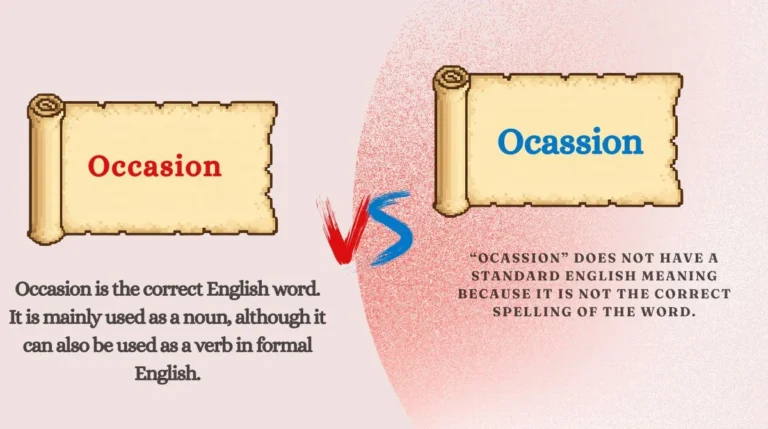
Occasion is the correct English word. It is mainly used as a noun, although it can also be used as a verb in formal English.
As a noun, occasion can refer to a particular time when something happens. It can also mean a special or formal event, such as a wedding, graduation, anniversary, ceremony, or birthday. Dictionaries also give it meanings connected with an opportunity, reason, or circumstance.
Simple definition
In easy English, occasion can mean:
- a special event
- a particular time
- an opportunity or suitable time
- a situation or reason for something
The exact meaning depends on the sentence.
When should you use “occasion”?
Use occasion when you are talking about an event or a specific time that has some importance.
For example:
- My sister’s wedding was a beautiful occasion.
Here, occasion means a special event.
- We have met on several occasions.
Here, it means several different times.
- This is a perfect occasion to thank everyone.
Here, it means a suitable opportunity or time.
- She wore her best dress for the occasion.
Here, the occasion refers to the special event being discussed.
- The school organized a special occasion for the graduating students.
Here, the word refers to an organized event.
- I have spoken to him on many occasions.
This means the speaker has spoken to him many times.
- On occasion, I walk to work instead of taking the bus.
Here, the phrase means “sometimes.”
- Her birthday was a joyful occasion for the whole family.
Here, occasion means a special event.
Grammar rule for “occasion”
Occasion is a countable noun when it refers to a particular event or time.
That means you can use:
- an occasion
- the occasion
- this occasion
- that occasion
- several occasions
- many occasions
- special occasions
For example:
It was an important occasion.
We have discussed this matter on several occasions.
She looked nervous on that occasion.
You can also use occasion after certain prepositions:
- on occasion
- on several occasions
- on the occasion of
- for the occasion
These combinations are very common.
“Occasion” as a verb
There is another, less common use. Occasion can be a verb meaning to cause something to happen. This use is more formal than the everyday noun use. Cambridge and Merriam-Webster both record this verb sense.
For example:
The decision occasioned a great deal of discussion.
This means the decision caused a lot of discussion.
For beginners, however, the noun form is much more important in ordinary conversation and writing.
Why do learners get confused?
The spelling is tricky because the word contains a double c, but only one s:
o c c a s i o n
Many learners remember that there is a repeated letter somewhere in the word, but they put the double letters in the wrong place.
That creates:
❌ ocassion
instead of:
✅ occasion
The pronunciation also makes the spelling harder to guess. Cambridge gives the pronunciation as /əˈkeɪ.ʒən/, approximately uh-KAY-zhun. The spoken sound does not clearly tell you that the written word contains cc followed by a single s.
What Does “Ocassion” Mean?
Here is the most important point:
“Ocassion” does not have a standard English meaning because it is not the correct spelling of the word.
When someone writes ocassion, they normally mean occasion.
So, you should not treat these as two different English words.
There is no meaning difference such as:
- occasion = one thing
- ocassion = another thing
That is not how this pair works.
Instead:
✅ occasion = correct spelling
❌ ocassion = incorrect spelling
This means you should not use ocassion in school assignments, exams, emails, invitations, essays, reports, websites, or professional communication.
Examples of the mistake
Here are some common examples:
❌ It was a very special ocassion.
✅ It was a very special occasion.
❌ Thank you for inviting me to this ocassion.
✅ Thank you for inviting me to this occasion.
❌ We have met on several ocassions.
✅ We have met on several occasions.
❌ She bought a new dress for the ocassion.
✅ She bought a new dress for the occasion.
❌ This is an important ocassion for our family.
✅ This is an important occasion for our family.
Why does “ocassion” look correct?
This is a good question.
English contains many words with ss, such as:
- message
- lesson
- discussion
- possession
- session
Because learners see ss in many common words, they may naturally expect another s in occasion.
There is also a pronunciation issue. When people speak quickly, they hear the word as a smooth sound rather than as individual letters. As a result, the spelling has to be learned rather than guessed.
This is one of those English words where memorization is more useful than trying to create a general pronunciation rule.
A second common mistake: “occassion”
Some learners go one step further and write:
❌ occassion
This version has both a double c and a double s.
The correct spelling has:
two Cs + one S
So remember:
✅ occasion
not:
❌ ocassion
and not:
❌ occassion
Difference Between Occasion and Ocassion: Detailed Explanation
The difference is very straightforward because only one of these forms is correct.
| Feature | Occasion | Ocassion |
|---|---|---|
| Spelling | ✅ Correct | ❌ Incorrect |
| Standard English word | Yes | No |
| Meaning | Event, time, opportunity, or situation | No standard meaning |
| Pronunciation | /əˈkeɪ.ʒən/ | Not a standard English pronunciation |
| Double letter | cc | ss |
| Used in formal writing | Yes | No |
| Used in everyday English | Yes | No |
The main thing to understand is that this is a spelling problem, not a difference in meaning.
Meaning difference
There is no real meaning difference because ocassion is simply a misspelling.
Consider:
We are celebrating a special occasion.
This sentence is correct.
If you write:
We are celebrating a special ocassion.
The reader will probably understand what you mean, but the spelling is still wrong.
Usage difference
There is only one accepted spelling for standard English:
occasion
You can use it in casual writing, academic writing, business communication, formal letters, and everyday conversation.
For example:
It was a wonderful occasion.
This occasion means a lot to me.
We have spoken on several occasions.
All of these are standard.
Grammar difference
There is no separate grammar rule for ocassion because it is not an alternative grammatical form.
You do not choose between them depending on singular or plural, tense, country, or formality.
The correct form remains:
- occasion
- occasions
- occasional
- occasionally
- occasioned
- occasioning
Notice how the word family keeps the same cc spelling.
Sentence structure
The word can appear in several sentence patterns.
Occasion + be + adjective
The wedding was a memorable occasion.
Occasion + for + noun
This is an occasion for celebration.
Occasion + to + verb
It is a good occasion to thank our teachers.
on + occasion
I eat out on occasion.
on + several/many/rare occasions
We have worked together on several occasions.
The important point is that the word always keeps its correct spelling.
Grammar Rules You Must Remember
Rule 1: Occasion has two Cs and one S
This is the most important spelling rule to memorize.
Write:
oc-ca-sion
Not:
o-ca-ssion
A simple visual check can help:
✅ ocCASION
The double letters are the C’s, not the S’s.
Example:
It was a memorable occasion.
Rule 2: Use “an occasion” when you mean one event or instance
Because occasion is a countable noun in common uses, it can take the article an when you are talking about one occasion.
Example:
It was an important occasion for the students.
You can also say:
I remember an occasion when everyone worked together.
When the listener already knows which event you mean, use the:
She wore a blue dress for the occasion.
Rule 3: “On occasion” means “sometimes”
This is one of the most useful expressions to learn.
On occasion = sometimes = from time to time
Cambridge and Merriam-Webster both record this idiomatic use.
Examples:
I go to the cinema on occasion.
He still calls his old friends on occasion.
We eat at that restaurant on occasion.
Be careful with the plural.
On occasion is a fixed expression meaning “sometimes.”
But on several occasions means several specific times.
Compare:
I see him on occasion.
= I see him sometimes.
I saw him on several occasions last year.
= I saw him several specific times.
Rule 4: “Occasionally” also comes from “occasion”
The adverb occasionally means sometimes, but not often. Cambridge defines it this way and gives examples such as “I see him occasionally in town.”
The spelling is:
occasionally
A useful way to see it is:
occasion + ally = occasionally
Examples:
I occasionally drink coffee in the evening.
She occasionally visits her grandparents.
We occasionally work late.
Do not write:
❌ ocassionally
The correct form is:
✅ occasionally
Learning the whole word family can make the spelling much easier.
Common Mistakes Students Make
Spelling mistakes with this word usually happen for one of three reasons: the pronunciation is not a clear guide, the doubled letter is easy to forget, and similar English words influence the learner’s memory.
Mistake 1: Writing “ocassion”
❌ The birthday party was a special ocassion.
✅ The birthday party was a special occasion.
The writer has doubled the wrong letter.
Correction tip: Remember CC, not SS.
Mistake 2: Writing “occassion”
❌ This is a very important occassion.
✅ This is a very important occasion.
This mistake happens when learners know that something is doubled but are unsure whether the repeated letter is c or s.
Correction tip: There are only two C’s. The S stays single.
Mistake 3: Writing “ocasion”
❌ It was a wonderful ocasion.
✅ It was a wonderful occasion.
Here, the learner has removed one of the C’s.
Correction tip: Start with occa-.
Mistake 4: Misspelling “occasionally”
❌ I ocassionally go there.
✅ I occasionally go there.
Because the base word is misspelled, the longer form is often misspelled too.
Correction tip: Learn the family together:
occasion → occasional → occasionally
Mistake 5: Using “on occasion” incorrectly
Some students write:
❌ I visit him on occasions.
This may be possible in a different context, but when you mean “sometimes,” the usual expression is:
✅ I visit him on occasion.
However, when you are talking about several particular times, the plural is normal:
✅ I visited him on several occasions.
The difference is small but useful.
Mistake 6: Confusing “occasion” with “opportunity”
These words can overlap, but they are not always identical.
An occasion can be a particular time, event, or circumstance.
An opportunity usually focuses more strongly on a favorable chance to do something.
For example:
The graduation was a special occasion.
You would not normally replace occasion with opportunity here.
But:
The meeting gave me an opportunity to ask questions.
Here, the focus is on the chance to do something.
Understanding this difference helps you use vocabulary more naturally.
Easy Trick to Remember the Difference
Here is a very simple memory trick:
Two Cs, one S — Occasion
Think:
“A special occasion needs two C’s.”
So picture the word like this:
OCCASION
Look closely:
CC = two C’s
S = one S
You can also remember this sentence:
“There are two Cs for every special occasion.”
It is a little silly, but silly memory tricks often work.
Another useful method is to break the word into small pieces:
oc + ca + sion
Focus on the middle:
OCCASION
The first important feature is CC.
Think about “occasionally”
The word occasionally can help reinforce the pattern:
occasion → occasionally
Both begin with:
occa-
So when you write occasionally, first remember the correct spelling of occasion.
A classroom trick
Imagine your teacher writes two words on the board:
OCASSION ❌
OCCASION ✅
Then ask yourself:
Which letter should be doubled?
Answer:
C.
Not S.
So the formula is:
O + CC + ASION
That gives you:
OCCASION
Daily Life Examples
The word is common in real conversations, invitations, school activities, workplaces, and family events. Here are some natural examples.
1. Talking about a wedding
A: Why are you wearing a suit today?
B: It’s my cousin’s wedding. It’s a special occasion.
Here, occasion means a special event.
2. Talking about birthdays
We usually eat at a nice restaurant on special occasions, such as birthdays.
3. Talking about a particular time
I remember meeting him on one occasion at the airport.
Here, the word means a particular instance or time.
4. Talking about repeated experiences
We have discussed this issue on several occasions.
This means the discussion happened several different times.
5. Talking about clothes
A: Why did you buy that expensive dress?
B: I need it for a formal occasion.
6. Talking about habits
I don’t eat sweets every day. I have them only on occasion.
Here, on occasion means sometimes.
7. Talking about family events
My grandparents always take family photos on special occasions.
8. Talking about an opportunity
The award ceremony was a good occasion to thank my teachers.
Here, the event provided a suitable chance to thank them.
9. Talking about work
Our manager gives us a speech on important occasions.
10. Talking about rare events
We occasionally go out for dinner after work.
Notice that occasionally is an adverb here. It means sometimes, but not regularly.
Practice Section
Choose the correct word in each sentence.
1. We are preparing for a special ______.
a) ocassion
b) occasion
2. I visit my old school ______.
a) on occasion
b) on ocassion
3. She ______ visits her aunt on weekends.
a) occasionally
b) ocassionally
4. The ceremony was an important ______ for the whole family.
a) occasion
b) ocassion
5. We have discussed the problem on several ______.
a) occasions
b) ocassions
Answers
1. b) occasion
The correct spelling is occasion.
2. a) on occasion
This expression means “sometimes.”
3. a) occasionally
The adverb keeps the correct occa- spelling.
4. a) occasion
A ceremony can be a special occasion.
5. a) occasions
The plural of occasion is occasions, with one S.
FAQs
1. What is the difference between occasion and ocassion?
Occasion is the correct spelling. Ocassion is a misspelling and is not a standard English word.
The correct form has two Cs and one S:
occasion
There is no separate meaning for “ocassion.”
2. Is “ocassion” ever correct?
No. In standard English, ocassion is not the correct spelling.
When you want to talk about an event, particular time, or special situation, use occasion.
For example:
It was a special occasion.
3. How do you spell occasion correctly?
The correct spelling is:
O-C-C-A-S-I-O-N
The easiest thing to remember is:
double C, single S.
A helpful memory sentence is: “Two Cs for every occasion.”
4. What does occasion mean in English?
Occasion can mean a special event, a particular time when something happens, an opportunity, or a circumstance.
For example:
Her graduation was a proud occasion.
It can also appear in the phrase on occasion, which means “sometimes.”
5. Is occasion a noun or a verb?
Occasion is most commonly used as a noun.
It can also be a verb in formal English, where it means “to cause” or “bring about.” For example:
The announcement occasioned a lot of discussion.
The verb use is much less common in everyday conversation.
6. What is the difference between occasion and occasionally?
Occasion is usually a noun referring to an event, time, or circumstance.
Occasionally is an adverb meaning sometimes but not often.
Examples:
The wedding was a special occasion.
I occasionally attend weddings.
Cambridge defines occasionally as meaning “sometimes but not often.”
Conclusion
The spelling question “occasion or ocassion?” has a clear answer: occasion is correct, while ocassion is a misspelling.
The easiest way to remember the spelling is to focus on the double C:
OCCASION
It has two C’s and one S.
The word itself is very useful in English. It can describe a special event, a particular time, an opportunity, or a situation. You will often see expressions such as special occasion, on occasion, on several occasions, and on the occasion of.
Do not worry if this spelling has confused you before. Many English learners make the same mistake because the pronunciation does not clearly show where the double letter belongs. The best solution is to remember the visual pattern and practice the word in real sentences.
Whenever you are unsure, stop and check one thing:
Is it CC or SS?
For occasion, the answer is CC.
So write it confidently:
✅ occasion
Never:
❌ ocassion
A little practice will make this spelling feel natural very quickly.

Evan Rellmont is a writer who turns thoughtful ideas into meaningful words, creating stories and reflections that connect, inspire, and leave a lasting impression.