
Have you ever typed “challange” and wondered whether it was actually correct? You are not alone.
This is a very common spelling mistake, especially for English learners who hear the word often but do not always remember the exact order of its letters.
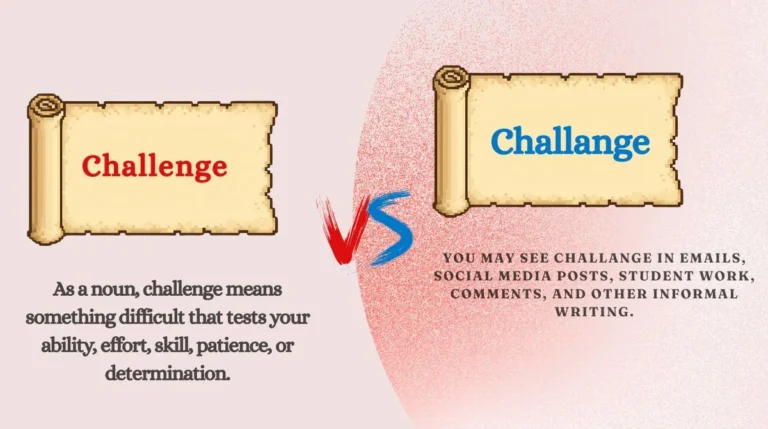
The correct spelling is challenge. The spelling challange is incorrect in standard English.
This confusion usually happens because English pronunciation does not always make spelling obvious.
When we say challenge, the ending can sound a little like “-lenge,” and learners may remember the word incorrectly as challange. The letters a and e can easily get mixed up, especially when writing quickly.
Knowing the correct form matters because challenge is a very common word. We use it when talking about difficult tasks, problems, competitions, personal goals, and situations that test our ability.
It can also be used as a verb when someone questions something, invites another person to compete, or asks someone to prove themselves. Cambridge lists both noun and verb uses for the word.
By the end of this guide, you will know exactly why challenge is correct, why challange is wrong, how to use the word naturally, and how to remember its spelling without making the same mistake again.
What Does “Challenge” Mean?
Challenge is the correct spelling.
As a noun, challenge means something difficult that tests your ability, effort, skill, patience, or determination. It can be a hard job, a difficult problem, or a situation that requires you to work hard to succeed. Cambridge describes it as something that needs significant mental or physical effort and tests a person’s ability.
For example, imagine you have to prepare for a difficult exam. You might say:
“The final exam is a real challenge.”
Here, challenge means a difficult task.
The word can also describe an invitation to compete. For example, one friend may challenge another person to a game of chess. Cambridge also gives this competitive meaning for both the noun and verb forms.
Challenge as a noun
A noun names a person, place, thing, or idea. In this case, challenge names a difficult task, situation, competition, or test.
Here are some examples:
- Learning English can be a challenge.
- This project is a big challenge for our team.
- She accepted the challenge without hesitation.
- Finishing the race was a personal challenge.
- The new job will be a challenge at first.
- He enjoys taking on difficult challenges.
- Finding a solution was our biggest challenge.
- The students faced a serious challenge.
Notice that the word stays the same whether the challenge is physical, mental, academic, or personal.
Challenge as a verb
Challenge can also be a verb.
As a verb, it can mean to invite someone to compete, question whether something is true or correct, or test someone’s ability. Cambridge gives these different verb meanings, including competing, expressing doubt, and testing someone’s skill or determination.
Examples:
- I challenge you to a game of chess.
- She challenged me to finish the task by Friday.
- The lawyer challenged the decision.
- He challenged the claim because he believed it was false.
- This difficult course will challenge your skills.
- The teacher challenged the students to think more carefully.
- They challenged the team’s record.
- She challenged him to prove his point.
A useful grammar pattern
A common structure is:
challenge + someone + to + noun/verb
Examples:
- She challenged me to a race.
- He challenged his brother to a game.
- The teacher challenged us to solve the problem.
When challenge means “question or dispute,” you can often use it with a noun:
- They challenged the decision.
- He challenged the result.
- She challenged the rule.
Common confusion about “challenge”
The biggest problem is usually not the meaning. It is the spelling.
Many learners hear the pronunciation and try to spell the word based on sound. That can lead to:
❌ challange
✅ challenge
The incorrect form contains a where the correct spelling has e:
challEnge
That small difference is the key.
What Does “Challange” Mean?
Challange is not the correct standard English spelling.
You may see challange in emails, social media posts, student work, comments, and other informal writing. However, seeing a misspelling often does not make it an accepted spelling.
When you want to write the English word for a difficult task, competition, or act of questioning something, use:
✅ challenge
Not:
❌ challange
Why do people write “challange”?
There are a few simple reasons.
First, English spelling can be difficult because pronunciation does not always clearly show every letter.
Second, some learners remember the middle of the word as -all-, so they write:
challange
instead of:
challenge
Third, people often type quickly. When a familiar word is written from memory, one vowel can easily be changed.
There is another reason this mistake can feel natural: English contains many words where a appears before consonants in a similar position, so learners may unconsciously copy that pattern.
But for this word, the ending is:
-enge
not:
-ange
Examples of incorrect usage
Here are some examples you should avoid:
❌ This challange is too hard.
✅ This challenge is too hard.
❌ I like a good challange.
✅ I like a good challenge.
❌ The teacher gave us a new challange.
✅ The teacher gave us a new challenge.
❌ She accepted the challange.
✅ She accepted the challenge.
The meaning is understandable even when the spelling is wrong, but correct spelling is important in school, business writing, websites, applications, and professional communication.
Is “challange” ever correct?
For normal modern English writing, no. It should be treated as a spelling error.
Use challenge in essays, emails, articles, assignments, resumes, reports, messages, and formal documents.
Difference Between Challenge and Challange
The difference is very simple:
Challenge = correct spelling
Challange = incorrect spelling
There is no separate meaning for challange. It is simply a misspelling of challenge.
Comparison Table
| Point | Challenge | Challange |
|---|---|---|
| Spelling | ✅ Correct | ❌ Incorrect |
| Standard English | Yes | No |
| Meaning | Difficult task, test, competition, etc. | No standard meaning |
| Part of speech | Noun and verb | Not a standard word |
| Used in formal writing | ✅ Yes | ❌ No |
| Used in everyday English | ✅ Yes | ❌ No |
| Example | This is a difficult challenge. | This is a difficult challange. ❌ |
Usage difference
There is actually no meaning-based difference between the two forms.
You might think that perhaps challenge and challange are two different words, just as affect and effect are different words. They are not.
Only challenge is the standard spelling.
That means you do not choose between them according to grammar, context, tense, formality, or meaning.
For example:
✅ Running five kilometers was a challenge.
There is never a situation where you need to replace challenge with challange.
Grammar logic
Because challenge is a real English word, it can function as both a noun and a verb.
As a noun:
The challenge was difficult.
As a verb:
They challenged me.
Its forms include:
- challenge
- challenges
- challenged
- challenging
Notice something important: even when the form changes, the basic spelling still begins with challeng-.
Examples:
- She challenges herself every day.
- He challenged the decision.
- The task is challenging.
This spelling family can help you recognize the correct base word.
Sentence structure difference
Because challange is incorrect, there is no proper sentence structure for it.
With challenge, however, several useful structures exist.
Challenge + noun
The problem challenged the team.
Challenge + someone + to + noun
She challenged me to a race.
Challenge + someone + to + verb
He challenged me to finish the project.
Challenge + idea/decision/rule
They challenged the new rule.
These structures are common in everyday and formal English.
Grammar Rules You Must Remember
Rule 1: “Challenge” is the correct base spelling
Always write:
challenge
The final part contains e:
chall + enge
Do not write:
challange
Example:
✅ This challenge will make you stronger.
Rule 2: “Challenge” can be a noun
When it names something difficult, it is a noun.
Examples:
- The exam was a challenge.
- This job presents a new challenge.
- He enjoys every challenge.
A useful test is to ask:
“What is difficult?”
The answer may be the challenge.
Rule 3: “Challenge” can be a verb
When someone tests, questions, or invites another person to compete, challenge works as a verb.
Examples:
- She challenged my opinion.
- He challenged me to a race.
- The teacher challenged us to think deeply.
A common pattern is:
subject + challenge + object
For example:
The student challenged the answer.
Rule 4: Related forms keep the “challeng” spelling
When you learn the word, it is useful to remember its related forms:
challenge → challenges → challenged → challenging
Examples:
- We face many challenges.
- She challenges herself every day.
- They challenged the decision.
- The course is challenging.
This gives you a spelling family rather than one isolated word.
Common Mistakes Students Make
Spelling mistakes like this usually happen because students depend too much on pronunciation. English has many words whose sounds do not perfectly reveal their spelling.
Mistake 1: Writing “challange” in schoolwork
❌ The project was a big challange.
✅ The project was a big challenge.
Correction tip: Before submitting your work, look for the ending -enge.
Mistake 2: Adding “a” because it sounds natural
Some learners think:
chall + ange
But the correct form is:
chall + enge
Try to train your eyes to recognize the correct visual shape of the word.
Mistake 3: Assuming “challange” is acceptable because you see it online
The internet contains many spelling mistakes. A word appearing in a comment or casual post does not automatically make it correct.
For standard English:
✅ challenge
is the form you should use.
Mistake 4: Using the wrong spelling in professional writing
A misspelling may seem small, but repeated spelling errors can make writing look less polished.
Compare:
❌ We are ready for the new challange.
✅ We are ready for the new challenge.
The second sentence looks clean and professional.
Mistake 5: Forgetting the spelling when adding endings
Some learners remember challenge correctly but get confused with related forms.
Correct:
✅ challenges
✅ challenged
✅ challenging
Not:
❌ challanges
❌ challangged
❌ challanging
The spelling base remains challeng-.
Easy Trick to Remember the Difference
Here is a very simple memory trick:
Think: “ENGE” belongs to challenge
Break the word into two parts:
chall + enge
The important ending is:
ENGE
Not:
ANGE
You can create a little memory sentence:
A challenge ends with E.
Look at the word:
challEnge
The E is your reminder.
Another way is to connect it with a related word:
challenge → challenging
The word challenging clearly shows the e before the ending changes.
For example:
challenge
challenging
Seeing both together can help your brain remember the original spelling.
Think about the meaning, too
Whenever you mean:
- a difficult task
- something that tests your ability
- a competition
- an invitation to compete
- something you question or dispute
think challenge.
Do not stop and ask, “Should I use challenge or challange?”
There is only one standard spelling to choose.
A quick classroom trick
Write this three times:
challenge
challenge
challenge
Then write:
challenging
challenged
challenges
This helps you notice the common spelling pattern.
Spelling becomes easier when your brain sees a word often instead of memorizing it only once.
Daily Life Examples
The word challenge appears in many normal conversations. Here are some natural examples you might hear or use.
1. Talking about studies
A: How was your math test?
B: It was a real challenge, but I think I did well.
Here, challenge means something difficult that required effort.
2. Talking about work
A: Do you like your new job?
B: Yes. It is challenging, but I enjoy it.
Here, challenging means difficult in a way that tests your skills.
3. Talking about exercise
A: Can you run five kilometers?
B: I can try. It will be a challenge.
The task is difficult, but the speaker is willing to attempt it.
4. Challenging someone in a game
A: Who wants to play chess?
B: I challenge you!
Here, the verb challenge means inviting another person to compete.
5. Talking about personal goals
A: Why are you waking up so early?
B: I gave myself the challenge of running every morning.
The person has created a personal goal.
6. Talking about a difficult problem
A: Did you solve the computer problem?
B: Not yet. It is quite a challenge.
The problem requires skill and effort.
7. Questioning an idea
A: Everyone agrees with the plan.
B: I know, but I want to challenge one part of it.
Here, challenge means questioning or disagreeing with something.
8. Talking about a new experience
A: Are you nervous about moving to another city?
B: A little. It will be a challenge, but I am excited.
The word describes a difficult new situation.
9. Encouraging a student
Teacher: This exercise is difficult, but I want you to challenge yourself.
Here, the teacher is encouraging the student to attempt something harder.
10. Talking about competition
A: Do you think our team can win?
B: Yes, but the other team will be a tough challenge.
The word refers to a strong competitor or difficult test.
Practice Section
Choose the correct spelling: challenge or challange.
1. This new job is a big ________.
2. I love taking on a good ________.
3. She ________ me to a game of tennis.
4. Learning a new language can be a ________.
5. The students were ready for the difficult ________.
Answers
- challenge
- challenge
- challenged
- challenge
- challenge
Remember that challange is not the correct spelling.
Extra spelling test
Which sentence is correct?
A. This is a difficult challange.
B. This is a difficult challenge.
The correct answer is:
✅ B. This is a difficult challenge.
FAQs
What is the difference between challenge and challange?
There is no meaning difference because challange is not a standard English word. Challenge is the correct spelling. Use it for something difficult, a competition, a test, or an act of questioning something.
Is “challange” a correct spelling?
No. Challange is a common spelling mistake. The correct form is challenge, with e in the middle and before the final n-g-e ending.
How do you spell challenge correctly?
The correct spelling is:
C-H-A-L-L-E-N-G-E
A useful way to remember it is chall + enge. Think of the ending ENGE, not ANGE.
Can “challenge” be used as a verb?
Yes. Challenge can be a verb meaning to invite someone to compete, question something, or test someone’s ability. For example, “She challenged me to a race.” Cambridge also lists these different verb meanings.
Is “challenge” a noun or a verb?
It can be both. As a noun, it can mean a difficult task: “The exam was a challenge.” As a verb, it can mean to test or question: “He challenged the decision.”
Why do people often spell challenge as challange?
The mistake usually comes from memory and pronunciation. The sounds do not make the exact spelling obvious, so learners may replace e with a. Repeated exposure to the correct spelling helps build stronger spelling memory.
Conclusion
The answer is simple: challenge is correct, while challange is incorrect.
The word challenge is extremely useful in everyday English. It can be a noun for a difficult task, test, competition, or problem. It can also be a verb when you invite someone to compete, question an idea, or test someone’s ability.
The main spelling point to remember is the e in the middle:
✅ challenge
❌ challange
A good memory trick is to focus on ENGE. Once you recognize that pattern, the correct spelling becomes much easier to recall.
Do not worry if you have made this mistake before. Spelling improves with practice and repeated exposure. Each time you write challenge correctly, you reinforce the right pattern. Before long, challange will look as unusual to you as it really is.

Evan Rellmont is a writer who turns thoughtful ideas into meaningful words, creating stories and reflections that connect, inspire, and leave a lasting impression.