
Have you ever seen the words appraise and apprise and wondered which one you should use? They look almost the same, sound similar, and both are verbs.
That is exactly why many English learners mix them up.
However, appraise and apprise have completely different meanings. Appraise is about examining, judging, or estimating the value of something.
Apprise means to tell or inform someone about something. Cambridge and Oxford dictionaries both make this difference clear.
For example, a person may appraise a house to decide how much it is worth.
But a person may apprise the owner of the results to make sure the owner knows what happened.
The confusion often comes from their spelling. Both words begin with appr-, and they have a similar ending. When students are writing quickly, it is easy to choose the wrong word.
Knowing the difference matters because using one word instead of the other can change the meaning of a sentence completely.
Once you understand what each verb does and learn its sentence pattern, the difference becomes much easier.
By the end of this guide, you will know exactly when to use appraise and when to use apprise, how their grammar works, which mistakes to avoid, and how to remember the difference without constantly checking a dictionary.
What Does “Appraise” Mean?
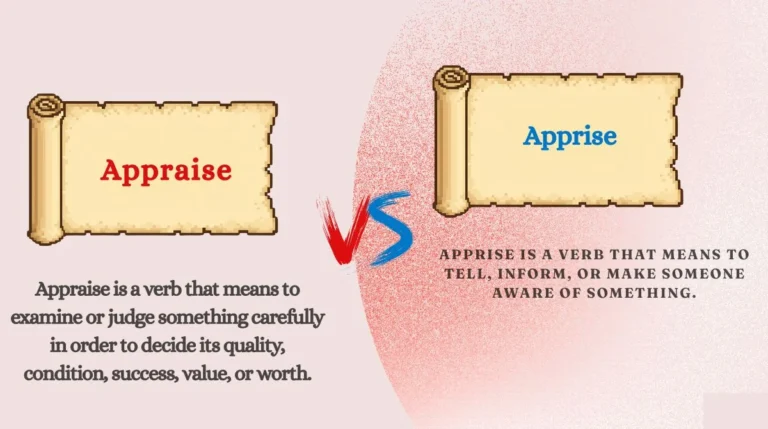
Appraise is a verb that means to examine or judge something carefully in order to decide its quality, condition, success, value, or worth.
In simple words, when you appraise something, you look at it carefully and make a judgment about it.
For example:
The expert will appraise the painting.
This means the expert will examine the painting and decide what it is worth or how valuable it is.
The word is often used for property, jewelry, artwork, performance, work, situations, skills, and other things that need careful evaluation. Cambridge defines it as examining someone or something to judge qualities, success, or needs. It can also mean deciding how much something might be sold for.
When should you use “appraise”?
Use appraise when the main idea is evaluation.
You might appraise:
- a house
- a painting
- a diamond
- an employee’s performance
- a business plan
- a situation
- someone’s work
- the value of an object
It is common in professional, business, financial, and formal situations.
Grammar rule for “appraise”
Appraise is normally a transitive verb, which means it usually takes a direct object.
The basic pattern is:
Subject + appraise + object
Examples:
The agent appraised the house.
The manager appraised my performance.
The expert appraised the necklace.
You can also use a pattern such as:
appraise something at + amount
This is especially common when talking about the estimated monetary value of something.
The painting was appraised at $50,000.
Oxford gives the same type of usage for officially examining an object or building and saying how much it is worth.
Examples of “appraise”
- The jeweler appraised my diamond ring.The jeweler examined the ring to determine its value.
- The company hired an expert to appraise the building.The expert was asked to judge the building’s value or condition.
- We need to appraise the situation before making a decision.Here, appraise means to carefully examine the situation.
- Her manager appraised her work at the end of the year.The manager evaluated the quality of her work.
- The painting was appraised at $20,000.An expert estimated that the painting was worth $20,000.
- The teacher asked the students to appraise their own performance.The students had to evaluate how well they had done.
- The architect appraised the condition of the old building.The architect examined it and formed a judgment.
- He took a moment to appraise the damage after the storm.He carefully examined the damage before deciding what to do.
A common confusion with “appraise”
Many learners connect appraise with the word praise because the spelling looks similar. But the meanings are different.
Praise means to express approval or admiration.
Appraise means to examine and evaluate.
Compare these:
The teacher praised Ali for his hard work.
Here, the teacher said something positive about Ali.
The teacher appraised Ali’s work.
Here, the teacher evaluated the quality of Ali’s work.
So, praise = admire or compliment, while appraise = evaluate or judge.
What Does “Apprise” Mean?
Apprise is a verb that means to tell, inform, or make someone aware of something.
In simple English, when you apprise someone, you give that person information.
For example:
The manager apprised me of the changes.
This means the manager informed me about the changes.
Unlike appraise, this word is not about judging value or quality. It is about giving information to someone.
Cambridge labels apprise as formal and gives the common pattern apprise someone of something.
When should you use “apprise”?
Use apprise when someone needs to be told about a situation, event, development, problem, decision, or change.
It is especially common in formal writing and professional communication.
For example:
Please apprise the team of any changes.
This means:
Please inform the team about any changes.
You will often see apprise in business letters, official notices, reports, legal writing, workplace communication, and other formal contexts.
Grammar rule for “apprise”
This is the most important grammar pattern to remember:
apprise + person + of + information
Or:
Subject + apprise + someone + of + something
Examples:
She apprised me of the problem.
The doctor apprised the family of the situation.
We were apprised of the new policy.
Notice the word of.
It is very common for learners to leave out of, but the usual structure is apprise someone of something.
Examples of “apprise”
- Please apprise me of any changes.Please inform me about any changes.
- The manager apprised the staff of the new schedule.The manager told the staff about the new schedule.
- We were apprised of the delay by email.We were informed about the delay.
- The doctor apprised the family of the patient’s condition.The doctor gave the family the necessary information.
- The company apprised its customers of the policy change.The company informed customers about the change.
- She quickly apprised her supervisor of the problem.She told her supervisor about the problem.
- The police apprised residents of the road closure.The police informed residents that the road was closed.
- Keep me apprised of the project’s progress.Keep me informed about how the project is developing.
A common confusion with “apprise”
The biggest problem is that apprise looks like appraise and can sound similar.
Learners may write:
Please appraise me of the changes.
But when the intended meaning is “inform me,” the correct word is:
Please apprise me of the changes.
The first sentence suggests evaluation rather than simply giving information.
This is why learning the sentence pattern is more useful than trying to remember the spelling alone.
Difference Between Appraise and Apprise
The easiest way to understand these words is to focus on the action.
Appraise = examine and evaluate.
Apprise = tell or inform.
They may look alike, but they do different jobs in a sentence.
Appraise vs Apprise Comparison Table
| Point | Appraise | Apprise |
|---|---|---|
| Part of speech | Verb | Verb |
| Basic meaning | Examine, evaluate, or estimate value | Tell or inform |
| Main idea | Judgment | Information |
| Common pattern | appraise something/someone | apprise someone of something |
| Often used with | Value, quality, performance, situation | News, changes, information, developments |
| Formality | Often formal, but widely used | Formal |
| Example | The expert appraised the ring. | She apprised me of the decision. |
| Easy synonym | Evaluate, assess, value | Inform, notify |
Usage difference
Think about what the person is doing.
If the person is looking carefully and making a judgment, use appraise.
The expert appraised the artwork.
The expert is evaluating the artwork.
If the person is giving information to another person, use apprise.
The expert apprised the owner of the results.
The expert is informing the owner.
The two actions can even happen in the same situation.
Imagine that a specialist examines a house.
First:
The specialist appraised the house at $300,000.
The specialist evaluated its value.
Then:
The specialist apprised the owner of the results.
The specialist told the owner what the evaluation showed.
That one example shows the difference very clearly.
Grammar logic
The grammatical patterns are also different.
With appraise, the thing being evaluated usually comes directly after the verb:
They appraised the property.
She appraised his work.
We appraised the situation.
With apprise, the person receiving the information comes after the verb, followed by of and the information:
They apprised us of the decision.
She apprised her manager of the problem.
We apprised the team of the changes.
This difference in grammar can help you choose the right word even when you are unsure about the meaning.
Sentence structure difference
A useful formula is:
APPRAISE
Subject + appraise + thing/person
The manager appraised the employee’s performance.
APPRISE
Subject + apprise + person + of + information
The manager apprised the employee of the new policy.
Notice that appraise usually points toward the thing being evaluated.
Apprise points toward the person being informed.
Meaning comparison
Here is another simple way to think about it:
Appraise asks: “How good, valuable, successful, or useful is this?”
Apprise answers: “Who needs to know this?”
For example:
The bank appraised the property.
The bank evaluated the property.
The bank apprised the customer of the result.
The bank informed the customer.
Once you see the difference as evaluation vs information, these two verbs become much easier.
Grammar Rules You Must Remember
Rule #1: Use “appraise” for evaluation
Use appraise when you examine something and form an opinion or estimate its value.
The expert appraised the antique table.
The expert examined the table and judged its value.
Do not use apprise here because the main action is evaluation, not communication.
Rule #2: Use “apprise” for information
Use apprise when you tell someone about something.
The most common pattern is:
apprise someone of something
The supervisor apprised us of the changes.
This means the supervisor informed us about the changes.
Rule #3: “Appraise” can be used with monetary value
When talking about houses, jewelry, artwork, land, antiques, and similar things, appraise can mean giving an estimated value.
The house was appraised at $450,000.
The necklace was appraised at $8,000.
The painting was appraised for insurance purposes.
This use is especially common in property, insurance, banking, and antiques.
Rule #4: Remember “apprise” + “of”
One of the best grammar clues is the word of.
When you mean “inform,” remember:
apprise someone of something
Please apprise me of the situation.
She apprised the director of the problem.
The office apprised us of the new rules.
This structure is one of the clearest ways to separate the two words.
Common Mistakes Students Make
These words are often confused because of their spelling and similar pronunciation. Students may know both words but still choose the wrong one in a sentence.
Mistake 1: Using “appraise” when you mean “inform”
❌ Please appraise me of the meeting time.
✅ Please apprise me of the meeting time.
The speaker wants information, not an evaluation.
A simple correction tip is to replace the word with inform.
If “inform” makes sense, apprise is probably the word you need.
Mistake 2: Using “apprise” when you mean “evaluate”
❌ The expert apprised the diamond.
✅ The expert appraised the diamond.
The expert is examining and judging the diamond’s value.
Try replacing the word with evaluate.
If “evaluate” works, use appraise.
Mistake 3: Forgetting “of” after apprise
❌ The manager apprised us the changes.
✅ The manager apprised us of the changes.
Remember the fixed pattern:
apprise + person + of + information
This is one of the most important grammar points for this word.
Mistake 4: Thinking “appraise” means “praise”
❌ The teacher appraised the student for being helpful.
If you mean the teacher complimented the student, use:
✅ The teacher praised the student for being helpful.
Praise means to express approval.
Appraise means to evaluate.
They may look related, but they do not have the same meaning.
Mistake 5: Confusing “appraise” with “apprise” in business English
Business writing often uses both words, which makes the confusion worse.
For example:
The company appraised the employee’s performance and apprised him of the results.
This sentence uses both words correctly.
The company evaluated the performance and then informed the employee about the result.
That is exactly how you can remember the difference in a real workplace situation.
Easy Trick to Remember the Difference
Here is a simple memory trick:
APPRAISE = ASSESS
Both appraise and assess are connected with judging or evaluating.
When you see appraise, think:
“I am checking the value or quality.”
For example:
Appraise a house.
Appraise a painting.
Appraise someone’s performance.
Now remember:
APPRISE = INFORM
When you see apprise, think:
“I am giving information.”
For example:
Apprise the manager of the problem.
Apprise the team of the change.
Keep me apprised of the situation.
Another helpful trick is to focus on the people involved.
With appraise, you are looking at the thing being judged:
appraise the car
With apprise, you are focusing on the person receiving information:
apprise the customer of the problem
So remember:
Appraise → assess
Apprise → inform
That two-word connection is usually enough to stop the confusion.
Daily Life Examples
Here are some natural examples showing how these words can appear in everyday work, study, and formal communication.
Example 1
A: Has the insurance company checked the car?
B: Yes. They appraised it yesterday.
Here, the company evaluated the car’s value or condition.
Example 2
A: Why did Sarah call you?
B: She apprised me of the schedule change.
Sarah gave information about the schedule.
Example 3
A: How much is this old painting worth?
B: We need an expert to appraise it.
The expert will evaluate its value.
Example 4
A: Does the director know about the delay?
B: Yes, we have apprised him of the situation.
The director has been informed.
Example 5
A: Has your manager reviewed your work?
B: Yes, she appraised my performance last week.
The manager evaluated the work.
Example 6
A: Did the doctor explain the test results?
B: Yes, she apprised the family of the results.
The doctor gave information to the family.
Example 7
A: Why is the bank checking the house?
B: It needs to appraise the property before approving the loan.
The bank needs an estimate of the property’s value.
Example 8
A: Should I tell Tom about the new meeting time?
B: Yes. Please apprise him of it.
The task is to inform Tom.
Example 9
A: What did the supervisor do during the review?
B: He appraised the employee’s performance.
He evaluated the employee’s work.
Example 10
A: Can you keep me updated about the project?
B: Sure. I’ll keep you apprised of any major changes.
This means the speaker will keep the other person informed.
Practice Section
Choose appraise or apprise to complete each sentence.
1. The jeweler will ______ the necklace before we sell it.
2. Please ______ me of any important changes.
3. The manager needs to ______ the employee’s performance.
4. We were ______ of the delay by email.
5. The bank hired an expert to ______ the property.
Answers
1. appraise
The jeweler is evaluating the necklace.
2. apprise
The person needs to be informed about changes.
3. appraise
The manager is evaluating performance.
4. apprised
The people were informed about the delay.
5. appraise
The expert is estimating or judging the property’s value.
A good way to practice is to ask yourself one question before choosing the word:
“Is someone judging something, or is someone informing someone?”
Judging or evaluating → appraise
Informing or notifying → apprise
FAQs About Appraise vs Apprise
What is the difference between appraise and apprise?
Appraise means to examine and evaluate something or someone, often to judge quality, success, condition, or value. Apprise means to tell or inform someone about something.
Can we use “apprise” in questions?
Yes. You can use apprise in questions, although it is a formal word.
For example:
Did you apprise the manager of the problem?
It simply asks whether the manager was informed.
Is “apprise” formal or informal?
Apprise is formal. It is common in official, professional, business, and written communication. In casual conversation, tell, inform, or let someone know will usually sound more natural. Cambridge specifically labels apprise as formal.
Is “appraise” a formal word?
Appraise can also sound formal, especially when it means evaluating performance, property, artwork, or value. However, it is a normal English verb and is widely used in professional contexts.
What is the correct phrase: “appraise me of” or “apprise me of”?
The correct phrase is “apprise me of” when you mean “inform me about.”
For example:
Please apprise me of the latest developments.
Appraise is used for evaluation, not for simply giving information.
Can “appraise” and “apprise” be used in the same sentence?
Yes, and this is a useful way to understand the difference.
The expert appraised the property and apprised the owner of its estimated value.
First, the expert evaluated the property. Then, the expert informed the owner about the result.
Conclusion
The difference between appraise and apprise becomes simple when you focus on their actions.
Appraise means to examine, evaluate, or estimate the value of something. You can appraise a house, painting, diamond, situation, or employee’s performance. Apprise means to tell or inform someone about something. Its most common structure is apprise someone of something.
The easiest memory trick is:
Appraise = assess
Apprise = inform
When you are writing, stop for a second and ask yourself whether the sentence is about judging or giving information. That small check can prevent the most common mistake.
These words may look almost identical, but their meanings are quite different. After practicing a few real sentences, you will be able to choose the correct one naturally. Keep noticing these words in emails, books, news reports, and workplace English. The more you see them in context, the easier the difference will become.

Evan Rellmont is a writer who turns thoughtful ideas into meaningful words, creating stories and reflections that connect, inspire, and leave a lasting impression.