
English has many words that look almost the same but do not mean the same thing.
This is especially true when a word begins with a prefix such as dis- or dys-. That is why many learners hesitate between disregulated and dysregulated.
The two spellings sound very similar, and the familiar word dis- can make “disregulated” look perfectly natural.
The important point is that, in standard modern English, dysregulated is the form you should use when you mean that a body process, system, emotion, or behavior is not being controlled normally.
Cambridge Dictionary uses dysregulated as a specialized medical and psychology adjective. It describes a process that is not controlled in the usual way and can also describe difficulty controlling emotions or behavior.
There is another word worth remembering: deregulated. It means that official rules or controls have been removed, especially from a business, industry, or activity.
So, these forms are not interchangeable. By the end of this guide, you will know which spelling to choose, what each term means, why dys- is used, and how to avoid the common spelling mistake.
What Does “Disregulated” Mean?
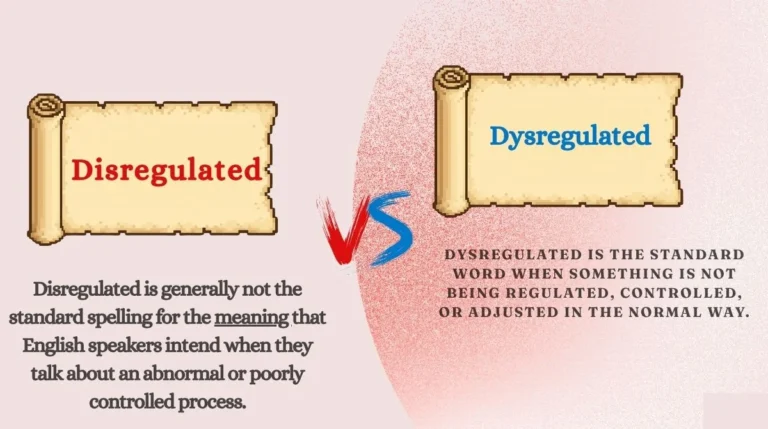
Disregulated is generally not the standard spelling for the meaning that English speakers intend when they talk about an abnormal or poorly controlled process.
Learners often write disregulated because the spelling seems logical. English has many familiar words beginning with dis-, such as disconnect, disagree, disorder, and disappear. It is easy to assume that dis + regulated should create disregulated.
However, standard modern usage normally uses dysregulated for this meaning. Reference sources define and use dysregulated in medical and psychological contexts, while dictionaries use deregulated for a different idea: removing official rules or controls.
When Do People Use “Disregulated”?
You may see disregulated in online writing, informal posts, or learner writing. It is often intended as a spelling of dysregulated. A dictionary-based Wiktionary entry specifically labels disregulated as a misspelling of dysregulated.
That does not mean every appearance of the form is impossible to understand. A reader can usually guess the intended meaning from context. Still, for school work, professional writing, academic writing, websites, and clear everyday English, dysregulated is the safer standard choice.
Grammar Rule for “Disregulated”
Because disregulated is not the standard form for this meaning, there is no useful grammar rule that recommends it. If your sentence means “not regulated normally,” replace it with dysregulated.
For example:
- ❌ The child became disregulated after the sudden change.
- ✅ The child became dysregulated after the sudden change.
- ❌ Stress can leave a person feeling disregulated.
- ✅ Stress can leave a person feeling dysregulated.
- ❌ The disease caused a disregulated immune response.
- ✅ The disease caused a dysregulated immune response.
Notice that the problem in these examples is not the sentence structure. The problem is the spelling of the key word.
Common Learner Confusion
The biggest trap is pronunciation. Dysregulated is pronounced with a sound that is close to “dis-regulated,” so hearing the word does not tell you whether the spelling uses dis- or dys-. Cambridge gives the pronunciation as /dɪsˈreɡ.jə.leɪ.tɪd/ in British English and a very similar form in American English.
That is why spelling must be learned separately from pronunciation.
What Does “Dysregulated” Mean?
Dysregulated is the standard word when something is not being regulated, controlled, or adjusted in the normal way.
Cambridge Dictionary defines it as a specialized adjective used in medicine for a body process that is not controlled as it normally should be. It also uses the word in psychology for people or behavior involving difficulty controlling emotions in the usual way.
Dictionary.com defines dysregulate as disrupting a physical or psychological system’s ability to adapt or respond appropriately to stimuli, and lists dysregulated as its past and past-participle form.
The word can describe many kinds of systems. You might read about dysregulated glucose metabolism, a dysregulated immune response, dysregulated behavior, or emotional dysregulation.
When to Use “Dysregulated”
Use dysregulated when something is still functioning but its control or balance is not working in the normal way.
You may use it for:
- body processes
- biological systems
- emotional responses
- behavior
- physiological activity
- signaling or regulatory systems
It is a more specialized word than simple everyday alternatives such as out of control, unbalanced, or not working normally.
Grammar Rule for “Dysregulated”
Dysregulated can work as an adjective:
Subject + linking verb + dysregulated
- Her emotions became dysregulated.
- The system was dysregulated.
It can also appear before a noun:
dysregulated + noun
- dysregulated behavior
- dysregulated hormones
- dysregulated glucose metabolism
- dysregulated immune activity
It is also the past participle of the verb dysregulate:
- Stress dysregulated his sleep pattern.
- The illness has dysregulated the body’s normal response.
Dictionary.com lists dysregulate, dysregulated, and dysregulating as the verb forms.
8 Example Sentences with “Dysregulated”
- The patient had dysregulated glucose metabolism.
- After the stressful event, she felt emotionally dysregulated.
- The study examined dysregulated immune activity.
- His sleep cycle became dysregulated after several late nights.
- Some cells showed dysregulated signaling.
- The child’s behavior appeared dysregulated during the difficult transition.
- Chronic stress can affect normal body systems and leave them dysregulated.
- The treatment aimed to restore a more stable response in the dysregulated system.
Common Learner Confusion
Many people believe dysregulated means exactly the same thing as unregulated. It does not.
Unregulated usually means that something is not controlled by rules, standards, or official oversight. Dysregulated focuses on a system that is not functioning or controlling itself normally. The difference becomes especially important in medical, scientific, and psychological writing.
Also remember that dysregulated does not simply mean “bad.” It points to a problem with normal regulation, balance, or control.
Difference Between Disregulated and Dysregulated
The simplest answer is this:
Dysregulated is the standard spelling for the meaning “not regulated normally.”
Disregulated is commonly used as a misspelling of dysregulated, so it should normally be avoided in careful writing.
There is also a third word, deregulated, that learners sometimes mix into this group. It has a different meaning: rules or official controls have been removed.
Comparison Table
| Word | Standard form? | Main meaning | Common context | Example |
|---|---|---|---|---|
| disregulated | Usually not standard for this meaning | Usually intended as “dysregulated” | Learner or informal writing | Avoid this spelling |
| dysregulated | Yes | Not controlled or functioning normally | Medical, biological, psychological | The process became dysregulated. |
| deregulated | Yes | Official controls or rules were removed | Business, government, economics | The industry was deregulated. |
Usage Difference
The key difference is not just one letter. The meanings come from different word-building patterns.
The prefix dys- is used for ideas such as abnormal, impaired, difficult, or faulty. Collins Dictionary gives meanings including “abnormal,” “faulty,” “difficult,” and “bad.”
That fits dysregulated because the regulation exists, but it is not working in the normal way.
By contrast, deregulate means to remove government controls or rules from a business or activity. Cambridge gives examples involving banking and bus systems.
So compare:
- The immune system is dysregulated.
The system’s normal control is disturbed. - The industry was deregulated.
Official rules or controls were removed.
Grammar Logic
Both dysregulated and deregulated are related to the verb regulate, but the prefixes change the meaning.
regulate = control or adjust something
dysregulate = disturb normal regulation
deregulate = remove official regulation or controls
Oxford defines regulate as controlling something by means of rules and also controlling speed, pressure, temperature, or other features of a system or machine.
This makes the spelling easier to understand. You are not simply choosing between two random forms. You are choosing a word based on the kind of change you mean.
Sentence Structure Difference
The word dysregulated can be used with a person, process, system, or behavior:
- The patient felt dysregulated.
- The child displayed dysregulated behavior.
- The signaling pathway became dysregulated.
- Researchers observed dysregulated metabolism.
The word deregulated is commonly used with an industry, market, activity, or system when formal controls have been removed:
- The government deregulated the industry.
- The market was deregulated.
- The sector became more deregulated.
Because disregulated is normally a mistaken spelling, you should not build a special sentence pattern around it.
Grammar Rules You Must Remember
Rule 1: Use “dys-” for abnormal or impaired regulation
When a system is not regulating normally, dysregulated is the standard choice.
Example:
The illness caused a dysregulated immune response.
The prefix dys- commonly carries ideas such as abnormal, impaired, difficult, or faulty.
Rule 2: Use “de-” for removal of regulation
When rules or official controls are taken away, use deregulated.
Example:
The government deregulated the telecommunications industry.
Cambridge defines deregulate as removing national or local government controls or rules from a business or other activity.
Rule 3: “Dysregulated” can be an adjective or a verb form
You can use it as an adjective:
The patient was dysregulated.
You can also use it as the past form of dysregulate:
The condition dysregulated the normal process.
Dictionary.com lists dysregulated as both the past and past participle of dysregulate.
Rule 4: Do not choose “disregulated” just because it sounds natural
English spelling does not always follow what seems logical from familiar prefixes.
Incorrect: The stressful situation left him disregulated.
Correct: The stressful situation left him dysregulated.
When in doubt, remember the standard form dysregulated.
Common Mistakes Students Make
The first common mistake is adding dis- because it feels like a normal negative prefix. Words such as disagree and disorganized make this pattern feel familiar. But English has many words built from different historical roots, so one prefix cannot always replace another.
Another mistake is confusing dysregulated with deregulated. The words sound similar, but they describe different situations.
Mistake 1: Using “disregulated” for emotions
❌ I feel disregulated today.
✅ I feel dysregulated today.
In psychology, dysregulated is used for difficulty controlling emotions or behavior in the usual way.
Mistake 2: Using “dysregulated” for removed laws
❌ The government dysregulated the banking industry.
✅ The government deregulated the banking industry.
Here the meaning is removal of government controls, so deregulated is appropriate.
Mistake 3: Thinking “dys” must be pronounced like “dies”
It does not work that way. In dysregulated, the beginning is pronounced like dis-. That is one reason learners make the spelling mistake. Cambridge gives a pronunciation beginning with /dɪs-/.
Easy Correction Tip
Before you write the word, ask one question:
“Am I talking about a system working abnormally, or rules being removed?”
If the system is functioning in an abnormal or poorly controlled way → dysregulated.
If official controls have been removed → deregulated.
If you mean either of those ideas, do not use disregulated in careful standard English.
Easy Trick to Remember the Difference
Here is a simple memory trick:
Think “DYS = Dysfunction”
The word dysregulated starts with the same useful idea you see in dysfunction. A dysfunction means a normal function is not working properly. In the same way, something dysregulated is not being controlled or adjusted in the normal way.
So remember:
DYS = something is not working normally.
Then compare it with:
DE = regulation is taken away.
That gives you:
dysregulated → abnormal regulation
deregulated → removed regulation
For the spelling, think of words such as dyslexia, dysfunction, and dysplasia. The prefix dys- is established in English medical and scientific vocabulary for abnormal, impaired, difficult, or faulty conditions.
A simple classroom memory line is:
Dysregulated = regulation gone wrong.
Deregulated = regulation removed.
And disregulated? Treat it as the spelling trap you want to avoid.
Daily Life Examples
These examples show how the correct word sounds in natural conversation.
1. A Friend After a Stressful Day
A: You seem really upset. Are you okay?
B: I’m just feeling a little dysregulated after everything that happened.
2. Talking About a Child
A: Why is Sam having such a hard time today?
B: He became dysregulated after his normal routine changed.
3. Talking About Sleep
A: Why are you sleeping during the day?
B: My sleep schedule is completely dysregulated this week.
4. In a Science Class
Teacher: What happens when normal cell signaling is disturbed?
Student: The signaling system can become dysregulated.
5. Talking About Emotions
A: She looked calm at first.
B: Yes, but the situation became overwhelming, and she felt emotionally dysregulated.
6. Talking About Medicine
Doctor: The tests show changes in glucose control.
Patient: So my glucose metabolism is dysregulated?
7. Talking About an Industry
A: Why did the rules change for that market?
B: The government deregulated the sector.
8. Talking About Online Writing
A: I wrote “disregulated” in my assignment.
B: Change it to dysregulated if you mean that the system was not functioning normally.
9. Talking About a Scientific Report
A: What did the researchers find?
B: They found evidence of dysregulated immune activity.
10. A Quick Spelling Check
A: Is it disregulated or dysregulated?
B: Use dysregulated for abnormal or poorly controlled regulation.
Practice Section
Choose the correct word: disregulated, dysregulated, or deregulated.
1.
The patient showed signs of ______ glucose metabolism.
2.
The government ______ the industry by removing several official controls.
3.
After the sudden change, the child became emotionally ______.
4.
I often see “disregulated” online, but is that the standard spelling?
5.
The researchers studied a ______ immune response.
Answers
1. dysregulated
The body process is not being controlled normally.
2. deregulated
Government controls were removed.
3. dysregulated
The sentence refers to emotional control.
4. No — use dysregulated in standard careful English.
“Disregulated” is commonly treated as a misspelling of dysregulated.
5. dysregulated
The immune response is functioning or being controlled abnormally.
FAQs
What is the difference between disregulated and dysregulated?
Dysregulated is the standard form when you mean that a process, system, emotion, or behavior is not regulated normally. Disregulated is commonly treated as a misspelling of dysregulated, so it is best avoided in formal and careful writing.
Is dysregulated a real word?
Yes. Dysregulated is a recognized English word, especially in medical, biological, and psychological contexts. Cambridge Dictionary lists it as a specialized adjective, and Dictionary.com also lists it as the past and past participle form of dysregulate.
Can I use dysregulated in everyday conversation?
Yes, especially when talking about emotions, behavior, stress responses, or body processes. However, it is more specialized than simple phrases such as out of control or not functioning normally. In casual speech, choose the wording that best fits your audience.
Is disregulated a correct English spelling?
For standard modern English, it is better not to use disregulated when you mean dysregulated. A dictionary-based entry treats disregulated as a misspelling of dysregulated.
Is dysregulated the same as deregulated?
No. Dysregulated means regulation is disturbed or not working normally. Deregulated means official rules or controls have been removed. Cambridge uses deregulate for removing government controls from a business or activity.
How do I remember dysregulated spelling?
Connect dysregulated with other dys- words such as dysfunction. The prefix dys- is associated with abnormal, impaired, difficult, or faulty conditions. Then remember: dysregulated = regulation gone wrong, while deregulated = regulation removed.
Conclusion
Choosing between disregulated and dysregulated becomes much easier once you understand the meaning behind the spelling. When you are talking about a body process, emotional state, behavior, or other system that is not being controlled in the normal way, the standard word is dysregulated. Cambridge specifically uses this word for medical and psychological contexts.
The spelling disregulated is a common-looking form, but it is best avoided in careful English. If your meaning is that official rules or controls have been removed, use deregulated instead.
The easiest memory line is simple: dysregulated means regulation gone wrong; deregulated means regulation removed. Write these two forms a few times, use them in your own sentences, and the spelling will start to feel natural. A little practice can save you from this confusing mistake every time you write.

Evan Rellmont is a writer who turns thoughtful ideas into meaningful words, creating stories and reflections that connect, inspire, and leave a lasting impression.