
Have you ever typed “planing” when you meant to write “planning”? You are not alone. These two words look almost the same, and the only visible difference is one extra n.
However, that small difference completely changes the word and its meaning.
The confusion usually happens when we add -ing to the verb plan. Some learners think they should simply add -ing and write planing.
But English spelling does not always work that way. The word planning follows a spelling rule that doubles the final consonant before adding -ing.
There is another interesting point: planing is also a real English word, but it does not normally mean making a future arrangement. It is the present participle of plane, a verb that can mean making a wooden surface smooth by removing thin strips of wood.
Knowing the difference between planning and planing is important because you will see “planning” often in school, business, travel, work, family life, and everyday conversations.
After learning the simple rule in this guide, you will know which spelling to use, why the extra n is needed, and when the less common word planing is correct.
What Does “Planning” Mean?
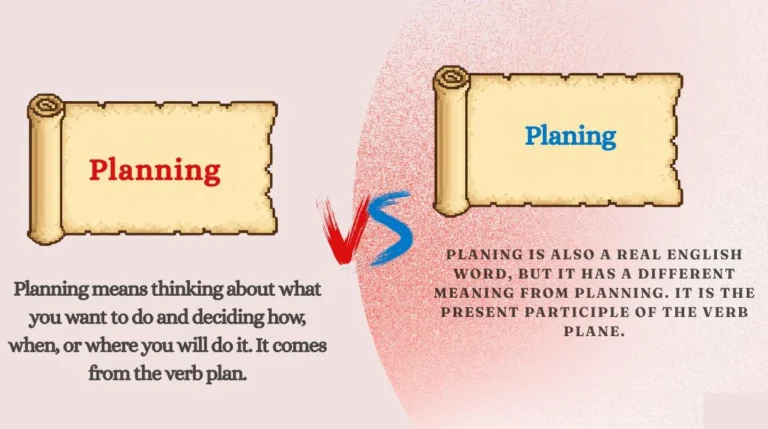
Planning means thinking about what you want to do and deciding how, when, or where you will do it. It comes from the verb plan.
For example, when you decide where to go on vacation, what time to leave, what to take, and where to stay, you are planning a trip. Cambridge defines planning as the act of deciding how to do something, while Oxford describes it as the act or process of making plans for something.
When Do We Use “Planning”?
We use planning when talking about preparing for something that may happen in the future. It can describe a small personal decision or a large organized project.
You can talk about:
- planning a trip
- planning a party
- planning a wedding
- planning a meeting
- planning a lesson
- planning a business
- planning your future
- planning a project
- planning a schedule
- planning a vacation
It is also common in phrases such as careful planning, detailed planning, financial planning, strategic planning, event planning, and career planning.
Grammar Rule for “Planning”
The base verb is:
plan
When we add -ing, we do not write:
plan + ing = planing ❌
Instead, we double the final n:
plan + n + ing = planning ✅
The verb plan has one syllable and ends in a consonant-vowel-consonant pattern: p-l-a-n. In this common spelling pattern, the final consonant is doubled before -ing.
The same pattern can be seen in:
- run → running
- sit → sitting
- stop → stopping
- get → getting
- begin → beginning
For plan, the correct form is always planning when you are using the verb in its -ing form.
Examples of “Planning”
- I am planning a trip for next month.
- She is planning her birthday party.
- We are planning to move to a new house.
- They spent weeks planning the event.
- He is planning what to do after college.
- Good planning can save time and money.
- My family is planning a vacation.
- The teacher is planning tomorrow’s lesson.
Common Learner Confusion
The most common mistake is thinking that planing is simply the shorter spelling of planning. It is not.
The word planning has two n letters before ing:
planning ✅
When you are talking about making arrangements or deciding what to do, this is the spelling you need.
For example:
I am planning my weekend. ✅
Not:
I am planing my weekend. ❌
So whenever the meaning is related to making arrangements, organizing, preparing, or thinking ahead, choose planning.
What Does “Planing” Mean?
Planing is also a real English word, but it has a different meaning from planning. It is the present participle of the verb plane.
One meaning of plane is to remove thin pieces of wood from a surface with a special tool so that the surface becomes smooth. Cambridge lists planing as the present participle of plane.
This word is mostly used in woodworking, carpentry, and other technical contexts. It is much less common in ordinary daily conversations than planning.
When Do We Use “Planing”?
Use planing when talking about the action of using a plane or planer to smooth, level, or shape wood.
For example, a carpenter may say:
I am planing the edge of this wooden board.
Here, planing has nothing to do with making a future arrangement. The person is physically working on wood.
The word can also appear in technical descriptions related to movement over water, especially when a boat moves quickly across the surface. However, this use is more specialized, so beginner English learners are much more likely to need planning in everyday writing.
Grammar Rule for “Planing”
The spelling comes from the verb plane:
plane + ing → planing
Because the verb ends with a silent e, that e is removed before -ing:
plane → planing
This is similar to other verbs such as:
- make → making
- write → writing
- drive → driving
- use → using
So the spelling is not related to the verb plan.
Examples of “Planing”
- The carpenter is planing the wooden door.
- He spent the morning planing a piece of oak.
- The board needs more planing before it can be painted.
- She is planing the rough surface of the table.
- The worker was planing the edge of the cabinet door.
- Planing the wood made the surface much smoother.
- The carpenter checked the board after planing it.
- This machine is designed for planing wooden surfaces.
Common Learner Confusion
Learners sometimes see planing and assume it is an incorrect spelling of planning. In everyday English, that is usually true when the intended meaning is “making arrangements.”
However, planing is not always a spelling mistake.
Compare:
We are planning a party.
This means we are organizing the party.
The carpenter is planing the table.
This means the carpenter is smoothing the table with a tool.
The difference is only one letter, but the meaning is completely different.
Difference Between Planning and Planing
The easiest way to understand planning vs. planing is to focus on the base verb.
Planning comes from plan.
Planing comes from plane.
That is the main difference.
| Word | Base Verb | Meaning | Common Use |
|---|---|---|---|
| Planning | plan | Making arrangements or deciding what to do | Everyday English, school, travel, work, business |
| Planing | plane | Smoothing or shaping wood with a tool | Carpentry, woodworking, technical writing |
Usage Difference
Planning is used when your mind is focused on the future. You are deciding what should happen and preparing for it.
For example:
We are planning our summer vacation.
You are deciding where to go, what to do, and how to organize the trip.
Planing, on the other hand, is a physical action involving a material, usually wood.
For example:
The carpenter is planing the wooden board.
The person is changing the surface of the board.
Grammar Logic
The spelling becomes much easier when you look at the original verb.
Plan → planning
The final n is doubled.
Plane → planing
The final e is dropped.
This means you should not memorize the two words as random spellings. Instead, remember their base verbs:
plan → planning
plane → planing
That one connection can prevent most spelling mistakes.
Sentence Structure Difference
Planning can be used as a verb in continuous tenses:
I am planning a meeting.
It can also work as a noun:
The planning took two weeks.
Oxford and Cambridge both recognize planning as a noun referring to the process of making plans.
Planing is mainly used as the -ing form of plane:
He is planing the wood.
The object after planing is often something that is being smoothed or shaped, such as wood, a board, a door, or a surface.
Meaning Comparison
Think of the words this way:
Planning = preparing with your mind.
Planing = smoothing with a tool.
For example:
I am planning a new kitchen.
You are deciding what the kitchen should look like.
He is planing a wooden cabinet door.
He is physically smoothing the wood.
That is the clearest difference.
Grammar Rules You Must Remember
Rule 1: Use “Planning” as the -ing Form of “Plan”
When plan becomes an -ing verb, double the final n.
plan → planning
Example:
She is planning her next lesson.
Do not remove the extra n:
She is planing her next lesson. ❌
Rule 2: Use “Planing” as the -ing Form of “Plane”
When plane becomes an -ing form, remove the final silent e.
plane → planing
Example:
The carpenter is planing the wood.
Here, the word is correct because the base verb is plane, not plan.
Rule 3: Think About the Meaning Before Spelling the Word
Ask yourself one simple question:
“Am I making arrangements, or am I smoothing something?”
If you are making arrangements, use planning.
We are planning a meeting. ✅
If you are smoothing or shaping wood, planing may be correct.
He is planing the board. ✅
This meaning-first method is very useful for learners.
Rule 4: Do Not Confuse “Planning” with “Planing”
The missing n is not a small grammar detail that you can ignore. It changes the word.
Planning = making arrangements.
Planing = smoothing a surface, especially wood, with a plane.
Pronunciation also helps. Planning is pronounced roughly like PLAN-ing, while planing starts with the long a sound of plane. Cambridge gives the pronunciation of planning as /ˈplænɪŋ/ and planing as /ˈpleɪnɪŋ/.
Common Mistakes Students Make
Mistake 1: Writing “Planing” for Everyday Arrangements
This is by far the most common mistake.
Wrong: I am planing my vacation.
Correct: I am planning my vacation.
The learner usually knows the meaning but forgets the consonant-doubling rule.
Mistake 2: Thinking “Planing” Is Always Wrong
This is the opposite mistake.
Planing is a valid English word when it comes from plane.
Correct: The carpenter is planing the door.
So do not automatically call the word wrong. Check the meaning first.
Mistake 3: Using “Planning” for Woodworking
Sometimes learners know that “planning” is the common spelling and use it everywhere.
Wrong: The carpenter is planning the rough board.
Correct: The carpenter is planing the rough board.
The correct word here comes from plane.
Mistake 4: Forgetting the Double Consonant in Other Words
The problem is not limited to plan. English has many verbs that double a final consonant before -ing.
For example:
run → running
sit → sitting
stop → stopping
get → getting
Learning this wider pattern will help you spell planning correctly without having to stop and think every time.
Easy Correction Tip
Whenever you write planing, pause for a second and ask:
“Do I mean plan or plane?”
If you mean plan, add the second n:
planning
If you mean plane, keep the spelling:
planing
That tiny question can save you from many mistakes.
Easy Trick to Remember the Difference
Here is a simple memory trick that works well for beginners:
Planning has two N’s because you are making a “new” plan.
Think:
PLAN + N + ING = PLANNING
The extra N can remind you that you are preparing a new idea, schedule, trip, meeting, or activity.
For planing, remember the word plane.
A plane is a tool used to smooth wood. So:
PLANE → PLANING
Look at the spelling:
plane loses the final e and becomes planing.
You can also remember the meaning with two simple sentences:
I am planning my future.
I am planing the wood.
One is about ideas and arrangements. The other is about wood and tools.
Another helpful trick is to connect planning with common everyday words such as:
planning a trip
planning a party
planning a meeting
planning a lesson
These phrases are so common that after seeing them many times, the double n will begin to feel natural.
Daily Life Examples
Here are some simple examples showing how native and fluent speakers normally use planning in everyday situations.
1. Talking About a Trip
A: Are you doing anything this weekend?
B: Yes, I’m planning a short trip with my family.
2. Talking About Dinner
A: What are you having for dinner?
B: I’m planning to make chicken and rice.
3. Talking About a Party
A: When is your birthday party?
B: It’s next Saturday. We’re still planning everything.
4. Talking About School
A: What are you doing after graduation?
B: I’m planning to study business.
5. Talking About Work
A: Why are you so busy today?
B: I’m planning next week’s meetings.
6. Talking About a Vacation
A: Have you booked your hotel yet?
B: Not yet. We’re still planning the vacation.
7. Talking About a Family Event
A: Are you having a family dinner this month?
B: Yes. My sister is planning it.
8. Talking About a New Project
A: When will the project start?
B: We are planning to start it in October.
9. A Woodworking Example
A: What is your brother doing in the workshop?
B: He is planing a wooden board.
Notice that this last example uses planing because the person is working with wood.
10. Talking About the Future
A: Do you have any plans for next year?
B: Yes, I’m planning to learn another language.
These examples show why planning is much more common in normal conversation. The word appears whenever people talk about future arrangements, goals, schedules, and preparation.
Practice Section
Choose the correct word: planning or planing.
1. We are ________ a surprise party for our mother.
2. The carpenter is ________ the rough piece of wood.
3. She is ________ a trip to Turkey next summer.
4. He spent the afternoon ________ the wooden door.
5. They are ________ their wedding for December.
Answers
1. planning
We are planning a surprise party.
2. planing
The carpenter is planing the wood.
3. planning
She is planning a trip.
4. planing
He is planing the wooden door.
5. planning
They are planning their wedding.
The pattern should now be clear: future arrangements use planning, while woodworking can use planing.
FAQs
What is the difference between planning and planing?
Planning is the -ing form of plan and means making arrangements or deciding what to do. Planing is the -ing form of plane and usually refers to smoothing wood with a special tool. The two words have different meanings and different base verbs.
Is “planning” the correct spelling of plan + ing?
Yes. The correct spelling is planning with two n letters. The verb plan changes to planning when -ing is added. The final consonant is doubled in this spelling pattern.
Is “planing” a real word?
Yes. Planing is a real English word. It is the present participle of plane, which can mean using a tool to remove thin pieces from wood and make the surface smooth.
Can I use “planing” when talking about future plans?
Usually, no. When you mean organizing or preparing for something, use planning. For example, write “We are planning a vacation,” not “We are planing a vacation.”
Is “planning” formal or informal?
Planning is completely normal in both formal and informal English. You can use it in school assignments, business writing, emails, conversations, reports, and everyday speech. It is a common English word.
Why does plan become planning with two n’s?
English spelling often doubles a final consonant when certain short verbs take -ing. Since plan fits this pattern, the final n is doubled: plan → planning. Similar examples include run → running and sit → sitting.
Conclusion
The difference between planning and planing is simple once you connect each word to its base verb.
Planning comes from plan and means making arrangements, preparing for the future, or deciding what you are going to do. This is the word you will use in everyday situations such as planning a trip, planning a party, planning a meeting, or planning your future.
Planing comes from plane. It is mainly used when talking about smoothing or shaping wood with a special tool.
So, before choosing a spelling, think about the meaning. Are you making arrangements? Write planning. Are you smoothing wood? Planing may be the correct word.
The easiest pair to remember is:
plan → planning
plane → planing
Keep using these words in your own sentences. A little practice will make the spelling feel natural, and you will no longer have to guess which form is correct.

Evan Rellmont is a writer who turns thoughtful ideas into meaningful words, creating stories and reflections that connect, inspire, and leave a lasting impression.