
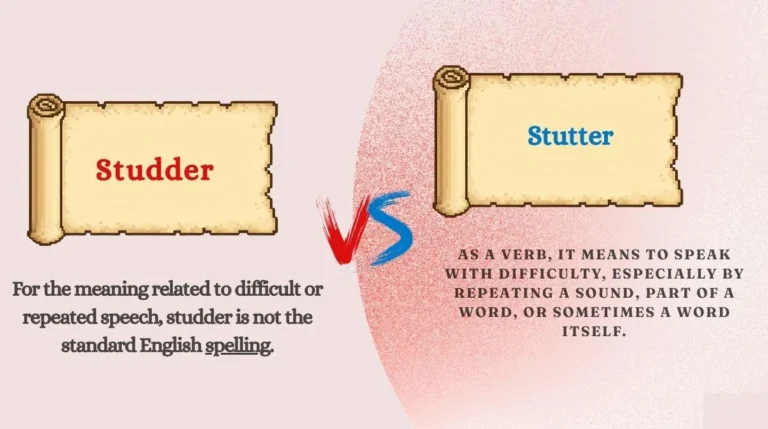
Have you ever written a word the way it sounds, only to wonder later whether the spelling is correct? Studder or stutter is one of those confusing word pairs.
Many English learners write “studder” because the middle sound can sometimes sound a little like a d when people speak quickly. But when it comes to standard English spelling, there is an important difference.
The correct spelling is stutter.
The word stutter is used when someone has difficulty speaking smoothly.
A person may repeat a sound or part of a word, pause while trying to speak, or struggle to get a word out. It can also be used as a verb, as in “He began to stutter,” or as a noun, as in “She has a slight stutter.” Major learner dictionaries such as Oxford and Cambridge list stutter as the standard word.
Studder, on the other hand, is generally a misspelling of stutter when someone is talking about speech.
It may appear in casual writing, online posts, or because a writer is spelling the word from memory, but it is not the standard spelling for this meaning.
By the end of this guide, you will know which spelling is correct, how to use the word in sentences, why people confuse the two forms, and how to remember the right spelling every time.
What Does “Studder” Mean?
For the meaning related to difficult or repeated speech, studder is not the standard English spelling. When a person wants to describe speech that is interrupted by repeated sounds or pauses, the correct word is stutter.
This is why you should not use “studder” in school assignments, professional writing, emails, articles, or other standard English communication.
The confusion usually happens because English spelling does not always perfectly match pronunciation. When people hear stutter, especially in fast or casual American speech, the middle t can sound softer and somewhat like a quick d-like sound. This can make learners think the word is spelled with d instead of t. In American English, a quick “flap” can make a t between vowel sounds sound similar to a light d.
So, if you are thinking about the speech problem or the act of speaking with repeated sounds, do not choose studder.
Common incorrect uses of “Studder”
Because studder is a spelling mistake for this meaning, the best way to understand it is to see the incorrect form beside the correct one.
- ❌ He started to studder during the interview.
✅ He started to stutter during the interview. - ❌ I sometimes studder when I am nervous.
✅ I sometimes stutter when I am nervous. - ❌ She has a small studder.
✅ She has a small stutter. - ❌ Why do you studder when you speak in public?
✅ Why do you stutter when you speak in public? - ❌ The child began to studder after becoming upset.
✅ The child began to stutter after becoming upset. - ❌ He was embarrassed because he studdered.
✅ He was embarrassed because he stuttered. - ❌ She does not studder when she talks to her friends.
✅ She does not stutter when she talks to her friends. - ❌ His studder became less noticeable with time.
✅ His stutter became less noticeable with time.
These examples show an important point: changing the u to d does not create a different standard English word. It simply creates a misspelling of the word you actually need.
Why do learners write “studder”?
There are a few simple reasons.
First, learners often spell words according to what they hear. This is a normal part of learning English. If the t sounds like a quick d in someone’s accent, “studder” may seem logical.
Second, English has many words in which t can sound different in natural speech. Words such as water, better, and little can have a soft middle sound in many American accents. This can make spelling from pronunciation difficult.
Third, people may see the incorrect form online and remember it visually. Once a spelling mistake appears several times, it can start to look correct.
The easiest solution is to remember the standard spelling: stutter.
What Does “Stutter” Mean?
Stutter is the correct standard English word for this topic.
As a verb, it means to speak with difficulty, especially by repeating a sound, part of a word, or sometimes a word itself. Cambridge describes it as speaking or saying something with difficulty, including pausing or repeating part of a word. Oxford also lists stutter as a verb and gives stammer as a synonym.
As a noun, stutter refers to the speech difficulty itself.
Grammar forms of “stutter”
The word can be used in several common grammatical forms:
- stutter — base form
- stutters — third-person singular present
- stuttered — past tense
- stuttering — present participle or gerund
- stutterer — a person who stutters
Oxford gives the forms stutter, stutters, stuttered, and stuttering.
Example sentences with “stutter”
- I sometimes stutter when I am under pressure.
- He began to stutter when the teacher asked him a difficult question.
- She stuttered as she tried to explain what had happened.
- The boy does not usually stutter when he talks to his family.
- He has a slight stutter, but he speaks very clearly.
- She was nervous and started stuttering during her presentation.
- Please be patient if someone stutters while speaking.
- The actor played a character who stutters.
These sentences show that stutter can describe the action of speaking with difficulty as well as the speech pattern itself.
“Stutter” can also describe a machine
There is another useful meaning that learners sometimes miss. Stutter can also describe a vehicle, engine, machine, or process that does not work smoothly. Cambridge explains that the verb can describe something that works or happens in an irregular or non-smooth way. Oxford gives the example of a car that “stuttered along.”
For example:
- The old engine started to stutter.
- The car stuttered and then stopped.
- The video began to stutter because of the slow connection.
- The computer game stuttered during a busy scene.
This second meaning has nothing to do with the spelling studder. The correct spelling is still stutter.
Difference Between Studder and Stutter
The difference is actually much simpler than it first appears.
Stutter is the standard spelling.
Studder is a common misspelling when people mean stutter.
| Word | Standard spelling? | Meaning | Part of speech | Example |
|---|---|---|---|---|
| stutter | ✅ Yes | To speak with repeated sounds or pauses | Verb | He began to stutter. |
| stutter | ✅ Yes | A speech difficulty | Noun | She has a stutter. |
| studder | ❌ No, for this meaning | Usually a misspelling of stutter | — | Use stutter, not studder. |
Usage difference
There is no normal meaning-based difference between studder and stutter in standard English. You do not choose one for formal speech and another for informal speech.
The correct choice is stutter.
That means these sentences are not two different ways to say the same thing:
- ❌ He began to studder.
- ✅ He began to stutter.
Only the second sentence uses the standard spelling.
Grammar logic
The word stutter can be both a noun and a verb.
As a verb:
Subject + stutter
- He stutters when he is nervous.
- She stuttered during the interview.
You can also use it with reported speech:
Subject + stuttered + speech
- “I-I-I don’t know,” he stuttered.
As a noun:
have + a stutter
- He has a stutter.
- She developed a slight stutter.
This difference is useful because learners sometimes know the verb but forget the noun form.
Sentence-structure difference
When stutter is used as a verb, it tells us what the person does.
He stutters when he is tired.
Here, stutters is the verb.
When it is used as a noun, it names the speech difficulty.
He has a stutter.
Here, stutter is a noun.
The spelling remains stutter in both cases.
Meaning comparison
Think of it this way:
stutter = the correct English word
studder = a spelling error when the writer means stutter
This is an easy distinction because you do not need to memorize two meanings. You only need to remember which spelling belongs to standard English.
Grammar Rules You Must Remember
Rule 1: Use “stutter,” not “studder,” for difficult or repeated speech.
This is the main rule.
Whenever you are talking about repeated sounds, pauses, or difficulty speaking smoothly, write stutter.
Correct:
He may stutter when he feels nervous.
Incorrect:
He may studder when he feels nervous.
Dictionary entries from Oxford and Cambridge use stutter for this meaning.
Rule 2: “Stutter” can be a verb.
As a verb, it describes the action of speaking with difficulty.
Examples:
- I stutter sometimes.
- He stutters when he is anxious.
- She stuttered during her speech.
- They were stuttering over their words.
Notice the normal verb endings:
stutter → stutters → stuttered → stuttering
Do not change the middle tt to dd.
Rule 3: “Stutter” can be a noun.
As a noun, it describes the speech difficulty.
Common patterns include:
have + a stutter
- He has a stutter.
- She has a slight stutter.
- The child has had a stutter for some time.
You can also use adjectives before the noun:
- a slight stutter
- a noticeable stutter
- a severe stutter
Oxford lists stutter as a singular noun meaning a speech problem involving repeated sounds.
Rule 4: Pronunciation does not always tell you the spelling.
This is perhaps the most useful lesson for English learners.
A sound may be produced differently in natural speech depending on accent, speed, and stress. In many American accents, the t in certain positions can become a quick flap that sounds somewhat like d. That does not mean the spelling has changed.
So do not spell the word as studder simply because it may sound that way to your ears.
Remember the written form:
STUTTER
Common Mistakes Students Make
Mistake 1: Spelling from sound
A learner may hear:
“studder”
and write:
studder
But the standard spelling is:
stutter
English has many examples where pronunciation can mislead learners. This is one reason reading and spelling practice are so important.
Mistake 2: Thinking “studder” is the informal form
Some learners believe stutter is formal and studder is casual.
That is not the correct distinction.
There is no standard rule saying that studder is the informal version. For the speech-related meaning, use stutter in both casual and formal English.
Casual:
I sometimes stutter when I am nervous.
Formal:
He explained that he may stutter during public speaking.
The spelling stays the same.
Mistake 3: Using the wrong noun form
Some students write:
❌ He has studder.
Even apart from spelling, the sentence needs the correct noun structure:
✅ He has a stutter.
Another correct option is:
✅ He sometimes stutters.
The first uses stutter as a noun. The second uses it as a verb.
Mistake 4: Changing “stuttered” to “studdered”
Because students think the base word is studder, they may write:
❌ He studdered when he answered.
The correct form is:
✅ He stuttered when he answered.
The base word is stutter, so the past tense is stuttered.
Mistake 5: Assuming spelling changes between British and American English
The spelling does not become studder in American English.
Oxford and Cambridge both list stutter as the English word, with pronunciation information for British and American varieties.
British English also commonly uses stammer for this speech difficulty, but stutter is still a standard word.
Easy Trick to Remember the Difference
Here is a simple memory trick:
STUTTER has two T’s — the correct word starts with “stut.”
Think:
STUT + TER = STUTTER
Not:
STUD + DER = STUDDER
You can connect the double T with the idea of speech that may stop, repeat, or struggle.
Another useful trick is to remember this sentence:
“I stutter with T, not D.”
Say it to yourself when you are writing.
You can also connect it with other familiar words that contain tt:
- better
- letter
- little
- matter
- butter
- stutter
This does not mean all these words have the same spelling pattern for every sound. It simply helps your eyes remember the double t.
A pronunciation trick
Say the word slowly:
STUT — TER
Do not try to spell the word from the way it may sound in fast conversation.
When you slow it down, the t becomes easier to notice. After that, write:
stutter
This is especially useful for students who learn new vocabulary mainly by listening.
Daily Life Examples
Here are some easy examples you may hear or use in everyday English.
Example 1: At school
Teacher: Why are you so quiet today?
Student: I get nervous when I speak in front of the class, and I sometimes stutter.
Example 2: Talking to a friend
Ali: You seemed nervous during the meeting.
Sam: I was. I started to stutter when everyone looked at me.
Example 3: Helping someone feel comfortable
Friend: Sorry, I cannot get the words out.
You: Take your time. You do not need to hurry.
Example 4: Describing a person
She has a slight stutter, but she communicates very clearly.
This sentence uses stutter as a noun.
Example 5: Using the verb
He sometimes stutters when he has to answer a difficult question quickly.
Here, stutters is the verb.
Example 6: Talking about the past
I stuttered during my first job interview because I was extremely nervous.
Here, stuttered is the past-tense form.
Example 7: A presentation
She was confident during the presentation, although she started stuttering during the question-and-answer session.
The -ing form is stuttering.
Example 8: A machine
The engine began to stutter, so the driver pulled the car over.
Here, stutter has the non-speech meaning of something working irregularly.
Example 9: A video game
The game keeps stuttering because the computer is having trouble handling the graphics.
Again, the word means that the action is not smooth.
Example 10: Asking a question
Do you sometimes stutter when you are speaking to strangers?
Notice the grammar:
Do + subject + base verb
So we say:
✅ Do you stutter…?
Not:
❌ Do you stutters…?
This example also shows that the correct spelling remains stutter in questions.
Practice Section
Choose the correct option in each sentence.
1. He began to ______ when he became nervous.
A) studder
B) stutter
2. She has a slight ______.
A) studder
B) stutter
3. I sometimes ______ during important meetings.
A) stutter
B) studder
4. He ______ when the interviewer asked an unexpected question.
A) studdered
B) stuttered
5. Does she ______ when she is tired?
A) stutters
B) stutter
Answers
1. B — stutter
The correct verb is stutter.
2. B — stutter
Here, stutter is a noun: have a stutter.
3. A — stutter
After I, use the base form stutter.
4. B — stuttered
The past-tense form comes from stutter.
5. B — stutter
After does, use the base verb: Does she stutter?
If you got all five right, you have understood the main spelling and grammar rule.
FAQs
What is the difference between studder and stutter?
Stutter is the standard English spelling. It can be a verb meaning to speak with difficulty or a noun meaning a speech difficulty. Studder is generally a misspelling of stutter when this is the intended meaning.
Can we use “studder” in questions?
No, not for standard English writing. Use stutter instead.
For example, say: “Do you stutter when you are nervous?”
After do or does, remember to use the base verb stutter.
Is “stutter” a formal or informal word?
Stutter is a standard English word that can be used in both everyday and formal communication. It appears in major English learner dictionaries and can be used as either a noun or a verb.
Is “studder” ever correct?
For the speech-related meaning discussed here, studder is not the standard spelling. It can appear as a misspelling, and it may also occur in unrelated uses such as a name, but it should not replace stutter in normal English writing.
Why does stutter sometimes sound like “studder”?
In some varieties of American English, especially in natural speech, a t can be pronounced as a quick flap that sounds somewhat like a soft d. This is a pronunciation feature, not a spelling change. The word is still written stutter.
Is “stammer” the same as “stutter”?
Stammer and stutter can refer to the same general kind of speech difficulty. Oxford lists stammer as a synonym of stutter in its verb entry. British English uses stammer quite commonly, while stutter is also a standard word.
Conclusion
When you are choosing between studder or stutter, the answer is simple: stutter is the correct standard spelling for this meaning.
Use stutter as a verb when you want to describe difficult, repeated, or interrupted speech: “He may stutter when he is nervous.” Use stutter as a noun when you are talking about the speech difficulty itself: “She has a slight stutter.”
The spelling studder is a common mistake, often caused by pronunciation. In some accents, especially in fast American English, the middle t can sound softer and may seem similar to a d. But pronunciation does not change the spelling.
A good way to remember the word is to focus on the two T’s: STUTTER.
Once you see the word several times and use it in your own sentences, the correct spelling will become natural. Keep practicing, keep reading, and do not worry when English spelling feels confusing. Every difficult word becomes easier with a little practice.
Meta Description
Studder or stutter? Learn the correct spelling, meaning, grammar rules, examples, common mistakes, and easy ways to remember stutter in 2026.

Evan Rellmont is a writer who turns thoughtful ideas into meaningful words, creating stories and reflections that connect, inspire, and leave a lasting impression.