
English has many words that look almost the same but do very different jobs. Insure and ensure are a good example.
They are only one letter apart, and both can sound similar, so learners often mix them up when writing.
The confusion becomes stronger because both words can be linked to the idea of protection or certainty. However, in standard everyday English, they usually have different meanings.
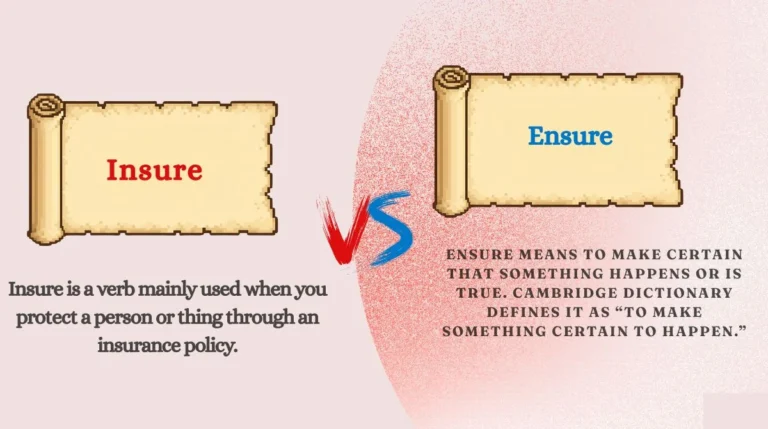
Insure is mainly connected with insurance and protection against financial loss or damage. Ensure means to make certain that something happens or is true.
This difference matters in emails, school assignments, reports, instructions, and everyday conversation. For example, you might insure your car, but you ensure that your car is locked.
You can insure your home against fire, but you ensure that everyone leaves the building safely.
The good news is that you do not need a complicated rule. Ask one simple question: Am I talking about insurance, or am I talking about making something certain? That question will usually give you the answer.
By the end, you will understand the meanings, grammar patterns, common mistakes, memory tricks, and everyday uses of both words.
What Does “Insure” Mean?
Insure is a verb mainly used when you protect a person or thing through an insurance policy. Insurance involves paying an insurance company for financial protection if a covered accident, loss, theft, or damage happens. Cambridge Dictionary defines insure in this insurance sense as protecting against risk and also as providing insurance for someone or something.
Think about a car. You cannot control every accident on the road, but you can buy car insurance to protect yourself from certain costs. In that situation, you insure the car.
When to use “insure”
Use insure when the sentence involves insurance, a policy, risk, damage, theft, loss, or financial protection.
Common structures are:
- insure + object
- insure + object + against + risk
- insure + object + for + amount
- be insured
For example, Cambridge gives the pattern insure something for something for agreeing on an insured value.
Grammar rule for “insure”
Use insure + person/thing:
We insured our new car.
Use insure + object + against + risk:
They insured the house against fire.
Use insure + object + for + amount:
The painting was insured for $50,000.
Examples of “insure”
- We decided to insure our new car.
- You should insure your home against fire and theft.
- The shop owner insured the expensive equipment.
- They insured the painting for $100,000.
- I need to insure my bicycle against theft.
- The company refused to insure his old car.
- Our household goods are insured against accidental damage.
- She wants to insure the package before sending it.
The common idea is always insurance protection.
Common learner confusion
A student may write:
Please insure that the door is locked.
But if the meaning is “make sure,” ensure is the natural choice in standard English:
Please ensure that the door is locked.
One extra point is useful for advanced learners: Cambridge records an American-English use of insure meaning “make certain.” Even so, using insure = insurance is the clearest habit for learners, especially in international or formal writing.
What Does “Ensure” Mean?
Ensure means to make certain that something happens or is true. Cambridge Dictionary defines it as “to make something certain to happen.”
For example:
Please ensure that all students are seated.
This means “make certain that all students are seated.” There is no insurance company involved.
When to use “ensure”
Use ensure when you want to make something certain, prevent a problem, check that a condition is met, or help a result happen.
It is common in workplaces, schools, instructions, notices, and formal writing.
Common structures are:
- ensure + noun
- ensure + that + clause
- ensure + object + result
Examples:
The rules ensure safety.
Please ensure that everyone signs in.
The plan ensured a smooth event.
Grammar rule for “ensure”
A very common pattern is:
ensure + that + subject + verb
Examples:
Please ensure that the door is locked.
We must ensure that the information is correct.
You can also use a noun after ensure:
Good planning ensures better communication.
Cambridge also records structures where ensure helps secure a particular result for someone.
Examples of “ensure”
- Please ensure that the window is closed.
- We checked the list to ensure that no name was missing.
- Good planning can ensure a smooth meeting.
- The teacher spoke slowly to ensure understanding.
- Please ensure that you have your passport.
- The company added checks to ensure safety.
- I set an alarm to ensure that I wake up on time.
- The manager called the supplier to ensure delivery.
The common idea is always certainty or making sure.
Common learner confusion
Students sometimes think ensure is simply another spelling of insure. It is not simply a spelling variation in ordinary British English.
Compare:
We insured the house.
This means we arranged insurance for the house.
We ensured the house was locked.
This means we made certain that the house was locked.
You can insure a house and ensure that it is secure. The object may be the same, but the action and meaning are different.
Difference Between Insure and Ensure
The easiest distinction is:
Insure = protect through insurance.
Ensure = make certain.
Comparison Table
| Feature | Insure | Ensure |
|---|---|---|
| Main meaning | Protect with insurance | Make something certain |
| Main idea | Risk and financial protection | Certainty or prevention |
| Common context | Cars, homes, property, policies | Safety, accuracy, results, instructions |
| Common structure | insure against a risk | ensure that something happens |
| Example | We insured the house against fire. | We ensured that the house was locked. |
Usage difference
Use insure because there is an insurance arrangement.
We insured the car against theft.
Use ensure because you want to make certain of a result.
We ensured that the car was locked.
Both sentences involve the same car and possible theft, but the actions are different. The first concerns financial protection. The second concerns a practical step to prevent a problem.
Grammar logic
Both words are verbs, so both can appear in different tenses:
insure → insured → insuring
ensure → ensured → ensuring
The tense is not the main issue. The meaning is.
Words such as policy, premium, claim, coverage, theft, damage, and loss often point to insure.
Words such as safety, accuracy, delivery, quality, result, and that often point to ensure.
Sentence structure difference
Insure + object + against + risk
They insured the building against fire.
Insure + object + for + amount
He insured the watch for $20,000.
Ensure + that + clause
Please ensure that the building is empty.
Ensure + noun
The new system will ensure safety.
Do not use ensure when you mean buying insurance, and do not normally use insure when you simply mean “make sure,” especially in British English.
Meaning comparison
Imagine three situations.
You buy insurance for your phone: you insure the phone.
You check that the phone is safely packed before a trip: you ensure that the phone is protected.
You buy insurance for your business: you insure the business.
You create rules so workers follow safety procedures: you ensure safety.
The words may appear in similar situations, but their meanings remain separate.
Grammar Rules You Must Remember
Rule 1: Use “insure” for insurance
When the idea involves an insurance company or protection against a covered loss, use insure.
Example:
We insured our house against flooding.
Rule 2: Use “ensure” for “make certain”
When you mean “make sure,” use ensure.
Example:
Please ensure that you lock the door.
A useful test is: Can I replace it with “make sure”? If yes, ensure is usually right.
Rule 3: “Insure” often works with “against” or “for”
Use these common patterns:
They insured the car against theft.
The collector insured the painting for $500,000.
Rule 4: “Ensure that” is very common
Use ensure that + clause when you want to say that someone makes certain something happens or is true.
The nurse checked the records to ensure that the correct information was entered.
Ensure that all forms are signed.
Common Mistakes Students Make
The words are confusing because they look similar, can sound similar, and can both appear in sentences about protection. A meaning check is more useful than guessing from spelling.
Mistake 1: “Insure” instead of “ensure”
Wrong:
Please insure that the report is complete.
Correct:
Please ensure that the report is complete.
Why? The writer means “make certain.”
Mistake 2: “Ensure” for an insurance policy
Wrong:
We ensured our house against fire.
Correct:
We insured our house against fire.
Why? The sentence is about insurance protection against a risk.
Mistake 3: Choosing only by spelling
Some students remember that ensure contains “sure” and stop there. That clue is useful, but the whole meaning still matters.
A better memory pair is:
insure → insurance
ensure → make sure
Mistake 4: Mixing the prepositions
We insured the car against theft.
We ensured that the car was locked.
The first describes insurance. The second describes certainty.
Mistake 5: Thinking they are always interchangeable
American English sometimes uses insure with the meaning “make certain,” and dictionaries record that usage. For learners, the clearest rule is still:
insure = insurance
ensure = make certain
Easy Trick to Remember the Difference
Use two simple memory links.
INSURE → INSURANCE
When you see insure, think about an insurance policy.
Car + insurance company + protection from loss = INSURE
I insured my car.
ENSURE → SURE
Ensure contains sure, so connect it with:
ensure = make sure
Please ensure that the door is locked.
You can mentally replace the sentence with:
Please make sure that the door is locked.
The two-question trick
Ask yourself:
Am I talking about insurance?
Yes → insure
Am I talking about making something certain?
Yes → ensure
Try these:
We ___ the shop against theft.
Answer: insured
Please ___ that the lights are off.
Answer: ensure
This little test is quick enough to use while writing an email or doing a grammar exercise.
Daily Life Examples
1. Car
A: Did you buy insurance for your new car?
B: Yes. I insured it yesterday.
2. Door
A: Are you ready to leave?
B: Almost. I need to ensure that the back door is locked.
3. House
A: Is the house covered against fire?
B: Yes, we insured the house against fire last year.
4. School
Teacher: Please ensure that your name is written on the paper.
The teacher means “make sure.”
5. Package
A: This package contains an expensive camera.
B: Then we should insure the package before sending it.
6. Meeting
Manager: Why did you call the supplier?
Employee: I called to ensure that the order arrives on Friday.
7. Jewelry
My aunt insured her jewelry for a large amount.
The sentence is about an insured value.
8. Safety
The staff checked every exit to ensure the safety of the visitors.
The goal is to make safety certain, not to buy insurance.
9. Travel
A: Did you get travel insurance?
B: Yes, I insured the trip because the tickets were expensive.
The wording used by an insurance provider may vary, but the idea is insurance protection.
10. Homework
Mother: Did you check your answers?
Son: Yes. I checked them twice to ensure that there were no mistakes.
Practice Section
Choose insure or ensure.
1. Please ___ that all students bring their ID cards.
2. We decided to ___ the house against theft.
3. The manager called to ___ that the delivery was on time.
4. They want to ___ the expensive painting for $75,000.
5. Read the instructions carefully to ___ that you complete the form correctly.
Answers
1. ensure — It means “make sure.”
2. insure — The sentence is about insurance against theft.
3. ensure — The manager wants to make certain the delivery is on time.
4. insure — The painting is being protected through insurance.
5. ensure — It means “make certain.”
FAQs
What is the difference between insure and ensure?
Insure usually means to protect a person or thing through insurance. Ensure means to make certain that something happens or is true. “We insured the car” is about insurance, while “We ensured that the car was locked” is about making sure.
Can we use “ensure” in questions?
Yes. For example, “How can we ensure that everyone gets a seat?” means “How can we make sure that everyone gets a seat?” It is common in both formal questions and everyday language.
Is “insure” formal or informal?
Insure is a normal verb used in everyday and formal English when the meaning is related to insurance. You can use it for cars, homes, businesses, property, travel, and other insurance situations.
Is “ensure” the same as “make sure”?
They have very similar meanings when ensure means making something certain. “Please ensure that the door is locked” is close in meaning to “Please make sure that the door is locked.” Ensure can sound more formal.
Can “insure” mean “make certain”?
Yes, especially in American English. Cambridge records insure as a US use meaning “make certain,” alongside ensure. For learners, using insure for insurance and ensure for certainty is the simplest approach.
Which is correct: “insure that” or “ensure that”?
When you mean “make certain that,” ensure that is the standard choice for most international English writing. American English can use insure in this sense, but ensure removes the ambiguity.
Conclusion
The difference between insure and ensure becomes simple when you connect each word with one clear idea.
Insure is mainly about insurance. You insure a car, house, person, package, or valuable object when you arrange insurance protection against a possible loss or risk.
Ensure is about certainty. You ensure that something happens when you make sure it is done, correct, safe, or successful.
Remember these two clues:
INSURE → INSURANCE
ENSURE → MAKE SURE
For example, you can insure your car against theft, and you can ensure that your car is locked. The first is about financial protection; the second is about taking action to make something certain.
Do not worry if the words still feel similar at first. Use them in your own sentences with familiar situations such as driving, school, work, travel, and home safety. A little practice will make the difference feel natural and automatic.

Evan Rellmont is a writer who turns thoughtful ideas into meaningful words, creating stories and reflections that connect, inspire, and leave a lasting impression.