
Laying and lying are two words that confuse many English learners.
They look and sound similar, and both are often used when talking about something being placed or someone resting.
The problem becomes even bigger because the basic verbs lay and lie have different grammar rules and different past forms.
For example, you may want to say that you are resting on your bed. The correct sentence is:
“I am lying on my bed.”
You would use laying when you are putting something somewhere:
“I am laying the books on the table.”
That small difference is important in everyday English. You will hear these words at home, at school, at work, in conversations, and in writing.
There is another reason learners struggle with this pair: the verb lay changes to laid in the past, while lie changes to lay. This makes the whole topic seem more confusing than it really is.
The good news is that you do not need to memorize dozens of difficult rules. Once you understand whether there is a direct object after the verb, the difference becomes much easier.
By the end of this guide, you will know when to use laying and when to use lying, understand the grammar behind both words, avoid common mistakes, and use them naturally in everyday sentences.
What Does “Laying” Mean?
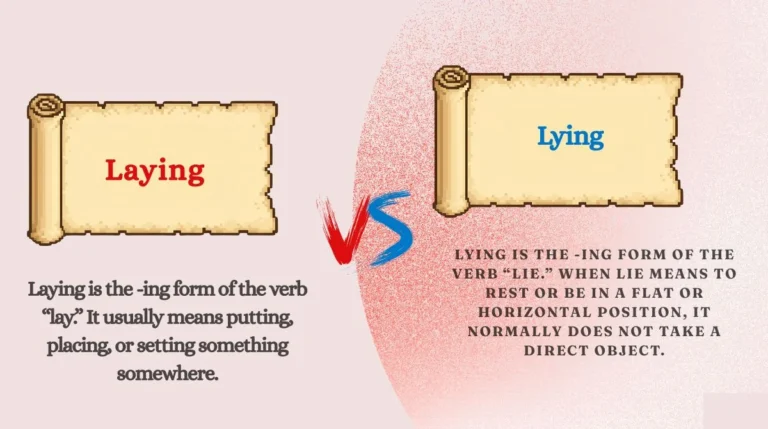
Laying is the -ing form of the verb “lay.” It usually means putting, placing, or setting something somewhere.
The most important grammar point is this:
Lay normally needs a direct object.
A direct object is the person or thing that receives the action.
For example:
“She is laying the baby on the bed.”
What is she laying?
She is laying the baby.
Another example:
“He is laying the papers on my desk.”
What is he laying?
He is laying the papers.
So, when someone is actively putting something in a particular place, laying is usually the correct word.
When Should You Use “Laying”?
Use laying when someone is:
- putting something down
- placing something somewhere
- arranging something in a position
- setting something on a surface
- producing or putting an egg somewhere
The exact meaning depends on the context, but the idea of placing something is the main one.
Grammar Rule for “Laying”
The basic structure is:
Subject + am/is/are + laying + object
Examples:
“I am laying the clothes on the bed.”
“She is laying the plates on the table.”
“They are laying new tiles in the kitchen.”
The object is very important in these sentences.
Examples of “Laying”
- I am laying the book on the table.
- She is laying the baby in his crib.
- He is laying the tools on the floor.
- We are laying the cards on the desk.
- The worker is laying bricks for the new wall.
- The hen is laying eggs every morning.
- They are laying a blanket over the grass.
- Mom is laying the plates on the dining table.
These examples show that laying describes an action being done to something.
Common Learner Confusion About “Laying”
A very common mistake is using laying when you want to say that a person is resting.
For example:
❌ “I am laying on the sofa.”
In standard English, this should be:
✅ “I am lying on the sofa.”
Why?
Because the person is not putting an object somewhere. The person is simply resting in a position.
Another common mistake is:
❌ “She is laying down.”
In careful standard English, when you mean that she is reclining or resting, use:
✅ “She is lying down.”
But when there is an object, laying works:
✅ “She is laying the baby down.”
That one extra word, the baby, changes the grammar.
What Does “Lying” Mean?
Lying is the -ing form of the verb “lie.” When lie means to rest or be in a flat or horizontal position, it normally does not take a direct object.
In simple words, lying usually means resting, reclining, or being in a particular position.
For example:
“I am lying on the bed.”
You are not placing anything. You are simply resting on the bed.
Another example:
“The dog is lying under the table.”
The dog is not putting something under the table. The dog is resting there.
When Should You Use “Lying”?
Use lying when someone or something is:
- resting
- reclining
- in a flat position
- staying in a particular place or position
- located somewhere without actively placing itself there
The verb can describe people, animals, and things.
Grammar Rule for “Lying”
The common structure is:
Subject + am/is/are + lying + place/position
Examples:
“I am lying on the bed.”
“She is lying on the floor.”
“The keys are lying beside the phone.”
Notice that these sentences do not have a direct object receiving the action.
Examples of “Lying”
- I am lying on the couch.
- She is lying in bed.
- The baby is lying on the blanket.
- The dog is lying under the chair.
- He was lying on the grass.
- My phone is lying beside my laptop.
- The books are lying on the floor.
- We were lying in the sun after lunch.
In each example, the subject is already in a position. The subject is not actively putting another object somewhere.
A Second Meaning of “Lying”
There is one more thing to remember. Lying can also be the -ing form of “lie” meaning to tell something that is not true.
For example:
“He is lying to his parents.”
Here, lying has nothing to do with resting on a bed or sofa.
It means not telling the truth.
The context tells you which meaning is intended.
For the main grammar difference between laying and lying, however, the important meaning is usually placing something versus resting.
Difference Between Laying and Lying
The easiest way to understand the difference is to focus on the action.
Laying means putting or placing something somewhere.
Lying means resting or being in a position.
Here is a simple comparison:
| Laying | Lying |
|---|---|
| Comes from lay | Comes from lie |
| Usually needs an object | Usually does not take a direct object |
| Means putting or placing something | Means resting or being in a position |
| Example: laying the book on the desk | Example: lying on the desk |
| Something receives the action | The subject is in a position |
| Present participle of lay | Present participle of lie |
Usage Difference
Compare these two sentences:
“I am laying the blanket on the bed.”
“I am lying on the bed.”
In the first sentence, I am doing something to the blanket. I am putting the blanket on the bed.
In the second sentence, I am simply resting on the bed.
This is the central difference.
Grammar Logic
Ask yourself:
“Am I putting something somewhere?”
If the answer is yes, use laying.
“Am I resting or already in a position?”
If the answer is yes, use lying.
For example:
“She is laying the clothes on the chair.”
She is putting the clothes there.
But:
“The clothes are lying on the chair.”
The clothes are already there.
This distinction is one of the best ways to understand these words without trying to memorize every sentence.
Sentence Structure Difference
The structure often looks like this:
Laying: Subject + is/am/are + laying + object + place
Example:
“He is laying the keys on the table.”
Lying: Subject + is/am/are + lying + place
Example:
“The keys are lying on the table.”
The first sentence focuses on the action of placing the keys.
The second sentence focuses on the position of the keys.
Meaning Comparison
Think of laying as an action that moves or places something.
Think of lying as a state or position.
A person can lay a towel on the beach.
Once the towel is there, the towel is lying on the sand.
For another example:
“The mother is laying the baby on the bed.”
After the mother puts the baby there:
“The baby is lying on the bed.”
The two words can even appear in the same situation, but they describe different parts of the action.
Grammar Rules You Must Remember
Rule #1: Use “Laying” When You Place Something
When the verb means putting or placing something, use laying.
“She is laying the plates on the table.”
The plates are the object.
You can ask, “What is she laying?”
Answer: the plates.
That tells you that laying is correct.
Rule #2: Use “Lying” When Someone or Something Is Resting
When the subject is already in a resting or flat position, use lying.
“The child is lying on the bed.”
The child is not placing another object. The child is simply resting.
Another example:
“My cat is lying near the window.”
The cat is in that position.
Rule #3: “Lay” and “Lie” Have Different Past Forms
This is where many learners get stuck.
The verb lay has these forms:
lay – laid – laid
The verb lie meaning “rest” has these forms:
lie – lay – lain
For example:
Present: I lie on the sofa.
Past: I lay on the sofa yesterday.
Past participle: I have lain on that sofa many times.
For lay:
Present: I lay the book on the desk.
Past: I laid the book on the desk.
Past participle: I have laid the book on the desk.
This is why lay can be especially confusing. It is both the present form of one verb and the past form of another.
Rule #4: Check Whether There Is an Object
This simple test can help you quickly.
Ask:
“What is being placed?”
If there is a clear object, laying may be right.
Example:
“He is laying the jacket on the chair.”
What is being placed?
The jacket.
Now compare:
“He is lying on the chair.”
What is he placing?
Nothing.
He is simply resting.
This object test is not a perfect answer for every advanced use of English, but it is an excellent rule for beginners and everyday situations.
Common Mistakes Students Make
These mistakes happen because lay, lie, laid, lying, and laying are closely related. Native speakers sometimes use them differently in casual speech, too, which can make learning even harder.
Mistake 1: “I am laying on the bed.”
❌ I am laying on the bed.
✅ I am lying on the bed.
The speaker is resting on the bed. No object is being placed.
Mistake 2: “She is lying the baby on the bed.”
❌ She is lying the baby on the bed.
✅ She is laying the baby on the bed.
The baby is the object receiving the action.
Mistake 3: “The book is laying on the table.”
❌ The book is laying on the table.
✅ The book is lying on the table.
The book is already there. It is not actively placing itself on the table.
Mistake 4: “I was laying down after work.”
❌ I was laying down after work.
✅ I was lying down after work.
When you mean resting or reclining, standard English uses lying down.
Compare:
✅ “I was laying the baby down.”
This means you were placing the baby down.
Mistake 5: Mixing Up “Laid” and “Lay”
Many learners say:
❌ “I laid on the sofa yesterday.”
For the verb lie, the past form is lay:
✅ “I lay on the sofa yesterday.”
But:
✅ “I laid the blanket on the sofa yesterday.”
Here, laid belongs to the verb lay, which takes an object.
Easy Correction Tip
Whenever you see laying, ask:
“What am I laying?”
Whenever you see lying, ask:
“Who or what is resting?”
That quick question can help you fix many mistakes.
Easy Trick to Remember the Difference
Here is a simple memory trick:
Lay = Place
Think:
Lay it down.
You can lay down a book, baby, phone, coat, blanket, or plate.
So:
Laying = placing something.
Now think:
Lie = Rest
When you lie down, you rest.
So:
Lying = resting or being in a position.
Try this little pair:
I am laying the baby down.
The baby is lying down.
The first person is doing an action to the baby.
The second subject is simply resting.
Another easy trick is to remember:
Laying → object
Lying → no direct object
Imagine yourself cleaning your room.
You are laying the clothes on the bed.
Then you become tired.
You are lying on the bed.
The same room gives you both words, but the grammar is different.
Daily Life Examples
The best way to learn these confusing verbs is to see them in normal conversations.
Example 1: At Home
Ali: Where is Mom?
Sara: She is lying on the sofa. She is watching TV.
Here, Mom is resting.
Example 2: Cleaning the Room
Ali: What are you doing?
Sara: I am laying the books on the shelf.
The books are being placed somewhere, so laying is correct.
Example 3: With a Baby
Dad: Is the baby sleeping?
Mom: Yes. I am laying him in his crib now.
The mother is putting the baby in the crib.
Afterward, you could say:
“The baby is lying in his crib.”
Example 4: At the Beach
Friend 1: What are you doing?
Friend 2: I’m lying on the sand.
The person is resting.
Example 5: Setting the Table
Sarah: Dinner is almost ready.
Emma: Great. I’m laying the plates on the table.
The plates are receiving the action.
Example 6: Looking for a Phone
John: Have you seen my phone?
Mike: Yes. It’s lying next to your laptop.
The phone is already in that place.
Example 7: After Exercise
Tom: Where’s David?
Sam: He’s lying on the grass. He needs a rest.
David is resting on the grass.
Example 8: Putting Down a Blanket
Mom: Can you help me?
Son: Sure. I’m laying the blanket on the floor.
The blanket is being placed there.
Example 9: Talking About a Pet
Anna: Why is the dog so quiet?
Lucy: He’s lying under the table.
The dog is simply in that position.
Example 10: Getting Ready for Bed
Peter: I’m tired.
Jack: Go to bed and lie down.
Notice that lie down is the base form.
You could later say:
“I’m lying down now.”
This is the normal standard form for resting.
Practice Section
Choose the correct word in each sentence.
1. I am ______ on the couch.
A. laying
B. lying
2. She is ______ the books on the desk.
A. laying
B. lying
3. The dog is ______ beside the door.
A. laying
B. lying
4. He is ______ the baby down for a nap.
A. laying
B. lying
5. The jacket is ______ on the chair.
A. laying
B. lying
Answers
1. B — lying
“I am lying on the couch.”
You are resting on the couch.
2. A — laying
“She is laying the books on the desk.”
She is placing the books there.
3. B — lying
“The dog is lying beside the door.”
The dog is already in that position.
4. A — laying
“He is laying the baby down for a nap.”
He is putting the baby down.
5. B — lying
“The jacket is lying on the chair.”
The jacket is already there.
FAQs
What is the difference between laying and lying?
Laying usually means putting or placing something somewhere and normally takes an object.
Lying usually means resting or being in a position and does not take a direct object.
For example, “She is laying the book on the desk” means she is placing it. “She is lying on the desk” means she is resting there.
Can we use “lying” in questions?
Yes. Lying is commonly used in questions when you are asking whether someone is resting or in a particular position.
For example:
“Are you lying on the bed?”
“Why is the dog lying under the table?”
The same grammar applies in questions as in statements.
Is “laying” formal or informal?
Laying is standard English when it comes from lay and means putting or placing something.
Examples include “laying the baby down,” “laying the book on the desk,” and “laying the plates on the table.”
The important point is not whether the word is formal or informal. The important point is whether the verb has the correct meaning and object.
Is “I am laying down” correct?
In standard English, use “I am lying down” when you mean that you are resting or reclining.
Use “I am laying the baby down” when you mean that you are putting the baby into a lower position.
The object changes the meaning and the grammar.
Is “the book is laying on the table” correct?
In standard English, “The book is lying on the table” is the usual form.
The book is not actively placing itself on the table. It is already there.
Use laying when someone is performing the placing action:
“She is laying the book on the table.”
What is the past tense of lie?
When lie means to rest, the past tense is lay.
For example:
Present: I lie on the bed.
Past: I lay on the bed.
Past participle: I have lain on the bed.
This is one of the main reasons the verb pair causes confusion.
Does “lying” always mean resting?
No. Lying can also mean telling something that is not true.
For example:
“He is lying to me.”
Here, lying means he is not telling the truth.
Context makes the meaning clear.
Conclusion
The difference between laying and lying becomes much easier once you focus on the action. Laying usually means putting or placing something somewhere, while lying usually means resting or being in a particular position.
Remember the simple idea:
Laying = placing something.
Lying = resting or being there.
So you say:
“I am laying the blanket on the bed.”
But:
“I am lying on the bed.”
The confusing part comes from the verbs lay and lie, especially their past forms. Still, regular practice can make the difference feel natural. When you are unsure, ask yourself whether there is an object being placed. That one question can solve many problems.
Try using these words in your own daily conversations. The more you see and hear them in real sentences, the easier they become. Soon, choosing between laying and lying will feel like a normal part of speaking English.

Evan Rellmont is a writer who turns thoughtful ideas into meaningful words, creating stories and reflections that connect, inspire, and leave a lasting impression.