
Have you ever looked at the word majestic and wondered whether it should be spelled magestic? You are not alone.
Many English learners make this mistake because both spellings look almost the same, and the word’s pronunciation does not make the correct spelling obvious.
The good news is that the difference is simple: majestic is the correct spelling in standard English.
Magestic is a common misspelling. When you want to describe something as grand, impressive, beautiful, powerful, or worthy of admiration, the word you need is majestic.
Cambridge Dictionary defines majestic as something that is beautiful or powerful and causes great admiration and respect.
This word is useful in everyday English, especially when talking about mountains, buildings, animals, nature, people, performances, and other things that create a strong feeling of admiration.
In this guide, you will learn why majestic is correct, what the word means, how to use it in sentences, why magestic is wrong, and how to remember the spelling without struggling each time you write it.
What Does “Magestic” Mean?
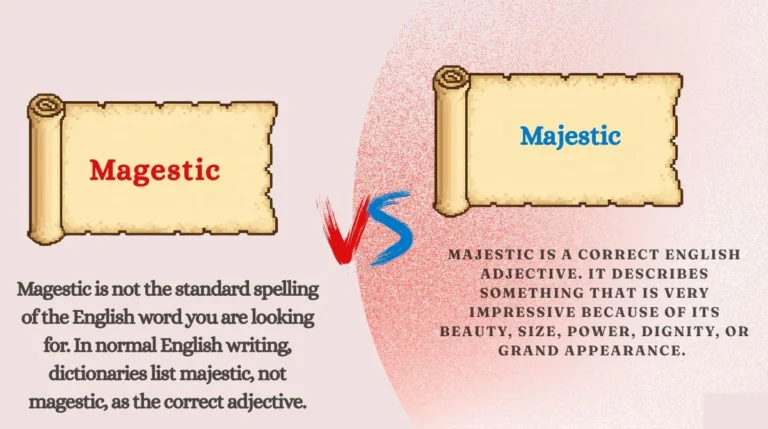
Magestic is not the standard spelling of the English word you are looking for. In normal English writing, dictionaries list majestic, not magestic, as the correct adjective. Spelling references also identify magestic as an incorrect spelling of majestic.
So, if you see a sentence such as:
The mountain was magestic.
The spelling should be corrected to:
The mountain was majestic.
The problem with magestic is mainly a spelling problem, not a grammar problem. A learner may know exactly what they want to say but write the word incorrectly because the sounds can make the spelling confusing.
Why Do People Write “Magestic”?
One reason is pronunciation. The correct word majestic is commonly pronounced /məˈdʒes.tɪk/. The beginning has a sound similar to the sound in words such as “job” and “jungle.”
When learners hear a word rather than see it written, they may choose g instead of j. English spelling can be tricky because the same sound can sometimes be represented in different ways.
There is also a useful word connection that can help. Majestic is closely connected to majesty, so seeing the j in majesty can remind you to keep the j in majestic.
What Should You Do Instead?
Whenever you mean “grand,” “impressive,” or “full of dignity,” use majestic.
Incorrect:
The palace looked magestic.
Correct:
The palace looked majestic.
Incorrect:
We watched a magestic eagle flying above the valley.
Correct:
We watched a majestic eagle flying above the valley.
So, there is no special grammar rule that tells you when to use magestic, because in standard English there is no normal use for this spelling. The important lesson is to recognize it as a misspelling and replace it with majestic.
Examples of the Incorrect Spelling
Here are some common examples showing how learners may accidentally use magestic:
- The waterfall looked magestic from the hill.
- We saw a magestic horse near the farm.
- The old castle had a magestic appearance.
- The bird looked magestic as it spread its wings.
- She described the mountain as magestic.
- The building has a magestic entrance.
- The sunset created a magestic view.
- The king entered the hall with a magestic presence.
All eight sentences use the wrong spelling. The meaning can still be understood, but the spelling should be changed to majestic.
What Does “Majestic” Mean?
Majestic is a correct English adjective. It describes something that is very impressive because of its beauty, size, power, dignity, or grand appearance. Cambridge Learner’s Dictionary describes it as something very beautiful or powerful in a way that people admire.
Collins also gives meanings such as having great dignity, being grand, lofty, or stately.
When Do We Use “Majestic”?
We use majestic when ordinary words such as “nice,” “beautiful,” or “big” do not fully express how impressive something feels.
For example:
The mountains are beautiful.
This is correct, but:
The mountains are majestic.
gives a stronger sense of grandeur and admiration.
We often use majestic for:
- mountains and landscapes
- large trees and forests
- powerful animals
- castles, palaces, and important buildings
- impressive people or appearances
- grand movements
- memorable scenes and views
It is also common in descriptive writing because it creates a strong visual image.
Grammar Rule for “Majestic”
Majestic is an adjective. An adjective describes or gives more information about a noun.
It can come directly before a noun:
a majestic mountain
a majestic eagle
a majestic palace
It can also come after a linking verb such as be, look, seem, appear, or become:
The mountain looks majestic.
The palace was majestic.
The eagle seemed majestic.
You can also use the adverb majestically when you want to describe an action:
The eagle flew majestically across the sky.
8 Example Sentences with “Majestic”
- The majestic mountains were covered with snow.
- We stood quietly and admired the majestic waterfall.
- A majestic eagle flew over the lake.
- The palace has a majestic entrance.
- The old tree looked majestic in the morning light.
- The horse moved across the field in a majestic way.
- The dancers made a majestic entrance onto the stage.
- From the top of the hill, we could see a majestic view of the valley.
Notice that majestic describes something that creates a feeling of greatness or admiration. It is stronger and more expressive than simply saying something is “good-looking.”
Difference Between Magestic and Majestic
The main difference is very easy:
Majestic = correct spelling
Magestic = incorrect spelling
There is no standard meaning difference between the two because magestic is simply a misspelling of majestic in ordinary English use. Spelling references consistently identify majestic as the correct form.
Comparison Table
| Feature | Magestic | Majestic |
|---|---|---|
| Correct spelling | ❌ No | ✅ Yes |
| Standard English word | ❌ No | ✅ Yes |
| Part of speech | — | Adjective |
| Meaning | Intended meaning of majestic | Grand, impressive, beautiful, powerful |
| Use in formal writing | ❌ Avoid | ✅ Appropriate |
| Use in school writing | ❌ Incorrect | ✅ Correct |
| Common cause of confusion | Sound-based spelling | Correct dictionary form |
| Related word | — | Majesty |
Usage Difference
There is no normal situation in standard English where you choose magestic instead of majestic.
For example:
We admired the magestic scenery.
should be:
We admired the majestic scenery.
Likewise:
The lion looked magestic.
should be:
The lion looked majestic.
The second sentence is grammatically correct and correctly spelled.
Grammar Logic
The important grammar point is that majestic is an adjective.
It can describe a noun:
a majestic building
It can appear after a linking verb:
The building looks majestic.
The misspelling magestic does not become a different adjective. Writing it with g does not create a new grammatical form.
Sentence Structure Difference
Because majestic is an adjective, you can use it in two common patterns.
Pattern 1: Adjective + noun
The majestic castle attracted many tourists.
Here, majestic describes the noun castle.
Pattern 2: Subject + linking verb + adjective
The castle looked majestic.
Here, majestic describes the subject castle after the linking verb looked.
Another useful form is:
Subject + verb + adverb
The eagle flew majestically.
Here, majestically is the adverbial form of majestic.
Meaning Comparison
The meaning you intend stays the same, but only one spelling is correct.
We saw a majestic mountain.
This tells the reader that the mountain was grand, impressive, and worthy of admiration.
We saw a magestic mountain.
The reader can probably understand what you mean, but the spelling is incorrect.
Grammar Rules You Must Remember
Rule 1: Always Spell the Word “Majestic” with J
The correct spelling is:
M-A-J-E-S-T-I-C
Not:
M-A-G-E-S-T-I-C
The letter j comes after ma.
Example:
The majestic river flowed through the valley.
A simple spelling check is to look at the first four letters:
MAJE
Not MAGE.
Rule 2: “Majestic” Is an Adjective
Because it is an adjective, majestic describes a person, place, animal, thing, or scene.
Example:
We saw a majestic elephant.
The word majestic tells us what kind of elephant it was.
You can also say:
The elephant looked majestic.
Here again, the adjective describes the elephant.
Rule 3: Use “Majestic” for Strong Admiration
The word often suggests more than ordinary beauty. It can describe something that makes people feel admiration because of its size, power, dignity, or grandeur. Cambridge specifically connects the word with beauty, power, admiration, and respect.
Example:
The majestic mountains rose above the clouds.
The sentence suggests that the mountains are not simply large. They are impressive and awe-inspiring.
Rule 4: Remember “Majesty” to Remember “Majestic”
One of the easiest spelling tricks is to connect majestic with majesty.
Think:
majesty → majestic
Both words begin with MAJ.
Example:
The king’s majestic palace was surrounded by gardens.
The relationship between the words makes the correct j easier to remember.
Common Mistakes Students Make
Mistake 1: Writing “Magestic”
This is the most common error in this pair.
Wrong:
The view from the mountain was magestic.
Correct:
The view from the mountain was majestic.
The extra confusion usually comes from writing the word according to how it sounds.
Mistake 2: Thinking “Magestic” Is an American Spelling
It is not a British-versus-American spelling difference.
English speakers in different regions use the standard spelling majestic. You should not switch to magestic because you are writing American English or British English.
For both varieties, write:
majestic
Mistake 3: Using “Majestic” as a Noun
Because the word sounds grand, some learners may try to use it as a noun.
Incorrect:
The majestic of the palace was amazing.
Correct:
The majesty of the palace was amazing.
Here, majesty is the noun, while majestic is the adjective.
Compare:
The palace was majestic.
The palace had great majesty.
The first uses an adjective. The second uses a noun.
Mistake 4: Confusing “Majestic” and “Majestically”
These words are related, but they have different jobs.
Use majestic to describe a noun:
The mountain was majestic.
Use majestically to describe how an action happens:
The eagle flew majestically.
A simple test is to ask, “Am I describing a thing, or am I describing an action?”
If you are describing a thing, majestic may be the right choice. If you are describing how something happens, majestically may be better.
Easy Correction Tip
Whenever you type magestic, stop and check the middle letters.
Remember:
MAJESTIC
The word has J, not G.
You can even whisper the spelling to yourself:
“MA-JES-TIC”
That small habit can save you from repeating the mistake in school assignments, emails, blog posts, and professional writing.
Easy Trick to Remember the Difference
Here is a very simple memory trick:
Think of “Majesty”
Imagine a king wearing a crown.
The king is connected with majesty.
Now turn:
majesty → majestic
Both start with:
MAJ
So whenever you need the adjective, remember the royal connection:
Majesty has J, so majestic has J.
You can also picture something enormous and beautiful, such as a mountain, palace, eagle, or waterfall.
Say:
“A majestic mountain.”
Now look carefully at the spelling:
M A J E S T I C
Not:
M A G E S T I C
The easiest thing to remember is not the whole word. Just remember the key part:
MAJ
Once you remember MAJ, the rest becomes much easier.
Another helpful idea is to connect majestic with major. Both words begin with maj, although they have different meanings and histories. Seeing the shared spelling can help you recognize the correct beginning.
Daily Life Examples
The word majestic is not limited to formal writing. It can sound natural in everyday conversation when you are talking about something especially impressive.
Example 1: Talking About Mountains
Ali: How was your trip to the north?
Sara: Amazing! The mountains looked absolutely majestic.
Here, majestic means grand and impressive.
Example 2: Talking About an Animal
A: Did you see that eagle?
B: Yes! It looked so majestic flying over the lake.
The adjective describes the eagle’s impressive appearance.
Example 3: Talking About a Building
A: Have you visited that old palace?
B: Yes. The main hall is really majestic.
The word describes the grand appearance of the hall.
Example 4: Talking About Nature
A: What did you like most about the park?
B: The huge trees. They were so majestic.
The speaker is expressing admiration for their size and appearance.
Example 5: Talking About a Waterfall
A: Was the waterfall worth seeing?
B: Definitely. It was even more majestic than I expected.
This is a natural spoken use of the word.
Example 6: Talking About a Horse
Look at that horse. It has such a majestic appearance.
This means the horse looks powerful, graceful, and impressive.
Example 7: Talking About the Sea
The ocean looked majestic at sunset.
The word adds a feeling of grandeur to the description.
Example 8: Talking About a Tree
That old oak tree looks majestic.
Here, the tree’s size, age, shape, or appearance creates admiration.
Example 9: Talking About a Performance
The orchestra gave a majestic performance.
The word can also describe something that feels grand, powerful, or dignified, not only something that exists in nature.
Example 10: Talking About a View
The view from our hotel was majestic.
This is a natural way to describe a very impressive scene.
These examples show that majestic works with many different nouns. You can use it whenever something feels grand, beautiful, powerful, or worthy of admiration.
Practice Section
Choose the correct word in each sentence.
1. The eagle looked very ______ as it flew over the mountains.
a) magestic
b) majestic
2. We enjoyed the ______ view from the top of the hill.
a) majestic
b) magestic
3. The old palace has a ______ entrance.
a) magestic
b) majestic
4. The mountains looked ______ under the morning sun.
a) majestic
b) magestic
5. She described the waterfall as ______.
a) magestic
b) majestic
Answers
1. b) majestic
2. a) majestic
3. b) majestic
4. a) majestic
5. b) majestic
If you got all five correct, remember the main lesson: majestic always uses J in this word.
FAQs
What is the difference between magestic and majestic?
Majestic is the correct English spelling. It is an adjective meaning grand, impressive, beautiful, powerful, or worthy of admiration. Magestic is a common misspelling and should not be used in standard English writing.
Is magestic a correct word?
No, magestic is not the standard spelling of the word. The correct form is majestic. When you want to describe something as grand or impressive, use majestic.
Can we use majestic in questions?
Yes. Majestic can be used in questions just like any other adjective.
For example:
Did you see that majestic mountain?
You can also ask:
Why does this building look so majestic?
Is majestic formal or informal?
Majestic can be used in both everyday speech and formal writing. It is especially common in descriptive language, travel writing, stories, essays, and conversations about nature, buildings, or impressive scenes.
What is the noun form of majestic?
The noun form is majesty.
For example:
The mountain has a majestic appearance.
But:
The mountain has a sense of majesty.
Majestic is an adjective, while majesty is a noun.
What is the adverb form of majestic?
The common adverb form is majestically.
For example:
The eagle flew majestically across the sky.
Use majestic to describe a person or thing, and majestically to describe how an action happens.
Conclusion
The choice between magestic and majestic is much easier once you remember one important fact: majestic is the correct spelling. The spelling magestic is a common mistake, often caused by writing the word the way it sounds.
Majestic is an adjective used for something that is grand, beautiful, powerful, dignified, or deeply impressive. You can use it for mountains, waterfalls, animals, buildings, trees, views, performances, and many other things that create admiration. Cambridge Dictionary connects the word with beauty, power, admiration, and respect.
The best spelling trick is to remember the related noun majesty. Both words begin with MAJ, so think:
majesty → majestic
Not magesty and not magestic.
Once you see the pattern a few times, the correct spelling will begin to feel natural. Try using majestic in your own sentences today. A little practice can make this spelling mistake disappear for good.

Evan Rellmont is a writer who turns thoughtful ideas into meaningful words, creating stories and reflections that connect, inspire, and leave a lasting impression.