
Many English learners pause when they see blond and blonde. Both words describe light-colored hair, and both are pronounced the same way.
So why are there two spellings? Is one for men and the other for women? Does the choice change when you talk about hair instead of a person?
The confusion is understandable because English adjectives usually do not change according to gender. We say “a tall man” and “a tall woman,” not tall and talla. But blond/blonde is a special case.
The two spellings have a long history, including French influence, and English developed different patterns for them.
This topic is useful in everyday English because you may see blond hair, blonde hair, a blond man, a blonde woman, or a natural blonde.
These expressions are closely related, but the preferred spelling can vary by region and by how the word is being used.
By the end, you will understand when to use blond, when blonde is common, why British and American English sometimes differ, and why the noun a blonde needs some care.
You do not need to memorize a complicated chart. Once the basic pattern is clear, the choice becomes much easier.
4. What Does “Blond” Mean?
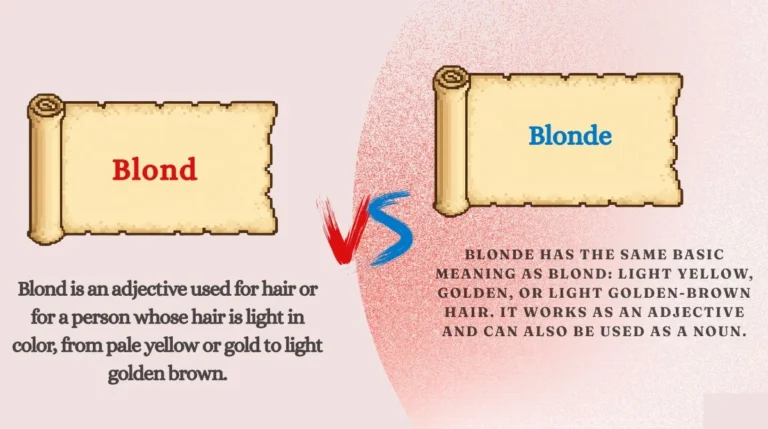
Blond is an adjective used for hair or for a person whose hair is light in color, from pale yellow or gold to light golden brown. Dictionaries also record blond as a noun in some varieties of English. Cambridge lists blond and blonde as forms used for this hair color, while Oxford notes that American English often prefers blond for either sex.
The easiest way to understand blond is to think of it as the general spelling. It is especially common in American English, where it can describe a man, woman, boy, girl, or the hair itself.
Examples of “Blond”
- He has blond hair.
- My brother is blond.
- She was blond when she was a child.
- The actor plays a tall blond man.
- I saw a blond boy near the door.
- Her hair is naturally blond.
- They have two blond children.
- The child has short blond curls.
When blond is an adjective, it tells us about hair color. It can come before a noun or after a linking verb:
- blond hair
- blond curls
- He is blond.
- She is blond.
In American English, this adjective normally does not need a different spelling for a woman. Oxford specifically says that blond is often preferred for either sex in American English.
One important grammar point: do not make the adjective plural. Write blond boys, not blonds boys. The noun blonds is possible in some usage, but people with blond hair is often clearer.
A common beginner question is, “Is blond only for men?” The answer is no. That is mainly a traditional British pattern, not a universal rule in modern English.
5. What Does “Blonde” Mean?
Blonde has the same basic meaning as blond: light yellow, golden, or light golden-brown hair. It works as an adjective and can also be used as a noun.
In traditional British English, blonde is commonly used for a woman or girl, while blond is commonly used for a man or boy. Oxford also notes that blonde can sometimes be used for men and boys, so the old rule is not absolute. In American English, blond is often preferred for either sex.
Examples of “Blonde”
- She has blonde hair.
- The actress wore her blonde hair loose.
- The girl has blonde curls.
- Her blonde ponytail was easy to notice.
- She dyed her hair blonde.
- The woman had long blonde hair.
- I like her natural blonde color.
- A blonde-haired child was sitting by the window.
The word is also common in phrases such as platinum blonde, strawberry blonde, and dirty blonde.
“Blonde” as a Noun
This is where learners should pay attention to tone.
A blonde can mean a person, especially a woman, with blond hair. Cambridge and Oxford record this noun use, but Oxford marks it as sometimes offensive because it can reduce a woman to her hair color or connect her with a stereotype.
For example:
- She is a blonde.
- Who is the blonde talking to Tom?
- My sister is a natural blonde.
These can be grammatically correct, but context matters. In neutral or professional writing, a woman with blond hair is often a better choice.
You may also see blond used as a noun:
- He is a natural blond.
- Two blonds were waiting outside.
Oxford’s American English entry says blond is usually preferred for both people and peopleas a noun and adjective.
Why Does “Blonde” Exist?
The unusual spelling has a historical reason. Oxford traces blonde to French, where it was the feminine form of blond. The English word entered the language in the late 17th century, with blond appearing earlier.
This helps explain why English sometimes keeps two spellings even though most English adjectives do not change for gender.
6. Difference Between Blond and Blonde
The most important point is simple: blond and blonde have the same basic meaning. The preferred spelling can change because of regional English, traditional gender-based usage, and whether the word is used as an adjective or noun.
| Point | Blond | Blonde |
|---|---|---|
| Basic meaning | Light yellow/golden hair | Light yellow/golden hair |
| Main use | Adjective; also noun in some usage | Adjective; also noun |
| Traditional British pattern | Man/boy | Woman/girl |
| Common American pattern | Either sex | Also used, but less necessary as a gender marker |
| Used for hair | Yes | Yes |
| Pronunciation | Same | Same |
Blond vs. Blonde for Hair
When talking about hair itself, both spellings can be correct:
- She has blond hair.
- She has blonde hair.
Cambridge lists both forms, and Oxford gives blonde hair while identifying blond as an alternative.
So do not think that blonde hair must mean the hair belongs to a woman. Hair has no grammatical gender. The choice is mainly about spelling style.
Blond vs. Blonde for a Person
The difference is more noticeable here.
Traditional British English commonly follows:
- blond man
- blond boy
- blonde woman
- blonde girl
For example:
- He is a blond man.
- She is a blonde woman.
American English often uses blond for both:
- He is blond.
- She is blond.
Oxford confirms this British/American difference.
Adjective or Noun?
Ask yourself one question: Am I describing someone, or am I naming someone by hair color?
When describing:
- blond hair
- blonde hair
- He is blond.
- She is blonde.
When using a noun:
- He is a blond.
- She is a blonde.
Because the noun a blonde can sometimes sound labeling or stereotyped, a phrase like a woman with blond hair is often more neutral.
7. Grammar Rules You Must Remember
Rule #1: Both Spellings Can Describe Hair
You can write blond hair or blonde hair.
Example:
She has blonde hair.
She has blond hair.
Both forms are recorded in learner dictionaries.
Rule #2: Traditional British English Often Uses Blond for Males and Blonde for Females
Examples:
- Jack is blond.
- Emma is blonde.
- The blond boy is my cousin.
- The blonde girl is my sister.
This is a common British pattern, not a rule that every English speaker follows.
Rule #3: American English Commonly Uses Blond for Both Sexes
Examples:
- He is blond.
- She is blond.
- Their daughter is blond.
- Her blond hair is naturally light.
Oxford specifically notes this American preference.
Rule #4: Use Care When Using “A Blonde” as a Noun
A blonde is an established noun, but it can sound objectifying in some contexts.
Instead of:
- I spoke to a blonde.
you can write:
- I spoke to a woman with blond hair.
The second sentence is more neutral because it describes the person’s hair without turning that feature into her main label.
8. Common Mistakes Students Make
The biggest mistake is memorizing blond = male and blonde = female as if it works everywhere. That is too simple. It describes a traditional British pattern, while American English often uses blond for both sexes.
Mistake 1: Thinking “Blonde Hair” Is Wrong
Some learners believe only blond hair is correct. That is not true.
Correct:
- She has blond hair.
- She has blonde hair.
Both are established forms.
Mistake 2: Thinking “She Is Blonde” Is Always Incorrect
The sentence She is blonde is normal in traditional British English and widely understood elsewhere.
In American English, many writers prefer:
- She is blond.
The important thing is to follow the English style expected by your audience.
Mistake 3: Assuming Adjectives Normally Have Male and Female Versions
Most English adjectives do not. We say:
- a quiet man
- a quiet woman
- a kind boy
- a kind girl
Blond/blonde is unusual because of its history and the influence of French.
Mistake 4: Using “A Blonde” Without Considering Tone
Although a blonde is grammatically established, it may sound impersonal in some situations.
More neutral:
- a woman with blond hair
This is especially useful in school, business, news, or other formal writing.
Mistake 5: Changing the Spelling Randomly
If you are writing in American English, using blond consistently is often simple. If you are following traditional British usage, the male/female distinction may help you choose the spelling.
Consistency makes your writing look more controlled.
9. Easy Trick to Remember the Difference
Use this memory trick:
Blond = the general spelling. Blonde = the traditional feminine spelling in British English.
Think of the two patterns:
British style
- blond boy
- blond man
- blonde girl
- blonde woman
American style
- blond boy
- blond man
- blond girl
- blond woman
Then remember one extra rule:
For hair, both blond and blonde can be correct.
So these are both possible:
- blond hair
- blonde hair
Another real-life trick is to imagine writing for an American audience. When you do not want to stop and think about gender, blond is often the easiest general choice.
For British English, keep the traditional pattern in mind. You will then understand why a book might say a blond man but a blonde woman.
Most importantly, do not treat the two words as completely different vocabulary items. They share the same basic meaning. The spelling is what changes.
10. Daily Life Examples
1. At School
A: Who is the new student?
B: The blond boy near the window.
A: Oh, I see him now.
2. Talking About a Friend
A: What does Sarah look like?
B: She is tall and blonde, with long hair.
3. At a Salon
Customer: I want to make my hair blonde.
Stylist: Do you want a light blonde or a darker shade?
4. Talking About Childhood
A: Was your hair always dark?
B: No. I was blond when I was little.
5. Talking About a Family
They have two children with blond hair.
6. At a Party
A: Which person is your cousin?
B: The woman with blonde hair near the table.
7. Talking About Natural Color
A: Is that your natural color?
B: Yes, I am a natural blond.
8. Looking at an Old Photo
A: Who is the girl in the picture?
B: That is my aunt. She had blonde curls when she was young.
9. Common American Usage
A: Is your sister blond?
B: Yes. Her hair is naturally very light.
10. Traditional British Usage
A: Is your sister blonde?
B: Yes, she is. She has always had blonde hair.
These examples show that the meaning does not change. What changes is the spelling pattern a speaker chooses.
11. Practice Section
Choose the correct option. Some questions allow both answers depending on the English variety.
1. She has long ___ hair.
a) blond
b) blonde
2. In traditional British English, a woman may be described as ___.
a) blond
b) blonde
3. In American English, which spelling is often preferred for either sex?
a) blond
b) blonde
4. Which sentence is more neutral?
a) I talked to a blonde.
b) I talked to a woman with blond hair.
5. Which pair shows the traditional British distinction?
a) blond man / blonde woman
b) blonde man / blond woman
Answers
1. a or b — blond / blonde
Both forms are used for hair color.
2. b — blonde
This matches the traditional British pattern.
3. a — blond
American English often prefers blond for either sex.
4. b — I talked to a woman with blond hair.
It is more neutral and avoids labeling the woman mainly by her appearance.
5. a — blond man / blonde woman
That is the traditional British pattern.
12. FAQs About Blond or Blonde
What Is the Difference Between Blond and Blonde?
Both words refer to light yellow, golden, or light golden-brown hair. Traditional British English often uses blond for people and boys and blonde for people and girls, while American English often uses blond for either sex.
Which Is Correct: Blond Hair or Blonde Hair?
Both are correct. Dictionaries record both spellings for hair color. Blonde hair is very common, while blond hair is especially common in American English.
Is “Blonde” Only Used for people?
No. It is traditionally associated with people and girls in British English, but blonde can also be used for males. American English commonly uses blond for both sexes.
Is Blond More Correct Than Blonde?
Neither is universally more correct. Both are established English forms. The better choice depends on the variety of English and the context in which you are writing.
Can “Blonde” Be a Noun?
Yes. A blonde can mean a person, especially a woman, with pale-gold or blond hair. However, Oxford notes that this noun can be considered offensive in some contexts, so a woman with blond hair is often a more neutral choice.
How Do You Pronounce Blond and Blonde?
They are normally pronounced the same way. The final e in blonde does not normally create a different sound. The main difference is spelling and usage.
13. Final Conclusion
The difference between blond and blonde is much smaller than it first appears. Both words describe light-colored hair, and both are accepted in English. The main variation comes from regional and traditional usage.
In British English, you will often see blond for people and boys and blonde for women and girls. In American English, blond is commonly used for both sexes. When you are talking about hair itself, both blond hair and blonde hair can be correct.
The noun a blonde needs more care because it can sound labeling or stereotyped in some contexts. A neutral phrase such as a woman with blond hair is often a better choice.
The best way to learn this pair is to notice how native speakers use it in the type of English you read and write. With a little practice, choosing between blond and blonde will become much easier.
Meta Description
Blond or blonde? Learn the simple difference, British vs American usage, grammar rules, examples, common mistakes, and easy tips for using both forms correctly.

Evan Rellmont is a writer who turns thoughtful ideas into meaningful words, creating stories and reflections that connect, inspire, and leave a lasting impression.