
Many English learners get confused by freshman and freshmen because the two words look almost the same.
There is only one small spelling change, but that change matters. One word refers to one student, while the other refers to more than one student.
The confusion becomes even greater because freshman and freshmen are often pronounced very similarly in American English.
Cambridge Dictionary lists the pronunciation of both forms as /ˈfreʃ.mən/. So, when you hear the word in a conversation, it may be difficult to know which spelling you need.
These words are common in American schools, colleges, and universities. A student in the first year of high school, college, or university can be called a freshman.
Several students in their first year are called freshmen. The word can also describe someone who is new to a particular activity or position.
The good news is that the rule is simple. Freshman = one. Freshmen = two or more. Once you understand this basic difference, sentences such as “She is a freshman,” “They are freshmen,” and “The freshmen have orientation today” become much easier to use correctly.
What Does “Freshman” Mean?
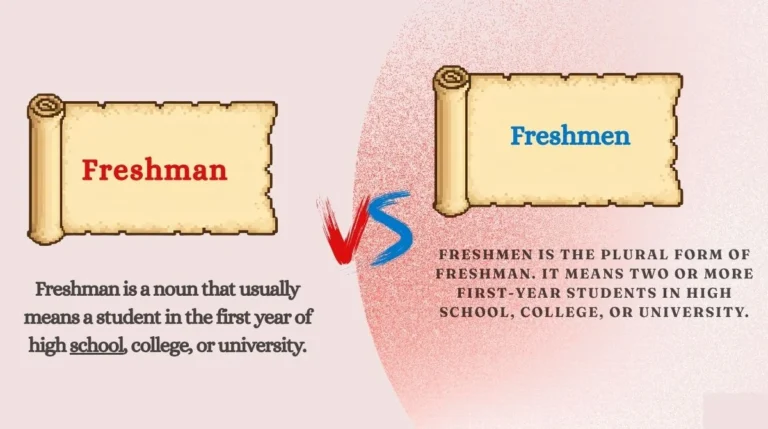
Freshman is a noun that usually means a student in the first year of high school, college, or university. It is a singular noun, so it normally refers to one person. Cambridge Dictionary describes it as a student in the first year of high school, college, or university and notes that it is mainly a U.S. term.
For example, if Sarah is in her first year at a university, you can say:
Sarah is a freshman.
Here, Sarah is one person, so the singular form freshman is correct.
When Should You Use “Freshman”?
Use freshman when you are talking about one first-year student.
You can use it after a verb such as is, was, or becomes:
- He is a freshman.
- Maria was a freshman last year.
- My brother became a freshman in September.
You can also use freshman before another noun as a modifier:
- freshman year
- freshman class
- freshman orientation
- freshman student
- freshman dorm
Notice something important here: even when these phrases describe many students, freshman can stay singular when it is acting as a modifier.
For example:
The freshman class starts Monday.
This can refer to a whole group of first-year students. The word freshman is being used to describe the class, not to count individual students.
Grammar Rule for “Freshman”
When freshman is used as a noun for one student, it is singular.
You can think of it like this:
One student = one freshman
Here are some examples:
- My sister is a freshman at college.
- He joined the freshman basketball team.
- I met a freshman in the library.
- That freshman needs help finding the science building.
- She was a freshman when she moved to New York.
- The professor welcomed every freshman to the course.
- My cousin is a freshman this year.
- A freshman asked me where the student center was.
A Common Confusion
A common mistake is adding -s to the end and writing freshmans.
For example:
❌ There are five freshmans in the room.
This is incorrect.
The normal plural form is freshmen, not freshmans.
Another common mistake is using freshmen for one student:
❌ John is a freshmen.
Correct:
✅ John is a freshman.
The easiest way to avoid this mistake is to ask yourself one question:
Am I talking about one student or several students?
If the answer is one, use freshman.
What Does “Freshmen” Mean?
Freshmen is the plural form of freshman. It means two or more first-year students in high school, college, or university.
Cambridge Dictionary lists freshmen as the plural form of freshman.
For example:
The freshmen are attending orientation today.
This sentence talks about a group of new students, so freshmen is correct.
When Should You Use “Freshmen”?
Use freshmen when you are talking about more than one first-year student.
Look at these examples:
- The freshmen are in the gym.
- Five freshmen joined the club.
- The university welcomed its new freshmen.
- Those freshmen live in the same dorm.
- Our teacher gave the freshmen some advice.
The word usually works as a plural noun, so it commonly takes a plural verb.
For example:
✅ The freshmen are excited.
Not:
❌ The freshmen is excited.
Because freshmen refers to several people, we use are, not is.
Grammar Rule for “Freshmen”
The basic rule is:
Two or more students = freshmen
Here are eight examples:
- The freshmen are learning how the campus works.
- Three freshmen joined our study group.
- The school invited all freshmen to the meeting.
- Those freshmen are waiting outside the classroom.
- Many freshmen feel nervous during their first week.
- The freshmen received their student ID cards.
- Several freshmen live in the same residence hall.
- Our teacher asked the freshmen to introduce themselves.
Another Common Confusion
Some learners see the spelling -men and think the word must refer only to males.
That is not how the word is normally used in modern American English. Freshman is commonly used as a general term for a first-year student, regardless of gender. A female student can be called a freshman, too. Cambridge’s learner definition uses gender-neutral wording such as “a student in their first year.”
So these sentences are both possible:
Lena is a freshman.
Lena and Daniel are freshmen.
The form changes because of number, not because of the student’s gender.
Difference Between Freshman and Freshmen
The main difference is very simple:
Freshman = singular
Freshmen = plural
The spelling is different because English has some irregular plural nouns. Instead of adding -s, the word changes from -man to -men.
| Word | Number | Meaning | Example |
|---|---|---|---|
| freshman | Singular | One first-year student | She is a freshman. |
| freshmen | Plural | Two or more first-year students | They are freshmen. |
Usage Difference
Use freshman for one person:
My son is a freshman.
Use freshmen for a group:
My sons are freshmen.
This is the same kind of singular/plural idea you see in other English words:
- one man → two men
- one woman → two women
- one child → two children
- one freshman → two freshmen
The important point is that freshman does not usually become freshmans. The plural changes the spelling to freshmen.
Grammar Logic
English nouns normally form plurals by adding -s or -es, but some nouns have irregular plural forms.
For example:
- man → men
- woman → women
- child → children
- person → people
Freshman follows the man → men pattern:
freshman → freshmen
That is why the plural looks unusual.
Sentence Structure Difference
The form of the verb can also help you recognize the correct word.
For one student:
The freshman is waiting outside.
For several students:
The freshmen are waiting outside.
Notice the change:
freshman + is
freshmen + are
Another example:
A freshman wants to join the club.
Many freshmen want to join the club.
The first sentence has a singular subject. The second has a plural subject.
Meaning Comparison
Both words describe students at the beginning of a course of study. The only major grammatical difference is number.
Freshman tells you that the person is a single first-year student.
Freshmen tells you that the people are a group of first-year students.
Cambridge also notes that freshman can be used for someone who is new to a particular job or activity, such as “a freshman in Congress.” In these wider uses, the same singular/plural rule applies.
For example:
He is a freshman in Congress.
The freshmen in Congress met today.
So the number rule stays the same even when the word is used outside education.
Grammar Rules You Must Remember
Rule 1: Use “freshman” for one person
When only one first-year student is being discussed, use freshman.
Example:
✅ Anna is a freshman.
You would not write:
❌ Anna is a freshmen.
A quick check is to look for words such as a, one, each, or a singular name.
For example:
- a freshman
- one freshman
- each freshman
- David is a freshman
All of these refer to one person.
Rule 2: Use “freshmen” for more than one person
When the sentence describes two or more first-year students, use freshmen.
Example:
✅ The freshmen are meeting after class.
Words such as many, several, two, three, all, and these often signal a plural noun.
For example:
- two freshmen
- many freshmen
- several freshmen
- all freshmen
- these freshmen
Rule 3: “Freshman” can modify another noun
This rule causes a lot of confusion.
You can say:
✅ freshman year
✅ freshman class
✅ freshman orientation
✅ freshman dorm
Even though these things may involve many students, freshman is being used as a modifier.
For example:
The freshman class has 400 students.
Here, “freshman” describes the class. It does not mean there is only one student.
Similarly:
Our freshman orientation begins tomorrow.
This is a normal compound expression.
Writing freshmen orientation is generally not the standard form when “freshman” is acting as the modifier.
Rule 4: Use plural verbs with “freshmen”
Because freshmen is plural, it normally takes plural verbs.
Correct:
✅ The freshmen are ready.
✅ The freshmen have arrived.
✅ The freshmen want more information.
Incorrect:
❌ The freshmen is ready.
❌ The freshmen has arrived.
❌ The freshmen wants more information.
The noun and verb need to agree in number.
A simple trick is to replace freshmen with students.
If you would say:
The students are ready.
then you can say:
The freshmen are ready.
Common Mistakes Students Make
Learners often make these mistakes because the words look and sound so similar. A little practice can make the difference much easier.
Mistake 1: Using “freshmans”
❌ There are twenty freshmans in our class.
✅ There are twenty freshmen in our class.
Why does this happen? English learners often expect every plural noun to take -s. But freshman is an irregular noun.
Remember:
man → men
Therefore:
freshman → freshmen
Mistake 2: Using “freshmen” for one student
❌ My brother is a freshmen.
✅ My brother is a freshman.
The word a means one. Since the noun is singular, freshman is needed.
Mistake 3: Using the wrong verb
❌ The freshmen is in the cafeteria.
✅ The freshmen are in the cafeteria.
The subject is plural, so the verb should also be plural.
Mistake 4: Writing “freshmen year”
❌ I remember my freshmen year.
✅ I remember my freshman year.
This is one of the most common mistakes on social media, in student writing, and even in casual messages.
The standard expression is freshman year.
Here, freshman modifies the noun year, so it remains in its singular form.
Mistake 5: Confusing “freshman” with “first-year”
Both terms can describe a new student, but their use depends on style and regional preference.
For example:
She is a freshman.
She is a first-year student.
Both can communicate the same basic idea. Cambridge identifies freshman as mainly a U.S. term, so first-year student may be a more natural choice in some international or British contexts.
Easy Correction Tip
Before writing the word, count the students.
1 student → freshman
2+ students → freshmen
Then check the verb:
freshman → is
freshmen → are
This small three-step habit can prevent most errors.
Easy Trick to Remember the Difference
Here is a simple memory trick:
ONE = FRESHMAN
MORE = FRESHMEN
Think about the word man and its plural men:
one man → two men
Now use the same pattern:
one freshman → two freshmen
You can even remember a short classroom sentence:
“One freshman, many freshmen.”
Say it a few times. The pattern becomes easier to remember.
Another useful trick is to look at the final letters:
freshmaN → one
freshmeN → more than one
This is not a grammar rule by itself, but it can help you remember which ending goes with which form.
There is also an important pronunciation trick. In American English, freshman and freshmen are generally pronounced the same or nearly the same, which is why listening alone may not help you identify the spelling. Cambridge gives the same pronunciation for both forms.
So when writing, do not depend on sound. Think about number.
Ask:
One student? Freshman.
Several students? Freshmen.
That is the key.
Daily Life Examples
These examples show how the two forms naturally appear in everyday school and college conversations.
Example 1
A: What year are you in?
B: I’m a freshman.
Here, the speaker is talking about one person.
Example 2
A: Who are those students?
B: They’re freshmen from the engineering department.
There is a group of students, so freshmen is correct.
Example 3
A: Is your sister a freshman?
B: Yes, she started college this year.
Because the question is about one person, freshman is used.
Example 4
A: Are the freshmen attending the meeting?
B: Yes, most of them are there.
The word freshmen refers to several students.
Example 5
A: How was your freshman year?
B: It was challenging, but I learned a lot.
Notice that the correct phrase is freshman year, not freshmen year.
Example 6
A: When is freshman orientation?
B: It starts next Monday.
Again, freshman is used as a modifier before orientation.
Example 7
A: How many freshmen live in your dorm?
B: About thirty, I think.
The question asks about a group, so freshmen is used.
Example 8
A: I saw a freshman looking for the library.
B: Did you help him?
Only one student is mentioned, so a freshman is correct.
Example 9
A: Why are the freshmen so excited?
B: They just got their class schedules.
The subject is plural, so are works with freshmen.
Example 10
A: My cousin is a freshman at a large university.
B: That sounds exciting. Is she enjoying it?
Again, freshman refers to one person.
These examples show an important pattern: the word changes according to how many people you mean, not according to the subject, school, course, or gender of the student.
Practice Section
Choose the correct word: freshman or freshmen.
1. My brother is a ______ at the university.
a) freshman
b) freshmen
2. The ______ are waiting outside the classroom.
a) freshman
b) freshmen
3. We had a great ______ year.
a) freshman
b) freshmen
4. Several ______ joined the science club.
a) freshman
b) freshmen
5. Is your sister a ______ this year?
a) freshman
b) freshmen
Answers
1. freshman
“My brother” means one person.
2. freshmen
“The … are” shows a plural subject.
3. freshman
The standard expression is freshman year.
4. freshmen
“Several” always refers to more than one.
5. freshman
The phrase a freshman is singular.
A good practice method is to read each sentence aloud and ask, “Am I talking about one student or several?” That question will usually give you the answer immediately.
FAQs
What is the difference between freshman and freshmen?
Freshman is singular and means one first-year student. Freshmen is plural and means two or more first-year students. For example, “He is a freshman” is singular, while “They are freshmen” is plural. Cambridge Dictionary confirms freshmen as the plural of freshman.
Can we use “freshman” in questions?
Yes. You can use freshman when asking about one student.
For example: “Are you a freshman?”
For a group, use freshmen: “Are the freshmen attending the meeting?”
The same singular and plural rule applies in questions.
Is “freshman” formal or informal?
Freshman is a standard English word, especially common in American education. It is not simply slang, although frosh is an informal alternative listed by Cambridge. In some British or international contexts, first-year student may be more common.
Is “freshmen” the plural of “freshman”?
Yes. The correct plural is freshmen, not freshmans.
This follows the irregular pattern seen in man → men. So the correct pair is one freshman and two freshmen.
Is it correct to say “freshmen year”?
The standard phrase is freshman year.
For example:
✅ I enjoyed my freshman year.
Here, freshman is working as a modifier before year, so the singular form is normally used.
Can a girl be called a freshman?
Yes. Freshman is commonly used as a general term for a first-year student and does not mean that the student is male. Cambridge’s learner definition uses gender-neutral wording for the term.
For example:
She is a freshman.
They are freshmen.
The singular or plural form depends on the number of students.
Do “freshman” and “freshmen” sound different?
In American English, they are generally pronounced the same or very similarly. Cambridge lists the pronunciation of freshman and freshmen as /ˈfreʃ.mən/.
That is why spelling can be confusing. When writing, remember the number rule instead of relying on pronunciation.
Conclusion
Understanding freshman vs freshmen is much easier once you focus on one simple idea: number. Use freshman when you mean one first-year student, and use freshmen when you mean two or more first-year students.
For example, you can say, “My sister is a freshman,” but “My sister and her friends are freshmen.” Also remember that phrases such as freshman year, freshman class, and freshman orientation normally use the singular form because freshman is acting as a modifier.
Do not worry if these words were confusing before. Their similar pronunciation makes the problem very common. Just ask yourself one question before you write: How many students am I talking about?
One student is a freshman. Several students are freshmen. Practice this small rule in real sentences, and the correct form will soon feel natural.

Evan Rellmont is a writer who turns thoughtful ideas into meaningful words, creating stories and reflections that connect, inspire, and leave a lasting impression.