
Have you ever written a sentence and suddenly stopped because you were not sure whether the correct spelling was “seak” or “seek”? You are not alone.
This is a common spelling problem, especially for English learners. The confusion often happens because English spelling does not always match the way a word sounds.
When people hear seek, they may think the word could be written with “ea” because English has many words with different spelling patterns.
That can lead to the incorrect form seak. However, when you want to say “look for,” “try to find,” “try to get,” or “ask for,” the standard English spelling is seek. Major learner dictionaries define seek as a verb and give its main forms as seek, seeking, and sought.
Knowing this small difference matters because seek is used in everyday communication, school writing, job-related English, formal emails, and professional situations.
You may seek help, seek advice, seek a solution, seek information, or seek a new job.
By the end of this guide, you will know exactly when to use seek, why seak is usually incorrect, how to use the verb naturally, and how to avoid related mistakes such as “seeked” instead of “sought.”
What Does “Seak” Mean?
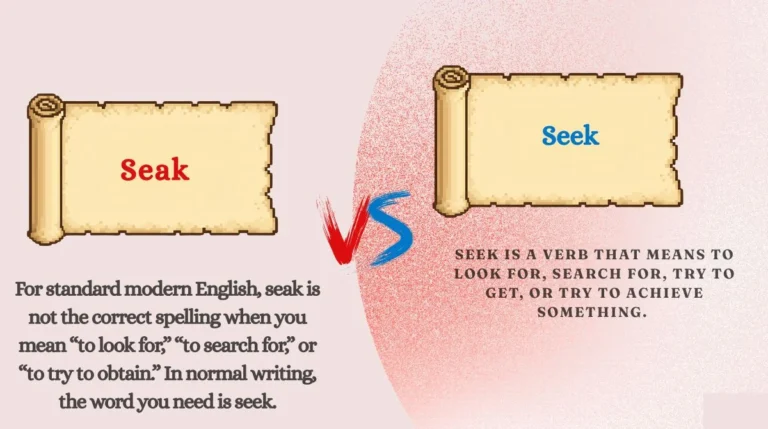
For standard modern English, seak is not the correct spelling when you mean “to look for,” “to search for,” or “to try to obtain.” In normal writing, the word you need is seek.
This mistake is easy to understand. English learners often spell unfamiliar words according to the way they sound. Because seek is pronounced /siːk/, a learner may guess that it should be spelled seak. But pronunciation alone cannot tell you the correct spelling.
Major English learner dictionaries have an entry for seek, not seak, and define seek as a verb meaning to try to find, get, or achieve something.
Is “Seak” Ever Used?
You may occasionally see seak online because people make spelling mistakes or type quickly. There are also rare historical or specialized dictionary records for the spelling, but that is not the form an English learner should use in ordinary modern writing. Wiktionary, for example, records an obsolete noun and a misspelling use, but this does not make seak an appropriate replacement for seek in everyday standard English.
So, when your sentence means “look for” or “try to get,” remember:
Seak ❌
Seek ✅
Grammar Rule for “Seak”
There is no normal modern grammar pattern in which you should use seak to express the meaning of seek.
If you are writing:
- seek help
- seek advice
- seek information
- seek a solution
- seek permission
- seek employment
do not replace seek with seak.
Examples of the Incorrect Spelling
Here are some examples to make the mistake easy to notice.
- ❌ I want to seak advice from my teacher.
✅ I want to seek advice from my teacher. - ❌ They are trying to seak a better solution.
✅ They are trying to seek a better solution. - ❌ You should seak help if you need it.
✅ You should seek help if you need it. - ❌ She went to college to seak new opportunities.
✅ She went to college to seek new opportunities. - ❌ We need to seak more information before deciding.
✅ We need to seek more information before deciding. - ❌ He wants to seak permission first.
✅ He wants to seek permission first. - ❌ The company is looking to seak experienced workers.
✅ The company is looking to seek experienced workers. - ❌ They decided to seak professional guidance.
✅ They decided to seek professional guidance.
The important point is simple: these sentences need seek, not seak.
What Does “Seek” Mean?
Seek is a verb that means to look for, search for, try to get, or try to achieve something. It can be used for physical things, but it is especially common with ideas and goals such as help, advice, information, employment, permission, solutions, peace, and success.
For example:
- I need to seek help.
- She is seeking a job.
- We should seek advice.
- They are seeking a solution.
- He went abroad to seek better opportunities.
The word is common in both everyday English and formal English, although dictionaries often label it as formal, especially in meanings such as asking for help or trying to obtain something.
When Do We Use “Seek”?
We use seek when someone makes an intentional effort to find, obtain, ask for, or achieve something.
1. To Look for Something
You can seek a person, place, answer, or solution.
Example:
The police are seeking witnesses to the accident.
2. To Try to Obtain Something
You can seek a job, opportunity, permission, funding, compensation, or other goals.
Example:
She is seeking employment after finishing college.
3. To Ask for Help or Advice
This is one of the most useful patterns for learners.
We say:
seek help
seek advice
seek permission
seek guidance
seek assistance
Cambridge and Collins both give this meaning of seek: asking for or obtaining help, advice, approval, or permission.
4. To Try to Do Something
Another important pattern is:
seek + to + verb
It means try or attempt to do something.
For example:
- The company seeks to improve customer service.
- She is seeking to solve the problem.
- They sought to reduce costs.
Oxford, Cambridge, and Collins all describe this structure.
Grammar Forms of “Seek”
The verb is irregular, so you should memorize its forms:
Base form: seek
Third-person singular: seeks
-ing form: seeking
Past tense: sought
Past participle: sought
Oxford and Collins list these forms, while Cambridge identifies sought as both the past simple and past participle.
8 Example Sentences with “Seek”
- I want to seek advice from my teacher.
- She is seeking a new job.
- We should seek more information before making a decision.
- He went to the library to seek the answer.
- They sought help from their neighbors.
- The company is seeking experienced employees.
- You should seek permission before using the equipment.
- The team is seeking to improve its performance.
Notice how naturally seek fits with nouns and with to + verb.
Difference Between Seak and Seek
The easiest way to understand seak or seek is to remember that these spellings do not have equal status in ordinary modern English.
Seek is the standard English verb.
Seak is generally a misspelling when the intended meaning is seek.
Comparison Table
| Feature | Seak | Seek |
|---|---|---|
| Standard spelling | ❌ No | ✅ Yes |
| Used to mean “look for” | ❌ No | ✅ Yes |
| Part of speech in normal modern English | Not normally used | Verb |
| Meaning | Usually a misspelling | Look for, try to get, try to achieve |
| Past tense | — | Sought |
| -ing form | — | Seeking |
| Example | ❌ I seak advice. | ✅ I seek advice. |
Usage Difference
There is no normal usage choice between these two spellings when you mean “look for.”
You do not choose seak for informal English and seek for formal English. Instead, seek is the standard spelling in both contexts.
For example:
Informal idea:
I need to look for a job.
More formal wording:
I need to seek employment.
The difference here is between look for and seek, not between seak and seek. The spelling seak is not an informal version of seek.
Grammar Logic
Seek functions as a verb.
You can put it after a subject:
- I seek advice.
- She seeks information.
- They seek answers.
You can change its form to fit the tense:
- We seek help.
- She is seeking help.
- They sought help.
- He has sought help.
The word seak does not replace any of these standard forms.
Sentence Structure
One important structure is:
Subject + seek + object
Examples:
- I seek advice.
- She seeks a solution.
- They seek permission.
- We seek better opportunities.
Another useful structure is:
Subject + seek + to + base verb
Examples:
- We seek to improve.
- She seeks to learn.
- They seek to reduce costs.
Oxford identifies both object patterns and the seek to do something structure.
Meaning Comparison
The meaning of seek is broad but connected to one main idea: making an effort to find, get, ask for, or achieve something.
For example, you can:
- seek a job
- seek help
- seek advice
- seek information
- seek a solution
- seek permission
- seek peace
- seek success
By contrast, seak does not carry these standard meanings in modern everyday English.
Grammar Rules You Must Remember
Rule 1: Use “Seek” for “Look For” or “Try to Find”
When you want to say that someone is searching for something, use seek.
Example:
The researchers seek answers to difficult questions.
You could also say:
The researchers look for answers to difficult questions.
Both are possible, although seek often sounds more formal.
Rule 2: Use “Sought” for the Past
Do not add -ed to make the past tense.
The correct pattern is:
seek → sought → sought
Examples:
- She sought help yesterday.
- They sought a better solution.
- He has sought advice from several experts.
Cambridge and Oxford both identify sought as the past form and past participle of seek.
Incorrect:
❌ He seeked help.
Correct:
✅ He sought help.
This is one of the most important facts to remember about this verb.
Rule 3: Use “Seek to + Verb” When You Mean “Try to”
When seek means “try” or “attempt,” use:
seek + to + base verb
Examples:
- The company seeks to expand overseas.
- She is seeking to improve her English.
- They sought to solve the problem quickly.
Do not write:
❌ They seek improving the system.
For this meaning, use:
✅ They seek to improve the system.
This pattern is documented by Cambridge, Oxford, and Collins.
Rule 4: Usually Put the Thing You Want Directly After “Seek”
In standard modern usage, seek commonly takes a direct object:
seek + something
Examples:
- seek advice
- seek help
- seek information
- seek employment
- seek permission
- seek a solution
Cambridge Grammar notes that seek is not usually followed by “for” in this pattern, so learners are generally better off saying “seek help” rather than “seek for help.”
Compare:
✅ We need to seek advice.
❌ We need to seek for advice.
There are some British English uses where seek for can occur, and Oxford records such a pattern, but for beginners the direct-object pattern is the easiest and most natural rule to follow.
Common Mistakes Students Make
Mistake 1: Writing “Seak” Instead of “Seek”
This is the most obvious problem.
Wrong:
❌ I want to seak information.
Correct:
✅ I want to seek information.
Why does this happen?
The main reason is spelling-by-sound. A learner hears /siːk/ and tries to guess the letters. English has many words where ea and ee can create related sounds, so the guess may feel reasonable.
But English spelling has to be learned word by word in many cases.
Mistake 2: Writing “Seeked”
Many learners know that look becomes looked, help becomes helped, and work becomes worked. They then apply the same pattern to seek.
Wrong:
❌ She seeked help from her teacher.
Correct:
✅ She sought help from her teacher.
Remember:
Seek → Sought
not:
Seek → Seeked
Mistake 3: Using “Seek” Where “Look For” Sounds More Natural
Although seek is correct, it can sound formal in a casual conversation.
For example:
Formal:
I am seeking a new apartment.
Everyday:
I am looking for a new apartment.
Both are grammatically correct. The choice depends on tone and context.
Collins and Cambridge note that seek is particularly associated with formal usage.
This does not mean you should avoid seek. It is a useful English word. Just understand that look for is often more natural in relaxed speech.
Mistake 4: Adding “For” Automatically
Because we often say:
look for help
learners may copy that structure and write:
❌ seek for help
A more natural standard pattern is:
✅ seek help
Similarly:
❌ seek for advice
✅ seek advice
❌ seek for a solution
✅ seek a solution
Cambridge Grammar specifically recommends the direct-object pattern for ordinary use.
Mistake 5: Confusing “Seek” With “Search”
These words are related but are not exactly the same in every sentence.
Search often focuses on examining or looking through something:
- The police searched the house.
- I searched the internet for the answer.
Seek often focuses on the goal of finding, obtaining, or achieving something:
- I seek advice.
- They seek a solution.
- She seeks employment.
Both verbs can involve looking, but their usual sentence patterns can differ.
Easy Trick to Remember the Difference
Here is a simple memory trick:
Seek has “ee” — think “see”
When you seek something, you are trying to see/find it.
Think:
SEE → SEEK
The letters are not exactly the same, of course, but this small memory link can help you remember that the correct spelling has ee, not ea.
So remember:
✅ SEEK
❌ SEAK
You can also connect seek with words you already know:
- seek help
- seek advice
- seek answers
- seek information
- seek opportunities
Try writing these phrases several times. Seeing the correct spelling in common phrases is often more useful than memorizing a single rule.
A Real-Life Memory Example
Imagine you have lost your phone.
You are seeking your phone.
Now imagine you have a difficult homework question.
You seek an answer.
Imagine you do not understand something.
You seek help.
In each situation, you are trying to find or obtain something.
That is the basic idea behind seek.
Daily Life Examples
The word seek appears often in work, school, travel, personal conversations, and formal communication. Here are some simple examples that sound natural in real situations.
1. Asking for Help
A: I do not understand this question.
B: You should seek help from your teacher.
2. Looking for a Job
A: What are you doing after graduation?
B: I am seeking a job in marketing.
3. Asking for Advice
A: I am not sure what to do.
B: You should seek advice from someone you trust.
4. Looking for Information
A: Did you find the details?
B: Not yet. I am seeking more information online.
5. Asking for Permission
A: Can I use your office?
B: You should seek permission from the manager first.
6. Finding a Solution
A: This problem is becoming difficult.
B: We need to seek a better solution.
7. Improving a Skill
A: Your English is getting better.
B: Thanks. I am seeking new ways to improve it.
8. Asking for Professional Assistance
A: The computer keeps crashing.
B: You may need to seek professional help.
9. Talking About Opportunities
A: Why did you move to another city?
B: I moved there to seek better opportunities.
10. Looking for Answers
A: Why did this happen?
B: We are still seeking answers.
These examples show that seek works especially well with words such as help, advice, information, answers, solutions, permission, opportunities, and employment.
Practice Section
Choose the correct word or form in each sentence.
1. I need to ______ advice from my teacher.
A) seak
B) seek
2. She ______ help from her parents yesterday.
A) sought
B) seeked
3. They are ______ a better solution.
A) seaking
B) seeking
4. The company seeks ______ improve its service.
A) to
B) for
5. You should ______ permission before entering.
A) seek
B) seak
Answers
1. B — seek
The correct spelling is seek.
2. A — sought
The past tense of seek is sought, not seeked.
3. B — seeking
The -ing form is seeking.
4. A — to
The correct pattern is seek to + base verb.
5. A — seek
Use seek permission, not seak permission.
FAQs
What is the difference between seak and seek?
For normal modern English, seek is the correct spelling when you mean “look for,” “try to find,” “try to obtain,” or “ask for.” Seak is generally a misspelling of seek in this context. Major learner dictionaries give the standard verb as seek.
Is “seak” a correct English word?
Not as the standard spelling of the common verb seek. A learner writing about searching for something, asking for help, or trying to obtain something should use seek. Rare historical dictionary records of seak exist, but they are not the normal modern English usage learners need.
Is it “seak advice” or “seek advice”?
The correct phrase is seek advice.
Example:
You should seek advice from an experienced teacher.
The verb seek is commonly used with nouns such as advice, help, guidance, permission, and information.
What is the past tense of seek?
The past tense of seek is sought.
Correct:
She sought help from her teacher.
Incorrect:
She seeked help from her teacher.
Both Cambridge and Oxford list sought as the past form of seek.
Is “seek” formal or informal?
Seek is often more formal than “look for,” especially in professional, academic, legal, or official writing. Dictionaries commonly label it as formal.
For example, “I am looking for a job” is very natural in everyday conversation, while “I am seeking employment” sounds more formal.
Can we use “seek” in questions?
Yes. Seek can be used in questions just like other verbs.
Examples:
Where can I seek help?
Should I seek advice first?
Who should I seek permission from?
The key is to use the correct grammar and spelling. Never change seek to seak just because the word appears in a question.
Conclusion
The difference between seak and seek is much easier than it may first seem. When you want to talk about looking for something, trying to find something, trying to obtain something, or asking for help or advice, the correct spelling is seek.
The spelling seak is generally a mistake in this context. It often appears because English learners write words according to their sound, but pronunciation does not always show the correct spelling.
There is one more important point to remember: seek is an irregular verb. Its past tense and past participle are sought, not seeked. The -ing form is seeking, and another useful grammar pattern is seek to + verb, as in “They seek to improve.”
A good way to remember the spelling is to connect seek with see. Whenever you are trying to find something, think: SEE → SEEK.
Use seek confidently, and your English writing will become clearer and more accurate with practice.

Evan Rellmont is a writer who turns thoughtful ideas into meaningful words, creating stories and reflections that connect, inspire, and leave a lasting impression.