
Have you ever written counselling and wondered if it should actually be counseling? You are not alone.
Many English learners notice both spellings online, in books, at universities, and on professional websites. The confusing part is that both spellings are correct.
The difference is mainly connected to the variety of English being used.
Counselling is the spelling commonly used in British English, while counseling is the usual spelling in American English.
Cambridge Dictionary identifies counselling as mainly UK and counseling as US, while Oxford also gives counselling as the British form and counseling as the American form.
This difference is similar to other British and American spelling differences, such as travelling/traveling, cancelled/canceled, and counsellor/counselor.
The meaning does not change just because one spelling has an extra l.
This topic matters because choosing the right spelling can make your writing look consistent and natural. If you are writing for a British audience, counselling is normally the better choice. If you are writing in American English, counseling is normally preferred.
By the end of this guide, you will know exactly when to use counselling and counseling, why the spelling changes, how the related words work, and how to avoid common mistakes.
What Does “Counselling” Mean?
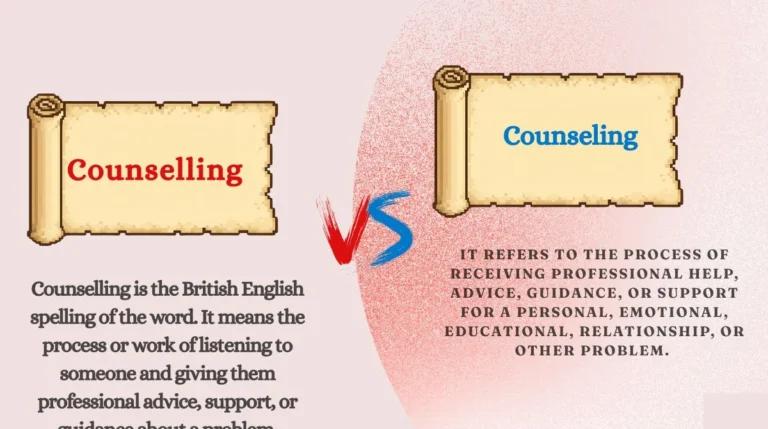
Counselling is the British English spelling of the word. It means the process or work of listening to someone and giving them professional advice, support, or guidance about a problem.
Cambridge Dictionary describes counselling as the job or process of listening to someone and giving advice about their problems. Oxford also lists counselling as the British form and gives examples such as relationship counselling and student counselling.
The word is commonly used when talking about emotional problems, relationships, education, careers, stress, family issues, and other personal concerns.
For example:
- She decided to get counselling after a difficult year.
- The school offers free counselling to students.
- They went to relationship counselling together.
- He works in a counselling centre in London.
- The doctor recommended professional counselling.
- Many students use the university’s counselling service.
- She received counselling after losing her job.
- The couple found counselling helpful.
When Should You Use “Counselling”?
Use counselling when you are following British English spelling.
It is especially common in the United Kingdom and in writing that follows British spelling conventions. The word can appear in many expressions, including:
- career counselling
- student counselling
- marriage counselling
- relationship counselling
- financial counselling
- grief counselling
- professional counselling
- counselling service
- counselling session
- counselling centre
For example:
The university provides career counselling for final-year students.
Here, counselling is used because the sentence follows British English spelling.
Grammar Rule for “Counselling”
Counselling is usually a noun when it refers to the activity or process of helping someone through advice and support.
It is generally treated as an uncountable noun when referring to the activity as a whole.
For example:
She needs counselling.
We do not normally say:
She needs a counselling. ❌
Instead, we can say:
She needs counselling. ✅
If you want to talk about one particular meeting, you can use a counselling session:
She has a counselling session tomorrow.
This is an important point for learners because English often uses counselling as the name of an activity rather than as a countable object.
A Common Confusion About “Counselling”
Some learners think the extra l makes counselling a different word from counseling. It does not.
The two spellings have the same meaning. The difference is spelling convention, not meaning.
So these sentences mean essentially the same thing:
She is receiving counselling.
She is receiving counseling.
The first follows British spelling, while the second follows American spelling.
What Does “Counseling” Mean?
Counseling is the American English spelling of the same word.
It refers to the process of receiving professional help, advice, guidance, or support for a personal, emotional, educational, relationship, or other problem. Cambridge labels counseling as the US spelling, while Oxford’s American dictionary uses counseling as the standard American form.
Here are some examples:
- She started counseling last month.
- The college offers free counseling services.
- He went to counseling after the accident.
- They decided to try marriage counseling.
- The doctor suggested counseling.
- Many employees have access to workplace counseling.
- She works as a counseling psychologist.
- The school provides counseling for students.
When Should You Use “Counseling”?
Use counseling when you are writing in American English.
It is particularly common in American books, websites, schools, universities, medical information, and professional writing.
For example:
The university provides counseling services to students.
This is natural American English.
You might also see:
- career counseling
- student counseling
- marriage counseling
- mental health counseling
- financial counseling
- family counseling
- counseling service
- counseling center
- counseling session
Notice another related spelling difference:
counseling center is American English.
In British English, you are more likely to see:
counselling centre
The spelling of both words changes according to the English variety.
Grammar Rule for “Counseling”
Like counselling, counseling is commonly used as an uncountable noun when it means the general activity or process.
For example:
He is getting counseling. ✅
Not normally:
He is getting a counseling. ❌
However, you can use a countable noun with it when you mean a particular event:
He has a counseling session on Friday.
This makes the sentence clear because session is the countable noun.
Common Learner Confusion
The most common mistake is thinking that one spelling is correct and the other is wrong.
That is not the case.
Counselling = British English
Counseling = American English
Both are standard spellings.
If you are writing an essay in British English, choose counselling and continue using British spelling throughout your work.
If you are writing for an American audience, choose counseling.
The main goal is consistency.
Difference Between Counselling and Counseling
The biggest difference between counselling and counseling is the spelling.
There is no important difference in basic meaning. Both words describe the process of receiving advice, support, or professional guidance.
Comparison Table
| Feature | Counselling | Counseling |
|---|---|---|
| English variety | British English | American English |
| Meaning | Professional advice and support | Professional advice and support |
| Extra “l” | Yes | No |
| Common spelling | UK and other British-style writing | US English |
| Example | She needs counselling. | She needs counseling. |
| Related person | counsellor | counselor |
| Related place | counselling centre | counseling center |
| Meaning difference | None | None |
Cambridge explicitly describes counselling as mainly UK and counseling as US, while Oxford similarly marks counselling as the British form and counseling as the American form.
Usage Difference
The choice depends on your audience and the spelling system you are following.
If your writing uses British English, write:
The school offers counselling services.
If your writing uses American English, write:
The school offers counseling services.
Both sentences are correct.
Grammar Logic
There is no separate grammar rule that makes one form a noun and the other something else.
Both are used as nouns when referring to the process or activity.
The spelling difference comes from different English spelling conventions.
This is important: do not treat counselling and counseling as two different vocabulary words.
They are spelling variants of the same word.
Sentence Structure
The sentence structure stays the same.
British:
She received counselling from a trained professional.
American:
She received counseling from a trained professional.
The only change is the spelling of the key word.
You can also use both after common verbs:
- receive counselling/counseling
- get counselling/counseling
- provide counselling/counseling
- offer counselling/counseling
- attend counselling/counseling
- seek counselling/counseling
For example:
The clinic provides counselling to young people.
The clinic provides counseling to young people.
Again, the meaning remains the same.
Why Does One Spelling Have Two “L”s?
This is where many learners become confused.
The spelling difference follows a broader pattern between British and American English.
British English often keeps an additional l in certain forms of words ending in -l, especially when a suffix is added.
American English often uses a single l in these forms.
Compare:
- travelling — traveling
- travelled — traveled
- cancelled — canceled
- counsellor — counselor
- counselling — counseling
This does not mean that every British or American word follows one simple rule without exceptions. English spelling has developed over a long period and contains many historical patterns.
For this particular word, however, the easiest thing to remember is:
British: counselling
American: counseling
Oxford gives the related verb counsel as counselled/counseled and counselling/counseling, with the American forms using one l.
Grammar Rules You Must Remember
Rule 1: Both Spellings Are Correct
Do not mark either spelling as automatically wrong.
Counselling is correct British English.
Counseling is correct American English.
Example:
She decided to start counselling. ✅ British
She decided to start counseling. ✅ American
Rule 2: Match the English Variety You Are Using
If your school, university, employer, or website follows British English, use counselling.
If it follows American English, use counseling.
For example:
British:
The counselling centre is open until six.
American:
The counseling center is open until six.
Notice that centre/center changes too.
Rule 3: Do Not Mix Spelling Styles Without a Reason
Consistency makes your writing look more polished.
For example, if you are using:
- centre
- colour
- travelling
- counsellor
then counselling usually fits that British spelling style.
If you are using:
- center
- color
- traveling
- counselor
then counseling fits the American style.
You do not need to worry about this in casual communication, but it matters more in essays, professional documents, websites, and academic writing.
Rule 4: The Related Words Change Too
The same spelling pattern appears in related forms.
British English:
counsellor
counselling
American English:
counselor
counseling
Oxford identifies counsellor as the British form and counselor as the US form.
So if you write:
She spoke to a counsellor about her problems.
you are using British spelling.
In American English:
She spoke to a counselor about her problems.
The meaning is unchanged.
Common Mistakes Students Make
Mistake 1: Thinking “Counseling” Is Wrong
Some students learn British English first and assume counseling is a spelling mistake.
It is not.
Counseling is the standard American spelling.
Wrong idea:
“Counseling is misspelled because it needs two l’s.”
Correct idea:
“Counseling is the American spelling, while counselling is the British spelling.”
Mistake 2: Thinking “Counselling” Is Wrong
The opposite mistake is also common.
American English learners may see counselling and think the extra l is unnecessary.
But counselling is a standard British spelling.
For example:
The college offers counselling services.
There is nothing wrong with this sentence.
Mistake 3: Mixing British and American Forms
Consider this sentence:
The counseling centre offers career counselling.
It is understandable, but it mixes American counseling with British centre and counselling.
For a consistent British style, write:
The counselling centre offers career counselling.
For American style:
The counseling center offers career counseling.
Mixing varieties is not always a serious error, but consistency is usually better in formal writing.
Mistake 4: Adding “A” Before Counselling or Counseling
Learners sometimes write:
I need a counseling. ❌
or:
She received a counselling. ❌
When referring to the activity generally, these forms are normally uncountable.
Better:
I need counseling.
She received counselling.
If you mean one particular meeting, say:
I have a counseling session tomorrow.
or:
I have a counselling session tomorrow.
Mistake 5: Confusing “Counsel” and “Council”
The words counsel and council look similar but have different meanings.
Counsel can mean advice, or it can be a verb meaning to advise someone.
Council usually means an organized group or governing body.
For example:
She sought legal counsel.
But:
The city council held a meeting.
This distinction is useful because counselling/counseling comes from counsel, not from council.
Easy Trick to Remember the Difference
Here is a simple trick:
Think: British = Extra L
When you see British spelling, remember the extra L:
counseLLing
There are two L’s before -ing.
For American English, remove one:
counseling
You can also connect the words with their related nouns:
British:
counseLLor → counseLLing
American:
counselor → counseling
Another easy method is to remember the pairs:
travelling → British
traveling → American
counselling → British
counseling → American
cancelled → British
canceled → American
You do not need to memorize a complicated spelling rule. If you know which English variety you are writing, simply choose the matching spelling.
Real-Life Logic
Imagine you are writing for a British university:
The university counselling service is available to all students.
That looks natural in British English.
Now imagine an American university:
The university counseling service is available to all students.
That also looks natural.
The service itself has not changed. Only the spelling has changed.
Daily Life Examples
Here are some natural examples you may hear or use in everyday English.
1. Talking About School
Student: Does the school offer counselling?
Teacher: Yes. You can make an appointment with the school counsellor.
British spelling is used here.
2. Talking About a University
Student: Where can I get counseling?
Staff member: The counseling center is on the second floor.
This follows American English spelling.
3. Talking About Relationships
They decided to try relationship counselling before making a final decision.
The word counselling is commonly used in British-style writing.
4. Talking About Work
Our company provides free counseling for employees.
This sentence uses American spelling.
5. Talking About a Friend
My friend has been getting counselling to help with stress.
Here, counselling is the British spelling.
6. Talking About a Professional
She is seeing a counselor every week.
This uses the American spelling counselor.
In British English, you would normally write:
She is seeing a counsellor every week.
7. Talking About a Service
The hospital offers professional counseling services.
This is natural American English.
8. Talking About a Student
The student was referred to the university counselling service.
This follows British spelling.
9. Talking About a Session
I have a counseling session tomorrow morning.
The noun session makes it clear that we mean one particular appointment.
10. Talking About Career Help
I went to career counselling because I was not sure which job to choose.
In American English, the same sentence would use career counseling.
These examples show something important: changing the spelling does not change the basic meaning or sentence structure.
Practice Section
Choose the correct option based on the English variety mentioned.
1. British English
The university provides free ________ to students.
A. counseling
B. counselling
2. American English
She decided to start ________ after speaking with her doctor.
A. counselling
B. counseling
3. British English
I spoke to a ________ about my career.
A. counselor
B. counsellor
4. American English
The ________ center is open every weekday.
A. counselling
B. counseling
5. Both varieties
Which statement is correct?
A. Only counselling is correct.
B. Only counseling is correct.
C. Both are correct, depending on the English variety.
Answers
1. B — counselling
British English normally uses counselling.
2. B — counseling
American English normally uses counseling.
3. B — counsellor
Counsellor is the usual British spelling.
4. B — counseling
American English uses counseling center.
5. C — Both are correct
The difference is mainly British versus American spelling.
FAQs
1. What is the difference between counselling and counseling?
There is no major difference in meaning. Counselling is the usual British English spelling, while counseling is the usual American English spelling. Both refer to professional advice, support, or guidance.
2. Is counselling British or American English?
Counselling is mainly associated with British English. Cambridge specifically labels it as mainly UK and gives counseling as the usual US spelling.
3. Is counseling the correct spelling?
Yes. Counseling is a correct and standard spelling in American English. It is not a spelling mistake. Oxford’s American English dictionary uses counseling as the American form.
4. Which is correct: counselling or counseling?
Both are correct. Choose counselling if you are following British English and counseling if you are following American English. The important thing is to keep your spelling consistent.
5. Is counselling a formal word?
Yes. Counselling is a standard word used in professional, educational, medical, and everyday contexts. You can see it in phrases such as career counselling, student counselling, and relationship counselling.
6. What is the American spelling of counsellor?
The usual American spelling is counselor. British English generally uses counsellor. Both refer to a person trained to provide advice or support, depending on the context.
Conclusion
So, counselling or counseling—which one should you use? The simple answer is that both are correct. The difference is mainly between British and American English spelling.
Use counselling when you are following British English. Use counseling when you are following American English. The meaning stays the same, and the sentence structure does not change.
Remember the easy trick: British English keeps the extra L, while American English usually uses one L. The same pattern can be seen in related words such as counsellor/counselor.
The most important thing is consistency. If your writing follows British English, keep using British spellings throughout your text. If it follows American English, use American forms.
Once you learn this small difference, you will no longer need to stop and wonder whether counselling or counseling is correct. Just check which English variety you are using, choose the matching spelling, and keep writing with confidence.

Evan Rellmont is a writer who turns thoughtful ideas into meaningful words, creating stories and reflections that connect, inspire, and leave a lasting impression.