
Have you ever stopped while writing a sentence and wondered whether the correct spelling is seeing or seing? You are not alone.
This is a common spelling problem, especially for English learners who are still learning how verbs change when we add -ing.
At first, seing may look reasonable. The base verb is see, so a learner may think that we simply remove the final letter and add -ing.
But English does not work that way with this particular verb. The correct form is seeing, with two e’s before -ing.
The word seeing is very common in everyday English. We use it when talking about what our eyes notice, meeting people, watching something, understanding something, and several other situations.
Cambridge Dictionary lists seeing as the present participle of see.
Understanding this small spelling difference can help you avoid mistakes in school assignments, emails, messages, social media posts, and professional writing.
By the end of this guide, you will know exactly why seeing is correct, why seing is incorrect in standard English, how to use seeing in sentences, and how to remember the spelling without having to think about it every time.
What Does “Seeing” Mean?
Seeing is the correct spelling.
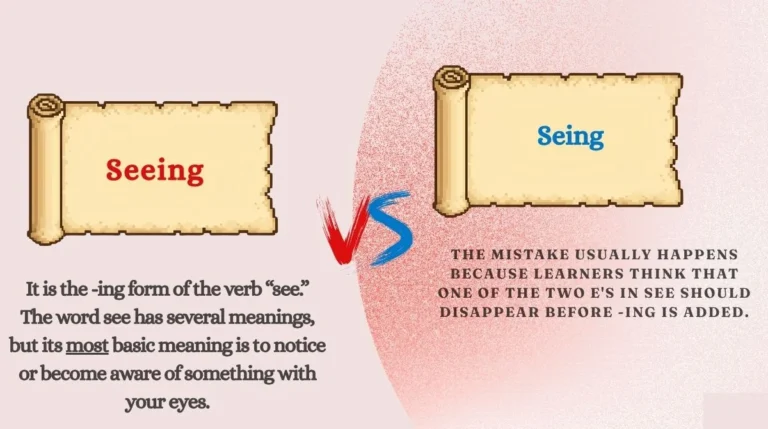
It is the -ing form of the verb “see.” The word see has several meanings, but its most basic meaning is to notice or become aware of something with your eyes.
For example:
- I am seeing a beautiful view from my window.
- She is seeing her friends this evening.
- We are seeing a movie tonight.
Cambridge Dictionary gives seeing as the present participle of see. The base verb see can mean to notice something with your eyes, meet or visit someone, understand something, watch something, or consider something in a particular way.
When Do We Use “Seeing”?
We use seeing in several common grammar structures.
1. With “be” to describe an action in progress
The most common use is in the present continuous tense:
am/is/are + seeing
Examples:
- I am seeing a doctor tomorrow.
- She is seeing her sister today.
- They are seeing a movie tonight.
- We are seeing some friends this weekend.
Here, seeing is part of the verb phrase.
For example:
I am seeing my teacher after lunch.
The word am is the helping verb, while seeing is the main verb in its -ing form.
2. As a gerund
An -ing form can also work like a noun. In this use, seeing can be the subject or object of a sentence.
For example:
Seeing is believing.
Here, seeing is being used as a noun-like form.
Another example is:
I enjoy seeing my old friends.
The activity of seeing or meeting old friends is the thing the speaker enjoys.
3. After certain verbs and expressions
We can use seeing after some verbs and expressions.
For example:
- I enjoy seeing new places.
- She loves seeing her grandchildren.
- He kept seeing the same mistake.
- They talked about seeing a movie.
The exact meaning depends on the sentence.
4. In expressions such as “seeing that”
The word seeing can also be used as part of the expression seeing that, which means something like considering the fact that.
For example:
Seeing that it was raining, we stayed home.
Cambridge Dictionary also records seeing that as a conjunction meaning “considering or accepting the fact that.”
8 Example Sentences With “Seeing”
Here are some easy examples:
- I am seeing my doctor tomorrow.
- She is seeing a beautiful sunset.
- We are seeing our cousins this weekend.
- He enjoys seeing new places.
- I am seeing what you mean now.
- They are seeing a movie tonight.
- Seeing that it was late, we went home.
- Seeing her smile made me happy.
Notice that the spelling stays seeing in every sentence.
A Common Learner Confusion
Many learners think:
see + ing = seing
This looks logical if you have learned simple rules such as:
- read + ing = reading
- work + ing = working
- jump + ing = jumping
However, see is different because it already ends in two e’s. We do not remove one of those e’s when adding -ing.
The correct formation is:
see + ing = seeing
Not:
see + ing = seing
That extra e is important.
What Does “Seing” Mean?
Seing is not the standard English spelling of the -ing form of see.
If you want to write the present participle of see, the correct word is:
seeing
So:
❌ I am seing the doctor tomorrow.
is incorrect.
The correct sentence is:
✅ I am seeing the doctor tomorrow.
The mistake usually happens because learners think that one of the two e’s in see should disappear before -ing is added.
But this does not happen.
The spelling remains:
see + ing = seeing
There is no standard grammar rule that changes this into seing.
Why Does “Seing” Look Correct to Some Learners?
The confusion comes from the spelling patterns of other verbs.
For example:
- make → making
- write → writing
- take → taking
- dance → dancing
With many verbs ending in a silent e, the final e is removed before -ing is added.
For example:
make + ing → making
write + ing → writing
A learner may therefore assume that:
see + ing → seing
But see is not treated like make or write in this spelling pattern.
The word see ends in ee, and the standard -ing form keeps both e’s:
seeing
Cambridge specifically lists seeing as the present participle of see.
Is “Seing” a Word?
For normal English writing, seing should be treated as an incorrect spelling of seeing.
If you are writing an essay, school assignment, website article, email, application, or professional message, use seeing, not seing.
For example:
❌ I am seing my friend tomorrow.
✅ I am seeing my friend tomorrow.
Examples Showing the Correct Form
Here are more examples:
- I am seeing my brother tonight.
- Are you seeing the doctor tomorrow?
- She is seeing something strange.
- We are seeing a new movie.
- He enjoys seeing his old classmates.
- I am seeing the problem now.
- They were seeing each other regularly.
- Seeing the accident made him nervous.
In every case, seeing contains two e’s before -ing.
Difference Between Seeing and Seing
The main difference is simple:
Seeing is correct. Seing is incorrect when you mean the -ing form of “see.”
There is no difference in meaning because seing is not the standard spelling you should use for this verb.
| Word | Correct? | Meaning | Use |
|---|---|---|---|
| Seeing | ✅ Yes | -ing form of “see” | Used in standard English |
| Seing | ❌ No | Incorrect spelling of “seeing” | Avoid in standard English |
Usage Difference
There is really only one correct choice when you want the -ing form of see.
Use:
seeing
Do not use:
seing
For example:
❌ She is seing her friends.
✅ She is seeing her friends.
The second sentence is correct because seeing is the established present participle form of see.
Grammar Logic
The important point is that adding -ing does not always follow one simple spelling rule.
English has several spelling patterns.
For many verbs ending in a silent e, the e disappears:
- hope → hoping
- write → writing
- make → making
But see is different.
It already ends in ee, and the spelling of the vowel combination is maintained:
see → seeing
Think of it as:
SEE + ING
There is no reason to remove one of the e’s.
Sentence Structure
Seeing can appear in different sentence structures.
Present continuous
Subject + am/is/are + seeing
I am seeing my friend.
She is seeing a doctor.
They are seeing a movie.
Past continuous
Subject + was/were + seeing
I was seeing my friend when you called.
They were seeing the sights of the city.
Gerund
Seeing + object/complement
Seeing the ocean made me happy.
I enjoy seeing new places.
So the spelling does not change simply because the grammar changes.
Meaning Comparison
Seeing can have different meanings depending on context.
It can mean:
- using your eyes to notice something
- meeting or visiting someone
- watching something
- understanding something
- considering something
- experiencing something
For example:
I am seeing a bird.
Here, it means noticing with your eyes.
I am seeing my friend tonight.
Here, it means meeting or spending time with the friend.
I am seeing what you mean.
Here, it means understanding.
Cambridge documents several of these meanings for the verb see, including noticing with the eyes, meeting or visiting someone, understanding, and considering something.
Grammar Rules You Must Remember
Rule 1: The correct -ing form of “see” is “seeing”
This is the most important rule.
When you add -ing to see, keep both e’s.
see + ing = seeing
Example:
I am seeing my friend tomorrow.
Not:
I am seing my friend tomorrow.
A quick spelling check can save you from this common mistake.
Rule 2: Do not remove one “e” from “see”
The word see has two e’s:
s + e + e
When you make its -ing form, both e’s remain:
s + e + e + i + n + g
So:
see → seeing
This is different from verbs such as write, make, and take, where the final silent e is removed.
Examples:
- write → writing
- make → making
- take → taking
- see → seeing
Example:
She is seeing her parents this weekend.
Rule 3: “Seeing” can be part of a continuous verb phrase
Use seeing after a form of be when the grammar requires the continuous form.
Examples:
I am seeing my dentist tomorrow.
She is seeing a movie tonight.
They were seeing the sights of the city.
The structure is:
am/is/are/was/were + seeing
Remember that the helping verb changes according to the tense and subject, but seeing keeps the same spelling.
Rule 4: “Seeing” can also work as a gerund
An -ing form does not always describe an action happening right now. It can also act like a noun.
For example:
Seeing is believing.
Here, seeing is the name of an activity or experience.
Another example:
I enjoy seeing my family.
Here, seeing functions as the activity that the speaker enjoys.
So do not assume that every -ing word automatically means “happening right now.”
Common Mistakes Students Make
The most common mistake is simply leaving out one of the e’s.
Mistake 1: Writing “seing”
❌ I am seing my friend today.
✅ I am seeing my friend today.
The learner has removed one e from see before adding -ing.
Mistake 2: Thinking every verb ending in “e” loses the e
This is an understandable mistake.
Students learn:
make → making
and then apply the same idea to see.
But English spelling has exceptions and special patterns.
Compare:
- make → making
- write → writing
- hope → hoping
- see → seeing
The correct form must be learned as seeing.
Mistake 3: Using “seing” in questions
Some learners may remember the correct spelling in statements but forget it when making questions.
For example:
❌ Are you seing your doctor tomorrow?
✅ Are you seeing your doctor tomorrow?
The spelling does not change because the sentence is a question.
Mistake 4: Using “seing” in formal writing
A spelling error that seems small can still make your writing look careless.
Avoid seing in:
- school assignments
- exams
- job applications
- emails
- reports
- blog posts
- website content
- business communication
Use seeing instead.
Easy Correction Tip
Whenever you type seing, stop for a second.
Ask yourself:
“What is the base verb?”
The answer is see.
Now add -ing:
see + ing
That gives you:
seeing
This simple check works surprisingly well.
Easy Trick to Remember the Difference
Here is an easy memory trick:
“SEE keeps both E’s when ING arrives.”
Think of the word as:
SEE + ING = SEEING
Imagine that the two e’s are friends holding hands. When -ing comes along, neither e leaves.
So remember:
SEE keeps EE → SEEING
This is much easier than trying to memorize a complicated spelling rule.
Think About the Word “See”
The base word is:
SEE
Now attach:
ING
Do not change the base word:
SEE + ING
Result:
SEEING
If you see seing, something is missing. One of the e’s has disappeared.
A Quick Visual Memory Trick
You can remember it this way:
SEE → SEEING
Look at the first part:
SEE
It stays exactly the same.
Then ING is added:
SEE + ING
That gives:
SEEING
This trick is especially useful for students who often make spelling mistakes while typing quickly.
Daily Life Examples
The word seeing is very common in everyday English. Here are some natural examples you might hear in conversations.
1. Talking about meeting someone
A: What are you doing tonight?
B: I am seeing my cousin.
Here, seeing means meeting or spending time with someone.
2. Talking about a doctor
A: Why are you leaving work early?
B: I am seeing the doctor this afternoon.
Here, seeing means visiting or having an appointment with the doctor. Cambridge also gives examples of see meaning to meet or visit someone.
3. Talking about a movie
A: Do you want to go to the cinema?
B: Sure. We are seeing a movie tonight.
Here, seeing means watching a movie.
4. Talking about understanding
A: Do you understand what I mean?
B: Yes, I am seeing your point now.
Here, the idea is understanding or recognizing the point.
5. Talking about a beautiful view
A: What can you see from your window?
B: I am seeing the mountains from here.
The word refers to noticing something with your eyes.
6. Talking about friends
A: Are you free on Saturday?
B: No, I am seeing some old friends.
The meaning here is meeting friends.
7. Talking about a problem
A: Do you understand the problem now?
B: Yes, I am seeing it more clearly.
Here, seeing means understanding or recognizing.
8. Talking about a new place
A: What did you do on vacation?
B: We enjoyed seeing new places.
Here, seeing refers to visiting or experiencing different places.
9. Talking about something happening
A: What are you looking at?
B: I am seeing something strange outside.
Here, the speaker means noticing something with their eyes.
10. A common expression
Seeing is believing.
This expression means that it can be easier to believe something after you have actually seen it.
The important point in all these examples is the spelling:
seeing
Never write seing when you mean the -ing form of see.
Practice Section
Choose the correct word: seeing or seing.
1. I am ______ my doctor tomorrow.
A. seeing
B. seing
2. Are you ______ your friends tonight?
A. seeing
B. seing
3. She enjoys ______ new places.
A. seeing
B. seing
4. We are ______ a movie this evening.
A. seeing
B. seing
5. I am ______ what you mean now.
A. seeing
B. seing
Answers
- A — seeing
- A — seeing
- A — seeing
- A — seeing
- A — seeing
The answer is always seeing because that is the correct -ing form of see.
A useful way to check each answer is to return to the base verb:
see + ing = seeing
FAQs
What is the difference between seeing and seing?
Seeing is the correct spelling and is the -ing form of the verb see. Seing is an incorrect spelling when you mean this verb form. The two forms should not be treated as two different English words. Use seeing in standard English.
Is “seing” a correct word?
No, seing is not the standard spelling of the -ing form of see. The correct spelling is seeing. If you are writing a sentence such as “I am seeing my friend,” always use the double e.
Why is seeing spelled with two e’s?
The base verb is see, which already contains two e’s. When -ing is added, the spelling remains see + ing, giving seeing. Unlike many verbs ending in a single silent e, see does not lose an e in this form.
Can I use “seeing” in questions?
Yes. Seeing can be used naturally in questions.
For example:
“Are you seeing your doctor tomorrow?”
“Are you seeing anyone this weekend?”
The spelling remains seeing whether the sentence is a statement, question, or negative sentence.
Is “seeing” a verb?
Yes. Seeing is the present participle or -ing form of the verb see. It can be used in continuous verb phrases, such as “I am seeing my friend.” It can also function as a gerund in sentences such as “Seeing is believing.” Cambridge identifies seeing as the present participle of see.
Is seeing formal or informal English?
Seeing is normal standard English and can be used in both formal and informal situations. You can use it in everyday conversation, school writing, professional emails, and other standard forms of English. The important spelling point is to write seeing, not seing.
Conclusion
The spelling question “seeing or seing?” has a simple answer: seeing is correct, while seing is an incorrect spelling when you mean the -ing form of see.
The reason learners often make this mistake is easy to understand. Many English verbs ending in a single silent e lose that e before -ing, as in make → making and write → writing. But see is different. It keeps both e’s when -ing is added.
So remember this simple pattern:
SEE + ING = SEEING
The word seeing can mean noticing something with your eyes, meeting someone, watching something, understanding something, or considering something, depending on the sentence.
The best way to remember the spelling is to think: “SEE keeps both E’s.” With a little practice, seeing will soon feel natural, and you will no longer have to stop and wonder whether seing is correct.

Evan Rellmont is a writer who turns thoughtful ideas into meaningful words, creating stories and reflections that connect, inspire, and leave a lasting impression.