
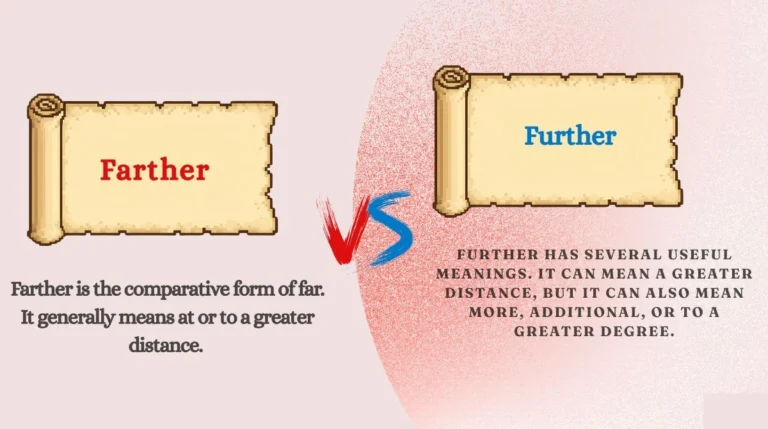
Further or farther? These two words confuse many English learners because they look almost the same and are both connected with the word far.
In many sentences, they can even be used in the same way. That makes the choice feel harder than it really is.
The good news is that you do not need to memorize a long list of complicated grammar rules.
The main idea is quite simple. Farther is traditionally connected with physical distance, such as walking, driving, running, or moving from one place to another. Further can also describe distance, and it is especially common in British English.
It is also used for ideas such as more, additional, or to a greater degree.
For example, you can say, “How much farther do we have to walk?” You can also say, “We need further information.” The first sentence talks about distance.
The second talks about additional information.
By the end of this guide, you will understand when to use further, when to use farther, why both can sometimes be correct, and how to avoid common mistakes.
You will also see simple examples from everyday English, so the difference becomes natural rather than something you have to think about every time.
What Does “Farther” Mean?
Farther is the comparative form of far. It generally means at or to a greater distance. It is most strongly associated with physical distance, such as the distance between two places or how much farther someone needs to travel.
Think about a person standing at a bus stop. The person may say:
“The next bus stop is farther than I thought.”
Here, farther describes actual distance.
You can use it when talking about walking, driving, running, traveling, moving, or looking at something that is physically more distant.
Grammar rule for “farther”
The basic pattern is:
farther + than
or:
verb + farther
For example:
- This shop is farther than the supermarket.
- We walked farther than we planned.
- The airport is farther away than I expected.
- How much farther do we have to go?
Farther can also appear before a noun as an adjective:
- We reached the farther shore.
- They live on the farther side of the valley.
Cambridge and Oxford both note that farther and further can be used for distance. In North American English, farther/farthest are especially common for physical distance, while British English often uses further/furthest instead.
Examples of “farther”
- How much farther is the airport?
- We need to walk farther to reach the village.
- My new house is farther from school.
- She ran farther than her brother.
- The mountains looked farther away after the rain started.
- Can you throw the ball farther?
- The farther shore was covered with trees.
- We drove farther north before stopping for lunch.
Notice that all these examples can be connected to distance or movement.
A common confusion about “farther”
Many learners are taught one simple rule:
Farther = physical distance.
Further = everything else.
This is a useful shortcut for beginners, but it is not the complete story.
Modern English allows further to be used for physical distance too. Cambridge specifically says that further means the same as farther when talking about distance, and further is more common overall.
So these can both be correct:
- We walked farther down the road.
- We walked further down the road.
The important point is that farther is not wrong simply because English also allows further.
What Does “Further” Mean?
Further has several useful meanings. It can mean a greater distance, but it can also mean more, additional, or to a greater degree. It can even work as a verb meaning to help something develop or progress.
For beginners, the easiest way to understand it is:
Further can mean “more” or “additional,” and it can also refer to distance.
This makes further more flexible than farther.
Further for distance
When talking about physical distance, further can be used just like farther:
- We walked further down the road.
- How much further do we have to travel?
- The school is further from here than I expected.
This usage is especially common in British English. Oxford notes that British English commonly uses further/furthest for distance, while North American English commonly uses farther/farthest for physical distance.
Further meaning “more” or “additional”
This is where further becomes very important.
For example:
- Do you need further information?
- We need further discussion.
- Are there any further questions?
- The company needs further evidence.
- Please wait for further instructions.
In these sentences, further does not mean physical distance. It means more or additional.
You would not normally replace further with farther here.
For example:
❌ Please give me farther information.
✅ Please give me further information.
Grammar rule for “further”
Further can be used as:
1. An adverb
- We need to investigate further.
- I don’t want to discuss it further.
2. An adjective
- We need further information.
- Do you have any further questions?
3. A verb
- This training will further your career.
- The project aims to further scientific research.
Cambridge lists this verb meaning as developing or making progress in something.
Examples of “further”
- Do you need any further information?
- We need to discuss this matter further.
- Please contact me if you have any further questions.
- The investigation will continue further.
- The company needs further evidence before making a decision.
- I don’t want to go any further into the subject.
- Further research may be necessary.
- This experience helped further her career.
Notice how many of these examples are about ideas, information, discussion, progress, or additional things rather than physical distance.
Difference Between Further and Farther
The easiest way to understand the difference is to look at what kind of “distance” or “more” you mean.
Traditionally, farther is preferred for physical distance, while further is preferred for figurative distance, degree, extent, or additional things. However, modern English does not always keep this distinction. Both words can describe physical distance, and further is very common for that purpose, especially in British English.
Further vs. Farther comparison table
| Point | Farther | Further |
|---|---|---|
| Basic meaning | Greater distance | Greater distance, more, or additional |
| Physical distance | Yes | Yes |
| “More” or “additional” | Usually no | Yes |
| Ideas or degree | Usually no | Yes |
| Common in British English for distance | Less common | More common |
| Common in North American English for physical distance | More common | Also used |
| Can be an adjective | Yes | Yes |
| Can be an adverb | Yes | Yes |
| Can be a verb | No | Yes |
1. Usage difference
Use farther when you want to make the idea of physical distance clear:
We drove farther than expected.
Here, the people actually moved through physical space.
Use further when you mean additional:
We need further information.
You are not talking about miles or meters. You are talking about more information.
2. Grammar logic
Both words are comparative forms related to far.
The basic pattern is:
far → farther/further
Their superlative forms are:
far → farthest/furthest
Cambridge describes farther and further as irregular comparative forms of far. It also notes that further is more common overall.
Examples:
- This road is farther than that one.
- This road is further than that one.
- This is the farthest point we can reach.
- This is the furthest point we can reach.
3. Sentence-structure difference
Farther often appears with verbs of movement:
- walk farther
- drive farther
- run farther
- travel farther
- move farther
Examples:
We need to walk farther.
She can run farther than me.
Further can also be used in these structures:
We need to walk further.
But further has additional sentence patterns that farther does not normally have:
We need further information.
Let’s discuss the problem further.
Do you have any further questions?
4. Meaning comparison
Compare these two sentences:
We walked farther.
This usually suggests physical distance.
Now:
We discussed the issue further.
This means we continued or developed the discussion. It has nothing to do with physical space.
That is the main distinction beginners should remember.
Grammar Rules You Must Remember
Rule 1: Use “farther” for physical distance when you want to make the distinction clear
If you are talking about actual space, farther is a safe and clear choice, particularly in North American English.
Examples:
The store is farther away than I expected.
We walked farther than the other group.
How much farther do we need to go?
The idea is measurable distance.
You could often use further in these sentences too, especially in British English.
Rule 2: Use “further” for additional or extra things
When further means more or additional, use further, not farther.
Examples:
Do you need further information?
We need further evidence.
There will be further discussion tomorrow.
Please wait for further instructions.
This is one of the strongest rules to remember because farther does not normally have this meaning. Oxford specifically gives further as meaning “more” or “additional.”
Rule 3: Use “further” for a greater degree or continued discussion
Further is common when talking about ideas, progress, discussion, investigation, or an action that continues.
Examples:
Let’s examine this issue further.
The police decided to investigate further.
We need to think about this further.
I don’t want to discuss it further.
Here, there is no physical distance. The word means something like more deeply or to a greater extent.
Rule 4: Remember that “further” can also describe physical distance
Do not think that further = non-physical in every situation.
That old classroom rule is too strict for modern English.
These are both possible:
We walked farther down the road.
We walked further down the road.
Cambridge states that further and farther have the same meaning when talking about distance. It also notes that further is more common.
So, if you see “We went further,” do not assume the sentence is incorrect.
Common Mistakes Students Make
These words cause mistakes because learners often try to create a perfect one-to-one rule. English is not always that neat.
Mistake 1: Using “farther” for “additional”
❌ Do you need farther information?
✅ Do you need further information?
Why?
Because information does not have physical distance. Here, further means additional.
Mistake 2: Thinking “further” can never mean physical distance
Some students learn:
“Farther is for distance, so further is never for distance.”
That is incorrect.
Both can describe physical distance:
We walked farther down the beach.
We walked further down the beach.
Both forms are used in English. Further is especially common in British English.
Mistake 3: Using “farther” with abstract ideas
❌ Let’s discuss this farther.
✅ Let’s discuss this further.
Why?
The discussion is not moving through physical space. Further means “more” or “to a greater degree.”
Another example:
❌ We need to investigate the problem farther.
✅ We need to investigate the problem further.
Mistake 4: Confusing “further” with “farthest”
Remember that farther is comparative, while farthest is superlative.
Comparative means comparing two things or showing a greater amount:
Ali ran farther than Tom.
Superlative means the greatest amount among three or more:
Ali ran the farthest of all the students.
The same pattern applies to further and furthest:
We went further than they did.
They went the furthest.
Cambridge identifies farther/further as comparative forms and farthest/furthest as superlative forms.
Easy Trick to Remember the Difference
Here is a simple trick that works well for beginners:
Think: Farther = physical far
If you can imagine a person, car, road, building, mountain, or place moving farther away, farther is a good choice.
For example:
The bus stop is farther away.
We walked farther.
She threw the ball farther.
Now use this second memory idea:
Further = “more”
If you can replace the word with more or additional, choose further.
For example:
We need further information.
You can think:
We need more information.
Another example:
Do you have any further questions?
Think:
Do you have any more questions?
This trick will solve many everyday grammar questions.
But remember one important detail: further can also be used for physical distance. So the trick is a helpful guide, not a strict law.
A real-life memory picture
Imagine you are driving.
You say:
“How much farther do we have to drive?”
You are thinking about road distance.
Now imagine you are talking to a teacher.
You say:
“I need further explanation.”
You are asking for more explanation.
So remember:
Road = farther
More = further
And when you hear “further” used for distance, don’t worry. That is normal English too.
Daily Life Examples of Further and Farther
Here are some natural sentences you might hear in everyday conversations.
Example 1: Asking about a journey
A: Are we close to the hotel?
B: Not yet. We have to drive farther.
This clearly talks about physical distance.
Example 2: Asking for more information
A: Do you understand the instructions?
B: Not completely. Can you give me further information?
Here, further means additional information.
Example 3: Talking about walking
A: Should we keep walking?
B: Yes. The park is a little farther down the road.
The word refers to physical distance.
Example 4: Continuing a conversation
A: Can we discuss this problem further?
B: Sure. Let’s talk about it after lunch.
Here, further means more or in greater detail.
Example 5: Talking about a school
A: Is your new school far away?
B: Yes. It’s farther from my home than my old school.
This is physical distance.
Example 6: Asking for extra help
A: Do you have any further questions?
B: Yes. I have one more question.
Here, further means additional.
Example 7: Talking about a trip
A: How much farther do we have to travel?
B: About twenty kilometers.
The distance is physical and measurable.
Example 8: Talking about research
A: Is this enough information?
B: No. We need further research.
Further means additional or more.
Example 9: Talking about continuing an activity
A: Should we go further into the forest?
B: Maybe not. It’s getting dark.
Here, further is used for physical distance. This is completely natural.
Example 10: Asking someone to continue
A: Would you like to explain this further?
B: Yes. The main problem is the cost.
Here, further means “in more detail.”
These examples show why it is better to understand the meaning of each word instead of memorizing only one rigid rule.
Practice Section: Choose the Correct Word
Choose further or farther in each sentence.
1. How much ______ do we have to walk?
A. further
B. farther
2. Please send me ______ information about the course.
A. further
B. farther
3. My new house is ______ from the city center.
A. further
B. farther
4. We need to discuss this matter ______.
A. further
B. farther
5. She ran ______ than anyone else in the race.
A. further
B. farther
Answers
1. Farther / Further — Both can be used because the sentence talks about physical distance. Farther is a traditional choice for physical distance.
2. Further — It means additional information.
3. Farther / Further — Both are possible for physical distance. Regional usage can affect the preferred choice.
4. Further — The discussion is abstract, so further means “more” or “in greater detail.”
5. Farther / Further — Both can be used for distance. Farther is especially natural in North American English for physical distance.
FAQs
What is the difference between further and farther?
Traditionally, farther is used for physical distance, while further is used for additional information, greater degree, or abstract progress. However, both words can be used for physical distance, and further is particularly common in British English.
Can further be used for physical distance?
Yes. Further can describe physical distance just like farther.
For example:
We walked further down the road.
This is correct. In fact, Cambridge notes that further and farther have the same meaning when they refer to distance.
Is farther only used for physical distance?
Farther is mainly associated with greater distance, especially physical distance. It is not normally used to mean “additional.”
For example, say further information, not farther information.
Which is correct: “further information” or “farther information”?
The correct expression is further information.
Here, further means additional or more. The phrase is common in everyday, academic, professional, and formal English.
Please contact us for further information.
Is further more common than farther?
Yes. Cambridge states that further is more common overall. Regional preferences also matter. British English commonly uses further for distance, while North American English often prefers farther for physical distance.
What is the difference between farther and farthest?
Farther is the comparative form, while farthest is the superlative form.
Use farther when comparing distances:
My house is farther than yours.
Use farthest when talking about the greatest distance:
My house is the farthest from the school.
The related forms further and furthest can also be used for comparison and greatest extent.
Conclusion
The difference between further and farther is easier once you focus on meaning instead of trying to memorize every possible sentence.
Use farther when you want to talk about a greater physical distance, especially in North American English. Use further when you mean more, additional, or to a greater degree. For example, you can walk farther, but you ask for further information.
However, there is an important point to remember: further can also describe physical distance. This is very common in British English and is also widely used elsewhere. So sentences such as “We walked further down the road” are perfectly normal.
When you are unsure, ask yourself: Am I talking about distance, or do I mean more/additional? That simple question will help you choose the right word in most situations.
Keep practicing with real sentences, and soon further and farther will feel much less confusing.

Evan Rellmont is a writer who turns thoughtful ideas into meaningful words, creating stories and reflections that connect, inspire, and leave a lasting impression.