
Drier vs dryer is a common spelling confusion, especially for English learners.
The two words look almost identical, sound the same in everyday speech, and are both connected to the word dry. That makes it easy to type one when you actually need the other.
The good news is that the difference is much simpler than it first appears.
Drier is normally the comparative form of the adjective dry. We use it when we compare one thing with another and mean “more dry.” For example, This towel is drier than that one.
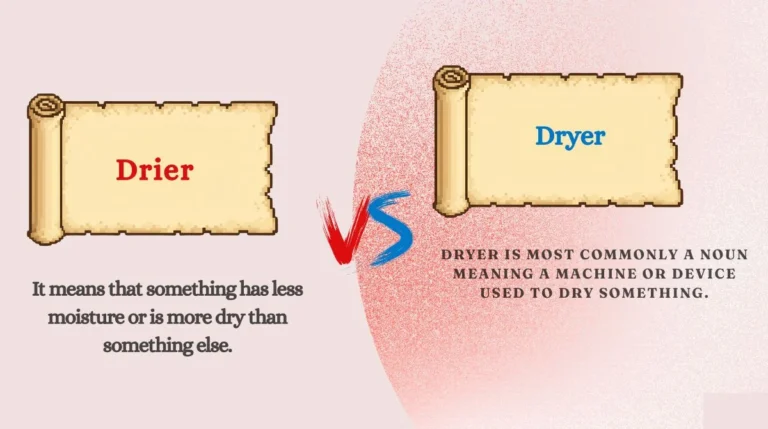
Dryer is most commonly a noun. It means a machine or device that removes moisture from something. You probably use or hear this word when talking about a hair dryer, clothes dryer, or tumble dryer. Major dictionaries list dryer as a machine for drying things, while drier is the regular comparative form of dry.
There is one small twist: drier can also be used as a noun, especially in British English, as another spelling of dryer. So the context matters.
By the end of this guide, you will know when to write drier, when to write dryer, how to build correct sentences, why people confuse them, and how to remember the difference without memorizing a difficult grammar rule.
What Does “Drier” Mean?
Drier is usually the comparative form of dry.
It means that something has less moisture or is more dry than something else.
For example:
- This shirt is drier than the other one.
- The air is drier today.
- My hair feels drier after swimming.
- This towel is drier than that towel.
Cambridge Dictionary identifies drier as the comparative form of dry, and Oxford gives drier as the comparative form of the adjective dry.
When Do We Use Drier?
Use drier when you are making a comparison.
The basic idea is:
dry → drier → driest
For example:
- Room A is dry.
- Room B is drier.
- Room C is the driest.
The word drier often appears with than because comparisons commonly follow this pattern:
A + is + drier + than + B
Example:
The desert is drier than the forest.
You can also use drier without than when the comparison is already clear from the situation:
After a few hours in the sun, the clothes are much drier.
The listener understands that the clothes have become more dry than before.
Grammar Rule for Drier
Because drier is normally a comparative adjective, it describes a person, place, thing, condition, or situation.
It commonly comes:
- before a noun
- after a linking verb such as be, feel, look, or seem
- with than in direct comparisons
- with words such as much, far, a little, and slightly
Examples:
We need drier soil for these plants.
My skin feels drier in winter.
This towel is much drier now.
The northern region is drier than the south.
8 Example Sentences with Drier
- This towel is drier than the one on the floor.
- The weather became drier as summer continued.
- My hair feels drier after using that shampoo.
- We need drier wood for the fire.
- The second room is drier than the first room.
- The clothes are getting drier in the sunlight.
- This area is much drier than the coastal region.
- The soil will become drier if it does not rain.
Common Confusion About Drier
Learners often see the ending -er and assume that drier must be the name of a machine.
That is not usually the case.
Compare these sentences:
The towel is drier now.
Here, drier describes the towel. It means more dry.
Put the towel in the dryer.
Here, dryer names a machine.
A useful question is:
Am I describing something, or am I naming a machine?
If you are describing something as more dry, drier is normally the word you need.
What Does “Dryer” Mean?
Dryer is most commonly a noun meaning a machine or device used to dry something.
It can dry clothes, hair, hands, crops, or other materials.
Cambridge defines a dryer as a machine that dries things, including examples such as a hair dryer and grain dryer. Oxford also lists dryer as a machine for drying something and notes that drier is another form.
Some very common expressions are:
- hair dryer
- clothes dryer
- tumble dryer
- hand dryer
- grain dryer
When Do We Use Dryer?
Use dryer when you are talking about a device or machine that dries something.
For example:
My clothes are in the dryer.
I need a new hair dryer.
The hand dryer is not working.
The clothes dryer makes a strange noise.
Here, the word is a noun because it names a thing.
Grammar Rule for Dryer
As a noun, dryer can be singular or plural.
Singular:
The dryer is broken.
Plural:
The dryers are noisy.
You can place a noun before it to show what kind of dryer you mean:
hair dryer
clothes dryer
hand dryer
grain dryer
The noun dryer comes from the verb dry plus the suffix -er, which can form words for a person, thing, or device that performs an action. Oxford traces the word to dry + -er.
8 Example Sentences with Dryer
- The clothes are in the dryer.
- I bought a new hair dryer yesterday.
- The dryer stopped working this morning.
- Please clean the dryer after using it.
- The hand dryer in the bathroom is broken.
- My sister uses a hair dryer every morning.
- The clothes dryer takes about an hour to finish.
- We need to repair the old dryer.
Common Confusion About Dryer
One reason this word causes trouble is that dictionaries also recognize drier as another spelling for the drying machine in some varieties of English.
Cambridge lists drier as another spelling of dryer when the word is a noun. Collins likewise gives drier as a variant spelling of dryer.
So:
Put the clothes in the dryer.
is completely normal.
And:
Put the clothes in the drier.
can also be found, particularly in British English.
However, when you are writing for a general English-learning audience, dryer is the clearest choice for the machine, while drier is the standard comparative spelling for dry.
That keeps the two meanings easy to separate.
Difference Between Drier and Dryer
The easiest way to understand drier vs dryer is to focus on meaning and word type.
Comparison Table
| Word | Common Part of Speech | Main Meaning | Example |
|---|---|---|---|
| drier | Adjective | More dry; having less moisture | The towel is drier now. |
| dryer | Noun | A machine or device that dries things | Put the towel in the dryer. |
| drier | Noun in some usage | Another spelling of dryer | The clothes are in the drier. |
| dry | Adjective | Not wet; without much moisture | The towel is dry. |
The main distinction is straightforward: drier is normally used to compare levels of dryness, while dryer usually names a machine. Dictionaries also record drier as an alternative noun spelling for dryer.
Usage Difference
Consider this pair:
The clothes are drier.
The clothes are in the dryer.
The first sentence tells us about the condition of the clothes.
The second sentence tells us about the machine holding the clothes.
That is the key difference.
Here is another example:
This towel is drier than mine.
The towel is being described.
Your towel is in the dryer.
The machine is being named.
Grammar Logic
Think of drier as an adjective created from dry.
The word changes like this:
dry → drier → driest
This follows the normal pattern for many short adjectives ending in -y:
- happy → happier → happiest
- easy → easier → easiest
- busy → busier → busiest
- dry → drier → driest
The y changes to i before -er and -est.
So:
❌ dry + er = dryer, when you mean the comparative adjective
✅ dry → drier
For example:
Today is drier than yesterday.
Not:
Today is dryer than yesterday.
That distinction is especially useful for learners.
Sentence Structure Difference
A common structure with drier is:
Subject + linking verb + drier
Example:
The clothes are drier.
Another common pattern is:
Subject + linking verb + drier + than + comparison
Example:
The towels are drier than the shirts.
You can also place drier before a noun:
We need drier weather.
With dryer, the structure usually treats the word as a thing:
Subject + verb + the dryer
Example:
I cleaned the dryer.
Or:
There + be + noun
Example:
There is a new dryer in the laundry room.
Meaning Comparison
Here is a very simple test:
Drier = more dry
Dryer = a machine that dries
Try replacing the word.
The ground is drier.
Can you say:
The ground is more dry?
Yes. The meaning is still clear.
Now try:
I bought a dryer.
Can you replace it with more dry?
No.
That tells you that dryer is being used as a noun for a device.
Grammar Rules You Must Remember
Rule 1: Use Drier for “More Dry”
When you compare two things and one has less moisture than the other, use drier.
Example:
This climate is drier than ours.
Here, drier means more dry.
Another example:
The towel became drier after an hour in the sun.
There is an understood comparison with its earlier condition.
A simple test is to replace drier with more dry.
This room is more dry.
The sentence sounds less natural, but the meaning shows you that drier is the comparative adjective.
Rule 2: Use Dryer for a Machine or Device
When you are talking about equipment that removes moisture, use dryer.
Example:
The washing machine is next to the dryer.
Other common examples include:
hair dryer
clothes dryer
hand dryer
grain dryer
Cambridge and Oxford both use the machine meaning in their dictionary entries for dryer.
Rule 3: Remember That Drier Can Also Be a Noun
English has an extra detail here.
Drier can be used as another spelling of the noun dryer. This usage is recognized by major dictionaries.
So you may see:
The clothes are in the drier.
This can be correct.
The context tells you that drier is being used as a noun rather than as a comparative adjective.
For learners, the safest mental shortcut is:
drier = more dry
dryer = machine
Then remember that drier may also be used as an alternative noun spelling.
Rule #4: Use Drier in Normal Comparisons
When the meaning is more dry, do not automatically write dryer simply because the spelling seems logical.
The correct comparative form taught in standard learner dictionaries is:
dry → drier → driest.
Examples:
My hands are drier now.
This season is drier than last season.
The paint is drier than it was an hour ago.
This soil is drier than the soil near the river.
Common Mistakes Students Make
Mistake 1: Using “Dryer” as the Comparative
A student may write:
❌ This towel is dryer than mine.
The intended meaning is probably “more dry,” so the standard comparative form is:
✅ This towel is drier than mine.
The confusion happens because dryer is a real English word. The spelling is not wrong in itself. It simply has a different common function.
Mistake 2: Using “Drier” When Naming a Machine
A learner may write:
❌ I put my clothes in the drier.
This sentence is not necessarily wrong because drier can be an alternative spelling of the noun dryer. However, dryer is the clearer and very common form for the machine.
For clear general writing:
✅ I put my clothes in the dryer.
Mistake 3: Forgetting the Change from Y to I
Students sometimes build the comparative as:
dry + er = dryer
But English spelling rules usually change the final y to i before -er:
dry → drier
Just as:
happy → happier
easy → easier
busy → busier
So when you mean more dry, remember the spelling drier.
Mistake 4: Choosing by Pronunciation
Drier and dryer are usually pronounced the same or almost the same.
Cambridge gives the same pronunciation for the two forms in its entries.
That means listening alone may not help you decide which spelling to write.
Instead, ask:
What does the word mean in my sentence?
If it means more dry, choose drier.
If it names the machine, choose dryer.
Wrong vs Correct Examples
| Wrong or less clear choice | Better choice | Why |
|---|---|---|
| This place is dryer than before. | This place is drier than before. | Comparative adjective |
| The shirt is dryer now. | The shirt is drier now. | Means more dry |
| Put the clothes in the drier. | Put the clothes in the dryer. | Clear machine spelling |
| I need a new hair drier. | I need a new hair dryer. | Common machine spelling |
| The air is dryer here. | The air is drier here. | Means less humid/more dry |
Remember that the first column is not always absolutely “wrong” in every dictionary-based context. English allows some variation, especially for the noun drier/dryer. The goal is to use the spelling that makes your meaning immediately clear.
Easy Trick to Remember the Difference
Here is a simple classroom trick.
Think: “More Dry” = Drier
Whenever you can mentally put more before dry, use drier.
For example:
The towel is drier.
Think:
The towel is more dry.
So:
✅ drier
Another example:
The weather is drier today.
Think:
The weather is more dry today.
Again:
✅ drier
Think: “Machine” = Dryer
When the word refers to something that does the drying, think:
dryer = device
A hair dryer dries your hair.
A clothes dryer dries your clothes.
A hand dryer dries your hands.
You can remember it like this:
Drier describes. Dryer dries.
It is not a perfect grammar rule for every dictionary use, but it is a very helpful memory trick for everyday writing.
A Real-Life Memory Picture
Imagine doing laundry.
First, you put wet clothes into the dryer.
After the machine runs for a while, the clothes become drier.
So remember this little story:
The dryer makes the clothes drier.
That one sentence captures the main difference beautifully.
Daily Life Examples
Seeing the words in everyday situations makes the difference much easier to remember.
1. Doing Laundry
A: Are the clothes ready?
B: Not yet. They need to stay in the dryer for another ten minutes.
Here, dryer is the machine.
2. Comparing Towels
A: Which towel should I use?
B: Take this one. It is drier than the other one.
Here, drier means more dry.
3. Talking About Hair
A: Where is my hair dryer?
B: It is on the bathroom shelf.
The word names the device.
4. Talking About the Weather
A: Why does the air feel different here?
B: It is drier here than near the coast.
The word describes the air.
5. At a Gym or Public Bathroom
A: The paper towels are empty.
B: Use the hand dryer.
The word names the machine.
6. Gardening
A: Should I water this plant again?
B: Yes. The soil is drier than it was yesterday.
Here, drier compares the soil’s moisture level.
7. Cooking
A: Why is this cake different?
B: It is drier than the one we made last week.
The adjective describes the cake.
8. Painting
A: Can I put on another coat of paint?
B: Wait until the first coat is drier.
The word describes the paint’s condition.
9. Traveling
A: Should I pack a light jacket?
B: Yes. The mountain area is usually drier and cooler at night.
Again, drier describes the climate.
10. At Home
A: Did you wash the blankets?
B: Yes. They are in the dryer now.
This time, dryer is the machine.
Practice Section
Choose the correct word: drier or dryer.
1. This towel is ______ than the blue one.
a) dryer
b) drier
2. Please put the wet clothes in the ______.
a) drier
b) dryer
3. The air is much ______ in winter.
a) drier
b) dryer
4. My hair ______ is in the bathroom.
a) drier
b) dryer
5. This soil is ______ than the soil near the river.
a) dryer
b) drier
Answers
1. b) drier
The towel is being compared, so drier means more dry.
2. b) dryer
The sentence refers to a machine used for drying clothes.
3. a) drier
The air is being described as having less moisture.
4. b) dryer
A hair dryer is a device.
5. b) drier
The soil is being compared with other soil.
Quick Self-Test
Before choosing a spelling, ask yourself:
Does the word mean “more dry”?
Use:
drier
Does it mean “a machine that dries”?
Use:
dryer
This small test can solve most everyday cases.
FAQs
What is the difference between drier and dryer?
Drier is normally the comparative form of dry, meaning “more dry” or having less moisture. Dryer is commonly a noun for a machine that dries things, such as a hair dryer or clothes dryer. Major dictionaries also recognize drier as an alternative noun spelling for dryer.
Can “drier” be used as a noun?
Yes. Drier can be used as a noun meaning a machine or device that dries something. Cambridge and Oxford both recognize drier as another spelling of dryer. This means the spelling can be correct when the context clearly refers to a drying machine.
Is “dryer” ever an adjective?
Yes, some dictionaries record dryer as a variant spelling of the comparative adjective drier. Collins, for example, lists dryer as a variant spelling of drier in British English. However, drier is the regular and widely taught comparative form of dry, so it is the clearer choice for learners when you mean “more dry.”
Which is correct: “hair drier” or “hair dryer”?
Both spellings can be found, but hair dryer is the very common spelling in modern general English dictionaries. Oxford and Cambridge list hair dryer, while also recognizing drier as an alternative spelling.
Should I write “drier than” or “dryer than”?
When you are making a comparison meaning more dry, use drier than.
For example:
This room is drier than the other room.
The word is the comparative form of dry.
Are drier and dryer pronounced the same?
In normal English pronunciation, they are generally pronounced the same or very similarly. Cambridge gives the same pronunciation for its drier and dryer entries. Because pronunciation does not reliably show the spelling, you need to look at the meaning and grammar of the sentence.
Is “dryer” more common for a machine?
Yes, dryer is a standard and very common spelling for a drying machine, especially in everyday expressions such as hair dryer and clothes dryer. Dictionaries such as Oxford and Cambridge list this noun spelling directly, while also noting drier as an alternative.
What is the comparative form of “dry”?
The usual comparative form is drier, and the superlative form is driest.
The pattern is:
dry → drier → driest
For example:
Today is drier than yesterday.
July is the driest month here.
Oxford and Cambridge both list drier and driest as the comparative and superlative forms of dry.
Conclusion
Understanding drier vs dryer becomes easy when you focus on the job each word is doing in the sentence.
Drier is normally the comparative form of dry. Use it when something is more dry, has less moisture, or is being compared with another thing. For example, This towel is drier than that one.
Dryer is most commonly a noun for a machine or device that removes moisture. You see it in everyday phrases such as hair dryer, clothes dryer, and hand dryer.
There is also a small spelling variation to remember: drier can be used as another noun spelling for dryer. That is why you may sometimes see both forms for a machine. (
For everyday writing, keep this simple idea in mind:
Drier = more dry.
Dryer = the machine.
Once you start noticing the difference in real sentences, the spelling will feel much more natural.

Evan Rellmont is a writer who turns thoughtful ideas into meaningful words, creating stories and reflections that connect, inspire, and leave a lasting impression.