
English has many words that look almost the same but have completely different meanings. Skull and scull are a good example.
They differ by only one letter, but you cannot use them in the same situation.
Skull is mainly used when we talk about the hard bones of the head that protect the brain. For example, we can say, “He injured his skull in the accident.” Cambridge defines a skull as the bones of the head that surround the brain and give the head its shape.
Scull, on the other hand, is connected with boats and rowing. It can be a noun meaning a small oar, a small rowing boat, or a rowing race. It can also be a verb meaning to row a boat using a pair of oars.
Many English learners become confused because both words have the same pronunciation: /skʌl/. The vowel sound is the same one we hear in words such as “cup” and “luck.”
The good news is that the difference becomes easy once you connect each spelling with a clear picture.
By the end of this guide, you will know when to use skull, when to use scull, how they work in sentences, and how to avoid common spelling mistakes.
What Does “Skull” Mean?
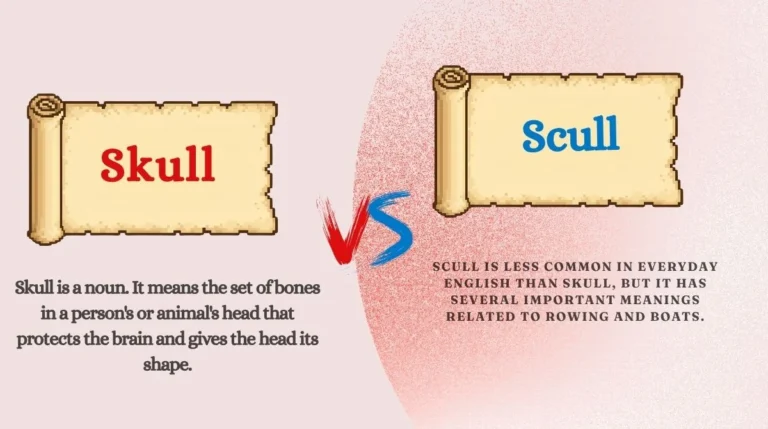
Skull is a noun. It means the set of bones in a person’s or animal’s head that protects the brain and gives the head its shape. In everyday English, it is normally used when talking about the head, bones, injuries, anatomy, fossils, or related subjects.
The word is a countable noun, so we can talk about a skull or several skulls.
For example:
- I saw a human skull in the science museum.
- The doctor checked his skull after the accident.
- The dinosaur had a very large skull.
- The archaeologist found an ancient skull.
- She suffered a fracture to her skull.
- The animal’s skull was much smaller than expected.
- The museum displays several human skulls.
- He wore a shirt with a skull design on it.
A useful point for learners is that skull does not simply mean the whole head. Its main literal meaning is the bony structure of the head. In informal English, however, skull can sometimes be used to mean a person’s head or mind. For example, someone might jokingly say, “Use your skull!” meaning “Use your brain.” This informal use depends on context. Cambridge also records an informal sense referring to someone’s head or mind.
When should you use “skull”?
Use skull when the topic is related to bones, the head, the brain’s protection, anatomy, or an image of a skull.
You might see it in:
- Science lessons
- Medical discussions
- Museums
- History and archaeology
- Animal studies
- Halloween designs
- Warning symbols
- Everyday descriptions of head injuries
For example, skull and crossbones is a familiar symbol used to show danger or death. It is commonly found on warnings for dangerous substances or machinery.
Grammar rule for “skull”
Because skull is a countable noun, singular forms usually need a determiner such as a, an, the, my, his, her, this, or that.
Correct:
- I saw a skull.
- The skull was damaged.
- He injured his skull.
Incorrect:
- I saw skull. ❌
For plural meaning, use skulls:
- The museum has three skulls.
- Scientists studied animal skulls.
A common learner confusion is thinking that skull and scull are spelling choices for the same thing. They are not. Choosing one instead of the other can completely change your meaning.
What Does “Scull” Mean?
Scull is less common in everyday English than skull, but it has several important meanings related to rowing and boats.
As a noun, a scull can mean a small oar used as one of a pair to move a small, light boat. It can also mean a small boat used in the sport of sculling. In rowing, sculls can refer to a race in which each person uses a pair of oars.
As a verb, to scull means to row a boat using a pair of oars.
Here are some examples:
- The rower picked up a scull.
- The boat had two sculls.
- He learned how to scull when he was at college.
- They went out on the lake to scull.
- She is sculling across the river.
- He sculled the boat toward the shore.
- The team entered a sculls race.
- A small scull moved quietly across the water.
When should you use “scull”?
Use scull when you are talking about:
- Rowing
- Oars
- Small boats
- Rowers
- Rowing races
- The sport of sculling
If the sentence has words such as boat, river, lake, oar, rower, rowing, race, or water, there is a good chance that scull is the correct spelling.
For example:
She went to the lake to scull.
Here, the word is a verb because it tells us what she did.
Compare that with:
The doctor examined his skull.
Here, we are talking about a part of the body.
Grammar rules for “scull”
The grammar depends on whether scull is being used as a noun or a verb.
As a noun:
- a scull
- the scull
- two sculls
- several sculls
As a verb:
- I scull
- You scull
- He sculls
- She sculls
- We scull
- They scull
For the past tense, use sculled:
- He sculled across the lake yesterday.
For the continuous form, use sculling:
- They are sculling on the river.
Notice the double l in sculled and sculling. This is a normal spelling pattern when a short word ending in a single consonant doubles that final consonant before certain endings.
Difference Between Skull and Scull
The easiest way to understand these words is to remember that they belong to completely different topics.
| Word | Part of Speech | Main Meaning | Common Context | Example |
|---|---|---|---|---|
| skull | Noun | The bones of the head | Body, health, science, history | He fractured his skull. |
| scull | Noun | A small oar or small rowing boat | Rowing and boats | He picked up a scull. |
| scull | Verb | To row using a pair of oars | Rowing and water sports | They scull across the lake. |
Meaning difference
The biggest difference is simple:
Skull = head bones
Scull = rowing or an oar
When you see skull, think about a human or animal head.
When you see scull, think about a boat.
That one mental picture can prevent many spelling mistakes.
Usage difference
Skull is common in general English. You may hear it in news reports, school lessons, medical conversations, documentaries, movies, and everyday speech.
Scull is more specialized because it belongs mainly to the world of rowing and boating.
For example:
- “The patient injured his skull.”
- “The athlete learned to scull.”
The first sentence is about the body. The second is about a sport.
Grammar logic
These two words do not have the same grammatical job in normal use.
Skull is primarily a noun.
The skull protects the brain.
Scull can be a noun or a verb.
He bought a scull.
He learned to scull.
That means you should look at the role of the word in the sentence as well as its meaning.
Sentence structure difference
When skull is a noun, it often appears after an article, possessive, adjective, or another noun:
- a skull
- the skull
- his skull
- a broken skull
- an animal skull
When scull is used as a verb, it can appear after a subject:
- I scull on weekends.
- She sculls every morning.
- They sculled across the river.
- We are sculling now.
This grammar clue can help you choose the right word.
Pronunciation difference?
Interestingly, there is no useful pronunciation difference for learners here. Both skull and scull are pronounced /skʌl/ in English.
So you cannot depend on sound alone.
This is why these words are called homophones: they sound alike but have different spellings and meanings.
Grammar Rules You Must Remember
Rule #1: Use “skull” for the bones of the head
When you are talking about the hard bones around the brain, write skull.
Example:
The doctor took an X-ray of his skull.
A useful question to ask yourself is: “Am I talking about the head or its bones?”
If the answer is yes, skull is the word you need.
Rule #2: Use “scull” for rowing
When the subject is a boat, oar, or rowing action, use scull.
Example:
She learned to scull on the river.
Remember the simple connection:
Scull → sport → boat → oar
Rule #3: “Scull” can be a verb
A very common mistake is to think that scull is only a noun.
It can also be a verb.
Example:
They scull every Saturday.
Past tense:
They sculled every Saturday last summer.
Continuous form:
They are sculling right now.
Rule #4: Watch the context, not just the sound
Because both words sound the same, spelling must come from meaning.
Compare:
He hurt his skull.
He hurt his scull. ❌
The first sentence makes sense because it is about the head. The second is wrong if you mean a head injury.
Now look at:
He learned to scull on the lake. ✅
Using skull here would change the word and make the sentence incorrect.
Common Mistakes Students Make
Mistake 1: Writing “scull” when they mean the head
A learner may hear /skʌl/ and write the first spelling that comes to mind.
Wrong:
He broke his scull. ❌
Correct:
He broke his skull. ✅
The sound does not tell you the spelling. You must think about the meaning.
Mistake 2: Writing “skull” for rowing
Wrong:
The athletes went to the river to skull. ❌
Correct:
The athletes went to the river to scull. ✅
Here, the word is a verb connected with rowing.
Mistake 3: Treating “scull” as only a noun
Some students learn scull as “an oar” and then miss its verb form.
For example:
She is sculling across the lake. ✅
This is correct because sculling means rowing a boat using the relevant oars.
Mistake 4: Forgetting the plural forms
The plural of skull is skulls.
The museum displayed five skulls.
The plural of the rowing noun scull is also sculls.
The race included several sculls.
The sentence context tells you which meaning is intended.
Easy correction tip
Whenever you are unsure, stop and ask one question:
“Is this about a head or a boat?”
Head → skull
Boat/rowing → scull
This small check can save you from most mistakes.
Easy Trick to Remember the Difference
Here is a simple memory trick that works well for beginners:
Think: “SKull = Skeletal head”
Both skull and skeletal begin with sk. When you see skull, think about the skeleton of your head.
SKULL = skeleton of the head
For scull, think about sports and boats.
SCULL = sculling on water
You can also make a picture in your mind.
Imagine a doctor holding a bone model of a head. The label says:
SKULL
Now imagine a rower sitting in a boat with two oars:
SCULL
The words sound identical, but the pictures are completely different.
Another useful trick is to remember that scull is a special rowing word. It is not the word you normally need in general conversation.
So when someone says:
“He injured his ___.”
You almost certainly need skull.
When someone says:
“She learned to ___ on the lake.”
The answer is scull.
Daily Life Examples
Here are some natural examples that show how these words appear in real English.
Example 1
A: What happened to your brother?
B: He fell off his bicycle and hurt his skull.
The conversation is about an injury, so skull is correct.
Example 2
A: What are those people doing on the lake?
B: They are sculling.
The action involves boats and oars, so we need sculling.
Example 3
A: What did the museum display?
B: It displayed an ancient human skull.
This is a history or archaeology context.
Example 4
A: Do you know how to row?
B: Yes. I learned to scull when I was younger.
Here scull is a verb.
Example 5
A: Why are you wearing that shirt?
B: I like the skull design.
The word refers to a picture or image of a skull.
Example 6
A: Did the team practice today?
B: Yes. They were sculling on the river all morning.
Again, this is a rowing activity.
Example 7
A: What did the doctor say?
B: He said there was no serious damage to my skull.
The context is medical, so skull is clearly correct.
Example 8
A: What is a scull?
B: It can mean a small oar used for rowing, or a small rowing boat.
This is a dictionary-style question about the word itself.
Example 9
A: What did you see in the science lab?
B: We saw a human skull and several other bones.
The topic is anatomy.
Example 10
A: What sport does he enjoy?
B: He enjoys sculling on weekends.
This is a natural example of the verb form.
Practice Section
Choose the correct word: skull or scull.
- The doctor examined the patient’s ______ after the accident.
- They went to the lake to ______.
- The museum has several ancient ______.
- She bought a new ______ for her rowing boat.
- He was ______ across the river when it started to rain.
Answers
- skull
- scull
- skulls
- scull
- sculling
A good way to improve is to explain your answer, not just memorize it. Ask yourself what the sentence is about. If it is about the head, choose skull. If it is about rowing, choose scull.
FAQs About Skull or Scull
What is the difference between skull and scull?
Skull means the bones of the head that protect the brain. Scull is mainly related to rowing and can mean a small oar, a small rowing boat, or the action of rowing with a pair of oars.
They sound the same, but their meanings and spellings are different.
Can we use “scull” as a verb?
Yes. Scull can be used as a verb meaning to row a boat using a pair of oars.
For example:
They scull on the lake every Sunday.
You can also use sculled for the past and sculling for the continuous form.
Is “skull” a noun or a verb?
For everyday learner English, skull is mainly taught and used as a noun meaning the bones of the head.
For example:
The accident injured his skull.
It is a countable noun, so we can say a skull and skulls.
Do skull and scull sound the same?
Yes. In standard English, both are pronounced /skʌl/. Cambridge gives the same pronunciation for both words.
This means you must use the sentence meaning and context to choose the correct spelling.
Is scull a common English word?
Scull is a real English word, but it is much more specialized than skull. You are most likely to see it when reading about rowing, boats, oars, or rowing competitions.
In normal daily English, skull is much more familiar.
Which is correct: “broken skull” or “broken scull”?
When you mean a head injury, the correct phrase is broken skull.
For example:
He suffered a broken skull in the accident.
Scull would not be correct because it does not mean the bones of the head.
Conclusion
Skull and scull are easy to confuse because they look almost identical and sound exactly the same. However, their meanings are very different.
Use skull when you are talking about the bones of the head, the brain’s protective structure, anatomy, injuries, fossils, or skull images. The plural is skulls.
Use scull when you are talking about rowing. As a noun, it can refer to an oar or a small rowing boat. As a verb, it means to row using a pair of oars. Its forms include scull, sculls, sculled, and sculling.
The easiest memory trick is simple: skull = head, scull = boat.
When you hear /skʌl/, do not choose the spelling from sound alone. Look at the meaning of the sentence. A little attention to context will help you use these words naturally and confidently.
Keep practicing with short sentences, and soon the difference will feel automatic.

Evan Rellmont is a writer who turns thoughtful ideas into meaningful words, creating stories and reflections that connect, inspire, and leave a lasting impression.
3 thoughts on “Skull or Scull? Meaning, Difference, Examples & Grammar Guide 2026”