
Have you ever written flavour and wondered whether it should be flavor instead? Or perhaps you have seen both spellings in books, websites, food labels, and school assignments and thought that one of them must be wrong.
The good news is that both “flavour” and “flavor” are correct spellings.
The main difference is not meaning or grammar. It is the variety of English being used.
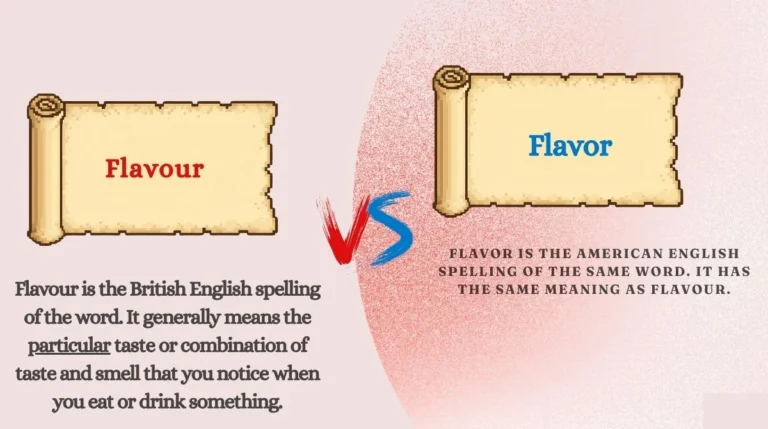
Flavour is the standard British spelling, while flavor is the standard American spelling.
Cambridge Dictionary and Merriam-Webster both recognize this difference.
This small spelling change can confuse English learners because British and American English often use different spellings for the same word.
You may also notice the same pattern in related words, such as flavouring/flavoring, flavoured/flavored, and flavourful/flavorful.
The important thing is to understand when each spelling is appropriate.
You do not need to memorize two different meanings because there are not two different meanings here.
Once you understand the British-versus-American spelling rule, choosing the correct form becomes much easier.
Whether you are writing a school assignment, preparing a website, reading a recipe, or speaking about food, you can confidently use the spelling that matches your variety of English.
What Does “Flavour” Mean?
Flavour is the British English spelling of the word. It generally means the particular taste or combination of taste and smell that you notice when you eat or drink something. It can also describe the general character or quality of something. Cambridge Dictionary lists flavour as the UK spelling of flavor.
For example, when you eat mango ice cream, you may say that it has a sweet mango flavour. When you drink coffee, you might describe its rich or bitter flavour.
The word can be used as both a noun and a verb.
As a noun, it refers to a taste or a distinctive quality.
As a verb, it means to give food or drink a particular taste. Cambridge gives examples such as food being flavoured with garlic and herbs.
When should you use “flavour”?
Use flavour when you are writing in British English or another variety of English that follows British spelling conventions.
This is especially common in countries such as the United Kingdom. British spelling is also widely used in many educational and formal contexts in other parts of the world.
For example:
- This soup has a wonderful flavour.
- I love the chocolate flavour of this cake.
- The herbs give the dish a fresh flavour.
- Which flavour of ice cream do you want?
- The sauce has a strong garlic flavour.
- This tea has a light, fruity flavour.
- The chef added lemon to improve the flavour.
- The restaurant offers many different flavours of ice cream.
Notice that the meaning stays exactly the same. The important point is simply the spelling.
“Flavour” as a verb
You can also use flavour as a verb when you mean “to give something a particular taste.”
For example:
- The chef flavoured the soup with garlic.
- Fresh herbs flavour the sauce.
- The rice is flavoured with tomato and spices.
- You can flavour the cake with vanilla.
In these sentences, flavour is an action. Someone is adding or giving a taste to food or drink. Merriam-Webster gives the same basic verb meaning: to give or add flavour to something.
A common confusion about “flavour”
Many learners see the letters -our and think that “flavour” may be an older or more formal form. That is not the right way to think about it.
It is simply the British spelling.
The American spelling removes the u, producing flavor.
So this is not a case of one word being more correct than the other. The choice depends mainly on the English variety you are using.
What Does “Flavor” Mean?
Flavor is the American English spelling of the same word. It has the same meaning as flavour. Cambridge identifies flavor as the US spelling of flavour, while Merriam-Webster uses flavor as its main dictionary form.
It can refer to the taste of food or drink, a particular kind of taste, or a distinctive quality or character.
For example, you can talk about the flavor of coffee, soup, fruit, candy, or ice cream.
When should you use “flavor”?
Use flavor when you are writing in American English.
For example:
- This soup has a rich flavor.
- What flavor of ice cream do you want?
- I love the chocolate flavor.
- The sauce has a strong garlic flavor.
- This tea has a fresh, fruity flavor.
- The chef added herbs for extra flavor.
- This drink has a strange flavor.
- Vanilla is my favorite flavor of ice cream.
The grammar is exactly the same as with flavour.
You can use flavor as a noun:
- The dish has a spicy flavor.
You can also use it as a verb:
- The chef flavored the dish with garlic.
Merriam-Webster explains the noun as the quality that affects taste, a particular type of taste, or a distinctive quality. It also defines the verb as meaning to give or add flavor to something.
“Flavor” can have meanings beyond food
Although people often use flavor when talking about food, the word can also describe a general style, character, or quality.
For example:
- The neighborhood has a unique flavor.
- The movie has a strong historical flavor.
- The festival has a traditional flavor.
In these examples, nobody is talking about eating or drinking. The word means something like character, quality, or atmosphere. Cambridge also records this broader meaning.
So do not assume that flavor always means taste. Context matters.
Difference Between Flavour and Flavor
The easiest way to understand the difference is this:
Flavour = British English
Flavor = American English
They have the same meaning, the same pronunciation, and the same basic grammatical functions. Cambridge gives the UK pronunciation and US pronunciation as essentially the same word, with the spelling varying by variety of English.
Comparison Table
| Feature | Flavour | Flavor |
|---|---|---|
| English variety | British English | American English |
| Meaning | Taste or distinctive quality | Taste or distinctive quality |
| Noun | Yes | Yes |
| Verb | Yes | Yes |
| Pronunciation | /ˈfleɪ.və(r)/ | /ˈfleɪ.vɚ/ |
| Main spelling difference | Contains u | No u |
| Plural | flavours | flavors |
| Verb form | flavoured | flavored |
| -ing form | flavouring | flavoring |
| Typical use | UK-style writing | US-style writing |
The difference is therefore a spelling convention, not a grammar rule that changes the meaning.
Usage difference
Imagine two people describing exactly the same ice cream.
A British English speaker might say:
This is my favorite chocolate flavour.
An American English speaker might write:
This is my favorite chocolate flavor.
The sentence communicates the same basic idea. The spelling simply tells you something about the writer’s preferred English variety.
Grammar logic
There is no separate grammar rule for flavour and flavor.
Both can be:
Nouns
- The soup has a strong flavour.
- The soup has a strong flavor.
Verbs
- They flavour the sauce with herbs.
- They flavor the sauce with herbs.
Plural nouns
- There are many flavours available.
- There are many flavors available.
Past participles
- The cake is flavoured with vanilla.
- The cake is flavored with vanilla.
The grammar stays the same while the spelling changes.
Sentence structure difference
There is actually no sentence structure difference caused by these spellings.
Compare:
- This drink has a natural flavour.
- This drink has a natural flavor.
Both use the same structure:
Subject + has + noun
Another pair:
- The chef flavoured the soup with herbs.
- The chef flavored the soup with herbs.
Both use:
Subject + verb + object + extra information
This is why learners should not treat flavour and flavor as two separate vocabulary words.
Grammar Rules You Must Remember
Rule 1: Use “flavour” in British English
When your writing follows British spelling, use flavour.
Examples:
- The curry has a rich flavour.
- I like the strawberry flavour.
- The soup was full of flavour.
This spelling includes the letter u.
Rule 2: Use “flavor” in American English
When your writing follows American spelling, use flavor.
Examples:
- The curry has a rich flavor.
- I like the strawberry flavor.
- The soup was full of flavor.
The spelling is shorter because the u is removed.
Rule 3: Keep the same spelling style in related words
Do not mix British and American forms in the same sentence or piece of writing unless there is a specific reason.
British style:
- flavour
- flavours
- flavoured
- flavouring
American style:
- flavor
- flavors
- flavored
- flavoring
Cambridge specifically identifies flavouring as the UK form and flavoring as the US form.
So avoid writing:
The restaurant offers many different flavours, and the cake is flavored with vanilla.
That mixes spelling systems.
A consistent British version would be:
The restaurant offers many different flavours, and the cake is flavoured with vanilla.
A consistent American version would be:
The restaurant offers many different flavors, and the cake is flavored with vanilla.
Rule 4: Do not treat one spelling as wrong
This is perhaps the most important rule.
Flavour is not a misspelling of flavor.
And flavor is not a misspelling of flavour.
Each spelling is standard in a different variety of English. Merriam-Webster describes flavour as chiefly British, while Cambridge directly labels the pair UK/US.
Common Mistakes Students Make
English learners often make mistakes with these words because they think there must be a hidden difference in meaning.
Mistake 1: Thinking “flavour” and “flavor” mean different things
Incorrect idea:
“Flavour” means the taste of food, while “flavor” means the type of food.
That is not correct.
Both can describe the taste of food and both can have the broader meaning of a particular character or quality.
Mistake 2: Calling “flavour” incorrect
Some students learn American English first and assume that the -our ending is a spelling error.
For example:
❌ The British spelling is wrong.
✅ The British spelling is flavour.
Always consider the variety of English before deciding that a spelling is incorrect.
Mistake 3: Mixing spelling systems
This is very common in longer writing.
For example:
❌ I love the different flavours of snacks, and this one is flavored with cheese.
The writer has used a British plural with an American verb form.
Choose one system and stay consistent:
✅ I love the different flavours of snacks, and this one is flavoured with cheese.
Or:
✅ I love the different flavors of snacks, and this one is flavored with cheese.
Mistake 4: Changing the pronunciation
The spelling changes, but the pronunciation is essentially the same. Cambridge gives closely corresponding UK and US pronunciations.
So do not try to create two completely different pronunciations just because one spelling contains u.
Mistake 5: Forgetting the related forms
Learners sometimes remember flavour but write flavored, or remember flavor but write flavouring.
Try to keep the spelling pattern consistent.
British:
flavour → flavoured → flavouring
American:
flavor → flavored → flavoring
Easy Trick to Remember the Difference
Here is a simple memory trick:
British English likes the “U”
Think of:
FlavoUR = UK style
The word flavour contains our.
This can remind you of many British spellings that keep u, such as:
- colour
- favourite
- honour
- behaviour
- flavour
American English often removes the u:
- color
- favorite
- honor
- behavior
- flavor
You do not need to memorize every spelling separately. Once you notice the pattern, many words become easier.
Real-life logic
Imagine you are writing for a British audience.
A British recipe might say:
Add salt to bring out the flavour.
Now imagine an American recipe:
Add salt to bring out the flavor.
Neither writer is making a grammar mistake.
They are simply following different spelling conventions.
A second memory trick
Remember:
Flavour = U
Flavor = US
The second one is especially useful for beginners.
You can think:
US → flavor
It is not a formal grammar rule, of course. It is just a quick memory trick to help you remember the spelling.
Daily Life Examples
Here are some natural examples that you may hear or use in everyday English.
1. Talking about ice cream
British:
“Which flavour do you want?”
American:
“Which flavor do you want?”
Both are completely correct.
2. Talking about soup
British:
“This soup has a lovely flavour.”
American:
“This soup has a lovely flavor.”
3. Talking about coffee
British:
“I really like the rich flavour of this coffee.”
American:
“I really like the rich flavor of this coffee.”
4. Reading a food label
You might see:
“Natural vanilla flavour”
in British-style writing, or:
“Natural vanilla flavor”
in American-style writing.
5. Talking about cake
British:
“The cake is flavoured with lemon.”
American:
“The cake is flavored with lemon.”
6. Discussing a drink
British:
“This drink has a strange flavour.”
American:
“This drink has a strange flavor.”
7. Talking about cooking
British:
“Fresh herbs add flavour to the dish.”
American:
“Fresh herbs add flavor to the dish.”
8. Talking about personal preference
British:
“Chocolate is my favorite flavour.”
American:
“Chocolate is my favorite flavor.”
Notice that favorite itself is also an American spelling. In British English, many writers would use favourite.
9. Describing a place
The word can also describe character rather than food.
British:
“The old town has a traditional flavour.”
American:
“The old town has a traditional flavor.”
Here, the word is not about taste. It describes the town’s distinctive character. Cambridge records this broader use as well.
10. Describing a book or event
British:
“The book has a strong historical flavour.”
American:
“The book has a strong historical flavor.”
Again, the meaning is about the overall character or quality.
Practice Section
Choose the correct spelling for the variety of English mentioned.
1. British English
The soup has a wonderful ________.
Answer: flavour
2. American English
What ________ of ice cream do you like?
Answer: flavor
3. British English
The rice is ________ with garlic and herbs.
Answer: flavoured
4. American English
This drink has a strong vanilla ________.
Answer: flavor
5. British English
The restaurant offers many different ________.
Answer: flavours
A useful extra exercise is to write five sentences of your own. Write them first in British English and then change them to American English. You will quickly notice that the meaning and grammar stay the same while the spelling changes.
FAQs
What is the difference between flavour and flavor?
There is no difference in basic meaning. Flavour is the standard British spelling, while flavor is the standard American spelling. Both can be used as nouns and verbs.
Is “flavour” British or American?
Flavour is the British spelling. It is commonly used in British English and other writing systems that follow British spelling conventions. The American form is flavor.
Is “flavor” correct English?
Yes. Flavor is the standard American English spelling. It is not an informal or incorrect version of “flavour.” Merriam-Webster uses flavor as its main entry.
Can “flavour” be used as a verb?
Yes. Flavour can be a verb meaning to give food or drink a particular taste. For example: “The chef flavoured the sauce with garlic.” The American equivalent is “flavored.”
Which is better for formal writing: flavour or flavor?
Neither is automatically more formal. The best choice depends on your audience and the variety of English you are using. Use flavour for British English and flavor for American English, and keep the style consistent.
Should I use flavour or flavor on an English-learning website?
Choose the spelling based on your target audience. If your website mainly follows British English, use flavour. If it follows American English, use flavor. The most important thing is consistency across the site.
Conclusion
So, flavour or flavor — which one is correct? The answer is simple: both are correct.
The only major difference is the variety of English. Flavour is the British spelling, while flavor is the American spelling. The words have the same basic meaning and can both work as nouns and verbs.
The best habit is to choose one spelling system and stay consistent. If you are writing in British English, use flavour, flavoured, flavouring, and flavours. If you are writing in American English, use flavor, flavored, flavoring, and flavors.
Do not worry when you see the other spelling in a book, recipe, website, or exam. It does not mean that the writer has made a spelling mistake.
Once you learn that this is a British-versus-American spelling difference, the confusion disappears. Keep practicing, pay attention to the English variety around you, and these small spelling differences will become much easier to handle.

Evan Rellmont is a writer who turns thoughtful ideas into meaningful words, creating stories and reflections that connect, inspire, and leave a lasting impression.