
Content vs context is a common English vocabulary mix-up, especially for students and non-native speakers.
The two words look and sound somewhat similar, but they describe very different things.
Because both are often used when we talk about books, articles, conversations, videos, speeches, and ideas, it is easy to choose the wrong one.
Think about reading a short message from a friend. The content is what the message actually says.
The context is the information around that message that helps you understand why the person said it and what they really meant.
This small difference matters in everyday English. A teacher may ask about the content of a lesson.
A journalist may need more context before reporting a statement. A student may understand a new word by looking at its context.
A website may publish useful content, while a reader may misunderstand that content without enough context.
Once you learn the basic idea, the difference becomes much easier. Content is mainly about what is inside something or what is being said.
Context is about the situation, background, or surrounding words that help explain it. Dictionaries such as Cambridge and Oxford make the same basic distinction.
By the end, you should be able to use both words naturally in speaking and writing without stopping to think twice.
What Does “Content” Mean?
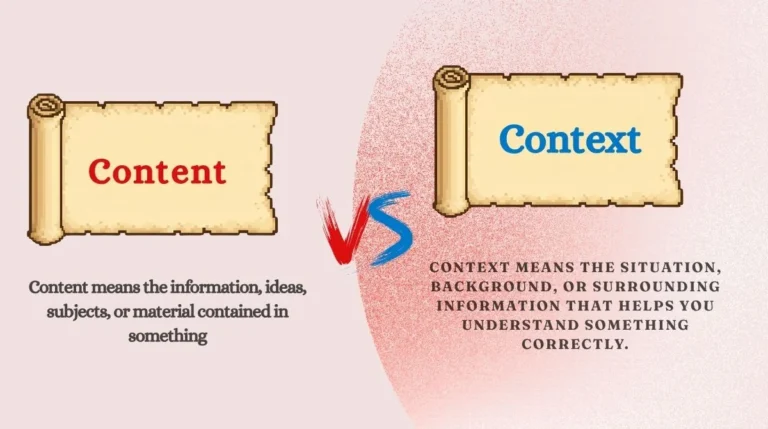
Content means the information, ideas, subjects, or material contained in something. It can refer to what is inside a book, article, speech, lesson, website, video, social media post, or other form of communication.
Oxford defines content as the subject matter of a book, speech, program, or similar material. Cambridge also uses the word for the ideas or information contained in something written, spoken, created, or represented.
In simple words:
Content = what something contains.
When you read a book, the story, facts, ideas, and information are its content. When you watch a video, what the video teaches, shows, or communicates is its content.
When should you use “content”?
Use content when you are talking about the actual information or material in something.
For example, you can talk about:
- the content of a book
- the content of an email
- the content of a lesson
- website content
- video content
- educational content
- the content of a speech
- the content of a report
Notice that content often answers the question:
“What is in it?”
Grammar rule for “content”
When content means information or subject matter, it is usually an uncountable noun.
We normally say:
- The content is useful.
- The content was easy to understand.
- I like the content of this course.
We do not normally say:
- The contents of the article is useful.
However, contents with an -s has a related but slightly different use. It can mean the things contained inside something, or the sections of a book. For example, the contents of a bag means the things inside the bag, while the contents page or table of contents refers to the listed sections of a book.
Examples of “content”
- The content of this book is very interesting.
- The teacher explained the content of the lesson clearly.
- I read the content of the email before replying.
- This website provides useful educational content.
- The content of the speech was easy to follow.
- We need better content for our English-learning website.
- The video contains helpful content for beginners.
- The article has a lot of useful content.
A common confusion with “content”
There is another important meaning of content. The word can also be an adjective meaning happy or satisfied.
For example:
She is content with her life.
Here, content does not mean information. It means satisfied or happy. Cambridge lists this as a separate adjective meaning.
So, pay attention to the sentence.
Compare:
The content of the article is useful.
She is content with her job.
In the first sentence, content means information. In the second, it means satisfied.
For the topic content vs context, however, we are mainly comparing content as a noun meaning information or subject matter with context as a noun meaning surrounding circumstances or words.
What Does “Context” Mean?
Context means the situation, background, or surrounding information that helps you understand something correctly.
Oxford explains context as the situation in which something happens and that helps you understand it. It can also mean the words that come before and after a particular word, phrase, or statement.
In simple words:
Context = the information around something that helps explain it.
Imagine that someone says:
“I’m leaving.”
Those two words are the content of the statement.
But why is the person leaving? Are they angry? Are they going home? Are they leaving a job? Are they joking?
The answer depends on the context.
When should you use “context”?
Use context when you want to talk about the background or situation that makes something easier to understand.
You may hear expressions such as:
- in context
- in the context of
- out of context
- historical context
- social context
- cultural context
- wider context
- the context of a conversation
Context is especially important when a word, sentence, action, or event could have more than one possible meaning.
Grammar rule for “context”
Context is a noun. It can be countable or uncountable, depending on how it is used.
Examples:
This word has a different meaning in another context.
We need more context before making a decision.
Both forms are natural.
The word often appears with the prepositions in, within, and of:
in context
in the context of education
within a social context
These patterns are very common in both everyday and formal English.
Examples of “context”
- You need to understand the word in context.
- The quote sounds rude when taken out of context.
- The teacher gave us some historical context.
- Try to understand her comment in the context of the conversation.
- Without more context, I cannot understand the message.
- The word can have a different meaning in another context.
- We need to consider the social context of the problem.
- The full story gives us more context.
A common confusion with “context”
Students sometimes use context when they simply mean the actual information being discussed.
For example:
❌ I enjoyed the context of the movie.
This is usually not what you want to say.
If you mean the story, ideas, or material in the movie, use content:
✅ I enjoyed the content of the movie.
But if you mean the background or situation needed to understand something in the movie, context may be correct.
Difference Between Content and Context
The easiest way to separate these words is to think about two questions:
Content asks: “What is there?”
Context asks: “What is happening around it?”
This distinction is simple, but it works in most situations.
| Feature | Content | Context |
|---|---|---|
| Basic meaning | What something contains | The situation or background around it |
| Main idea | Information, ideas, subject matter | Circumstances that help explain something |
| Common use | Books, videos, articles, lessons, speeches | Conversations, events, statements, history |
| Main question | “What does it say?” | “What does it mean here, and why?” |
| Grammar | Usually an uncountable noun for information | Countable or uncountable noun |
| Common expressions | website content, course content | in context, out of context, social context |
| Example | The content is useful. | The context is important. |
Usage difference
Suppose you are reading a newspaper story.
The content includes the facts, statements, details, and ideas presented in the story.
The context could include what happened before the event, who was involved, where it happened, and why the event matters.
So:
The content tells you what is being presented.
The context helps you understand how and why it should be understood.
Grammar logic
Both words are nouns, but they perform different jobs.
Content names the material or information contained in something.
The article contains useful content.
Context names the surrounding situation or information.
The context explains why the author used that phrase.
This is why replacing one word with the other can change the meaning.
Compare:
The content of the speech was inspiring.
This talks about the actual ideas in the speech.
The context of the speech was unusual.
This talks about the situation in which the speech was given.
Sentence structure difference
A common pattern with content is:
the content of + noun
Examples:
the content of the book
the content of the article
the content of the lesson
You can also use content + noun as a modifier:
educational content
digital content
video content
With context, common structures include:
in the context of + noun
out of context
the context of + noun
Examples:
in the context of education
in the context of the discussion
the historical context of the event
The sentence was taken out of context.
Meaning comparison with an easy example
Imagine your teacher writes this sentence on the board:
“He is cold.”
The sentence itself is part of the content.
But what does “cold” mean?
Does it mean:
- He has a low body temperature?
- He feels emotionally distant?
- He does not care about other people?
- The weather has made him cold?
The surrounding sentences and situation give you the context.
That is the heart of the difference.
Grammar Rules You Must Remember
Rule 1: Use “content” for the actual information or material
When you mean the ideas, facts, or material inside something, choose content.
The content of the course is very useful.
You are talking about what the course teaches.
Another example:
I did not like the content of the article.
You mean the actual ideas or information in the article.
Rule 2: Use “context” for surrounding information or circumstances
When you need to explain the situation around something, use context.
You need more context to understand his decision.
The sentence does not say that the decision itself is missing. It says you need background information.
Rule 3: “Content” is usually uncountable when it means information
Say:
The website has useful content.
Not:
The website has useful contents.
However, contents is correct when referring to things contained inside something:
I checked the contents of the box.
It is also used in table of contents.
Rule 4: “Context” often goes with “in” and “out of”
Two very common expressions are:
in context
out of context
Examples:
Read the sentence in context.
The quote was taken out of context.
When something is taken out of context, important surrounding information is removed, so the meaning may become unclear or misleading. Cambridge and Oxford both describe this use.
Common Mistakes Students Make
Mistake 1: Using “context” for information
A student may say:
❌ The context of the website is very helpful.
If they mean the information on the website, content is better.
✅ The content of the website is very helpful.
Mistake 2: Using “content” for background
Consider:
❌ I don’t understand the content of his comment.
This sentence can be correct if you mean the actual words or ideas are unclear. But if you understand what he said and want to know why he said it, you need context.
✅ I don’t understand the context of his comment.
You understand the words, but not the situation behind them.
Mistake 3: Confusing “content” and “contents”
Students often think adding -s is simply a plural form for all uses of content.
Not always.
The content of the article is interesting.
Here, content means the subject matter and is normally uncountable.
But:
I opened the box and checked its contents.
Here, contents means the things inside the box.
A useful tip is to ask:
Am I talking about information or physical things inside something?
Information → content
Things inside → contents
Mistake 4: Thinking context means “meaning”
Context can help you discover meaning, but it is not exactly the same as meaning.
For example:
The meaning of the word is “quick.”
The context could be the rest of the sentence that helps you realize “quick” means “fast.”
So context is the surrounding information, not simply the definition itself.
Easy correction tip
Whenever you are unsure, replace the word mentally with a question.
Ask:
“What is actually inside this?”
Choose content.
Ask:
“What information around this helps me understand it?”
Choose context.
That small test solves many mistakes.
Easy Trick to Remember the Difference
Here is a simple classroom trick.
Think of a box.
The things inside the box are its content.
Now imagine that someone gives you the box but does not tell you where it came from, why it is there, or what happened before it arrived.
That missing background is the context.
So remember:
Content = inside.
Context = around.
You can also connect the words to two simple questions.
CONTENT: “What is being said, shown, taught, or contained?”
CONTEXT: “What is happening around it?”
Imagine a social media post.
The words and pictures in the post are the content.
The conversation, previous comments, situation, and reason for posting can provide the context.
This is why people sometimes say:
“You need the full context.”
They are asking you to look beyond one sentence or one action.
A related phrase is:
“That was taken out of context.”
It means someone used only part of the original statement or situation and left out surrounding information that could change how it is understood.
Daily Life Examples
The difference becomes much clearer when you hear these words in normal conversation.
1. Talking about a website
A: Is this website useful for English learners?
B: Yes. The content is simple and easy to understand.
Here, content means the lessons, explanations, examples, and other information on the website.
2. Understanding a joke
A: I don’t understand why everyone laughed.
B: You need some context. They were talking about something that happened earlier.
The missing background is context.
3. Reading a book
A: Did you like the book?
B: Yes. The content was very interesting.
The speaker is talking about the story and ideas in the book.
4. Understanding a sentence
A: Why does this word have two meanings?
B: It depends on the context.
The surrounding words or situation decide which meaning is intended.
5. Watching a video
A: Why do you like this channel?
B: Its content is useful and entertaining.
The speaker means the material provided by the channel.
6. A misunderstood message
A: She sounded angry in her text.
B: Maybe, but you should look at the context. She had just received some bad news.
The situation helps explain her words.
7. Talking about a speech
A: What did the speaker discuss?
B: The content of the speech was mainly about education.
The answer focuses on the ideas presented.
8. Talking about history
A: Why did this event happen?
B: You need to understand its historical context.
The answer requires background information about the time and situation.
9. Learning a new word
Teacher: You don’t know this word?
Student: No.
Teacher: Read the whole sentence. The context may help you understand it.
The nearby words help the student guess the meaning.
10. Social media
A: That comment looks terrible.
B: Read the whole conversation before judging it. You don’t have enough context.
The full conversation provides background.
Practice Section
Choose content or context in each sentence.
- The ______ of this book is suitable for young learners.
- I need more ______ before I can understand his reaction.
- Try to guess the meaning from the ______ of the sentence.
- The website publishes grammar ______ every week.
- The quote sounds very different when taken out of ______.
Answers
- content
- context
- context
- content
- context
Here is a useful challenge: create your own sentence with both words.
“The content was confusing because I did not understand the context.”
That single sentence shows the difference very well. The material itself was confusing, and the surrounding situation or information was missing.
FAQs
What is the difference between content and context?
Content is the actual information, ideas, words, or material contained in something. Context is the surrounding situation, background, or words that help you understand that content correctly.
A simple way to remember it is: content is what is there; context is what surrounds it.
Can “content” be used in questions?
Yes. Content is commonly used in questions.
For example:
What is the content of this book?
Did you like the content of the video?
It is also common to ask about website content, course content, educational content, and other types of information.
Can “context” be used in questions?
Yes. It is very common in questions.
For example:
What is the context of this statement?
Can you give me some context?
What was the context of the conversation?
These questions ask for background information that makes something easier to understand.
Is “content” formal or informal?
Content is neutral and works in both everyday and formal English. You can use it in conversation, school writing, business communication, academic writing, and online discussions.
For example, “The content of the report is clear” sounds natural in a formal setting.
Is “context” formal or informal?
Context is also a neutral word, although it is especially common in academic, professional, and analytical English.
You can still use it in everyday conversation:
“You need more context.”
So it is not a word reserved for formal writing.
What does “out of context” mean?
Out of context means that words, actions, or information are being considered without the surrounding information needed to understand them properly.
For example:
The sentence sounds rude when it is taken out of context.
The words may seem different when you do not know what came before or after them.
Conclusion
The difference between content and context is much easier once you focus on the basic idea.
Content is the actual information, ideas, words, or material contained in something. It can be the information in a book, the ideas in a speech, the material on a website, or what a video teaches.
Context is the surrounding information or situation that helps you understand that content. It may include the words around a sentence, what happened before, who was involved, or the social and historical situation.
Remember the simplest rule:
Content = what is there.
Context = what is around it.
When you see content, think about what something contains. When you see context, think about the background that gives it meaning.
Keep practicing with real conversations, articles, videos, and short sentences. The more examples you notice in everyday English, the more natural these two words will feel. Soon, choosing between them will become automatic.

Evan Rellmont is a writer who turns thoughtful ideas into meaningful words, creating stories and reflections that connect, inspire, and leave a lasting impression.
1 thought on “Content vs Context: Meaning, Differences, Examples & Easy Rules (2026)”