
Have you ever wanted to praise a friend’s outfit but felt unsure whether to write compliment or complement? You are not alone!
These two English words look almost identical and sound very similar, so even confident English speakers sometimes mix them up.
However, their meanings are different. A compliment is something nice you say to someone or an expression of praise.
A complement is something that completes, improves, or goes well with something else. One word is about praise, while the other is about making a combination work well.
Think about these two sentences:
- Your teacher gave you a compliment about your English.
- Your blue shoes complement your new dress.
Both sentences are correct, but you cannot switch the two words without changing the meaning. The first sentence describes praise from a teacher. The second explains how two things look good together.
Knowing the difference matters in emails, school assignments, workplace conversations, social media posts, and everyday writing.
Choosing the wrong word can make your sentence confusing, even when the rest of your grammar is correct.
The good news is that you do not need to memorize complicated grammar rules. With a few clear definitions, everyday examples, and an easy memory trick, you can learn when to use each word.
You will also discover how complimentary and complementary differ, so you can avoid another common spelling mistake.
What Does “Compliment” Mean?
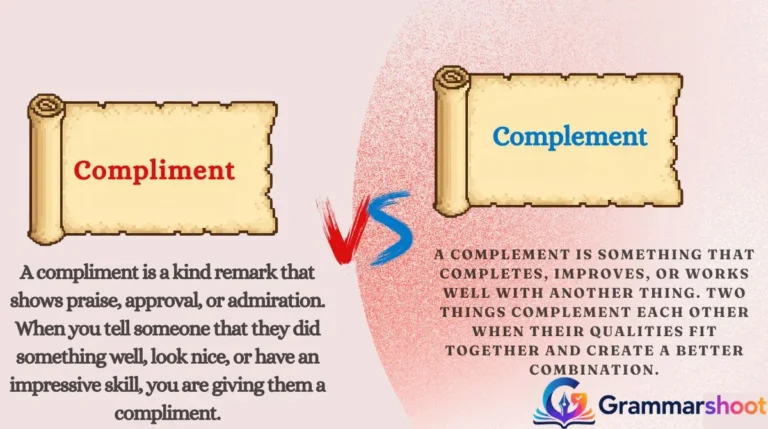
A compliment is a kind remark that shows praise, approval, or admiration. When you tell someone that they did something well, look nice, or have an impressive skill, you are giving them a compliment.
For example, when you say, “You gave an excellent presentation,” you are praising someone’s work. That statement is a compliment because it expresses something positive.
The word compliment can be used as both a noun and a verb. Its basic meaning stays connected to praise in both forms.
Compliment as a Noun
A noun names a person, place, thing, or idea. As a noun, compliment means a remark or action that expresses praise.
Consider this sentence:
Your kind words were a lovely compliment.
Here, compliment is a noun because it names the praise expressed through kind words.
Common expressions include:
- Give someone a compliment.
- Pay someone a compliment.
- Receive a compliment.
- Accept a compliment.
- Take something as a compliment.
- Return a compliment.
For example, you might say, “She paid me a compliment about my cooking.” This means she said something positive about your cooking.
Compliment as a Verb
A verb describes an action. When you compliment someone, you praise that person for something they have done, their appearance, their abilities, or their qualities.
For example:
I complimented my friend on her beautiful painting.
In this sentence, complimented is the past-tense form of the verb compliment.
You can use the following common structure:
Compliment + someone + on + something
Examples:
- I complimented Ali on his speaking skills.
- The manager complimented Sara on her hard work.
- Everyone complimented the chef on the delicious meal.
You can also use compliment without mentioning the reason for the praise.
For instance, “She complimented him in front of the whole class” is a complete sentence. The reader understands that she praised him, even though the exact reason is not given.
Examples of Compliment in Sentences
Here are eight everyday examples that show how the word works.
- My teacher gave me a compliment about my handwriting.
- She complimented her sister on her new hairstyle.
- Thank you for the compliment; that means a lot to me.
- The customer complimented the waiter on his excellent service.
- He received several compliments after his speech.
- Your little brother will love it if you compliment his drawing.
- I took her comment as a compliment.
- Emma returned the compliment by praising her friend’s singing.
Notice that every example involves praise, admiration, or approval.
Common Confusion About Compliment
Some learners think compliment only describes comments about a person’s appearance. That is not true. You can compliment someone’s behavior, effort, talents, work, ideas, or achievements.
For example, “You handled that difficult situation very well” is a compliment, even though it says nothing about appearance.
You can also give a compliment through an action, such as showing respect for someone’s work. Still, the most common everyday use involves saying something positive.
The key point is simple: Use compliment when you mean praise. This meaning applies whether you are giving praise, receiving it, or talking about it.
What Does “Complement” Mean?
A complement is something that completes, improves, or works well with another thing. Two things complement each other when their qualities fit together and create a better combination.
For example, imagine that you are wearing a white shirt and dark blue trousers. A brown belt might complement your outfit because it works well with the other colors and adds to the overall look.
Unlike compliment, this word is not mainly about praise. It is about how things fit together, support each other, or make a whole more complete.
The word complement can also be used as a noun and a verb.
Complement as a Noun
As a noun, complement refers to something that completes or improves another thing.
Consider this sentence:
A warm scarf is the perfect complement to her winter coat.
The scarf goes well with the coat and adds something useful to the outfit. Here, complement is a noun.
This word is often used when talking about clothing, colors, food, music, design, skills, and teams.
For instance, a fresh salad can be a good complement to a rich meal. The salad adds a different taste and makes the meal more balanced.
A complement can also mean the complete number of people or things needed for a particular purpose. For example, a ship may have a full complement of crew members. In everyday English, however, the meaning of something that completes or improves another thing is especially useful to remember.
Complement as a Verb
As a verb, complement means to go well with something or to improve it by adding a suitable quality.
For example:
Her calm personality complements his energetic nature.
This means that their different personalities work well together. Neither person is necessarily praising the other. Instead, their qualities fit together in a helpful way.
A common sentence structure is:
Something + complements + something else
You can also use the structure complement each other when two things work well together.
Examples:
- This sauce complements the flavor of the fish.
- Her skills complement those of her teammates.
- The wooden table complements the modern chairs.
- The background music complements the scene.
Remember that complement does not always mean making something perfect or filling a missing space. Sometimes it simply means adding a quality that makes the overall combination more attractive, balanced, or effective.
Examples of Complement in Sentences
Here are eight sentences showing how to use the word correctly.
- Your black shoes complement your gray suit.
- The fresh vegetables are a perfect complement to the rice.
- His patience complements her strong leadership skills.
- The blue curtains complement the color of the walls.
- Soft music complements the peaceful atmosphere.
- This short introduction complements the main presentation.
- The two players complement each other on the field.
- The hotel has a full complement of trained staff members.
Each example shows how something completes, supports, or works well with something else.
Common Confusion About Complement
Learners sometimes believe that complement always means adding a missing part. Although it can have that meaning, it also describes things that make each other better through a good combination.
For example, a red handbag can complement a black dress even if neither item is incomplete. They simply look good together.
In grammar, complement has another technical meaning. A subject complement can describe the subject, as in “Maya is happy.” An object complement can give more information about an object, as in “They elected Maya captain.”
These are specialized grammar uses. For ordinary writing, remember the central idea: A complement completes, supports, or improves something else. This distinction is consistent with the definitions in the Cambridge and Oxford learner’s dictionaries.
Difference Between Compliment and Complement (Detailed)
The main difference is the idea each word expresses. A compliment communicates praise, while a complement describes something that completes, supports, or works well with another thing.
They look similar because they share most of their letters. Their pronunciation is also very similar, although the vowel sound may differ slightly by accent. That is why checking the meaning is more helpful than relying only on sound.
Comparison Table
| Feature | Compliment | Complement |
|---|---|---|
| Main meaning | Praise or admiration | Something that completes or improves another thing |
| Part of speech | Noun and verb | Noun and verb |
| Main purpose | To express approval | To create a good or complete combination |
| Common noun use | A compliment about someone’s work | A complement to an outfit |
| Common verb use | Compliment someone on their effort | Complement another person’s skills |
| Common subject | A person giving or receiving praise | Things, qualities, people, or parts that fit together |
| Example | She complimented my cooking. | This sauce complements the meal. |
| Memory clue | Praise | Complete or fit well |
1. Usage Difference
Use compliment when someone expresses admiration or approval.
For example:
The coach complimented the player on her performance.
The coach praised the player for doing well.
Use complement when two things go well together or when one adds something useful to another.
For example:
The player’s speed complements her teammate’s strength.
Here, speed and strength are different abilities that work well together.
Both words can be used to describe people, but the meaning changes. You can compliment a person by praising their kindness. You can say that two people complement each other when their different skills or personalities work well together.
2. Grammar Logic
Both words can act as nouns and verbs, so you cannot choose the correct spelling simply by checking the part of speech. Instead, ask what the sentence means.
Consider these examples:
- Noun: He gave me a compliment.
- Verb: He complimented me on my work.
- Noun: This necklace is a perfect complement to the dress.
- Verb: The necklace complements the dress.
In the first pair, the idea is praise. In the second pair, the necklace and dress work well together.
Also notice the verb endings. In the present tense, we say she compliments when talking about praise and she complements when talking about a good combination. Both verbs take -s with he, she, or it.
3. Sentence Structure Difference
Certain patterns make these words easier to recognize.
With compliment, you will often see expressions such as:
- Someone gives someone a compliment.
- Someone pays someone a compliment.
- Someone compliments someone on something.
Example: “The teacher complimented the student on her improvement.”
With complement, you will often see patterns such as:
- Something is a complement to something.
- Something complements something.
- Two things complement each other.
Example: “The student’s creativity complements her partner’s careful planning.”
These patterns are helpful clues, but context remains important. The most reliable test is to identify whether the sentence refers to praise or a suitable combination.
4. Meaning Comparison in Real Life
Imagine that your friend has prepared dinner.
You say, “Your food tastes amazing!”
That is a compliment because you are praising your friend’s cooking.
Now imagine that you add a fresh salad to the meal. The salad brings a fresh taste that works well with the main dish.
The salad is a complement to the meal.
Here is another example. You tell your colleague, “Your report is very clear.” You are giving a compliment. However, if a chart makes the report easier to understand, you can say the chart complements the report.
This simple difference appears in many situations: conversations, fashion, cooking, music, teamwork, writing, and design.
Grammar Rules You Must Remember
You do not need dozens of rules to use these words correctly. The following four rules will help you make the right choice in most everyday situations.
Rule 1: Use Compliment for Praise
When you say something positive about a person’s work, appearance, behavior, or ability, choose compliment.
Correct: My boss complimented me on my presentation.
Incorrect: My boss complemented me on my presentation.
The incorrect sentence could suggest that your presentation worked well with something else, which is probably not what you mean.
A useful question is: “Is someone praising someone?” If the answer is yes, use compliment.
Rule 2: Use Complement for a Good Combination
When one thing improves, balances, completes, or goes well with another, use complement.
Correct: Her earrings complement her dress.
Incorrect: Her earrings compliment her dress.
The first sentence explains how the earrings look with the dress. The second would suggest that the earrings are somehow praising the dress, which is not the intended meaning.
Remember that a complement does not have to fill a physical gap. It may simply add a useful or attractive quality.
Rule 3: Learn the Difference Between Complimentary and Complementary
These related adjectives are another common source of confusion.
Complimentary can mean expressing praise. It can also mean provided free of charge.
Examples:
- The manager made complimentary comments about my work.
- The hotel offers complimentary breakfast.
In the second sentence, complimentary means free.
Complementary means that two things work well together or improve each other.
Examples:
- Their complementary skills make them a strong team.
- The curtains and sofa have complementary colors.
A quick way to decide is to ask whether you mean praise or something free, or whether you mean qualities that work well together.
Rule 4: Check the Meaning Before You Check the Spelling
Do not choose a word just because it looks familiar or sounds right. Read the whole sentence and work out the intended meaning first.
For example:
“I love how the blue and white colors ______ each other.”
The sentence describes colors that look good together, so the answer is complement.
Now consider:
“She gave me a lovely ______ about my new hairstyle.”
The sentence describes praise, so the answer is compliment.
Understanding the idea behind a sentence is more useful than memorizing a spelling list. Once you know the meaning, the correct word usually becomes clear.
Common Mistakes Students Make
Even students with good English skills can confuse these words. The main reason is that their spellings differ by only one letter, and both can appear as nouns or verbs.
Here are several mistakes to watch for.
Mistake 1: Using Complement When You Mean Praise
Wrong: My teacher gave me a complement on my essay.
Correct: My teacher gave me a compliment on my essay.
Why? The teacher is praising the essay, not describing something that completes it.
Correction tip: Whenever you see praise, approval, or admiration, check whether compliment is the correct choice.
Mistake 2: Using Compliment When You Mean a Good Match
Wrong: This tie compliments your suit.
Correct: This tie complements your suit.
Why? The tie looks good with the suit. It is not giving the suit praise.
Correction tip: Ask yourself whether two things fit together. If they do, complement is usually the right word.
Mistake 3: Confusing Complimentary and Complementary
Wrong: Breakfast is complementary at this hotel.
Correct: Breakfast is complimentary at this hotel.
Why? The intended meaning is that breakfast is provided free of charge.
Now look at another example:
Wrong: Their different talents are complimentary.
Correct: Their different talents are complementary.
Why? The talents work well together, so the adjective complementary is needed.
Correction tip: Remember that complimentary can mean praise or free, while complementary describes things that fit or work well together.
Mistake 4: Using the Wrong Verb Form
Wrong: She complement me on my drawing.
Correct: She complimented me on my drawing.
The second sentence uses the past-tense verb correctly. Because the speaker is describing praise that happened earlier, complimented is the right form.
Another example:
Wrong: This color compliment the room.
Correct: This color complements the room.
The present-tense subject this color is singular, so the verb takes -s.
Correction tip: First choose the correct word by meaning. Then check the tense and subject-verb agreement.
Mistake 5: Assuming Compliment Only Describes Appearance
Wrong idea: You can compliment someone only on how they look.
Correct understanding: You can compliment people on their effort, manners, work, talent, ideas, and achievements.
For example, “I complimented Sam on how patiently he helped the new student” is correct.
Correction tip: If your words express genuine praise, compliment can be used even when appearance is not involved.
Easy Trick to Remember the Difference
Here is a simple memory trick you can use whenever these words confuse you.
Compliment = praise. Complement = complete or fit well.
The words do not have exactly the same spelling as their memory clues, but the connection is easy to remember.
Think of compliment as a kind word. You might tell your friend, “You did a great job!” Your friend receives praise. That is a compliment.
Think of complement as something that completes a combination. A jacket complements your trousers when the two pieces look good together. A teammate’s skills complement yours when you work well as a pair.
You can also remember two small questions:
- Compliment: Am I praising someone?
- Complement: Do these things work well together?
If you are writing about praise, choose the word with an i after the l: compliment. If you are writing about a suitable combination, use the spelling with an e: complement.
Try attaching the memory trick to daily activities. Compliment a friend on their helpfulness. Notice how a pair of shoes complements your clothes. Using both words in real situations helps you remember the difference more naturally.
Daily Life Examples: Compliment vs Complement
Everyday conversations are one of the best ways to learn confusing words. The following examples show how both words work in familiar situations.
Example 1: Talking About Clothes
A: I really like your new jacket.
B: Thank you! I just bought it yesterday.
A: It complements your jeans perfectly.
Here, complements means that the jacket and jeans look good together.
Example 2: Talking About Schoolwork
A: Your science project looks amazing!
B: Thanks. I worked on it all weekend.
A: Our teacher will probably compliment you on your effort.
The word compliment refers to the praise the teacher may give.
Example 3: Talking About Cooking
A: This soup tastes wonderful.
B: Thank you! I added some fresh herbs.
A: They complement the flavor really well.
The herbs improve the overall taste of the soup.
Example 4: Talking About a Hairstyle
A: Did you notice Mia’s new haircut?
B: Yes, it looks great on her.
A: I complimented her on it this morning.
The speaker praised Mia’s hairstyle.
Example 5: Talking About Teamwork
A: Why do you and Omar work so well together?
B: I’m good at planning, and he’s good at solving problems.
A: Your skills complement each other.
The two people have different strengths that work well together.
Example 6: Talking About a Presentation
A: Your presentation was very easy to follow.
B: I’m glad you liked it.
A: The pictures complemented your explanation.
The pictures helped make the presentation clearer.
Example 7: Talking About a Gift
A: I love the watch you gave me!
B: I’m happy you like it.
A: It complements the bracelet I already have.
The watch and bracelet look good together.
Example 8: Talking About Work
A: How did your meeting with the manager go?
B: It went well. She complimented me on my recent work.
A: That’s great news!
The manager gave praise for the person’s work.
Example 9: Talking About a Hotel
A: Did you have to pay extra for breakfast?
B: No, the hotel provided complimentary breakfast.
A: That’s useful!
Here, complimentary means free of charge. It is related to compliment, but it does not mean that someone praised the breakfast.
Example 10: Talking About Interior Design
A: Your living room looks much brighter now.
B: I changed the curtains and added a rug.
A: The colors complement each other beautifully.
The colors work well together and improve the appearance of the room.
Practice Section: Choose the Correct Word
Test what you have learned. Choose the correct word in each sentence before checking the answers.
- My teacher gave me a nice (compliment / complement) after the speech.
- These shoes (compliment / complement) your new dress.
- The manager (complimented / complemented) Sara on her excellent work.
- Fresh lemon juice is a lovely (compliment / complement) to grilled fish.
- The hotel provides (complimentary / complementary) tea and coffee free of charge.
Answers and Explanations
- Compliment — The teacher is praising the speaker.
- Complement — The shoes and dress look good together.
- Complimented — The manager praised Sara’s work.
- Complement — The lemon juice goes well with the fish.
- Complimentary — The tea and coffee are provided free of charge.
If you missed an answer, go back to the memory trick and focus on the meaning of the sentence. A little practice can make these spellings much easier to remember.
FAQs About Compliment vs Complement
1. What is the difference between compliment and complement?
A compliment is an expression of praise, approval, or admiration. A complement is something that completes, improves, or works well with another thing. You compliment someone on their work, but a good accessory complements an outfit.
2. Can we use compliment in questions?
Yes, you can use compliment in both direct and indirect questions. For example, “Did your teacher compliment you on your essay?” asks whether the teacher praised the essay. You can also ask, “Was that meant as a compliment?” when checking whether someone intended to express praise.
3. Is compliment formal or informal?
The word compliment is suitable for both formal and informal English. You can compliment a friend on a new outfit or compliment a colleague on a successful presentation. Expressions such as “pay someone a compliment” are also common in polite and professional situations.
4. How do you use complement in a sentence?
Use complement when something completes, improves, or works well with something else. For example, “The blue curtains complement the white walls.” You can also say, “Her skills complement his experience,” when their qualities work well together.
5. What is the difference between complimentary and complementary?
Complimentary means expressing praise or, in another common use, provided free of charge. For example, “The hotel offers complimentary drinks.” Complementary describes things that work well together, such as complementary colors or complementary skills.
6. Are compliment and complement pronounced the same way?
They are pronounced very similarly, and they sound identical or nearly identical for many speakers. Small differences may occur across accents. Because pronunciation may not help you distinguish them, focus on meaning: compliment means praise, while complement means a good combination or something that completes another thing.
Final Conclusion
The difference between compliment and complement becomes much easier when you focus on meaning instead of spelling alone. A compliment is praise you give or receive. A complement is something that completes, improves, or goes well with another thing.
You can compliment a friend on a beautiful outfit, while a matching handbag can complement that outfit. Both words are useful in everyday English, and each has its own place in a clear sentence.
Remember the simple trick: compliment means praise, while complement means complete or fit well. Also, keep complimentary and complementary separate in your mind. The first can mean free or praising, while the second describes things that work well together.
The best way to learn is to notice these words when reading and listening, then use them in your own sentences. Try writing one sentence with each word today. With regular practice, choosing the correct spelling will begin to feel natural.
Meta Description
Learn compliment vs complement with simple definitions, clear examples, grammar rules, common mistakes, and an easy memory trick to improve your English.

Evan Rellmont is a writer who turns thoughtful ideas into meaningful words, creating stories and reflections that connect, inspire, and leave a lasting impression.