
English has many words that look simple but can confuse learners when they try to use them in everyday conversations. Choose and select are two good examples.
Both words describe the act of picking something from two or more options, so it is easy to think they always mean exactly the same thing.
However, there are small differences in how people use them.
The word choose is common in everyday conversations. We use it when talking about decisions, preferences, plans, and personal choices.
The word select often sounds more formal or careful. It is common in forms, menus, applications, instructions, and situations where someone must pick a specific item from a list.
Another question learners often ask is whether British English and American English use these words differently. The good news is that both varieties use choose and select with almost the same meanings and grammar rules.
The main differences are usually related to context, tone, and personal preference rather than spelling or grammar.
Understanding these words will help you speak more naturally, write clearer sentences, and avoid common mistakes in school, at work, and online.
By the end of this guide, you will know what each word means, how to use it correctly, when one sounds more natural than the other, and whether there is any important difference between UK and US English.
What Does “Choose” Mean?
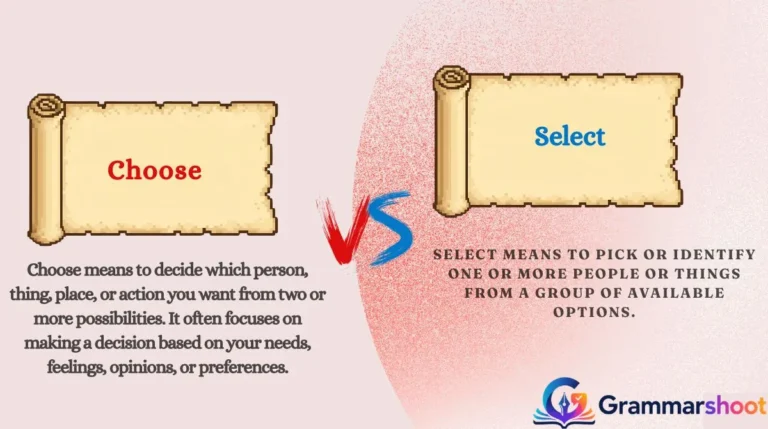
Choose means to decide which person, thing, place, or action you want from two or more possibilities. It often focuses on making a decision based on your needs, feelings, opinions, or preferences.
For example, when you visit a restaurant, you may choose a meal from the menu. When you buy clothes, you may choose a shirt because you like its color. When you plan your future, you may choose a career that matches your interests.
The word is very common in both British and American English. It sounds natural in everyday speech, friendly conversations, school discussions, and many types of writing.
When Should You Use “Choose”?
Use choose when you want to talk about a decision or preference.
You can use it in situations such as:
- Personal preferences: choosing your favorite food, color, or book.
- Important decisions: choosing a career, university, or place to live.
- Everyday activities: choosing what to wear or what to eat.
- Available options: choosing one answer from several questions.
- Actions and plans: choosing to stay home instead of going out.
The word does not always mean that you are picking a physical object. You can also choose an idea, an action, or a way of doing something.
For example, “She chose to forgive him” describes a decision about how to act. Nobody is picking an object from a table.
Grammar Rules for “Choose”
Choose is an irregular verb. Its main forms are:
| Verb form | Example |
|---|---|
| Base form | choose |
| Third-person singular | chooses |
| Past simple | chose |
| Past participle | chosen |
| Present participle | choosing |
Notice that the past form is chose, not choosed. The past participle is chosen, not chose.
Examples:
- I choose my clothes carefully.
- She chooses a different book every week.
- We chose the smaller room yesterday.
- They have chosen a new team leader.
- He is choosing a gift for his sister.
You can also use choose with an infinitive containing to.
For example:
- I chose to study English.
- She chooses to walk to school.
- They have chosen to remain at home.
In these sentences, choose to do something means deciding to take a particular action.
Example Sentences With “Choose”
Here are eight examples showing how people use the word in different situations.
- I usually choose tea instead of coffee in the morning.
- She chose a blue dress for the wedding.
- You can choose any seat you like.
- We need to choose a date for our meeting.
- He has chosen a career in medicine.
- My brother is choosing a new phone.
- They chose to travel by train because it was cheaper.
- If you could choose any country to visit, where would you go?
Each sentence describes a decision, preference, or selection between possible options.
Common Confusion About “Choose”
One common mistake is using choose when talking about the past and writing choosed.
Incorrect: I choosed the red bag.
Correct: I chose the red bag.
Another mistake is thinking that choose can only be used for personal preferences. In reality, it can describe formal decisions, too.
For example, a committee can choose a new chairperson, and a company can choose a supplier. The word remains correct even when the decision is official.
What Does “Select” Mean?
Select means to pick or identify one or more people or things from a group of available options. It often suggests that the choice is made carefully, according to particular needs, rules, or requirements.
For example, a teacher may select three students for a competition. A customer may select a delivery date on a website. A hiring manager may select a candidate after reviewing several applications.
Like choose, the word can refer to physical objects, people, answers, or actions. However, select often sounds more formal, technical, or procedural.
This does not mean that it is always formal. You may hear it in ordinary conversations, especially when someone is explaining how to use a computer, phone, menu, or other system.
When Should You Use “Select”?
Use select when the action involves picking a particular item or person from a group.
Common situations include:
- Forms and applications: selecting a country, date, or answer.
- Technology: selecting a file, icon, or option from a menu.
- Workplaces: selecting candidates, employees, or suppliers.
- Education: selecting an answer in a test or choosing students for a team.
- Organized processes: selecting products that meet certain conditions.
The word is especially useful when the available options are clearly listed or when the selection follows a process.
For example, a website might say, “Select your preferred language.” This sounds natural because the user is choosing from a list of available languages.
Grammar Rules for “Select”
Select is a regular verb. Its main forms are:
| Verb form | Example |
|---|---|
| Base form | select |
| Third-person singular | selects |
| Past simple | selected |
| Past participle | selected |
| Present participle | selecting |
Unlike choose, the past form is made by adding -ed.
Examples:
- I select the correct answer.
- She selects the best candidates.
- We selected a new supplier yesterday.
- They have selected three winners.
- He is selecting files for the presentation.
You can also use select with a direct object.
For example:
- Please select your country.
- The manager selected two employees.
- I selected the wrong option.
In these examples, the direct object tells us what was picked.
You can use select in the passive voice, too.
For example:
- Three students were selected for the competition.
- The winning design was selected by the judges.
The passive voice is common when the person doing the selection is less important than the result.
Example Sentences With “Select”
Here are eight examples of the word in different contexts.
- Please select your preferred language from the menu.
- The teacher selected five students for the debate.
- We selected a quiet room for the meeting.
- She has selected the photographs for her project.
- The company selected a new supplier last month.
- Select the correct answer before moving to the next question.
- The computer lets you select several files at once.
- Only qualified applicants will be selected for an interview.
These examples show that select is useful when describing a specific choice from a group, especially in organized situations.
Common Confusion About “Select”
Some learners think select is always more correct than choose because it sounds more professional. That is not true.
Both words are correct in many situations. The difference is often about style.
For example:
- You can choose your favorite meal.
- You can select your favorite meal.
Both sentences are grammatically correct. The first sounds more conversational, while the second may sound more formal or may appear in a digital ordering system.
Another common mistake is treating select as an irregular verb.
Incorrect: She select the best option yesterday.
Correct: She selected the best option yesterday.
Remember that the past simple and past participle forms of select are both selected.
Difference Between Choose and Select
The main difference is that choose often emphasizes making a decision, while select often emphasizes picking a particular option from a group.
This is a general tendency, not a strict rule. The words overlap in meaning, and you can often use either one without changing the basic message.
Choose vs Select: Comparison Table
| Feature | Choose | Select |
|---|---|---|
| Main meaning | Decide what you want | Pick something from a group |
| Common tone | Conversational and general | Often more formal or procedural |
| Personal decisions | Very common | Also possible |
| Forms and menus | Common | Especially common |
| Workplace use | Common | Common, particularly in formal processes |
| Verb type | Irregular | Regular |
| Past simple | Chose | Selected |
| Past participle | Chosen | Selected |
| British English | Common | Common |
| American English | Common | Common |
The table shows that the biggest differences concern tone and context. The two words do not belong to separate English varieties.
1. Difference in Everyday Usage
In everyday conversations, choose is often the more natural word when talking about personal decisions.
For example:
- I need to choose a birthday gift for my mother.
- We chose a restaurant for dinner.
- You can choose whichever movie you want.
These sentences focus on decisions made by a person.
However, select is also correct in many of these examples.
For instance, “We selected a restaurant for dinner” is grammatically correct. It may simply sound a little more deliberate or formal.
The choice between the words depends on the tone you want. If you are speaking casually with friends, choose is usually a safe option.
2. Difference in Formality
Select often appears in instructions, business documents, official processes, and technical settings.
For example:
- Select a payment method.
- Select the box to confirm your agreement.
- The panel will select the winning applicant.
These sentences sound natural because they describe a clear process.
In a friendly conversation, you might say:
- Choose a payment method.
- Choose the box you want.
- The panel will choose the winning applicant.
These alternatives are also correct. In some contexts, however, select may sound more precise or official.
Remember that formality is a tendency, not a fixed grammar rule. You can use select casually, and you can use choose in formal writing.
3. Difference in Meaning
Sometimes, choose places more attention on the decision itself, while select places more attention on identifying an option from a group.
Consider these examples:
Example A: I chose to become a teacher.
This sentence describes a personal decision or life choice.
Example B: The school selected me to become a team leader.
This sentence describes a decision made by someone else, usually from a group of candidates.
The difference comes from the context, not from an absolute rule about the verbs. You could say, “The school chose me to become a team leader,” and it would still be correct.
Similarly, you could say, “I selected teaching as my career.” This is correct, although chose teaching as my career may sound more natural in everyday speech.
4. Difference in Sentence Structure
Both verbs can take a noun as their object.
- I chose the red shirt.
- I selected the red shirt.
Both sentences are correct.
Both can also be followed by an infinitive with to when describing an action.
- She chose to leave early.
- She selected to leave early.
The first sentence is natural and common. The second is grammatically possible in certain contexts but sounds unusual in ordinary English. Native speakers generally prefer chose to leave early.
This is an important point: words with similar meanings do not always fit equally well into every sentence pattern.
With select, a direct object is often more natural:
- She selected the early train.
- The committee selected a new leader.
With choose, both a direct object and an infinitive are common:
- She chose the early train.
- She chose to take the early train.
5. Choose vs Select in UK English
British English uses both choose and select. There is no special British rule that changes their basic meanings.
A British person might say:
- Choose a seat and make yourself comfortable.
- Please select your preferred payment option.
- The school chose three pupils for the project.
- The judges selected the winner.
The first and third examples sound natural in ordinary communication. The second and fourth suit situations where a specific process is involved.
These are tendencies, not rules that every British speaker follows. Different people and organizations may prefer different wording.
6. Choose vs Select in US English
American English also uses both words in the same general way.
Common examples include:
- Choose your favorite dessert.
- Select a file from your computer.
- We chose a new name for the business.
- The committee selected a candidate.
American websites and applications often use select in instructions because it clearly tells users to pick an option. However, choose is also common in these settings.
There is no general American grammar rule requiring one word instead of the other.
Is There a UK vs US Difference?
No major UK-versus-US difference separates these two verbs. Both spellings are the same in British and American English, and their main meanings remain consistent.
The more useful distinction is between everyday language and language used for instructions or organized decisions.
If you want to sound natural in both varieties, use choose for ordinary decisions and preferences, and consider select when giving instructions or describing a formal selection process. You can adjust your wording to suit the situation.
Grammar Rules You Must Remember
Understanding the meanings is only part of learning these verbs. You should also know how their forms work in sentences.
Rule 1: Use “Choose” for Decisions and Preferences
When you talk about a personal decision, choose is often the most natural option.
Examples:
- I choose to eat healthy food.
- She chose a career in teaching.
- They have chosen to stay at home.
The verb can describe a small decision, such as choosing lunch, or a major one, such as choosing a career.
You can also use choose between when talking about two or more alternatives.
Example: I cannot choose between the blue dress and the black dress.
Rule 2: Use “Select” for Picking From a Group
Use select when you want to emphasize the act of identifying a particular option.
Examples:
- Select your country from the list.
- The teacher selected four students.
- Please select the correct answer.
This structure is especially common in instructions and formal processes.
You can also use select from to show the group that contains the available options.
Example: Customers can select from five different plans.
Rule 3: Learn the Correct Past Forms
The two verbs have different past forms.
| Tense or form | Choose | Select |
|---|---|---|
| Present | choose | select |
| Past simple | chose | selected |
| Past participle | chosen | selected |
| -ing form | choosing | selecting |
Examples:
- Yesterday, I chose the green one.
- I have chosen the green one.
- Yesterday, I selected the green one.
- I have selected the green one.
Do not write choosed or choosen. The correct forms are chose and chosen.
Rule 4: Remember That Both Words Can Be Correct
Do not assume that one verb is always right and the other is always wrong.
Examples:
- Choose your preferred seat.
- Select your preferred seat.
- The team chose a captain.
- The team selected a captain.
All four sentences are grammatically correct.
However, the best choice depends on context. When talking about personal preferences, choose often sounds more natural. When giving step-by-step instructions, select may be more suitable.
Common Mistakes Students Make
Learners often confuse these verbs because their meanings overlap. They may also believe that a formal-sounding word is always better in professional English.
Here are some common mistakes and ways to avoid them.
Writing “Choosed” Instead of “Chose”
Incorrect: I choosed the wrong answer.
Correct: I chose the wrong answer.
Why does this happen? Most English verbs form the past simple by adding -ed. For example, work becomes worked, and play becomes played. However, choose is irregular.
Correction tip: Memorize the three main forms together: choose, chose, chosen.
Writing “Choosen” Instead of “Chosen”
Incorrect: She has choosen a new dress.
Correct: She has chosen a new dress.
The word chosen is the past participle. It is used with helping verbs such as have, has, and had.
Examples:
- I have chosen my answer.
- She has chosen a new course.
- They had chosen a different route.
Correction tip: Remember that chose usually works alone as the past simple, while chosen follows a helping verb in perfect tenses.
Thinking “Select” Is Always More Professional
Incorrect idea: I must use select in every formal sentence.
Better approach: Use the word that fits the meaning and sentence structure.
For example, “I chose to accept the offer” is natural and appropriate in a professional email. There is no need to replace chose with selected.
Similarly, “Please select your preferred option” is a natural instruction.
Correction tip: Focus on the purpose of the sentence instead of choosing the word that sounds more complicated.
Using “Selected to” When “Chose to” Is More Natural
Unnatural in ordinary conversation: She selected to stay home.
Natural: She chose to stay home.
When choose is followed by an infinitive, it commonly describes a decision about an action. The pattern is:
choose + to + base verb
Examples:
- He chose to wait.
- We chose to leave early.
- They chose to help their neighbors.
With select, a direct object is generally more natural in ordinary usage.
For example: She selected a seat near the window.
Correction tip: When the next word is to followed by an action, check whether choose to is the natural expression.
Assuming British and American English Have Different Rules
Incorrect idea: British people use choose, but Americans use select.
Correct understanding: Both varieties use both words.
The verbs have the same spelling and broadly the same meaning in the UK and the US. Differences usually come from the context, the speaker’s style, or the type of text.
Correction tip: Learn the shared grammar rules first. Pay attention to how each word is used in real sentences instead of memorizing a false regional distinction.
Easy Trick to Remember the Difference
Here is a simple way to remember the difference.
Choose = decide what you want.
Select = pick a particular option from a group.
Imagine that you are at home and deciding what to eat for dinner. You might say, “I need to choose what to cook tonight.” This focuses on your decision.
Now imagine that you are using a food delivery website. The page asks you to pick a restaurant from a list. It might say, “Select a restaurant to continue.” This focuses on choosing a specific option in a process.
Think about the difference between a decision and an instruction.
When you are talking about what you like, what you want, or what you plan to do, choose is often a good option. When you are telling someone to pick an item from a menu, list, or group, select may sound more suitable.
You do not need to treat this trick as a strict rule. Both words can work in many of the same sentences.
For example, “Choose an answer” and “Select an answer” are both correct. The second may sound more like an instruction on a test or website, while the first is also perfectly natural.
The best way to remember the difference is to read and use both words in real situations.
Daily Life Examples: Choose vs Select
These short conversations show how both verbs work in everyday English.
Example 1: At a Restaurant
Ali: What do you want to eat?
Sara: I haven’t chosen my meal yet.
Ali: Take your time. The menu has lots of options.
Here, chosen describes Sara’s decision about her meal.
Example 2: Using a Website
Customer: I cannot continue to the next page.
Support agent: Please select your country from the list first.
In this example, select is suitable because the customer must pick an option from a list.
Example 3: Buying Clothes
Friend A: Which shirt should I buy?
Friend B: Choose the blue one. It looks better on you.
The word choose sounds natural in this friendly conversation because the speaker is giving personal advice.
Example 4: At School
Teacher: We need three students for the spelling competition.
Student: How will you decide who goes?
Teacher: I will select three students based on their results.
The teacher uses select to describe an organized process.
Example 5: Planning a Holiday
Maya: Have you chosen a destination for your holiday?
Zara: Yes, I have chosen Turkey because I want to learn about its history.
The word chosen describes a personal travel decision.
Example 6: On a Mobile Phone
Brother: How do I send these pictures?
Sister: Select the photos you want to share, then tap the send icon.
Here, select is natural because the sister is giving instructions for using a phone.
Example 7: Choosing a Career
Friend A: Why did you choose engineering?
Friend B: I enjoy solving problems and building things.
The word choose focuses on the person’s reasons for making a career decision.
Example 8: At Work
Manager: Have we found someone for the new position?
Assistant: Yes. The hiring team has selected a suitable candidate.
The word selected fits the formal hiring process.
Example 9: Taking a Test
Teacher: Read each question carefully and choose the best answer.
Student: Can I change my answer later?
Teacher: Yes, you can change it before you submit the test.
Both choose and select could be used in the teacher’s instruction. Choose sounds natural in this classroom setting.
Example 10: Booking a Ticket
Passenger: How can I book my train ticket online?
Agent: First, select your travel date. Then choose your departure time and complete the payment.
This example uses both words naturally. Select introduces a step in the booking process, while choose refers to the passenger’s decision about the departure time.
Practice Section: Test Your Understanding
Choose the correct option for each sentence. In some situations, both words may be grammatically possible, but select the option that sounds most natural in context.
- Yesterday, I _____ a red jacket for the party. (choose / chose)
- Please _____ your preferred language from the menu. (select / selected)
- She has _____ to study abroad next year. (chose / chosen)
- The company _____ three candidates for the final interview yesterday. (selected / select)
- I cannot _____ between these two books. (choose / chosen)
Answers and Explanations
- Chose — This is the past simple form of choose.
- Select — The sentence gives an instruction, so the base form is used.
- Chosen — The present perfect structure is has + past participle.
- Selected — The word yesterday indicates the past simple.
- Choose — After cannot, use the base form of the verb.
Try making five more sentences of your own. Use choose in sentences about personal decisions and select in sentences about lists, forms, or organized processes. Then check whether each sentence sounds natural.
FAQs
1. What is the difference between choose and select?
Both words mean to pick something from available options. Choose often emphasizes making a decision or expressing a preference, while select often emphasizes picking a specific item from a group. The meanings overlap, so both words are correct in many situations.
2. Is choose British English or American English?
Choose is used in both British and American English. The spelling and main meaning are the same in both varieties. Speakers use it when talking about decisions, preferences, plans, and actions.
3. Is select British English or American English?
Select is also common in both British and American English. It often appears in instructions, computer menus, applications, and formal selection processes. There is no major regional grammar difference between its UK and US usage.
4. Is select more formal than choose?
Select often sounds more formal, technical, or procedural than choose. For example, a website might say, “Select your payment method.” However, choose is also correct in formal writing. The best word depends on the context and tone.
5. Can choose and select be used in the same sentence?
Yes, you can use both words in one sentence when each fits its context. For example: “Select your travel date, then choose your preferred time.” The two verbs describe related actions, and using both can make the instructions sound natural.
6. What are the past tense forms of choose and select?
The past simple of choose is chose, and its past participle is chosen. The past simple and past participle of select are both selected. For example, “I chose a book” and “I have chosen a book” use different forms of choose.
Conclusion
The difference between choose and select is easier to understand when you focus on how each word is used. Both verbs mean picking something from available options, and both are correct in British and American English.
However, choose is often more natural when you talk about personal decisions, preferences, plans, or actions. Select is especially common when you pick a specific item from a list, follow instructions, or take part in a formal process.
Remember the grammar, too. The past forms of choose are chose and chosen, while the past forms of select are selected and selected. These forms are important for writing clear and correct sentences.
You do not need to worry about choosing the wrong regional variety. There is no major UK-versus-US difference in the basic use of these words. Instead, pay attention to the meaning, tone, and sentence structure.
Keep practicing with everyday examples, such as choosing a meal or selecting a file on your phone. The more you use both verbs, the easier it will become to choose the right word naturally.

Evan Rellmont is a writer who turns thoughtful ideas into meaningful words, creating stories and reflections that connect, inspire, and leave a lasting impression.