
“Trawling” and “trolling” look almost the same when you see them quickly, so it is easy to mix them up.
Both words are connected with fishing, and both can also appear when people talk about searching. However, they do not mean the same thing.
The confusion becomes even stronger because trolling has a very common modern meaning on the internet. When someone says, “He is trolling people online,” they are usually not talking about fishing at all.
They mean that the person is deliberately saying or doing something annoying to get a reaction.
Trawling, on the other hand, is most strongly connected with pulling a large net through the water to catch fish.
It also has a figurative meaning: searching through a large amount of information or many places to find something useful.
Cambridge Dictionary gives both the fishing and searching meanings of trawl, while troll includes fishing, searching in some contexts, and deliberately annoying people online.
The spelling difference is only one letter, but the meaning can change completely. Trawling comes from trawl, while trolling comes from troll.
The easiest way to remember them is to picture the tools involved: trawling uses a net, while trolling uses a baited fishing line.
Once you understand these basic ideas, sentences such as “They were trawling the sea” and “They were trolling for fish” will no longer seem confusing.
What Does “Trawling” Mean?
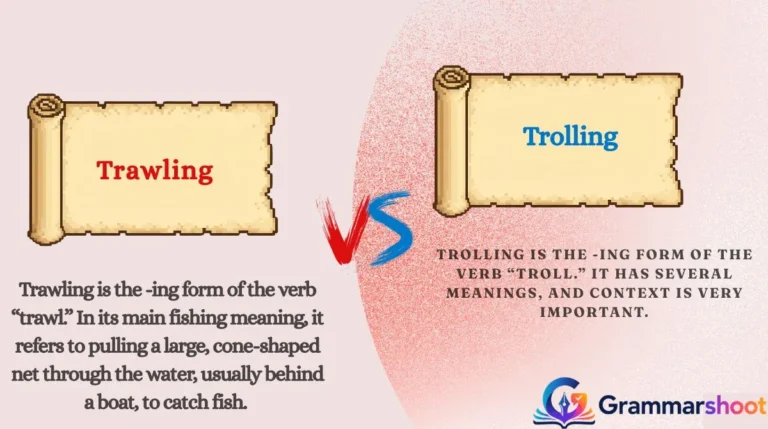
Trawling is the -ing form of the verb “trawl.” In its main fishing meaning, it refers to pulling a large, cone-shaped net through the water, usually behind a boat, to catch fish. Cambridge Dictionary describes a trawl as a large net used for fishing and also uses trawl for searching through many sources for information.
Think about a fishing boat moving through the water with a large net behind it. The net gathers fish as it moves. That activity is trawling.
The word can also be used in a non-fishing sense. When someone searches through a large amount of information, old records, websites, documents, or data, we can say they are trawling through that material.
When Should You Use “Trawling”?
Use trawling when you are talking about:
- catching fish with a large fishing net
- pulling a trawl net through water
- searching through a large amount of information
- examining many different sources to find something
The second use is often figurative. For example, a journalist might spend hours trawling through old newspapers to find a useful fact.
Grammar Rule for “Trawling”
Trawling is the present participle of trawl, and it can also function as a gerund or part of a continuous verb form.
For example:
They are trawling for fish.
Here, trawling is part of the present continuous tense.
Trawling can damage marine habitats.
Here, trawling acts as the subject of the sentence.
She spent the morning trawling through old files.
Here, trawling follows the verb spent and describes the activity.
The spelling is straightforward:
trawl + ing = trawling
There is no need to change the spelling of trawl before adding -ing.
Examples of “Trawling”
- The fishing boat was trawling far from the coast.
- Several boats were trawling for shrimp early in the morning.
- The fishermen spent the day trawling the waters.
- Scientists are trawling through old records for evidence.
- I spent hours trawling through websites for a suitable source.
- The reporter was trawling through newspaper archives.
- Commercial boats have been trawling for fish in this area.
- She was trawling through the database to find missing information.
Notice that the subject and context tell you which meaning is intended. In a sentence about boats, fishing, and nets, trawling usually has its literal fishing meaning. In a sentence about websites, records, or data, it often means searching widely.
A Common Confusion About “Trawling”
One common mistake is assuming that trawling simply means “fishing.”
That is too general. Many kinds of fishing exist. Trawling specifically involves dragging a large net through the water. It is different from fishing with a single baited line.
So, this sentence is more precise:
The boat was trawling with a large net.
The key image is the net being pulled through the water.
What Does “Trolling” Mean?
Trolling is the -ing form of the verb “troll.” It has several meanings, and context is very important.
In fishing, trolling means trying to catch fish by pulling a baited line through the water behind a moving boat. Cambridge Dictionary describes this fishing method as moving a boat slowly while a fishing line is pulled behind it.
That makes it different from trawling.
A second meaning is connected with the internet. Trolling can mean deliberately posting or saying something offensive, irritating, or provocative online in order to upset people, attract attention, or cause trouble.
For example:
Someone is trolling the other users in the comments.
This has nothing to do with fishing. The meaning comes from modern online communication.
There is also a less common use of troll meaning to search among many places for people or information, especially on the internet. Cambridge lists this search meaning as mainly American.
When Should You Use “Trolling”?
Use trolling when you are talking about:
Fishing:
Pulling a baited line behind a moving boat.
Internet behavior:
Deliberately trying to annoy, upset, or provoke people online.
Searching:
In some contexts, searching through many places for information or people.
These meanings are different, so the words around trolling help the reader understand what you mean.
Grammar Rule for “Trolling”
Trolling is formed by adding -ing to troll:
troll + ing = trolling
It can be part of a continuous tense:
They are trolling for tuna.
It can also be a noun or gerund:
Trolling is common on some online platforms.
In this sentence, trolling names an activity.
Examples of “Trolling”
- The fishermen were trolling for salmon near the island.
- We went trolling before sunrise.
- The captain has years of experience with trolling.
- Someone was trolling people in the comment section.
- Stop trolling and answer the question seriously.
- He was accused of trolling other users online.
- She thought I was trolling her, but I was being serious.
- The team spent the afternoon trolling for fish.
These examples show why context matters. In “trolling for salmon,” the activity is fishing. In “trolling people online,” it refers to provocative internet behavior.
A Common Confusion About “Trolling”
Many learners see the words trawling and trolling in fishing articles and assume they are alternative spellings for the same action.
They are not.
Even though both involve movement through water to catch fish, the method is different:
Trawling = dragging a large net.
Trolling = pulling a baited line.
That small difference is very important.
Difference Between Trawling and Trolling
The easiest way to compare the two words is to focus on the fishing method and the modern meanings.
| Word | Basic Meaning | Fishing Method | Other Common Meaning | Example |
|---|---|---|---|---|
| Trawling | Pulling a large net through water | Large net | Searching through lots of information | They were trawling the sea. |
| Trolling | Pulling a baited line behind a moving boat | Baited fishing line | Provoking people online | He was trolling users online. |
1. Trawling Uses a Net
When trawling refers to fishing, imagine a large net being dragged behind a boat.
The boats were trawling for fish.
The net can cover a broad area as the boat moves through the water. The defining idea is the trawl net.
2. Trolling Uses a Fishing Line
When trolling refers to fishing, imagine a boat moving slowly while a baited line trails behind it.
They were trolling for tuna.
The defining idea is the line and bait, not a large net. Cambridge explicitly distinguishes the two fishing methods in its dictionary definitions.
3. Trawling Can Mean Searching
English often uses fishing words metaphorically.
For example:
The researcher was trawling through thousands of documents.
The person is not using a physical net. Instead, they are searching widely through a huge collection of information.
This meaning is common in phrases such as:
trawling through data
trawling through records
trawling through websites
Cambridge defines trawl in this figurative sense as searching among many different places for information or people.
4. Trolling Can Mean Online Provocation
In modern English, this is probably the meaning many internet users know best.
He was trolling the other players.
This means he was deliberately trying to annoy or provoke them.
Are you trolling me?
This question is now common in informal online and spoken English. It usually means, “Are you deliberately saying something annoying or ridiculous just to get a reaction?”
Cambridge defines this modern use as intentionally saying or doing something annoying or offensive to upset someone or attract attention.
Sentence Structure Difference
Both words can appear after be in continuous tenses:
The boat is trawling for fish.
The boat is trolling for fish.
They can also appear after another verb:
They continued trawling the area.
They continued trolling for tuna.
When the meaning is online behavior, trolling often takes a person, group, or online community as its object:
He was trolling other users.
They were trolling me.
With the searching meaning of trawl, expressions such as trawl through and trawl for are common:
She trawled through the records.
The team trawled for useful information.
The context is therefore just as important as the spelling.
Grammar Rules You Must Remember
Rule 1: Use “trawling” for a large fishing net
When the action involves pulling a large net through the water, use trawling.
Correct:
The boats were trawling for shrimp.
Incorrect for this meaning:
The boats were trolling with a large net.
Trolling has its own fishing meaning, but it normally refers to a baited line rather than a trawl net.
Rule 2: Use “trolling” for fishing with a baited line
When a moving boat pulls a baited fishing line behind it, the correct word is trolling.
Correct:
They were trolling for tuna.
Correct:
We spent the morning trolling offshore.
The word describes the fishing method, not simply fishing in general. Cambridge gives this exact distinction in its fishing definitions.
Rule 3: Use “trolling” for deliberate online provocation
When a person intentionally tries to annoy or provoke people online, use trolling.
Correct:
He is trolling the fans in the comments.
Correct:
Are you trolling me?
The expression is informal and belongs mainly to internet and social-media language.
Do not confuse this with trawling through information.
Rule 4: “Trawling” can describe searching through lots of information
Use trawling when someone searches through many records, websites, files, or data sources.
Correct:
I spent the evening trawling through old emails.
Correct:
Researchers were trawling through historical records.
This is a figurative use based on the image of a net collecting things from a wide area.
Common Mistakes Students Make
The biggest problem is that the words are visually similar. Learners often remember the letters but forget the meaning.
Mistake 1: Thinking the words are different spellings of the same verb
A student may write:
The fishermen were trolling with a big net.
This can be confusing when the intended meaning is the use of a trawl net.
A clearer sentence is:
The fishermen were trawling with a big net.
Remember the basic fishing picture: trawl = net.
Mistake 2: Using “trawling” for internet arguments
Some learners write:
He was trawling people on social media.
That is not the usual word for deliberately provoking people online.
Use:
He was trolling people on social media.
The online meaning belongs to troll, not the usual internet meaning of trawl.
Mistake 3: Thinking every type of fishing is “trawling”
Fishing is a broad term. Trawling is a specific fishing method involving a trawl net.
Likewise, trolling in fishing is a specific method involving a baited line pulled through the water.
So do not replace the general word fishing with either word unless the method matches.
Mistake 4: Forgetting that “trawl” can be metaphorical
A sentence such as:
The reporter was trawling through old records.
may sound strange to a beginner because there is no boat or fish. But the word is being used figuratively to mean searching widely through a large amount of information.
Mistake 5: Confusing “trolling” with ordinary disagreement
Not every person who disagrees with you is trolling.
The modern internet meaning usually includes an intention to provoke, annoy, upset, or attract attention.
Compare:
She disagreed with my opinion.
This simply means she had a different view.
She was trolling me.
This suggests she was intentionally trying to get a reaction.
That difference matters.
Easy Correction Tips
Before choosing the word, ask yourself one question:
What is happening here?
If you see a large net, think trawling.
If you see a baited line behind a boat, think trolling.
If you see provoking people online, think trolling.
If you see searching through lots of records or information, think trawling.
That four-part check will prevent most mistakes.
Easy Trick to Remember the Difference
Here is a simple memory trick:
TRAWLING = TRAWL NET
The word trawl is connected with the large net used to catch fish.
Picture a wide fishing net moving through the sea:
NET → TRAWLING
Now remember:
TROLLING = TROLL PEOPLE
Online, a person who wants to provoke others may be called a troll.
Picture someone posting an annoying comment just to make people angry:
PROVOKE → TROLLING
For fishing, make the second picture slightly different:
TROLLING → baited LINE behind a boat
You can remember all three with one simple set of images:
Trawling = Net
Trolling = Fishing line
Trolling = Online provocation
Another useful trick is to notice the letters.
TRAWL has AWL in it, and you can imagine a wide tool or net sweeping through the water.
TROLL is the word that gives us troll, a person who tries to get a reaction online.
You do not need a complicated grammar rule. A strong mental picture is often enough.
Daily Life Examples
These examples show how the two words work in natural spoken and written English.
Example 1: Fishing with a net
A: Why are those boats so close to each other?
B: They are trawling for fish.
Here, trawling is correct because the boats are using a net.
Example 2: Fishing with a line
A: What are you doing out on the lake?
B: We are trolling for trout.
Here, trolling means pulling baited fishing lines through the water.
Example 3: Searching through files
A: Did you find the old contract?
B: Yes. I was trawling through the files all morning.
The person is searching through many documents.
Example 4: Searching online
A: How did you find that old photograph?
B: I was trawling through old websites.
This is figurative searching.
Example 5: Online provocation
A: Why did Daniel post that strange comment?
B: I think he was trolling people.
The speaker believes Daniel wanted to get a reaction.
Example 6: Asking about online behavior
A: Are you serious about that comment?
B: Of course I am. Why?
A: I thought you were trolling me.
Here, trolling means deliberately provoking someone.
Example 7: Talking about a fishing trip
A: Did you catch anything yesterday?
B: Yes. We spent six hours trolling for tuna.
The context clearly shows the fishing meaning.
Example 8: Research work
A: How did you find so many old references?
B: I spent the weekend trawling through academic records.
Here, trawling means searching through many sources.
Example 9: Social media
A: Why are people arguing under that post?
B: One person is trolling everyone in the comments.
This is the modern internet meaning.
Example 10: General fishing
A: Are you trawling today?
B: No, we are trolling. We brought fishing lines, not a net.
This conversation clearly shows the technical difference between the two fishing methods.
Practice Section
Choose the correct word: trawling or trolling.
1. The fishermen were ______ with a large net.
2. She spent hours ______ through old government records.
3. He keeps ______ people online just to get angry reactions.
4. The boat was ______ for tuna using baited lines.
5. The research team was ______ through thousands of documents.
Answers
1. trawling
A large net suggests trawling.
2. trawling
The person is searching through many records.
3. trolling
This means deliberately provoking people online.
4. trolling
A baited line behind a moving boat is trolling.
5. trawling
Searching through a large amount of information can be described as trawling.
A useful habit is to explain why you selected the answer. When you can explain the difference, you are much less likely to forget it.
FAQs
What is the difference between trawling and trolling?
Trawling usually means pulling a large net through water to catch fish. It can also mean searching through a large amount of information or many sources.
Trolling can mean fishing with a baited line behind a moving boat. In modern English, it also means deliberately provoking or annoying people online.
Is trawling the same as trolling in fishing?
No. They are different fishing methods.
Trawling uses a large net that is dragged through the water. Trolling uses a baited fishing line pulled behind a moving boat. Both are fishing techniques, but the equipment and method are different.
Can we use “trolling” in questions?
Yes. It is common in informal questions, especially when talking about internet behavior.
For example:
“Are you trolling me?”
It can also be used for fishing:
“Are you trolling for tuna today?”
The surrounding words make the meaning clear.
Is “trolling” formal or informal?
The internet meaning of trolling is generally informal. It is common in social media, online discussions, gaming communities, and everyday conversation.
The fishing meaning is a normal technical use of the verb troll and is not simply internet slang.
Can “trawling” mean searching the internet?
Yes. Trawling can be used figuratively to mean searching through many places or a large amount of information.
For example:
“The researcher was trawling through online archives.”
This means the researcher was looking through many sources to find information.
Which is correct: “trolling the internet” or “trawling the internet”?
Both expressions can occur, but they can suggest different meanings.
Trawling the internet usually suggests searching widely through websites or information.
Trolling the internet can refer to searching in some contexts, but in modern everyday English, trolling often suggests deliberately provoking people online. Cambridge lists the search meaning of troll as mainly American.
Is “troll” always related to the internet?
No. The verb troll existed as a fishing term before its modern internet meaning became common.
In fishing, to troll means to pull a baited line through the water behind a moving boat. The word also has other meanings, including the modern internet sense.
Can “trawling” be used as a noun?
Yes. Trawling can name the activity itself.
For example:
“Trawling can be an important fishing method.”
It can also be used in expressions describing a search:
“The team spent the day trawling through historical documents.”
The exact meaning depends on context.
Conclusion
The difference between trawling and trolling becomes simple when you remember the action behind each word.
Trawling usually involves a large net being pulled through the water. The word can also describe searching through a large amount of information, such as files, websites, records, or data.
Trolling in fishing involves a baited line being pulled behind a moving boat. In modern online English, trolling usually means deliberately provoking, annoying, or upsetting people to get a reaction.
So remember this quick guide:
Trawling = large net or wide information search.
Trolling = baited fishing line or provoking people online.
The two words may look almost identical, but their meanings are quite different. Pay attention to the context, picture the action in your mind, and practice using each word in your own sentences. A few minutes of practice can make this confusing pair much easier to remember.

Evan Rellmont is a writer who turns thoughtful ideas into meaningful words, creating stories and reflections that connect, inspire, and leave a lasting impression.