
Have you ever stopped while writing a sentence because you were unsure whether to use borne or born? You are not alone.
These two words look almost identical and sound the same in many English accents. However, they have different uses, and choosing the wrong one can make your sentence grammatically incorrect.
For example, you might write, “I was borne in Pakistan,” when you want to tell someone where you entered the world.
The correct sentence is “I was born in Pakistan.” On the other hand, if you want to say that someone has experienced a great deal of pain or difficulty, you might write, “She has borne many hardships.”
Why does English use two spellings for words that are so closely related? Both words come from the verb bear, which has several meanings, including to carry, to endure, and to give birth.
Over time, English developed a useful distinction between these forms.
The good news is that you do not need to memorize complicated grammar terms to understand the difference. You simply need to recognize what your sentence is trying to say and learn a few basic rules.
By the end of this guide, you will understand when to use each word, how they work in different sentence structures, and which mistakes to avoid.
You will also find everyday examples, a comparison table, practice questions, and answers to common questions.
What Does “Borne” Mean?
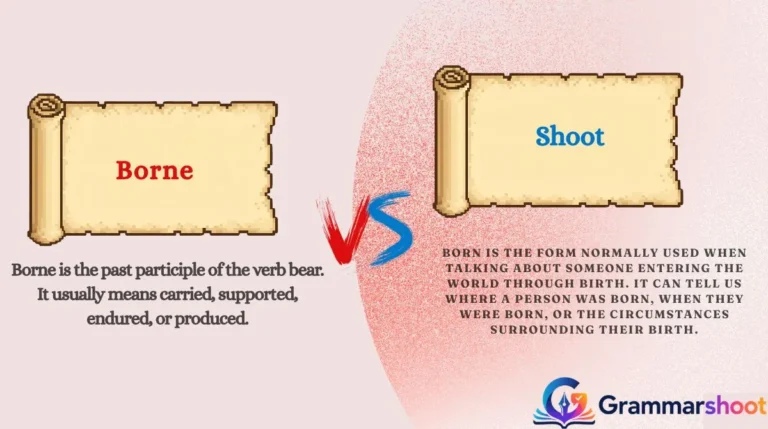
Borne is the past participle of the verb bear. It usually means carried, supported, endured, or produced. It can also describe something that has been paid for or transferred from one place or person to another.
Think of borne as a word connected to carrying something, dealing with something difficult, or bringing about a result.
For example, when someone says, “She has borne the pain bravely,” it means that she has endured the pain without giving up.
When Should You Use Borne?
Use borne when bear means to carry a load, accept a responsibility, tolerate a difficult situation, or produce something.
It is also used in expressions such as costs borne by the company, airborne particles, and the results have borne fruit.
Here are the main uses:
- Carried: Something is moved or carried by a person, animal, vehicle, or force.
- Endured: Someone experiences pain, pressure, or difficulty.
- Supported or paid for: A person or organization accepts a cost or responsibility.
- Produced: Something creates a result, such as fruit, success, or benefits.
- Transmitted: Something spreads through air, water, food, or another carrier.
Grammar Rule for Borne
The verb bear has three important forms:
| Verb Form | Word | Example |
|---|---|---|
| Base form | Bear | I can bear the pressure. |
| Simple past | Bore | She bore the responsibility. |
| Past participle | Borne | She has borne the responsibility. |
Remember that bore is the simple past form, while borne is the usual past participle for meanings other than the special passive birth expression.
Borne commonly appears after helping verbs such as has, have, and had. It also appears in passive sentences with forms of be.
Examples of Borne in Sentences
- She has borne many difficulties throughout her life.
- The heavy box was borne by two workers.
- The company has borne the cost of the repairs.
- He has borne the responsibility for the entire team.
- The message was borne across the country by travelers.
- These trees have borne fruit for many years.
- The pressure was more than he could have borne.
- The disease can be transmitted by insect-borne parasites.
Notice how the meaning changes with the sentence. In the first example, borne means endured. In the third, it means paid for or accepted as a cost. In the sixth, it means produced.
In the final example, insect-borne is a compound adjective that describes something carried or transmitted by insects.
A Common Confusion About Borne
Some learners think borne is only a formal version of born. That is not correct. The two words perform different grammatical jobs.
Compare these sentences:
- She was born in 2001.
- She has borne many responsibilities.
The first sentence tells us when someone entered the world. The second explains what someone has carried or endured.
There is one important exception to the simple birth rule: borne is also used when talking about a mother’s act of giving birth in certain sentence structures.
For example, “She has borne three children” is correct. Here, the mother is the person who has given birth. The distinction is explained in Cambridge’s grammar guide and the MLA Style Center’s guidance.
What Does “Born” Mean?
Born is the form normally used when talking about someone entering the world through birth. It can tell us where a person was born, when they were born, or the circumstances surrounding their birth.
For example, “My sister was born in July” tells us the month when her life began.
The word is most commonly used in the expression be born. It is also used in a wider sense to describe the beginning of an idea, movement, relationship, or other thing.
For instance, “A new business was born from a simple idea” means that the business began because of that idea.
When Should You Use Born?
Use born when the sentence describes a person or animal coming into the world. It is also appropriate when you describe the beginning of something or a natural quality that someone seems to have.
Here are the main uses:
- Physical birth: A baby was born yesterday.
- Time of birth: He was born in 1999.
- Place of birth: She was born in Lahore.
- Beginning of an idea or movement: A new project was born from their discussion.
- Natural ability or quality: He is a born leader.
- Origin or background: She is a British-born writer.
Grammar Rule for Born
In normal sentences about a person’s birth, use a form of the verb be followed by born.
The common structure is:
Subject + was/were + born + place, time, or other detail.
Examples include:
- I was born in Pakistan.
- They were born in the same year.
- My brother was born on Monday.
- The baby was born at home.
Use was with I, he, she, and singular nouns in the simple past. Use were with you, we, they, and plural nouns.
Do not write “I born in 2005” when you mean that your birth took place in that year. Write “I was born in 2005.”
Examples of Born in Sentences
- I was born in a small village.
- My cousin was born on December 10.
- The twins were born a few minutes apart.
- Our youngest child was born during the winter.
- A new friendship was born during the school trip.
- She is a born storyteller who makes everyone laugh.
- He was born and raised in Karachi.
- The idea for the school club was born during lunch.
These examples show that born is not always about a baby’s physical birth. In the fifth and eighth sentences, the word describes the beginning of something new.
In the sixth sentence, born storyteller means someone who seems to have a natural talent for telling stories.
A Common Confusion About Born
Some students believe that born must always refer to the physical birth of a person. However, English also uses it in expressions such as born leader, born winner, and a movement was born.
Another common mistake is using born after has when talking about a mother’s act of giving birth.
For example:
- Incorrect: She has born two children.
- Correct: She has borne two children.
In the correct sentence, the subject she is performing the action of giving birth. This is different from saying, “Her children were born in June,” where the children are the focus of the sentence.
Understanding who is doing the action can help you select the right form.
Difference Between Borne and Born (Detailed)
The main difference is that born is normally used for the passive expression about birth, while borne is used for most other meanings of bear, including carrying, enduring, and producing. In certain sentences about a mother giving birth, borne is also correct.
Both words come from the same verb, but their modern uses are different.
Borne vs Born: Comparison Table
| Feature | Borne | Born |
|---|---|---|
| Main meaning | Carried, endured, supported, or produced | Brought into the world; started to exist |
| Common use | Carrying a burden or accepting a cost | Talking about birth |
| Common structure | Has/have/had borne | Was/were born |
| Example | She has borne the pain. | She was born in 2004. |
| Passive example | The cost was borne by the company. | The child was born at night. |
| Birth-related exception | She has borne three children. | The children were born in June. |
| Related expression | Fruit-bearing or waterborne | Born leader or newborn baby |
1. Usage Difference
The easiest way to understand the difference is to look at the meaning of the sentence.
Use born when you are talking about someone entering the world:
“She was born in Islamabad.”
Use borne when you are talking about someone carrying or enduring something:
“She has borne many responsibilities.”
You can also use borne for costs, results, and things carried by natural forces.
For example, “The expenses were borne by the school” means that the school paid for the expenses.
2. Grammar Logic
Both words are forms of bear, but English uses them differently.
The verb forms are:
- Bear: the base form.
- Bore: the simple past.
- Borne: the usual past participle outside the special passive birth expression.
- Born: the spelling used in the usual passive birth expression.
Compare the following sentences:
- I can bear the pain.
- I bore the pain patiently.
- I have borne the pain for years.
- I was born in 2000.
In the first three sentences, bear means to endure something. The final sentence refers to birth.
This is why you should not choose the spelling only by looking at the tense. You must also consider the meaning and structure.
3. Sentence Structure Difference
In ordinary birth sentences, born usually follows was, were, or another appropriate form of be.
Examples:
- She was born in May.
- They were born in the same city.
- The child has been born safely.
For other meanings of bear, borne can follow have, has, or had:
- She has borne the burden.
- We have borne the costs.
- They had borne the responsibility for years.
In passive sentences, borne can also follow a form of be:
- The cost was borne by the employer.
- The boat was borne along by the river.
One important point is that the helping verb alone does not decide which spelling is correct. The meaning of bear matters too.
4. Meaning Comparison in Real Contexts
Look at these pairs:
Pair A: Birth and responsibility
- The child was born in April.
- The mother has borne many responsibilities.
The first is about the child’s birth. The second is about responsibilities the mother has carried or accepted.
Pair B: Origin and result
- A new idea was born during the meeting.
- Their hard work has borne fruit.
The first means that an idea began to exist. The second means their effort produced good results.
Pair C: Time and cost
- My brother was born in 2005.
- The repair costs were borne by the landlord.
The first describes a birth date. The second tells us who paid for the repairs.
These examples show why the two spellings cannot simply replace each other.
Grammar Rules You Must Remember
Four simple rules will help you make the right choice in most everyday situations.
Rule 1: Use Born for the Usual Expression About Birth
When you want to say where or when someone entered the world, use was born or were born.
Correct: “I was born in 2002.”
Incorrect: “I was borne in 2002.”
For everyday English, remember the familiar expression be born. It is the normal choice when describing a person’s birth.
Rule 2: Use Borne for Carrying or Enduring
When bear means to carry a load, accept a responsibility, or experience something difficult, use borne as the past participle.
Correct: “She has borne the pressure with patience.”
Incorrect: “She has born the pressure with patience.”
The same rule applies to expenses, burdens, and many other things that people or organizations carry or accept.
Rule 3: Use Borne When a Mother Has Given Birth
When you describe a mother’s action of giving birth, borne is the standard past participle.
Correct: “She has borne three children.”
Incorrect: “She has born three children.”
You can also write, “The children borne by her were healthy.” Here, borne by her describes the children she gave birth to.
This rule is especially important because it shows that not every sentence connected with birth uses born.
Rule 4: Learn the Full Verb Forms
The forms of bear are bear, bore, borne. The spelling born is used in the special expression about birth.
Consider these examples:
- Present: I bear the responsibility.
- Past: I bore the responsibility.
- Present perfect: I have borne the responsibility.
- Birth expression: I was born in Lahore.
Learning these forms together makes it easier to understand the relationship between the words.
Common Mistakes Students Make
Even students with good English skills sometimes confuse these words. The main reason is that both have the same root and sound very similar.
Another reason is that learners memorize one rule, such as “born means birth,” without learning the difference between the person being born and the mother giving birth.
Mistake 1: Writing “I Was Borne”
Incorrect: I was borne in Pakistan.
Correct: I was born in Pakistan.
Why? The sentence describes where the speaker entered the world. In normal modern English, the correct expression is was born.
Correction tip: Whenever you answer a question about your place or date of birth, use was born.
Mistake 2: Using Born for a Burden
Incorrect: He has born many hardships.
Correct: He has borne many hardships.
Why? The word hardships refers to difficulties he has experienced. Here, bear means to endure, so the past participle is borne.
Correction tip: If the sentence is about pain, pressure, responsibility, or difficulty, check whether borne is needed.
Mistake 3: Writing “She Has Born a Child”
Incorrect: She has born a child.
Correct: She has borne a child.
Why? The sentence focuses on the mother giving birth. The correct past participle for this active use is borne.
Correction tip: Ask yourself who is performing the action. If the mother is the subject and the sentence means she gave birth, use borne.
Mistake 4: Using Born Instead of Borne for Expenses
Incorrect: The expenses were born by the company.
Correct: The expenses were borne by the company.
Why? The company accepted or paid the expenses. The sentence is not about physical birth, so borne is correct.
Correction tip: Words such as costs, expenses, burden, and responsibility can be clues that you need borne.
Mistake 5: Choosing by Tense Alone
Incorrect: I have born this burden for years.
Correct: I have borne this burden for years.
The helping verb have tells you something about the tense, but it does not automatically mean you should select born. You must still consider the meaning of the main verb.
Correction tip: First identify the meaning of bear. Then choose the correct form for that meaning and sentence structure.
Easy Trick to Remember the Difference
Here is an easy memory trick:
Born = the usual word for being brought into the world.
Borne = carried, endured, supported, or produced.
Think about a baby arriving in the world. You would say, “The baby was born.” You would not normally say, “The baby was borne.”
Now imagine a worker carrying a heavy box or a family dealing with a difficult situation. You could say, “The box was borne by the worker” or “The family has borne many difficulties.”
Try asking yourself one simple question before writing either word:
Am I talking about someone being born, or about someone carrying, enduring, supporting, or producing something?
If the sentence describes the usual birth expression, choose born. If it describes another meaning of bear, choose borne.
There is one extra question for sentences about childbirth: is the mother the person giving birth? If so, borne may be the correct form, as in “She has borne a child.”
This small distinction will help you avoid most common mistakes.
Daily Life Examples
The best way to learn a grammar rule is to see how it works in everyday conversations. Here are ten short examples you might hear at home, at school, at work, or while talking to friends.
1. Talking About Your Birthplace
Ali: Where were you born?
Sara: I was born in Lahore, but I grew up in Islamabad.
Why? The speakers are discussing the place where Sara entered the world, so born is correct.
2. Asking About a Birthday
Friend A: When was your little brother born?
Friend B: He was born on March 14.
Why? The question asks about the date of birth. Use was born.
3. Talking About a Difficult Day
Ayesha: You look tired. Has work been difficult lately?
Maryam: Yes, I have borne a lot of pressure this week.
Why? Maryam means she has endured pressure. Use borne.
4. Discussing Household Expenses
Husband: Who paid for the new washing machine?
Wife: The cost was borne by my parents.
Why? The sentence explains who covered the expense. It has nothing to do with birth.
5. Talking About Responsibilities at School
Student A: Why does our class monitor look so busy?
Student B: She has borne most of the responsibilities for the school event.
Why? The monitor has carried or accepted many responsibilities, so borne is appropriate.
6. Asking About Twins
Friend A: Are your cousins twins?
Friend B: Yes, they were born just five minutes apart.
Why? The sentence describes the twins’ births.
7. Talking About a New Idea
Teacher: How did you decide to start the reading club?
Student: The idea was born during a classroom discussion.
Why? Here, born means that the idea began to exist.
8. Discussing Hard Times
Brother: How did Grandpa stay so strong during those difficult years?
Sister: He has borne many hardships without losing hope.
Why? Grandpa endured or experienced difficulties, so use borne.
9. Talking About a Mother’s Children
Friend A: How many children does your aunt have?
Friend B: She has borne four children and raised them with great care.
Why? The sentence describes the mother’s act of giving birth. Borne is correct in this structure.
10. Discussing a Successful Project
Manager: Did the new training program help our employees?
Employee: Yes, our efforts have borne fruit. The team is working much better now.
Why? The expression borne fruit means that an effort has produced good results.
Notice that these examples use both words naturally. The more you read and practice them in sentences, the easier the difference becomes.
Practice Section: Choose the Correct Word
Test your understanding with these five sentences. Choose either born or borne to complete each sentence.
1. My younger sister was ______ in 2010.
- A. born
- B. borne
2. He has ______ the pain without complaining.
- A. born
- B. borne
3. The expenses were ______ by the company.
- A. born
- B. borne
4. She has ______ two children.
- A. born
- B. borne
5. A new idea was ______ during our meeting.
- A. born
- B. borne
Answers and Explanations
1. Born — The sentence describes the sister’s birth. The correct phrase is was born.
2. Borne — The person endured pain. Borne is the past participle used for this meaning of bear.
3. Borne — The company accepted or paid the expenses. This is a non-birth meaning of bear.
4. Borne — The subject she is the person giving birth. The correct form is has borne.
5. Born — The sentence describes the beginning of an idea. English commonly uses born in this figurative sense.
If you missed one or more answers, review the comparison table and grammar rules. Focus especially on the difference between a child being born and a mother having borne children.
FAQs
1. What Is the Difference Between Borne and Born?
Born is normally used when someone enters the world, as in “I was born in Pakistan.” Borne is the usual past participle of bear for meanings such as carried, endured, supported, or produced. In a sentence such as “She has borne three children,” borne describes the mother’s act of giving birth.
2. Can We Use Borne in a Sentence About Birth?
Yes. Although born is the usual form in sentences such as “The baby was born yesterday,” borne is correct when describing a mother’s action of giving birth. For example, “She has borne two children.” The sentence structure and the person performing the action determine the correct word.
3. Is Borne Formal or Informal?
Borne is a standard English word, not an incorrect or outdated form. It appears in everyday expressions such as “borne the burden” and in formal writing about costs or responsibilities. You may encounter it more often in professional, academic, or written English than in casual conversation.
4. Is “I Was Borne” Grammatically Correct?
For ordinary modern English, when you mean that you entered the world, write “I was born.” The phrase “I was borne” is not the normal choice for telling someone about your birth. However, borne is correct in other passive constructions, such as “The cost was borne by the company.”
5. Is “She Has Born a Child” Correct?
No. The standard form is “She has borne a child.” The sentence describes the mother giving birth, so borne is used as the past participle of bear. Compare it with “The child has been born,” which correctly uses born to focus on the child.
6. What Are the Three Forms of Bear?
The three main forms are bear, bore, and borne. For example, “I bear the responsibility,” “I bore the responsibility,” and “I have borne the responsibility.” In the usual expression about birth, English uses born, as in “I was born in 2005.”
Conclusion
Understanding the difference between borne and born becomes much easier when you focus on the meaning of your sentence. Although both words come from the verb bear, they are not interchangeable in modern English.
Use born when talking about someone’s birth, as in “She was born in June.” You can also use it when describing the beginning of something, such as an idea or movement.
Use borne for most other meanings of bear, including carrying, enduring, supporting, or producing something. For example, “He has borne many hardships” and “The expenses were borne by the company” are both correct.
Remember the important exception: when the mother is the subject and the sentence describes her act of giving birth, borne is correct, as in “She has borne two children.”
You do not need to memorize every example at once. Start by learning the main rule, then practice with short sentences from daily life. When you are unsure, check what the verb means and who is performing the action.
With a little practice, you will be able to choose the right word confidently and write clearer, more natural English.

Evan Rellmont is a writer who turns thoughtful ideas into meaningful words, creating stories and reflections that connect, inspire, and leave a lasting impression.