
Have you ever wondered why we say sing, sang, sung but walk, walked, walked? Both words describe actions, yet their past forms follow different patterns.
This is where strong verbs and weak verbs come in.
English verbs can change when we talk about the past. Some verbs change their vowel sounds, while others form the past by adding an ending such as -ed or -d.
These patterns are especially important when you speak, write stories, complete grammar exercises, or learn English as a second language.
The terms strong verbs and weak verbs may sound difficult at first. However, the basic idea is easy to understand once you look at a few examples.
Strong verbs often change their vowel sounds to form the past tense, as in drink, drank, drunk. Weak verbs usually add an ending, as in work, worked, worked.
There is one important detail to remember: these terms have a special meaning in traditional English grammar.
They do not simply mean that one verb is more powerful or useful than another. Also, modern grammar sometimes uses the terms irregular verbs and regular verbs for similar groups, although the categories do not match perfectly in every case.
By understanding these patterns, you can choose the correct verb form, avoid common mistakes, and sound more natural in everyday English.
What Does a Strong Verb Mean?
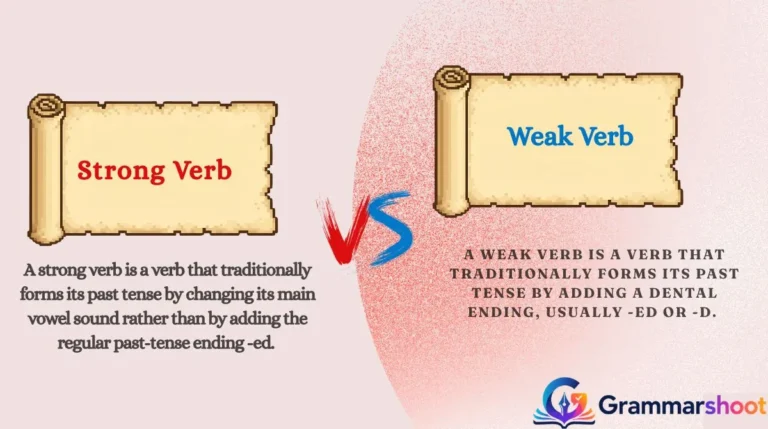
A strong verb is a verb that traditionally forms its past tense by changing its main vowel sound rather than by adding the regular past-tense ending -ed. Strong verbs are an important part of the history and structure of English.
For example:
- Sing → sang → sung
- Drink → drank → drunk
- Begin → began → begun
- Write → wrote → written
Notice what happens in these examples. The verbs change their internal vowel sounds when they move from the present form to the past form or past participle.
The term strong verb comes from an older system of English grammar. It describes a particular way of forming verb tenses. It does not mean that the action is strong, forceful, or important.
When Do We Use Strong Verbs?
We use strong verbs whenever we need them to express an action or state in the correct tense. They appear in daily conversation, books, news reports, schoolwork, and professional writing.
Consider these sentences:
- I drink water every morning.
- I drank two glasses of water yesterday.
- I have drunk enough water today.
- She begins her work at nine.
- She began her work early yesterday.
- The meeting has begun already.
- He writes in his notebook every day.
- He wrote a letter last night.
These sentences show that the correct form depends on the tense and sentence structure. You cannot choose a verb form simply because it sounds familiar.
Grammar Rules for Strong Verbs
Many traditional strong verbs use changes in vowel sounds to show different forms. However, not every strong verb follows one identical pattern.
Here are some common examples:
| Base form | Past tense | Past participle |
|---|---|---|
| Sing | Sang | Sung |
| Drink | Drank | Drunk |
| Ring | Rang | Rung |
| Swim | Swam | Swum |
| Begin | Began | Begun |
| Break | Broke | Broken |
| Speak | Spoke | Spoken |
| Choose | Chose | Chosen |
The base form is the form you find in a dictionary. The past tense describes an action that happened in the past. The past participle is used with helping verbs such as have, has, and had, and in some passive sentences.
For example:
- Base form: I speak English.
- Past tense: I spoke English yesterday.
- Past participle: I have spoken to the teacher.
Be careful not to assume that every strong verb has three completely different forms. Some strong verbs have the same past tense and past participle, while others follow different historical patterns.
Eight Examples of Strong Verbs in Sentences
- The children sang a song at school.
- My brother has written a short story.
- She drank a cup of tea before work.
- The baby has begun to walk.
- We swam in the pool yesterday.
- He has broken his favorite toy.
- The teacher spoke to the students.
- I have chosen a book for my assignment.
Each bold verb shows a form of a strong verb. Some change their vowels, while certain verbs also change their endings.
Common Confusion About Strong Verbs
A common mistake is thinking that every irregular verb is a strong verb. This is not correct in traditional grammar.
For example, go, went, gone is irregular, but its forms do not follow the usual vowel-change pattern of a traditional strong verb. Similarly, buy, bought, bought is irregular, but it uses a different pattern.
The important lesson is that strong verbs are a traditional grammatical category, not simply another name for all irregular verbs.
Another source of confusion is the word strong itself. It does not describe the force of an action. In the sentence “She lifted a heavy box,” the verb lifted describes a physically demanding action, but it is a weak verb under the traditional classification.
What Does a Weak Verb Mean?
A weak verb is a verb that traditionally forms its past tense by adding a dental ending, usually -ed or -d. The ending is called dental because it developed from a sound made near the teeth.
For most learners, weak verbs are easier to recognize because they often follow a regular pattern.
Examples include:
- Walk → walked → walked
- Play → played → played
- Help → helped → helped
- Love → loved → loved
In these examples, the main vowel does not change to create the past tense. Instead, an ending is added to the base form.
Weak verbs are often taught as regular verbs in modern English classes. This is a useful shortcut for beginners, but the two terms are not completely identical in every grammatical analysis.
When Do We Use Weak Verbs?
Weak verbs are used in the same situations as other verbs. They describe actions, events, habits, and states. The difference lies in how their forms are made.
Look at these examples:
- I walk to school every day.
- I walked to school yesterday.
- I have walked five kilometers today.
- She plays tennis on Sundays.
- She played tennis last Sunday.
- She has played tennis for many years.
The base form usually stays recognizable when the past tense is formed. The spelling may change slightly, but the verb generally uses the same basic stem.
Grammar Rules for Weak Verbs
Most weak verbs form the past tense and past participle by adding -ed or -d. Some verbs need a small spelling change before the ending is added.
| Base form | Past tense | Past participle |
|---|---|---|
| Walk | Walked | Walked |
| Talk | Talked | Talked |
| Play | Played | Played |
| Clean | Cleaned | Cleaned |
| Love | Loved | Loved |
| Stop | Stopped | Stopped |
| Study | Studied | Studied |
| Plan | Planned | Planned |
Notice that stop becomes stopped, and plan becomes planned. The final consonant is doubled because of spelling rules. The verb study changes its final y to i before adding -ed.
These changes do not make the verbs strong. Their past forms are still made through the weak, dental-ending pattern.
Eight Examples of Weak Verbs in Sentences
- We walked home after the game.
- She cleaned her room this morning.
- I have finished my homework.
- They played football after school.
- He helped his younger sister.
- My mother cooked rice for dinner.
- The students have studied for the test.
- We visited our grandparents last weekend.
The verbs use the familiar -ed ending, with spelling changes where needed.
Common Confusion About Weak Verbs
Some learners think weak verbs are less useful or less important than strong verbs. That is not true. Weak verbs are extremely common in everyday English.
Words such as work, need, want, call, ask, and help are used in countless conversations. They allow us to describe ordinary actions clearly and naturally.
Another common mistake is assuming that all weak verbs end in -ed in every sentence. The ending is used for the simple past and past participle, not for every tense.
For example:
- Correct: I work every day.
- Correct: I worked yesterday.
- Correct: I have worked here for two years.
The form changes according to the tense and the helping verbs in the sentence.
Difference Between Strong Verbs and Weak Verbs
Strong verbs and weak verbs differ mainly in how they form their past tense and past participle. Learning this difference helps you understand English verb patterns and recognize why some verbs change their vowels while others add an ending.
Comparison Table
| Feature | Strong verbs | Weak verbs |
|---|---|---|
| Traditional pattern | Often change the main vowel | Add a dental ending |
| Past-tense formation | Usually involves a vowel change | Usually adds -ed or -d |
| Example | Sing → sang | Walk → walked |
| Past participle | Sung | Walked |
| Spelling pattern | May change internally | May need spelling adjustments |
| Learning method | Learn the forms and patterns | Apply the ending and spelling rules |
| Modern classroom label | Often irregular | Often regular |
| Important exception | Not all irregular verbs are strong | Some weak verbs are historically irregular in other ways |
1. Usage Difference
Both groups are used to describe actions in the present, past, and other time frames. The difference is not what they mean, but how their verb forms develop.
Compare these sentences:
- I sang at the school concert.
- I played at the school concert.
Both describe past actions. The verb sing changes to sang, while play becomes played.
You can use both kinds of verbs in casual speech, formal writing, and storytelling. Neither group belongs only to a particular setting.
2. Grammar Logic
Traditional strong verbs belong to an older system in which vowel changes help mark tense and other grammatical forms. Linguists often call this process ablaut, a change in the vowel within a word.
For example:
- Drink → drank → drunk
- Begin → began → begun
Weak verbs developed or follow a different pattern. Their past forms use an ending related to -ed or -d.
For example:
- Open → opened → opened
- Call → called → called
English has changed over many centuries, so not every verb fits a simple rule perfectly. Some older strong verbs have become regular, and some irregular verbs use patterns that do not fit the traditional strong-verb system.
3. Sentence Structure Difference
The basic sentence structure is the same for both groups. The verb form changes according to the tense and the role of helping verbs.
Simple past tense
- Strong: She wrote a message.
- Weak: She typed a message.
Present perfect tense
- Strong: She has written a message.
- Weak: She has typed a message.
Past perfect tense
- Strong: She had written a message.
- Weak: She had typed a message.
Notice that the helping verb has or had is followed by the past participle. Using the simple past form after these helping verbs is a common error.
Incorrect: She has wrote a message.
Correct: She has written a message.
4. Meaning Comparison
The labels strong and weak do not change the meaning of the action by themselves. They describe how the verb forms are built.
For instance, broke and opened both describe completed past actions in the right context:
- He broke the window.
- He opened the window.
The first verb belongs to the traditional strong-verb pattern, while the second is a weak verb. Neither is stronger in grammatical meaning.
The surrounding words and context tell us what happened. The verb category tells us something about its form.
5. Strong Verbs vs Weak Verbs in Modern English
Modern English teachers often teach regular and irregular verbs instead of using the traditional strong-versus-weak distinction. This is because the regular/irregular distinction is usually easier for learners to apply.
For everyday learning, you can think of many strong verbs as irregular verbs and many weak verbs as regular verbs. However, remember that this is a practical shortcut, not a perfect linguistic definition.
For example, sing, sang, sung is traditionally strong. The verb go, went, gone is irregular but does not follow the usual strong-verb vowel pattern. Meanwhile, keep, kept, kept is irregular in modern spelling and pronunciation but belongs to the historical weak-verb family.
This is why dictionaries and grammar books may classify some verbs differently depending on whether they focus on modern classroom grammar or historical linguistics.
Grammar Rules You Must Remember
Understanding a few practical rules will help you choose the right form in sentences.
Rule 1: Learn the Three Main Forms of a Verb
For many strong verbs, the base form, past tense, and past participle are different. Learn all three forms together.
Examples:
- Sing → sang → sung
- Write → wrote → written
- Drive → drove → driven
Do not learn only the past tense. You also need the past participle for sentences with have, has, and had.
For weak verbs, the past tense and past participle are usually the same.
Example:
- Work → worked → worked
Rule 2: Use the Past Tense for a Finished Past Action
When you talk about a completed event at a definite past time, use the simple past form.
Examples:
- We drank tea yesterday.
- She visited her aunt last week.
- He wrote the report on Monday.
Do not use the base form just because the sentence is short. The verb must match the time being described.
Incorrect: We drink tea yesterday.
Correct: We drank tea yesterday.
Rule 3: Use the Past Participle After Have, Has, or Had
The present perfect and past perfect tenses need a past participle.
Examples:
- I have sung this song before.
- She has finished her homework.
- They had written the answers before the bell rang.
Avoid mixing the simple past form with the wrong helping verb.
Incorrect: I have sang this song before.
Correct: I have sung this song before.
Rule 4: Follow Spelling Rules When Adding -Ed
Weak verbs usually add -ed, but some need spelling changes.
Examples:
- Live → lived
- Carry → carried
- Stop → stopped
- Plan → planned
If a verb ends in a consonant followed by y, the y often changes to i before -ed. If a short verb ends in a consonant-vowel-consonant pattern, the final consonant is often doubled.
Correct spelling makes your writing clearer and more professional.
Common Mistakes Students Make
Many mistakes happen because English learners try to apply one verb rule to every word. English has several patterns, so it is useful to learn the most common forms and practice them in real sentences.
Mistake 1: Using the Past Tense Instead of the Past Participle
Incorrect: I have drank all the juice.
Correct: I have drunk all the juice.
Why it happens: Learners remember the past form but forget that have needs the past participle.
Correction tip: Practice the three forms together, such as drink, drank, drunk.
Mistake 2: Adding -Ed to an Irregular Verb
Incorrect: She writed a letter.
Correct: She wrote a letter.
Why it happens: Students learn that -ed often marks the past and apply that rule too widely.
Correction tip: Keep a short list of common irregular verbs and review it every day.
Mistake 3: Using the Wrong Past Participle
Incorrect: He has went home.
Correct: He has gone home.
Why it happens: The past tense went is familiar, but the sentence requires a past participle.
Correction tip: Memorize go, went, gone. Also remember that go is irregular without following the typical traditional strong-verb vowel pattern.
Mistake 4: Forgetting the -Ed Ending
Incorrect: We play football yesterday.
Correct: We played football yesterday.
Why it happens: Learners may forget to show that the action happened in the past.
Correction tip: Look for time expressions such as yesterday, last night, and two days ago. They often signal the simple past tense.
Mistake 5: Thinking Every Irregular Verb Is Strong
Incorrect idea: Every verb that does not end in -ed must be a strong verb.
Better understanding: Strong verbs are a traditional group associated with vowel changes. Some irregular verbs use other patterns.
Examples:
- Sing → sang → sung: traditionally strong
- Go → went → gone: irregular, but not a typical strong-verb pattern
- Keep → kept → kept: irregular in modern English, but historically weak
Correction tip: Use the regular/irregular distinction for everyday grammar exercises, and learn the strong/weak distinction when studying traditional grammar or the history of English.
Easy Trick to Remember the Difference
Here is a simple way to remember the basic pattern:
Strong verbs often change inside. Weak verbs usually add an ending.
Think about the word sing. Its past forms do not use -ed. Instead, the vowel changes:
Sing → sang → sung.
Now think about walk. The main form stays the same, and the past ending is added:
Walk → walked → walked.
You can also make two small lists in your notebook. Put verbs such as drink, begin, speak, and write in the first list. Put verbs such as work, play, clean, and help in the second.
When you learn a new verb, write its base form, simple past, and past participle together. This is much more helpful than memorizing one form at a time.
One final tip: do not depend on the word strong to tell you how powerful an action is. A strong verb is not necessarily more forceful than a weak verb. The label describes a grammatical pattern, not the action itself.
Daily Life Examples of Strong and Weak Verbs
You can find both verb types in everyday conversations. The following examples show how people use them naturally.
1. Talking About Breakfast
Ali: What did you have for breakfast?
Sara: I drank some milk and ate an egg.
Here, drank is traditionally strong. Ate is an irregular past form, but it does not follow the typical strong-verb pattern.
2. Talking About School
Teacher: Did you finish your homework?
Student: Yes, I finished it last night.
Finished is a weak verb. It uses the regular -ed ending.
3. Talking About Music
Friend A: Did you enjoy the concert?
Friend B: Yes! The band sang my favorite song.
Sang is the past tense of the strong verb sing.
4. Talking About a Letter
Amina: Have you written to your cousin?
Hina: Yes, I have written to her twice this week.
Written is the past participle of write.
5. Talking About Housework
Mother: Who cleaned the kitchen?
Son: I cleaned it after dinner.
Cleaned is a weak verb because it forms the past with -ed.
6. Talking About Sports
Friend A: Did you play cricket yesterday?
Friend B: Yes, we played for two hours.
Played follows the regular weak-verb pattern.
7. Talking About a Mistake
Brother: What happened to the cup?
Sister: It fell, and the handle broke.
Broke is the past tense of break, a traditional strong verb.
8. Talking About Travel
Friend A: Have you ever driven a car?
Friend B: Yes, I have driven my father’s car.
Driven is the past participle of drive.
9. Talking About Work
Manager: Did you call the customer?
Employee: Yes, I called her this morning.
Called is a weak verb. The past tense is formed by adding -ed.
10. Talking About Reading
Friend A: What did you do last night?
Friend B: I read a book and wrote some notes.
Wrote is the past tense of write, a strong verb. The spelling of read stays the same in the present and past, although its pronunciation changes.
These examples show that both types are part of ordinary English. The key is to use the correct form for the sentence.
Practice Section: Choose the Correct Verb
Test your understanding with these five questions. Choose the correct option in each sentence before checking the answers.
1. She has _____ three songs today.
- A. sang
- B. sung
- C. singed
2. We _____ our grandparents last Sunday.
- A. visited
- B. visit
- C. have visit
3. He _____ a beautiful picture yesterday.
- A. drawed
- B. drawn
- C. drew
4. I have _____ my homework already.
- A. finished
- B. finish
- C. finishing
5. They had _____ dinner before we arrived.
- A. ate
- B. eaten
- C. eat
Answers and Explanations
- B. sung — Use the past participle after has. The three forms are sing, sang, sung.
- A. visited — The sentence describes a finished past action, and visited is the simple past form.
- C. drew — Drew is the simple past form of draw.
- A. finished — Use the past participle after have. For this weak verb, the past tense and past participle are the same.
- B. eaten — The past perfect uses had + past participle. The correct forms are eat, ate, eaten.
If you made a mistake, do not worry. Write the correct forms in a notebook and use each one in a sentence of your own.
FAQs
1. What is the difference between strong verbs and weak verbs?
Strong verbs traditionally form their past tense through changes in the main vowel, as in sing, sang, sung. Weak verbs usually form the past tense by adding -ed or -d, as in walk, walked, walked. Both types are used in everyday English.
2. Are strong verbs the same as irregular verbs?
No. Many strong verbs are irregular in modern English, but not every irregular verb is traditionally classified as strong. For example, go, went, gone is irregular but does not follow the typical strong-verb vowel pattern. The two categories are related, but they are not identical.
3. Are weak verbs the same as regular verbs?
They often overlap, especially in beginner grammar lessons. Regular verbs usually add -ed or -d to form the past tense. However, weak verb is a historical and grammatical term, so it does not match the modern category of regular verbs perfectly in every case.
4. Can strong verbs be used in questions?
Yes. Strong verbs appear in questions just like other verbs. For example, you can ask, “Did she sing yesterday?” or “Have you written the report?” After did, use the base form. After have or has, use the past participle.
5. Are strong verbs more formal than weak verbs?
No. Strong and weak verbs are not divided by formal and informal language. Both types appear in casual conversation, academic writing, stories, and professional communication. The correct choice depends on the verb’s meaning and the sentence’s tense.
6. How can I learn strong and weak verbs quickly?
Start by learning the most common verbs and their three forms. Practice groups such as sing, sang, sung and work, worked, worked. Read simple stories, notice past-tense forms, and write your own examples. A little daily practice is more useful than trying to memorize a long list in one sitting.
Conclusion
Strong verbs and weak verbs follow different patterns when they form the past tense. Traditional strong verbs often change their main vowel, as in sing, sang, sung. Weak verbs usually add a dental ending such as -ed or -d, as in walk, walked, walked.
The most important thing is to remember that these names describe how verbs form their different forms. They do not tell us whether an action is powerful or weak. Also, strong verbs are not exactly the same as all irregular verbs, and weak verbs are not always identical to regular verbs in every grammatical system.
For everyday English, focus on learning the base form, past tense, and past participle of common verbs. Use these forms in short sentences and real conversations. When you read or listen to English, pay attention to how people use verbs with words such as yesterday, have, and had.
You do not need to master every verb at once. Learn a few each day, review them often, and use them whenever you speak or write. With regular practice, choosing the correct verb form will become much easier.

Evan Rellmont is a writer who turns thoughtful ideas into meaningful words, creating stories and reflections that connect, inspire, and leave a lasting impression.