
“Momma” and “mama” are two words that can make English learners stop and wonder: Which spelling is correct? Is one a mistake? Do they mean different things?
The good news is that this is much easier than it first appears.
Both momma and mama are used as informal words for mother.
Major dictionaries treat momma as a variant or less common spelling of mama, so you usually do not have to worry that one is grammatically “wrong.”
The confusion comes from the fact that English has several informal words for a mother, including mom, mommy, mama, mum, mummy, ma, and momma.
Some are linked to a certain country, some sound more childlike, and some simply reflect family or regional preference.
For example, an American child might say, “Momma, can you help me?” Another family might naturally use “Mama” in the same sentence.
Both can sound perfectly natural in the right setting.
The spelling can also affect the feeling of a sentence. Mama is widely recognized and appears in dictionaries as the main form, while momma is generally treated as a variant spelling.
By the end of this guide, you will know exactly when to use each form, how they differ in tone and usage, how to capitalize them, and which spelling is the safest choice in everyday writing.
What Does “Mama” Mean?
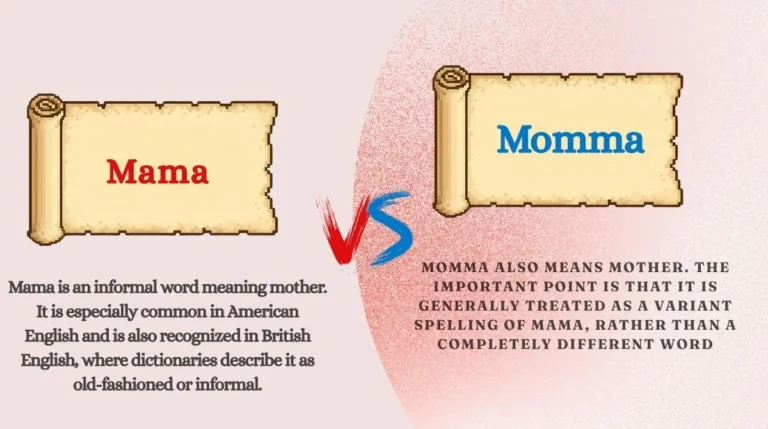
Mama is an informal word meaning mother. It is especially common in American English and is also recognized in British English, where dictionaries describe it as old-fashioned or informal.
It is often associated with children because “mama” can be one of the early words a child learns for a mother. However, adults can use it too, especially when speaking affectionately about their own mother. Oxford lists mama as “mother” in North American English and also notes its use in some parts of Africa as a respectful title for a mother or older woman.
When should you use “mama”?
Use mama when you want an informal, warm, or affectionate word for mother.
It can appear in several ways:
- When talking directly to your mother
- When talking about your mother
- In family conversations
- In stories and children’s writing
- In songs, popular culture, and informal speech
For example:
- Mama, can you help me with my homework?
- I called my mama after work.
- My mama makes the best soup.
- Mama is waiting for us at home.
- The little boy ran to his mama.
- I miss my mama when I travel.
- Her mama taught her how to cook.
- Mama, look at this!
These examples all use the word as a noun referring to a mother.
A simple grammar rule for “mama”
Mama is a countable noun when it refers to a mother as a person.
You can use possessives and articles depending on the sentence:
- my mama
- your mama
- her mama
- the mama
- a mama
However, when you are using Mama as a name or direct form of address, you often do not need another determiner:
Mama, I’m home.
Here, Mama works almost like a name.
This is similar to:
Mom, I’m hungry.
You would not normally say:
My Mom, I’m hungry.
when you are directly addressing her.
Common confusion about “mama”
A common mistake is thinking that mama is only for small children. That is not true.
It may be a child’s word, but adults also use it. The choice often depends on family habits, culture, region, and emotion. Cambridge describes mama as an informal word for mother in US English and an old-fashioned informal term in UK English.
So an adult can naturally say:
I’m going to visit my mama this weekend.
That sentence is informal, but it is not grammatically incorrect.
What Does “Momma” Mean?
Momma also means mother. The important point is that it is generally treated as a variant spelling of mama, rather than a completely different word. Merriam-Webster describes momma as a “less common spelling of mama,” while Cambridge defines it simply as an informal word for mother.
Dictionary.com likewise describes momma as a variation of mama and explains that both can be used informally for a mother.
When should you use “momma”?
Use momma in relaxed, personal, or expressive English, especially when that spelling fits the speaker’s usual style.
It can sound warm and affectionate, just like mama.
Here are some examples:
- Momma, can I have another cookie?
- I need to call my momma.
- Her momma was waiting by the door.
- The baby reached for his momma.
- My momma always told me to be kind.
- Momma is making dinner tonight.
- He ran to his momma after school.
- She learned that recipe from her momma.
There is no major grammar rule that separates these sentences from sentences using mama. The main difference is the spelling and the feeling or variety of English associated with it.
Is “momma” a spelling mistake?
Usually, no.
It is a recognized English word. Merriam-Webster lists it as a less common spelling of mama, and Cambridge lists it as an informal term for mother.
So this sentence is acceptable:
My momma made dinner.
And so is:
My mama made dinner.
The choice is mostly about style, familiarity, and personal or regional usage.
A useful point about pronunciation
Pronunciation can vary by accent. Cambridge gives pronunciations for both forms that reflect regional English differences, while Oxford and Merriam-Webster also show variation in how mama is pronounced.
This means you should not assume that every English speaker says these words exactly the same way.
The spelling momma may make the word visually resemble mom, but it does not create a completely different meaning.
Difference Between Momma and Mama
The easiest answer is this:
Mama and momma both mean “mother,” but “mama” is the more widely established spelling, while “momma” is a variant spelling that is especially informal.
Here is a simple comparison:
| Feature | Mama | Momma |
|---|---|---|
| Basic meaning | Mother | Mother |
| Part of speech | Noun | Noun |
| Style | Informal | Informal |
| Main use | Family and affectionate speech | Family and affectionate speech |
| Dictionary status | Main/common form | Variant spelling |
| Common in American English | Yes | Yes |
| Childlike use | Common | Common |
| Adult use | Yes | Yes |
| Formal writing | Usually avoid | Usually avoid |
| Meaning difference | Very little | Very little |
Merriam-Webster directly identifies momma as a less common spelling of mama. Oxford also lists momma as an alternative form of mama.
Usage difference
The biggest difference is not grammar. It is usage and style.
Imagine two people saying:
I love my mama.
and
I love my momma.
The meaning is almost the same.
The second spelling may give a slightly different impression because writers sometimes choose momma to reflect speech, family identity, or a particular regional voice. But this is a matter of style, not a strict grammar rule.
Grammar logic
Both words function as nouns.
You can use them as the subject:
Mama is cooking dinner.
Momma is cooking dinner.
You can use them as the object:
I called mama.
I called momma.
You can use possessives:
My mama lives nearby.
My momma lives nearby.
And you can use them as direct forms of address:
Mama, come here.
Momma, come here.
So the sentence structure does not change just because the spelling changes.
Meaning comparison
For the ordinary family meaning, there is essentially no important meaning difference.
Both refer to a mother.
However, mama has some additional dictionary uses. Cambridge and Merriam-Webster note that mama can also be used in slang for a woman, and Oxford notes a respectful title for a mother or older woman in some African contexts.
That does not mean every use of mama has those meanings. Context matters.
For a beginner, the safest rule is simple:
When mama or momma refers to your mother, both are informal nouns meaning “mother.”
Grammar Rules You Must Remember
Rule #1: Both words are informal nouns
Neither mama nor momma is normally used as formal vocabulary for a mother.
In formal writing, mother is the safest choice.
Compare:
My mother attended the meeting.
This sounds neutral and formal.
My mama attended the meeting.
This sounds personal and informal.
My momma attended the meeting.
This also sounds informal and personal.
The last two are not bad English. They simply have a different tone.
Rule #2: Use lowercase when the word is a general noun
When you are talking about someone’s mother generally, lowercase is normal:
Her mama lives in Texas.
His momma called yesterday.
But when you use the word like a personal name or title, capitalization is commonly used:
Mama, can you help me?
I’ll ask Momma when she gets home.
Dictionary.com notes this distinction for both words: when used as a title for one’s mother or as a form of address, the word is usually capitalized because it functions like a proper name.
Rule #3: Do not use “mama” and “momma” as verbs
These words are nouns.
You cannot normally say:
I mama every morning.
or
She momma the children.
That is not standard English.
Instead, use a real verb:
I call my mama every morning.
She is a loving mother.
Rule #4: Choose the spelling that matches your audience and style
There is no universal rule saying that every speaker must use one spelling.
For general educational or international English writing, mama is usually the simpler choice because dictionaries treat it as the main form and momma as a variant or less common spelling.
For dialogue, personal writing, stories, or lyrics, momma may be exactly the spelling a writer wants.
The key is consistency.
Common Mistakes Students Make
Learners make mistakes with these words for a few simple reasons.
First, they see the letters mom inside momma and think it must be a completely separate English word. It is not. Dictionaries identify it as a variant of mama.
Second, students sometimes believe one spelling is “correct” and the other is always wrong. That is also incorrect.
Mistake 1: “Momma is wrong.”
Wrong idea:
“Momma is not a real English word.”
Better understanding:
Momma is a recognized informal spelling of mama.
Both dictionaries and learner dictionaries recognize it.
Mistake 2: Using “mama” in a formal report
You might write:
My mama works at a government office.
The grammar is fine, but a formal report would usually sound better with:
My mother works at a government office.
The problem is not correctness. It is register, or level of formality.
Mistake 3: Random capitalization
A learner may write:
My Mama lives with us.
If Mama is simply a noun meaning “my mother,” lowercase is generally more natural:
My mama lives with us.
But:
Mama, where are my shoes?
Here it functions as a form of address, so capitalization makes sense.
Mistake 4: Changing spelling in the same piece
For example:
My mama is kind. My momma always helps me. My mama makes great food.
There is nothing grammatically impossible here, but the changing spelling can look careless if there is no reason for it.
Choose one form and stay consistent unless the context calls for a change.
Easy Trick to Remember the Difference
Here is the easiest memory trick:
Think “mama = main form” and “momma = more informal variant.”
You can also remember this:
Mama is the simpler spelling. Momma is the spelling with “mom” inside it.
That extra o does not create a new meaning.
Imagine you are writing a family message:
My mama is visiting us tomorrow.
That is completely natural.
Now imagine that the writer wants a more speech-like or personal spelling:
My momma is visiting us tomorrow.
The meaning stays the same.
This is one of those English questions where trying to memorize a complicated rule makes things harder. There is no need to do that.
Just remember:
Mama = mother
Momma = mother, variant spelling
When you are unsure in general-purpose writing, mama is the safer choice.
Daily Life Examples
These examples show how both spellings work in ordinary spoken English.
Example 1: Asking for help
Mama, can you help me with this box?
This is direct address. The speaker is talking to their mother.
Example 2: Talking about your mother
My mama is coming to visit this weekend.
Here, mama is a noun, not a name.
Example 3: A child speaking
Momma, I’m hungry!
This sounds natural in a family conversation.
Example 4: Talking about childhood
My mama used to read to me every night.
The word can be used naturally by an adult talking about the past.
Example 5: A family phone call
I’m going to call my momma after dinner.
This is informal but perfectly understandable.
Example 6: Giving advice
You should ask your mama what she thinks.
Again, mama means mother.
Example 7: A warm family sentence
Mama always knows when something is wrong.
This has an affectionate tone.
Example 8: A child at school
My momma packed my lunch today.
The spelling helps give the sentence a personal, informal feel.
Example 9: Speaking directly
Mama, we’re ready to go!
Because the speaker is addressing her directly, capitalization is natural.
Example 10: Talking about another person
Her momma waited outside until school ended.
Here, momma is a common noun and is lowercase.
Practice Section
Choose mama or momma in each sentence.
1.
_____ is making dinner tonight.
a) Mama
b) Momma
2.
I called my _____ after work.
a) mama
b) momma
3.
“_____, look at this!”
a) Mama
b) Momma
4.
Her _____ taught her how to bake.
a) mama
b) momma
5.
Is “momma” a real English word?
a) Yes
b) No
Answers
1. Both
Both Mama and Momma can work, depending on the writer’s preferred spelling.
2. Both
Both are informal nouns meaning mother.
3. Both
Both can be used as a form of direct address.
4. Both
Both spellings are grammatically possible.
5. Yes
Momma is a recognized informal variant spelling of mama.
The important lesson is that this exercise is not really about finding one “correct” spelling every time. It is about understanding usage, style, and consistency.
FAQs About Momma or Mama
What is the difference between mama and momma?
Both mama and momma are informal words for mother. The main difference is spelling and usage style rather than meaning. Dictionaries commonly treat momma as a variant or less common spelling of mama.
Is “momma” a correct word?
Yes. Momma is a recognized English word. Merriam-Webster describes it as a less common spelling of mama, and Cambridge lists it as an informal word for mother.
Is “mama” more common than “momma”?
Mama is generally the more widely established spelling in dictionaries. Oxford lists mama as the main entry and gives momma as an alternative, while Merriam-Webster calls momma the less common spelling.
Is mama formal or informal?
Mama is informal. Cambridge describes it as US informal and UK old-fashioned or informal. It is suitable for family conversation, casual speech, and personal writing, but mother is usually better in formal writing.
Can adults use the word “mama”?
Yes. Adults can use mama when talking about their own mothers or addressing them, especially in affectionate or family-centered speech. Dictionary.com specifically notes that adults sometimes use it for their mothers because of a close relationship.
Should “Mama” be capitalized?
It depends on how it is used. When it is used like a name or direct form of address, capitalization is common:
Mama, can you come here?
When it is used as a general noun, lowercase is normal:
My mama lives nearby.
This distinction is also reflected in dictionary usage guidance.
Conclusion
So, momma or mama—which one should you use?
The answer is simple: both are correct informal words for “mother.” The bigger difference is not grammar but spelling, style, and personal preference. Mama is the more widely recognized main form, while momma is a variant spelling that dictionaries describe as less common or informal.
For everyday English, either one can work:
My mama loves gardening.
My momma loves gardening.
Both sentences have the same basic meaning.
Choose mama when you want the simpler and more widely established spelling. Choose momma when that spelling matches the voice, family tradition, regional style, or informal tone you want.
And remember one final point: when you need a neutral or formal word, use mother.
Once you understand that, this little spelling question becomes much easier. English has many family words, and small differences often tell us more about tone and style than about grammar.

Evan Rellmont is a writer who turns thoughtful ideas into meaningful words, creating stories and reflections that connect, inspire, and leave a lasting impression.