
Have you ever typed “in route” and wondered whether it should be “en route” instead? You are not alone.
These two expressions look very similar, and both seem to contain the word route, which means a way from one place to another.
That small spelling difference can easily confuse English learners.
The good news is that the main rule is simple. When you want to say that someone or something is on the way to a place, the standard English expression is “en route.” Cambridge defines en route as “on the way to or from somewhere,” while Oxford also gives the meaning “on the way” or “while travelling from/to a particular place.”
You may also see “in route” in English, but it does not normally replace en route when you mean “on the way.”
In many cases, “in route” is simply a mistake caused by translating or rebuilding the expression with familiar English words.
This distinction matters in emails, travel messages, school writing, work communication, and everyday conversation.
Once you understand what each part is doing, the choice becomes much easier.
By the end of this guide, you will know when to use en route, why in route often sounds incorrect, how to form natural sentences, and how to avoid this common mistake.
What Does “In Route” Mean?
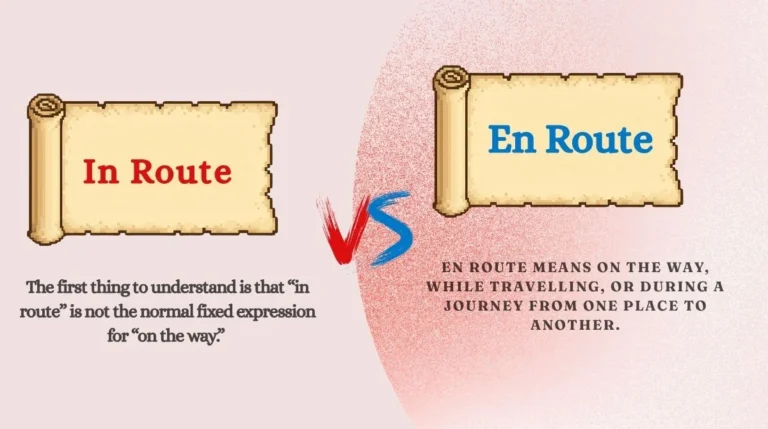
The first thing to understand is that “in route” is not the normal fixed expression for “on the way.” If you want to tell someone that you are travelling to a destination, saying in route will usually sound unnatural or incorrect in standard English.
For example:
- ❌ I am in route to the airport.
- ✅ I am en route to the airport.
The problem comes from treating the phrase as though English simply needs the preposition in before the noun route. But en route is an established expression borrowed from French, and it works as a unit. Oxford identifies its origin as French and explains that it entered English in the late 18th century.
When Should You Use “In Route”?
For ordinary English learners, the safest advice is this:
Do not use “in route” when you mean “on the way.”
There are situations where the separate words in and route can appear next to each other for a different grammatical reason. For example:
- The engineers are looking at changes in route design.
- The company has invested in route planning.
- We discussed the traffic problems in route selection.
Here, in is functioning as a normal preposition, and route is part of a larger noun phrase such as route planning or route design. This is completely different from saying that a person is travelling somewhere.
Compare these sentences:
- ❌ We are in route to Lahore.
- ✅ We are en route to Lahore.
- ✅ We are investing in route planning.
The first sentence tries to use in route as a travel expression. The third sentence uses in in its ordinary grammatical role.
Grammar Rule for “In Route”
There is no useful general grammar rule that says “in route” means travelling toward a destination. For that meaning, English normally uses en route.
Examples to Understand the Difference
- ❌ The train is in route to Karachi.
✅ The train is en route to Karachi. - ❌ We are in route to the hotel.
✅ We are en route to the hotel. - ❌ Your package is in route.
✅ Your package is en route. - ❌ The ambulance is in route to the hospital.
✅ The ambulance is en route to the hospital. - ✅ The team is working in route planning.
- ✅ We found a problem in route design.
- ✅ The company invests in route development.
- ✅ They specialize in route analysis.
The pattern is worth noticing. When route is part of a larger noun phrase, in may be perfectly correct. But when you are trying to say “on the way,” use “en route.”
What Does “En Route” Mean?
En route means on the way, while travelling, or during a journey from one place to another. Cambridge gives exactly this basic meaning and provides common patterns such as en route to and en route from … to ….
Merriam-Webster also defines en route as “on or along the way” and lists it as both an adverb and an adjective.
The phrase comes from French, which is one reason it may feel unusual to learners. The important point, however, is not its French origin. The important point is how English uses it today.
When Do You Use “En Route”?
Use en route when someone or something is travelling or moving toward a destination.
It can be used for:
- people
- cars
- buses
- trains
- planes
- ambulances
- deliveries
- parcels
- objects moving from one place to another
It can also be used in a more figurative way. For example:
The company is en route to becoming a global brand.
Here, nobody is physically travelling. The phrase means the company is on the way toward achieving something. Cambridge’s corpus examples also show en route to being used in wider, non-physical contexts.
Common Sentence Patterns
The most useful structures are:
en route + destination
- We are en route to the airport.
en route from + place
- She called me en route from Islamabad.
en route from + place + to + place
- The plane experienced turbulence en route from Dubai to London.
en route
- We stopped for coffee en route.
Oxford specifically lists en route (from…) (to…) and also notes the British pattern en route for.
8 Examples with “En Route”
- We are en route to the airport now.
- The ambulance is en route to the hospital.
- I called my brother while I was en route.
- The plane developed a problem en route to London.
- We stopped at a small café en route.
- The package was damaged en route to the customer.
- She sent me a message en route from work.
- The team is en route to winning the championship.
These examples show that the expression is flexible, but its central idea remains the same: something is on the way.
Pronunciation
Another reason learners sometimes hesitate over en route is pronunciation. Cambridge gives several English pronunciations, including forms beginning roughly like “on” and “an,” depending on variety and speaker.
In everyday speech, you do not need to force a strongly French pronunciation. The important thing is to recognize and use the phrase naturally.
Difference Between In Route and En Route
The biggest difference is not simply spelling. It is grammar and meaning.
En route is a standard fixed expression meaning on the way. In route is not the standard replacement for that expression.
Comparison Table
| Point | In route | En route |
|---|---|---|
| Standard travel expression? | No | Yes |
| Means “on the way”? | Usually incorrect | Yes |
| Common in standard English? | Rare in this meaning | Very common |
| Used before a destination? | ❌ Not normally | ✅ Yes |
| Example | ❌ We are in route to Paris. | ✅ We are en route to Paris. |
| Basic meaning | Depends on context | On the way / while travelling |
| Origin | Ordinary English words | French expression adopted into English |
Usage Difference
Imagine your friend calls and asks where you are.
You want to say that you are travelling to the restaurant.
Natural English:
I’m en route to the restaurant.
Not natural standard English:
I’m in route to the restaurant.
The choice has nothing to do with whether the trip is short or long. You can use en route for a five-minute drive or a ten-hour flight.
Grammar Logic
This is where many learners get stuck.
English contains many expressions that cannot be built word by word. En route is one of them. Its meaning comes from the expression as a whole.
You cannot simply replace en with the more familiar English preposition in and expect the same result.
It is similar to learning expressions such as:
- on time
- at once
- by chance
- in fact
You learn the whole expression because the natural English pattern matters.
Sentence Structure
The most common structure is:
Subject + be + en route + to + destination
Examples:
- She is en route to the office.
- They are en route to the station.
- The ambulance is en route to the clinic.
You can also use en route without to when the destination is already clear:
- We stopped en route.
- I grabbed some water en route.
- She called me en route.
Cambridge also gives the patterns en route from… to… and examples where the phrase appears without a destination.
Meaning Comparison
Think of it this way:
en route = on the journey
in route = not the normal phrase for this meaning
That simple idea will prevent most mistakes.
Grammar Rules You Must Remember
Rule #1: Use “en route” for “on the way.”
This is the most important rule.
✅ The bus is en route to the city.
❌ The bus is in route to the city.
Whenever you can replace the phrase with on the way, en route is usually the right choice.
Rule #2: Use “en route to” before a destination.
When you name the place someone is travelling toward, use to.
✅ We are en route to Islamabad.
✅ The plane is en route to New York.
✅ She is en route to the office.
A useful sentence pattern is:
be + en route + to + place
Rule #3: Use “en route from … to …” for a journey between two places.
This structure clearly shows the starting point and destination.
✅ The train broke down en route from Lahore to Rawalpindi.
✅ He called me en route from the airport to the hotel.
This is especially useful when explaining travel events.
Rule #4: “In route” may be correct only when “in” belongs to another grammatical structure.
Do not assume every appearance of in + route is wrong.
For example:
✅ The company is investing in route planning.
Here, in connects the verb investing with the noun phrase route planning. It does not mean on the way.
This distinction is very important for advanced learners because grammar depends on the entire sentence, not just two words sitting next to each other.
Common Mistakes Students Make
One common mistake is writing “I am in route to work.” Learners often make this error because in is such a common English preposition.
The correction is simple:
✅ I am en route to work.
Another mistake is removing to when a destination follows.
Less natural for a beginner’s sentence:
I am en route the airport.
Better:
I am en route to the airport.
Another problem is using en route when the speaker really means near a road or inside a specific route system. In those cases, different wording may be more appropriate.
For example:
The company is investing in route planning.
That does not describe someone’s travel. It describes planning routes.
Wrong vs. Correct
❌ We are in route to the station.
✅ We are en route to the station.
❌ The doctor is in route to the patient.
✅ The doctor is en route to the patient.
❌ Your order is in route.
✅ Your order is en route.
❌ I stopped in route to the party.
✅ I stopped en route to the party.
❌ The plane was in route from Tokyo to Seoul.
✅ The plane was en route from Tokyo to Seoul.
Easy Correction Tip
When you write in route, stop and ask yourself:
“Do I mean on the way?”
If the answer is yes, change it to en route.
That one question catches a large number of mistakes.
Easy Trick to Remember the Difference
Here is a simple memory trick:
EN ROUTE = ON THE WAY
Think of them as a pair.
En route → on the way → travelling
So:
I am en route to school.
means:
I am on the way to school.
Now look at in route. Do not try to memorize it as a replacement for en route. Instead, remember that in can still be used normally when route belongs to another noun phrase.
For example:
We are investing in route planning.
The word route is not telling us where someone is travelling. It is part of route planning.
Another helpful memory trick is to remember the French connection. Oxford identifies en route as coming from French.
You do not need to study French grammar to use the phrase correctly. Just remember:
The fixed English expression is EN ROUTE.
Daily Life Examples
Here are some natural examples you might hear or use in real life.
1. Talking to a friend
Friend: Where are you?
You: I’m en route to the café.
2. During a taxi ride
We’re en route to the airport, but traffic is heavy.
3. Giving a work update
The technician is en route to your office.
4. Talking about a delivery
Your package is en route and should arrive soon.
5. During a trip
We stopped for lunch en route to the beach.
6. Talking about a flight
The plane experienced some turbulence en route to Dubai.
7. Talking about an emergency
The ambulance is already en route to the hospital.
8. Talking about a journey from one place to another
We met some interesting people en route from Karachi to Lahore.
9. Talking about a goal
The company is en route to becoming one of the market leaders.
10. Casual spoken English
I’m en route. I’ll be there in ten minutes.
Notice how natural en route sounds in messages and travel updates. It is especially useful when you want a short way to say “I’m on my way.”
One small style point is worth remembering: in very casual conversation, “on my way” is often more common than en route.
For example:
I’m on my way home.
That sounds completely natural.
En route can sound slightly more formal or polished, although it is also common in ordinary speech and modern writing. Merriam-Webster and Cambridge both show the expression in current English usage.
Practice Section
Choose the correct option in each sentence.
1.
The ambulance is ___ to the hospital.
A. in route
B. en route
2.
We stopped for coffee ___ to the airport.
A. in route
B. en route
3.
The company is investing ___ route planning.
A. in
B. en
4.
The plane was ___ from Paris to Tokyo.
A. in route
B. en route
5.
I’ll call you when I’m ___.
A. in route
B. en route
Answers
1. B — en route
The sentence describes the ambulance travelling toward the hospital.
2. B — en route
The phrase means “while on the way.”
3. A — in
Here, in is a normal preposition before the noun phrase route planning.
4. B — en route
The standard expression is en route from Paris to Tokyo.
5. B — en route
The sentence means “I’ll call you while I’m on the way.”
FAQs
What is the difference between “in route” and “en route”?
En route is the standard English expression meaning “on the way” or “while travelling.”
In route does not normally carry this meaning. It may appear only when in is functioning as a regular preposition in a larger phrase, such as in route planning.
Can we use “en route” in questions?
Yes. It can be used naturally in questions.
For example:
Are you en route to the office?
Is the delivery en route?
Were you en route from the airport when you called?
The phrase works in questions just like it works in statements.
Is “en route” formal or informal?
En route is standard English and can be used in both everyday and formal settings. However, in very casual conversation, people often choose “on the way” instead.
For example:
I’m on my way.
is more casual than:
I’m en route.
Both are understandable and natural.
Is “en route” always about physical travel?
No. It can also be used figuratively.
For example:
The company is en route to success.
This means the company is on the way toward success, not physically travelling there. Cambridge’s usage examples also show the expression in broader, figurative and process-related contexts.
Can I say “en route to” a place?
Yes. En route to + destination is one of the most common structures.
Examples:
She is en route to the airport.
We stopped en route to school.
They called us en route to the hotel.
Cambridge specifically lists en route to as a standard pattern.
Why does “in route” sound wrong when “in” is a normal English word?
Because en route is a fixed expression, and fixed expressions cannot always be changed word by word.
English learners often choose in because it feels logical. But natural English sometimes follows an established phrase rather than a simple translation rule. Learning the full expression en route = on the way makes the choice much easier.
Conclusion
The choice between in route and en route becomes much easier once you stop treating them as simple spelling alternatives.
When you mean “on the way,” “while travelling,” or “during a journey,” use en route. This is the standard expression in English, and dictionaries such as Cambridge, Oxford, and Merriam-Webster all define it in terms of being on or along the way.
For most everyday travel sentences, remember these useful patterns:
en route to + destination
en route from + place
en route from + place + to + destination
You can also replace en route with on the way in many casual sentences. That gives you a quick test: if your sentence means “on the way,” choose en route, not in route.
At the same time, do not think the word in can never appear near route. Expressions such as in route planning can be completely correct because in is serving a different grammatical purpose.
The best way to remember the difference is simple: en route = on the way. Once you start noticing this phrase in travel messages, emails, news, and everyday English, it will soon feel completely natural.

Evan Rellmont is a writer who turns thoughtful ideas into meaningful words, creating stories and reflections that connect, inspire, and leave a lasting impression.