
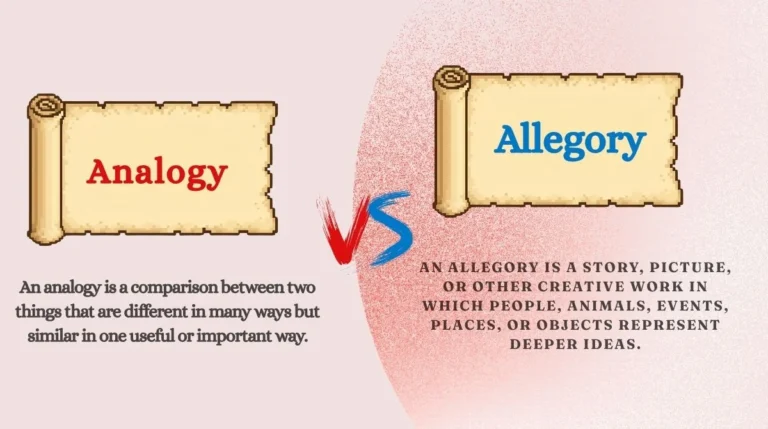
Many English learners see the words analogy and allegory and think they mean almost the same thing.
Both words are connected with comparison, meaning, or ideas that are not always stated directly. However, they are used in very different ways.
This confusion is understandable. An analogy often helps us explain one idea by comparing it with another familiar idea.
An allegory, on the other hand, is usually a story, picture, or work of art in which characters, events, or objects represent deeper ideas.
Merriam-Webster defines an analogy as a comparison based on a resemblance between things, while an allegory uses symbolic figures and actions to express a broader truth or idea.
You may hear analogy in classrooms, conversations, science, writing, and everyday explanations.
Teachers often use analogies because they make difficult ideas easier to understand.
You are more likely to meet allegory when reading literature, studying stories, discussing paintings, or analyzing a poem, novel, film, or other creative work.
The good news is that the difference becomes simple once you focus on one question: Are you making a comparison to explain something, or are you telling a symbolic story that stands for something deeper?
By the end of this guide, you will know how each word works, when to use it, how they differ, what mistakes to avoid, and how to remember the difference easily.
What Does “Analogy” Mean?
An analogy is a comparison between two things that are different in many ways but similar in one useful or important way.
The purpose of an analogy is usually to explain, clarify, or show a relationship.
Merriam-Webster describes analogy as a comparison based on a resemblance in a particular aspect. It can also refer to reasoning from one situation to another because they have something in common.
Imagine a student does not understand how memory works in a computer. A teacher might say:
“A computer’s memory is like a desk where you keep the things you are currently using.”
The computer is not really a desk. However, the comparison helps the student understand the idea.
When Do We Use “Analogy”?
We use analogy when we want to compare one thing with another to make an idea easier to understand.
You can use it in:
- Everyday conversation
- Teaching and education
- Science
- Business
- Writing
- Speeches
- Problem-solving
- Exams and aptitude tests
The word is a noun, so it normally names the comparison itself.
Common structures include:
an analogy between A and B
an analogy with something
by analogy
to make an analogy
Examples of Analogy
- The teacher used an analogy between the brain and a computer.
- She made an analogy between learning English and learning to ride a bicycle.
- By analogy, we can understand the new system more easily.
- His analogy helped me understand the difficult lesson.
- The writer compared a busy city to a beehive as an analogy.
- Can you think of an analogy for how the internet works?
- My father used a simple analogy to explain saving money.
- The coach made an analogy between teamwork and rowing a boat.
A Common Learner Confusion
Students sometimes think an analogy must be a fancy literary device. It does not have to be.
You can make a very simple analogy in normal conversation.
For example:
“Studying for an exam is like training for a race.”
That is an analogy because one activity is being compared with another to explain effort and preparation.
Another example is:
“The new employee is like a sponge.”
This can be an analogy if the comparison is being used to explain how quickly the person learns.
Remember that an analogy does not require a complete story. It can be just one comparison used to make a point.
What Does “Allegory” Mean?
An allegory is a story, picture, or other creative work in which people, animals, events, places, or objects represent deeper ideas.
The surface story has one meaning, but underneath it there is another meaning. Merriam-Webster defines allegory as the expression of truths or general ideas through symbolic figures and actions.
Think of an allegory as a story with a second level of meaning.
For example, imagine a story about a group of animals living on a farm. On the surface, it is simply a story about animals. But the animals may represent political groups, social classes, or types of leaders. The story is then working as an allegory.
An allegory can be found in literature, paintings, films, poetry, religious writing, and other forms of art.
When Do We Use “Allegory”?
Use allegory when talking about a work that has a symbolic meaning beyond its literal story.
Common contexts include:
- Literature
- Poetry
- Religious writing
- Art
- Film
- Politics
- History
- Moral stories
- Social commentary
The word is a noun.
You may see phrases such as:
an allegory of…
an allegory for…
the story is an allegory
an allegorical story
an allegorical meaning
Examples of Allegory
- The novel is an allegory of power and corruption.
- The story can be read as an allegory for human greed.
- The animals in the tale are part of an allegory.
- The painting is an allegory of peace and justice.
- Many readers believe the film is an allegory about freedom.
- The writer created an allegory to teach a moral lesson.
- The poem has an allegorical meaning beneath its simple language.
- The characters represent different ideas, making the story an allegory.
A Common Learner Confusion
One common mistake is thinking that every symbolic comparison is an allegory.
That is not true.
An allegory usually develops through characters, events, symbols, or a larger work. It is more than a quick comparison.
For example:
“Life is a journey.”
This is a comparison and may function as a metaphor or analogy depending on context.
But if a writer creates a whole story in which a traveler crosses mountains, faces storms, meets strangers, loses a path, and finally reaches a peaceful village—and those events represent stages of human life—the story may be an allegory.
The important idea is that allegory usually works across a larger piece of writing or art.
Difference Between Analogy and Allegory
The simplest difference is this:
An analogy compares two things to explain an idea.
An allegory uses a symbolic story, scene, or representation to express a deeper idea.
They can sometimes overlap, but their main jobs are different.
| Feature | Analogy | Allegory |
|---|---|---|
| Basic meaning | A comparison | A symbolic story or representation |
| Main purpose | To explain or clarify | To communicate a deeper meaning |
| Usually found in | Conversation, teaching, writing, science | Literature, art, stories, films |
| Length | Can be very short | Often develops across a larger work |
| Main tool | Comparison | Symbolism |
| Example | “Learning is like climbing a mountain.” | A story where climbing a mountain represents personal growth |
| Focus | Relationship between two things | Deeper meaning behind characters or events |
| Common question | “What is this like?” | “What does this story really represent?” |
Usage Difference
When someone makes an analogy, they are often trying to help another person understand something.
For example:
“Running a company is like steering a ship.”
The speaker is comparing two activities. The comparison helps explain leadership.
An allegory is different:
A writer might create a long story about a captain trying to guide a ship through dangerous waters, while the ship represents a country and the storm represents a political crisis.
Now the story has symbolic meaning. That is closer to allegory.
Grammar Logic
Both analogy and allegory are countable nouns.
You can say:
- an analogy
- two analogies
- an allegory
- several allegories
Examples:
She gave me an analogy.
The book contains several allegories.
You can also create related forms.
From analogy:
- analogous
- analogical
From allegory:
- allegorical
- allegorically
For example:
The two situations are analogous.
The painting has an allegorical meaning.
Merriam-Webster lists analogous and allegorical as related adjective forms.
Sentence Structure Difference
An analogy often appears in structures such as:
A is like B.
A is similar to B in this way.
There is an analogy between A and B.
Examples:
A classroom is like a small community.
There is an analogy between exercise and language practice.
An allegory is more often described with structures such as:
The story is an allegory of X.
The novel is an allegory for X.
The characters symbolize X.
Examples:
The novel is an allegory of political power.
The film works as an allegory for fear.
Grammar Rules You Must Remember
Rule 1: Use “analogy” for a comparison
When the main idea is comparing two things to explain a relationship, analogy is usually the correct word.
Correct:
The teacher used an analogy to explain gravity.
Why?
The teacher is comparing gravity with something familiar to make the lesson easier.
Rule 2: Use “allegory” for a symbolic work
When a whole story, artwork, or creative work represents another idea, allegory is the better word.
Correct:
The novel is an allegory of social inequality.
The story is not simply making one comparison. Its characters and events carry deeper symbolic meaning.
Rule 3: “Analogical” and “allegorical” are different
Do not confuse these related adjectives.
Analogical means connected with analogy.
Allegorical means connected with allegory.
Examples:
The teacher used an analogical explanation.
The story has an allegorical meaning.
For most beginners, the noun forms—analogy and allegory—will be the most useful to learn first.
Rule 4: An analogy does not have to be a story
This is an important point.
An analogy can be one sentence.
“A good team is like a good orchestra.”
That is enough to create a comparison.
An allegory generally needs a symbolic structure that extends beyond one simple comparison.
Easy rule: comparison = analogy; symbolic story or representation = allegory.
Common Mistakes Students Make
Mistake 1: Using “allegory” for every comparison
Some students say:
Wrong: The teacher gave an allegory about the internet.
If the teacher simply compared the internet with a road system to make the idea clearer, analogy is usually the right word.
Better: The teacher gave an analogy about the internet.
Mistake 2: Thinking every metaphor is an allegory
A single metaphor is not automatically an allegory.
“The classroom was a zoo.”
That is a metaphor.
It might become part of an allegory in a larger work, but one metaphor alone is not necessarily an allegory.
Mistake 3: Thinking allegories must be very old
An allegory is not limited to ancient stories.
Modern novels, films, poems, cartoons, and paintings can also use allegorical ideas.
The key is not the age of the work. The key is the symbolic meaning.
Mistake 4: Confusing “analogy” with “identical”
An analogy does not mean that two things are exactly the same.
Suppose you say:
“The heart is like a pump.”
A human heart is not a mechanical pump in every way. The analogy focuses on a particular relationship: both move fluid through a system.
Merriam-Webster specifically notes that analogy involves similarity or parallelism in particular aspects rather than complete sameness.
Easy Correction Tip
Before choosing the word, ask:
“Am I comparing two things to explain something?”
If yes, think analogy.
Then ask:
“Is there a story, artwork, or larger symbolic representation with a deeper meaning?”
If yes, think allegory.
Easy Trick to Remember the Difference
Here is a simple memory trick:
Analogy = Aids understanding
Think of analogy as a helpful comparison.
A teacher says:
“The brain is like a computer.”
The comparison helps you understand a difficult idea.
So:
Analogy = comparison for explanation.
Allegory = A story with another meaning
Think of allegory as a story that is doing more than telling a story.
A character may represent greed.
A journey may represent life.
A storm may represent conflict.
An animal may represent a political group.
So:
Allegory = symbolic story or representation.
You can remember it this way:
Analogy explains. Allegory represents.
That one sentence will help you in most everyday situations.
Daily Life Examples
Here are some natural examples showing how these words can be used in spoken and everyday English.
Example 1: In a classroom
Teacher: “Think of the cell as a small factory. Each part has a different job.”
This is an analogy because the factory comparison makes the scientific idea easier to understand.
Example 2: Talking about studying
“Learning a language is like building a house. You need a strong foundation first.”
This is an analogy.
Example 3: Talking about business
“Running a small business is like driving a car. You have to watch several things at once.”
Again, this is an analogy.
Example 4: Discussing a novel
“I think the whole novel is an allegory about greed.”
Here, the speaker believes the story has a deeper symbolic meaning.
Example 5: Talking about a film
“The monsters in the film are actually an allegory for fear.”
The monsters represent something beyond the literal story.
Example 6: Explaining teamwork
“A football team is like a machine. Every part has to work together.”
This is an analogy because the speaker is explaining teamwork through comparison.
Example 7: Talking about art
“The painting is an allegory of justice.”
The figures and symbols in the painting represent an idea.
Example 8: Explaining time management
“Your day is like a budget. You only have so much time to spend.”
That is an analogy.
Example 9: Discussing a story
“The journey in the story is an allegory for growing up.”
The journey has a symbolic meaning beyond the literal trip.
Example 10: Giving advice
“Think of your goals like steps on a staircase. You do not have to reach the top in one jump.”
This is an analogy used to explain progress.
Practice Section
Choose analogy or allegory in each sentence.
1.
The teacher used an ________ to explain how electricity moves through a circuit.
2.
The novel is an ________ about the dangers of uncontrolled power.
3.
She compared saving money to planting a tree. It was a useful ________.
4.
The animals in the story represent different parts of society, making it an ________.
5.
The coach made an ________ between teamwork and a rowing team.
Answers
1. analogy
The teacher is making a comparison to explain a concept.
2. allegory
The novel has a deeper symbolic meaning.
3. analogy
The comparison between saving and planting is being used to explain an idea.
4. allegory
The animals represent larger social ideas.
5. analogy
The coach is comparing teamwork with rowing.
FAQs
What is the difference between analogy and allegory?
An analogy is a comparison used to explain or clarify something. An allegory is usually a story, artwork, or symbolic representation with a deeper meaning.
The easiest way to remember the difference is: analogy compares, allegory represents.
Can an analogy be a story?
Yes. A story can be used as an analogy when its main purpose is to help explain another idea through comparison.
However, a long symbolic story in which characters and events consistently represent deeper ideas is more likely to be called an allegory.
Is an allegory a type of metaphor?
They are related, but they are not exactly the same.
A metaphor usually makes a direct comparison, often in a short expression. An allegory normally develops symbolic meaning across a larger story, artwork, or work.
An allegory can contain metaphors and other figures of speech.
Is analogy formal or informal?
Analogy can be used in both formal and informal English.
You may hear it in a classroom, casual conversation, academic writing, business discussions, science, and everyday explanations.
For example:
“My teacher used an analogy.”
This is completely natural English.
Is allegory only used in literature?
No. Literature is a very common place to find allegory, but allegorical meaning can also appear in paintings, films, poetry, religious writing, and other forms of art.
The important feature is the use of symbolic characters, events, or images to express a deeper idea.
Can one work contain both an analogy and an allegory?
Yes.
A story can be an allegory and also contain individual analogies.
For example, a novel may symbolize political problems through its characters while one character makes an analogy to explain an idea.
So the two terms are not complete opposites. They describe different ways meaning can be created or explained.
Conclusion
The difference between analogy and allegory is much easier once you focus on purpose.
An analogy is mainly a comparison. We use it to explain an unfamiliar idea by connecting it with something more familiar. Teachers, writers, speakers, and everyday people use analogies all the time.
An allegory goes a step further. It uses a story, characters, events, objects, or images to represent a deeper idea. The literal story is still there, but it also stands for something beyond itself.
Remember this simple line:
Analogy explains by comparing. Allegory expresses a deeper meaning through symbols.
When you see the word analogy, think of a teacher making a difficult idea easier.
When you see allegory, think of a story that has another meaning underneath it.
Keep practicing with real examples, and these two words will soon stop feeling confusing. English becomes much easier when you learn not only what a word means, but also why a speaker or writer chose it.

Evan Rellmont is a writer who turns thoughtful ideas into meaningful words, creating stories and reflections that connect, inspire, and leave a lasting impression.