
Have you ever written a sentence and stopped because you were not sure whether to use peace or piece? You are not alone.
These two words are very common in English, and they sound exactly the same when we say them aloud.
That is what makes them confusing, especially for beginners and non-native English speakers.
Even though peace and piece have the same pronunciation, they have completely different meanings. One word is connected with calm, safety, and the absence of fighting. The other usually means a part of something.
Using the wrong word can change the meaning of your sentence, and sometimes it can make your writing sound confusing.
The good news is that the difference is actually easy once you connect each word with its meaning. You do not need to memorize a long grammar rule.
You simply need to remember what each word describes and look at the context of the sentence.
After reading this guide, you will know exactly when to use peace and when to use piece.
You will also learn common mistakes, useful grammar patterns, everyday examples, and a simple memory trick that can help you choose the correct word quickly.
What Does “Peace” Mean?
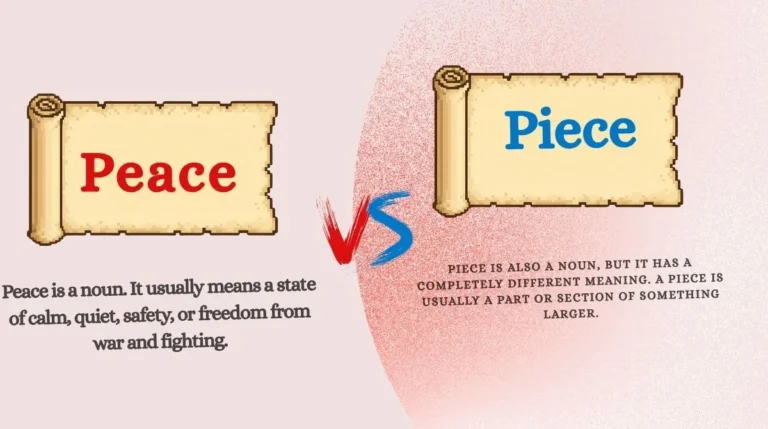
Peace is a noun. It usually means a state of calm, quiet, safety, or freedom from war and fighting. It can describe peace between countries, peace in a family, peace in a community, or even peace in your own mind.
When people are not fighting or arguing, we can say there is peace. The word can also describe a calm feeling when someone feels relaxed and free from stress.
For example, a country may have peace after a war ends. A family may enjoy peace when everyone gets along. A person may want some peace after a busy day at work.
When should you use “peace”?
Use peace when you are talking about:
- No war or violence
- No fighting or serious conflict
- A calm and quiet situation
- Emotional calm
- Harmony between people
Because peace is normally a noun, it often appears after words such as bring, find, have, keep, make, live in, and restore.
Grammar rule for “peace”
The word peace is generally used as an uncountable noun when we are talking about the general idea of calm or freedom from conflict.
We normally say:
- Peace is important.
- They want peace.
- We need peace in our community.
We usually do not say “a peace” when talking about the general condition. However, in special contexts, the word can appear in expressions such as “a peace agreement”, but there the article belongs to the noun phrase, not because “peace” itself is being counted.
Examples with “peace”
- Everyone wants to live in peace.
- The two countries finally made peace.
- I need some peace and quiet after a long day.
- The children were playing while the house was full of peace.
- The leaders are working to bring peace to the region.
- She found peace by spending time in the garden.
- We should try to solve problems peacefully and keep the peace.
- After many years of fighting, the people wanted peace.
Common confusion about “peace”
The biggest problem is pronunciation. Peace sounds like piece, so you cannot always choose the spelling by listening.
Think about the meaning.
If the sentence is about calm, no fighting, or harmony, you need peace.
For example:
- The country needs peace. ✅
- The country needs piece. ❌
Here, the sentence is about ending conflict, so peace is correct.
What Does “Piece” Mean?
Piece is also a noun, but it has a completely different meaning. A piece is usually a part or section of something larger.
For example, if you break a cake into six parts, each part is a piece of cake. If a glass breaks, one small part can be called a piece of glass.
The word can also be used in several common expressions. We say a piece of paper, a piece of furniture, a piece of advice, and a piece of information.
When should you use “piece”?
Use piece when you are talking about:
- A part of something
- A portion of food
- An individual item from a larger whole
- An object or work of art
- One unit of something
Grammar rule for “piece”
Unlike peace, piece is a countable noun when it means one part or one item.
You can say:
- a piece
- one piece
- two pieces
- three pieces
You can also use piece of before an uncountable noun or material.
For example:
- a piece of cake
- a piece of bread
- a piece of advice
- a piece of information
- a piece of furniture
This is very important for learners because English often uses piece of with nouns that cannot normally be counted individually.
Examples with “piece”
- Can I have a piece of cake?
- He found a piece of paper on the floor.
- Please give me one piece of information.
- She bought a beautiful piece of furniture.
- I broke a piece of the toy.
- There is a small piece of glass on the table.
- He ate two pieces of bread for breakfast.
- This is my favorite piece of music.
Common confusion about “piece”
Students often use piece when they actually mean peace because both words sound the same.
For example:
- I just want some piece and quiet. ❌
- I just want some peace and quiet. ✅
The phrase peace and quiet means a calm environment with little noise or trouble. It is a very common expression, so it is useful to memorize it as a complete phrase.
Difference Between Peace and Piece
The easiest way to understand the difference is to focus on meaning, not pronunciation.
| Word | Meaning | Part of Speech | Common Use | Example |
|---|---|---|---|---|
| Peace | Calm, harmony, or no war | Noun | Peace between people or countries | We all want peace. |
| Piece | A part of something | Noun | A part, portion, or item | I ate a piece of cake. |
Usage difference
Peace talks about a condition or state.
Piece talks about a part or unit.
Compare these two sentences:
- The country needs peace.
- The child wants a piece of cake.
In the first sentence, people want an end to fighting. In the second, the child wants one portion of cake.
Grammar logic
The two words behave differently because their meanings are different.
Peace is usually uncountable when it means calm or freedom from conflict. We talk about peace as an idea or condition.
Piece is countable. We can have one piece, several pieces, or many pieces.
For example:
- Peace is valuable.
- I need three pieces of paper.
The first sentence talks about a general condition. The second counts separate parts or items.
Sentence structure difference
Here are some common patterns:
Peace + verb
- Peace matters.
- Peace helps communities grow.
Verb + peace
- They want peace.
- We should protect the peace.
- The leaders made peace.
A piece of + noun
- a piece of cake
- a piece of paper
- a piece of advice
- a piece of information
Number + pieces of + noun
- two pieces of bread
- three pieces of furniture
- five pieces of chocolate
This is a useful clue. When you see a number such as two, three, or four, you are very likely talking about pieces, not peace.
Meaning comparison
A simple question can help you decide:
Are you talking about calm or a part?
If the answer is calm, choose peace.
If the answer is a part, choose piece.
That small question can prevent many spelling mistakes.
Grammar Rules You Must Remember
Rule 1: Use “peace” for calm or freedom from conflict
When people are not fighting, there is peace.
Example:
The families finally live in peace.
The sentence is about harmony, so peace is correct.
Another example:
The leader promised to work for peace.
The leader is working to stop conflict.
Rule 2: Use “piece” for one part of something
When you mean one part from a larger whole, use piece.
Example:
She cut a piece of bread for her son.
The bread is larger, and one part is taken from it. That part is a piece.
Another example:
I found a piece of the broken plate.
The broken part is a piece.
Rule 3: “Piece” can be counted
You can say:
- one piece
- two pieces
- several pieces
- many pieces
Example:
I need two pieces of paper.
But peace normally does not work this way when it means calm.
We do not normally say:
two peaces ❌
Remember: piece can mean separate parts; peace usually describes a condition.
Rule 4: Learn common fixed expressions
Some phrases become much easier when you learn them as complete expressions.
Common phrases with peace include:
- peace of mind
- peace and quiet
- make peace
- keep the peace
- world peace
- live in peace
Common phrases with piece include:
- a piece of cake
- a piece of advice
- a piece of paper
- a piece of information
- a piece of furniture
- a piece of bread
Memorizing these common phrases can make speaking and writing much faster.
Common Mistakes Students Make
These mistakes happen mainly because peace and piece are homophones. A homophone is a word that sounds the same as another word but has a different meaning or spelling.
Mistake 1: “Piece and quiet”
Wrong: I need some piece and quiet.
Correct: I need some peace and quiet.
Why? Because the phrase means a calm, quiet situation. It is not talking about a physical part of something.
Mistake 2: “Piece of mind”
Wrong: I want some piece of mind.
Correct: I want some peace of mind.
Peace of mind means a calm feeling without worry.
For example:
Knowing that my family is safe gives me peace of mind.
Here, we are talking about emotional calm.
Mistake 3: “World piece”
Wrong: Everyone hopes for world piece.
Correct: Everyone hopes for world peace.
The word world peace refers to a world without war and major conflict.
Mistake 4: “A peace of cake”
Wrong: This homework is a peace of cake.
Correct: This homework is a piece of cake.
A piece of cake is a common idiom meaning something is very easy.
Notice how funny the wrong spelling looks once you know the difference.
Easy correction tip
Do not ask, “Which word sounds right?”
Both sound right.
Instead ask:
Is it a part? → piece.
Is it calm? → peace.
That is the fastest correction trick.
Easy Trick to Remember the Difference
Here is a simple memory trick that works well for students:
Peace = calm
Think of the word peaceful.
A peaceful place is quiet and calm. The word peace is inside peaceful, so this can help you remember its meaning.
For example:
The room feels peaceful.
The room is full of peace.
Piece = part
Think about cutting a pizza.
A pizza can be divided into many pieces.
You can have:
- one piece of pizza
- two pieces of pizza
- three pieces of pizza
So remember this little idea:
Peace = calm
Piece = part
There is another helpful trick. The word piece contains “pie.” A pie can be cut into pieces. It is not a perfect spelling rule, but it is a fun way to remember the word.
When you see piece, imagine a slice of pie or pizza.
When you see peace, imagine people sitting together calmly without fighting.
That mental picture can make the difference much easier to remember.
Daily Life Examples
Real conversations are the best way to learn confusing words because you can see how they work naturally.
Example 1
A: Why did you go to the park alone?
B: I needed some peace and quiet.
Here, the person wants a calm place.
Example 2
A: Would you like some cake?
B: Yes, please. Just one piece.
The speaker wants one portion of cake.
Example 3
A: How can we solve this problem?
B: We need to talk and find a peaceful solution.
The idea is about avoiding conflict.
Example 4
A: Can you give me a piece of advice?
B: Of course. Always check your work before you submit it.
Advice is normally uncountable, so a piece of advice is a common English expression.
Example 5
A: Are the two friends still angry with each other?
B: No. They made peace yesterday.
They stopped fighting.
Example 6
A: What happened to this chair?
B: I think a piece of it is broken.
The speaker means one part of the chair.
Example 7
A: Did you get any sleep?
B: Not much. The baby never gave me any peace.
The speaker means they could not relax or enjoy quiet.
Example 8
A: How many sandwiches did you eat?
B: I had two pieces.
The person is counting portions.
Example 9
A: I have been worried about the exam.
B: Don’t worry. You have prepared well. Have some peace of mind.
The phrase means a calm feeling without worry.
Example 10
A: Why are the leaders meeting today?
B: They are trying to bring peace to the area.
Again, the sentence is about ending conflict.
Practice Section
Choose peace or piece in each sentence.
- I need some ______ and quiet tonight.
- Can I have another ______ of pizza?
- The two countries want ______.
- She gave me a useful ______ of advice.
- Knowing the truth gave him ______ of mind.
Answers
- peace
- piece
- peace
- piece
- peace
Here is a quick check for each answer. Peace and quiet is a fixed phrase about calm. A pizza can be divided into a piece. Countries may work for peace. Advice can come as a piece of advice. And the correct expression is peace of mind.
FAQs About Peace or Piece
What is the difference between peace and piece?
Peace means calm, harmony, or freedom from fighting and war. Piece means a part of something or one portion of something. They sound the same but have different meanings and spellings.
Can we use “peace” in questions?
Yes. Peace can be used naturally in questions.
For example:
Do you want peace?
How can we achieve peace?
Is there peace in the region?
The word still refers to calm or freedom from conflict.
Can we use “piece” in questions?
Yes. Piece is very common in questions.
For example:
Can I have a piece of cake?
Can you give me a piece of paper?
How many pieces do you need?
Because piece is countable, it often appears with numbers and words such as a, one, two, several, and many.
Is “peace” formal or informal?
Peace is used in both formal and informal English. You may hear it in everyday conversation, news reports, speeches, books, and school writing.
For example, peace and quiet is a very normal everyday expression, while world peace is common in formal discussions too.
Why do peace and piece sound the same?
They are homophones. This means they have the same pronunciation but different spellings and meanings. English has many homophones, which is why listening alone is not always enough to choose the correct word.
What does “a piece of cake” mean?
A piece of cake can have a literal meaning or an idiomatic meaning. Literally, it means one portion of cake. As an idiom, it means something is very easy.
For example:
The test was a piece of cake.
Here, the speaker means the test was easy, not that they were eating cake.
Final Conclusion
The difference between peace and piece may look difficult at first, but it becomes simple when you focus on meaning.
Peace is about calm, harmony, safety, and freedom from fighting. Piece is about a part, portion, or individual unit of something. They sound the same, but they do very different jobs in a sentence.
A useful rule to remember is this:
Peace = calm.
Piece = part.
Think of peace and quiet, peace of mind, and world peace when you see the first word. Think of a piece of cake, a piece of paper, and a piece of advice when you see the second.
Do not worry if you make mistakes at first. Homophones confuse even strong English learners. Read the sentence carefully, think about the meaning, and choose the word that matches the idea.
With a little practice, choosing peace or piece will become automatic. The more you notice these words in everyday English, the easier they will feel.

Evan Rellmont is a writer who turns thoughtful ideas into meaningful words, creating stories and reflections that connect, inspire, and leave a lasting impression.