
Have you ever typed “tieing” and stopped because it did not look right? You are not alone. Many English learners are unsure whether the correct spelling is tying or tieing.
The confusion is understandable because the word tie ends in -ie, and many English verbs simply add -ing to form the present participle. That can make tieing look like the natural choice.
However, English has a special spelling rule for verbs ending in -ie. When we add -ing, the final -ie usually changes to y. That is why tie becomes tying, not tieing.
This small spelling change matters because tying is the standard form used in modern English. Major learner dictionaries, including Oxford and Cambridge, list tying as the present participle or -ing form of tie.
Knowing this rule will help you with more than one word. It also applies to verbs such as lie → lying and die → dying. Once you understand the pattern, these spellings become much easier to remember.
So, when should you write tying, and why is tieing usually considered wrong? The answer is simple, and by the end of this guide, the difference should feel completely natural.
What Does “Tying” Mean?
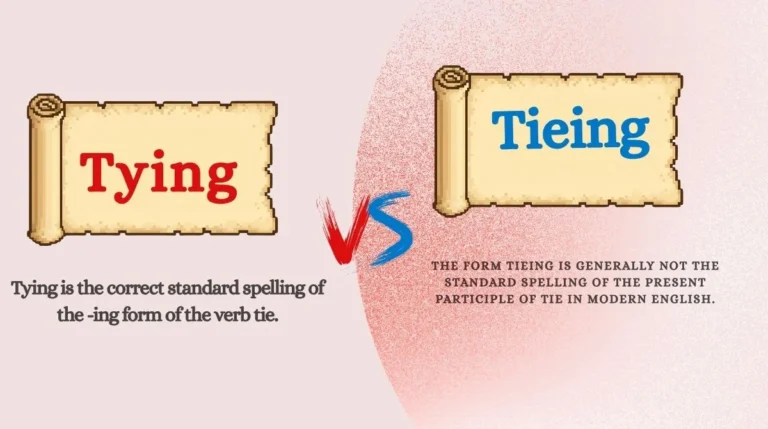
Tying is the correct standard spelling of the -ing form of the verb tie.
The verb tie means to fasten, connect, or hold something with a string, rope, ribbon, cord, or another material. It can also mean making a knot or connecting things in other ways. Oxford gives several uses of tie, including fastening things together, fastening something to another object, and making a knot.
For example:
- I am tying my shoelaces.
- She is tying a ribbon around the gift.
- He is tying the boxes together.
- They are tying the boat to the dock.
- Mom is tying her hair back.
- The boy is tying a knot in the rope.
- We are tying the balloons together.
- She is tying a label onto the bag.
The word tying can appear in several common grammar structures.
Tying in the present continuous
We often use tying with forms of be to describe an action happening now.
Subject + am/is/are + tying + object
Examples:
- I am tying my shoes.
- She is tying her scarf.
- They are tying the ropes.
The action is in progress at the moment of speaking.
Tying as a present participle
The -ing form can also be used after verbs such as start, keep, finish, and stop.
Examples:
- He started tying the package.
- She kept tying and untying the knot.
- I finished tying the ribbon.
- They stopped tying the boxes when it started raining.
You may also see tying in phrases where it has a wider meaning. For example, Cambridge lists uses of tie connected with linking or connecting ideas and events, so tying can also mean connecting one thing with another.
Examples:
- The teacher is tying the lesson to real-life examples.
- The company is tying the bonus to performance.
- We are tying the event to a charity campaign.
The important point is spelling: tying is the accepted standard form.
Why is it spelled “tying”?
This is because of a special spelling rule.
The base verb is:
tie
When we add -ing, we do not simply write:
tie + ing = tieing
Instead, the final -ie changes to y:
tie → tying
This same pattern appears in other English verbs.
lie → lying
die → dying
That is the key spelling rule to remember.
What Does “Tieing” Mean?
The form tieing is generally not the standard spelling of the present participle of tie in modern English.
In everyday writing, schoolwork, exams, websites, business communication, and standard English, you should use:
tying
not:
tieing
For example:
❌ I am tieing my shoes.
✅ I am tying my shoes.
❌ She is tieing the ribbon.
✅ She is tying the ribbon.
❌ They are tieing the boxes together.
✅ They are tying the boxes together.
The confusion happens because learners often apply a very common English rule:
verb + ing
For many verbs, that works perfectly:
- play → playing
- work → working
- help → helping
- clean → cleaning
- wash → washing
So it is natural to think:
tie + ing = tieing
But tie belongs to a special group of verbs ending in -ie. The spelling changes before -ing is added.
This means tieing does not have a different meaning from tying. The problem is not meaning. The problem is spelling.
Think about it this way:
tying = standard spelling
tieing = nonstandard spelling and generally considered incorrect for ordinary modern English
There is another important point here. A spelling that looks logical is not always the spelling English actually uses. English spelling has developed over a long period, so some forms have special patterns that must simply be learned.
The best approach is not to think that tieing is a different word. Instead, remember that the correct -ing form of tie is tying.
Oxford lists the verb forms as tie, tied, tied, tying, while Cambridge also gives tying as the present participle.
Difference Between Tying and Tieing
The biggest difference is simple: tying is correct standard spelling, while tieing is not the normal standard form.
| Point | Tying | Tieing |
|---|---|---|
| Base verb | tie | tie |
| -ing form | tying | tieing |
| Standard English | Yes | No |
| Used in dictionaries as the normal form | Yes | No |
| Meaning | Fastening or connecting | Intended to mean the same thing |
| Recommended for writing | Yes | No |
Usage difference
There is no useful meaning difference between these two spellings.
A learner may think:
- tying means making a knot
- tieing means something else
That is not the case.
The intended word in both cases is the -ing form of tie. The issue is simply that English spelling changes -ie to y before -ing.
Grammar logic
The grammar is the same because both forms are attempts to create the present participle.
The correct pattern is:
tie → tying
For example:
She is tying her shoes.
Here:
- She = subject
- is = helping verb
- tying = present participle
- her shoes = object
The incorrect form would be:
She is tieing her shoes.
The sentence structure is fine, but the spelling of the verb is wrong.
Meaning comparison
The word tie has several meanings. It can refer to fastening something with string or rope, making a knot, connecting something, or being connected in other ways.
Examples:
Physical fastening:
He is tying the rope.
Clothing or hair:
She is tying her hair back.
Connecting objects:
They are tying the boxes together.
Connecting ideas:
The speaker is tying the new idea to an earlier lesson.
The spelling remains tying in each case.
Grammar Rules You Must Remember
Rule 1: Verbs ending in “-ie” usually change to “-y” before “-ing”
This is the most important rule.
When a verb ends in -ie, change ie to y, then add -ing.
Examples:
tie → tying
lie → lying
die → dying
So:
❌ tieing
✅ tying
The spelling change keeps the word easier to write and follows the established English pattern.
Rule 2: Do not apply the normal “just add -ing” rule to “tie”
For many verbs, adding -ing is simple:
read → reading
walk → walking
open → opening
But tie is different.
You should not think:
tie + ing = tieing
Instead, think:
tie → replace ie with y → add ing
So:
tie → tying
A useful way to see it is:
tie
↓
change ie to y
↓
ty
↓
add ing
↓
tying
Rule 3: The same spelling pattern appears in “lie” and “die”
Remembering similar words makes the rule much easier.
lie → lying
Not:
❌ lieing
And:
die → dying
Not:
❌ dieing
So you can create a small memory group:
tie → tying
lie → lying
die → dying
When you see a verb ending in -ie, check whether the -ing form changes the ending to -ying.
Rule 4: “Y” is part of the correct spelling
Some learners see tying and wonder why the word contains y.
The y is not an extra letter added by mistake. It replaces the final ie before -ing.
That means tying is not an unusual pronunciation trick. It is the correct spelling pattern.
Common Mistakes Students Make
Many learners make this mistake because they know a good rule but apply it in the wrong situation.
Mistake 1: Simply adding “-ing”
A student sees tie and thinks:
tie + ing = tieing
This is a reasonable first guess, especially for beginners.
But English spelling has exceptions and special patterns. The correct form is:
tying
Mistake 2: Thinking the “e” should disappear
Students sometimes use the general rule for verbs ending in silent e.
For example:
make → making
write → writing
dance → dancing
They may try to treat tie in the same way.
But tie is not simply changing from tie to ti.
It follows the special -ie → y pattern:
tie → tying
Mistake 3: Confusing spelling with pronunciation
The pronunciation of tie is /taɪ/, and tying is pronounced /ˈtaɪɪŋ/.
The spelling looks different, but the root sound is still clearly connected to tie.
Do not let pronunciation make the spelling harder than it is.
Mistake 4: Using “tieing” because it looks familiar
Sometimes a wrong spelling can look familiar simply because we have seen learners use it online or in informal writing.
Seeing a spelling often does not make it standard.
When in doubt, trust a reliable learner dictionary and remember the spelling rule.
Easy correction tips
When you write the word, pause for one second and ask:
Does the base verb end in -ie?
If the answer is yes and you are adding -ing, think:
-ie becomes -y
Then write:
tying
A quick comparison can help:
❌ tieing
✅ tying
❌ lieing
✅ lying
❌ dieing
✅ dying
Easy Trick to Remember the Difference
Here is a simple classroom trick:
“IE changes to Y before ING.”
Say it out loud:
IE → Y + ING
Then apply it:
TIE → TY + ING = TYING
You can make the trick even easier by remembering three friends:
Tie is tying.
Lie is lying.
Die is dying.
These three words are excellent memory helpers because they all follow the same basic spelling pattern.
Another trick is to imagine that the letters i and e “move out” before -ing, and y takes their place.
You do not need to think about this every time after enough practice. Eventually, tying will simply look correct.
Daily Life Examples
You are likely to see tying in ordinary conversations because tie is a common verb.
1. Getting ready for work
“I’m tying my shoes. Give me a minute.”
This is natural spoken English. The person is doing the action right now.
2. Helping a child
“Hold the other end while I’m tying it.”
Here, tying describes the action of fastening something.
3. Wrapping a gift
“She is tying a ribbon around the box.”
The verb means fastening the ribbon around the package.
4. Getting ready to cook
“I’m tying my hair back before I start cooking.”
This is a common use of tie back, especially when talking about hair. Cambridge and Oxford both list this kind of use.
5. Working in a garden
“He is tying the plant to a stick.”
The plant may need support, so he attaches it with string.
6. Moving boxes
“We’re tying the boxes together so they don’t fall.”
Here, tying means connecting or fastening the boxes.
7. Camping
“They are tying the tent rope to a tree.”
The rope is being fastened securely.
8. School activity
“The students are tying pieces of string together.”
The teacher may be giving students a hands-on activity.
9. Sports or competition
“The team is tying the score.”
The verb tie can also be used when two players or teams have the same score. Cambridge lists this meaning as well.
10. Connecting ideas
“The teacher is tying this lesson to what we learned yesterday.”
Here, tying does not mean using rope. It means connecting one idea with another.
These examples show why learning the correct spelling is useful. You may need this word in school, work, conversation, instructions, messages, and everyday writing.
Practice Section
Choose the correct option in each sentence.
1. She is ___ her shoes.
A. tieing
B. tying
2. We are ___ the boxes together.
A. tieing
B. tying
3. He is ___ a knot in the rope.
A. tieing
B. tying
4. I’m ___ my hair back.
A. tieing
B. tying
5. They are ___ the boat to the dock.
A. tieing
B. tying
Answers
- B. tying
- B. tying
- B. tying
- B. tying
- B. tying
Notice the same pattern in every sentence. The base verb tie changes to ty before -ing is added.
Frequently Asked Questions
What is the difference between tying and tieing?
Tying is the correct standard spelling of the -ing form of tie. Tieing is generally considered a misspelling in modern standard English. The two forms are not different verbs with different meanings.
Is “tieing” a correct word?
For normal modern English, you should use tying, not tieing. Reliable dictionaries list tying as the present participle of tie. Therefore, tying is the spelling recommended for school, work, exams, and general writing.
Why does tie become tying?
The verb tie ends in -ie. When forming the -ing form, this ending changes to y before -ing. Therefore:
tie → tying
The same pattern appears in:
lie → lying
die → dying
Can I use “tying” in questions?
Yes. Tying can be used in questions just like any other -ing form.
Examples:
“Are you tying your shoes?”
“Why are you tying the rope?”
“Who is tying the boxes together?”
“Are they tying the balloons now?”
Is “tying” formal or informal?
Tying is neither especially formal nor especially informal. It is the normal standard English form of the verb tie in the -ing form. You can use it in casual conversations, school assignments, emails, reports, and professional writing.
Is the pronunciation of tying difficult?
Not usually. Tying is pronounced approximately like “tie-ing,” with the sounds of tie followed by the -ing ending. Oxford gives the pronunciation /ˈtaɪɪŋ/.
Is “tieing” ever acceptable?
For ordinary modern English writing, it is best to avoid tieing and use tying. Historical or unusual texts may contain different spellings, but that does not make tieing the standard form for modern learners.
Does the rule also work with “lie” and “die”?
Yes. These are useful examples of the same spelling pattern:
lie → lying
die → dying
Remember:
-ie + ing → -ying
This simple pattern helps prevent many common spelling mistakes.
Conclusion
The correct spelling is tying, not tieing.
The reason is a simple English spelling rule: when a verb ends in -ie, the ie usually changes to y before -ing is added. So:
tie → tying
This is the same pattern you see in:
lie → lying
die → dying
The word tying can describe fastening something with a rope, string, ribbon, or cord, making a knot, connecting objects, or even connecting ideas. It is a common word in everyday English, so learning the correct spelling is worth remembering.
The easiest memory trick is:
“IE changes to Y before ING.”
Whenever you are unsure, check the base word. If it is tie, write tying.
A little practice will make the spelling automatic. The next time you write about tying your shoes, tying a ribbon, or tying two things together, you will know exactly which spelling to use.

Evan Rellmont is a writer who turns thoughtful ideas into meaningful words, creating stories and reflections that connect, inspire, and leave a lasting impression.