
Have you ever written “make due” and then wondered whether it should be “make do”? You are not alone.
These two expressions are easy to confuse because do and due sound almost the same when we speak.
However, they are different words, and they do not have the same job in a sentence.
The confusion becomes even stronger because “make due” looks logical at first. We know that “due” can mean something that is expected, owed, or suitable.
So a learner may naturally think that “make due” must be a normal English phrase. In standard modern English, however, the common expression meaning “manage with what you have” is make do, not make due.
Cambridge Dictionary defines make do as managing without things you would like to have or managing with something of lower quality than you want.
Merriam-Webster similarly defines it as managing with the means available.
This small spelling difference matters in emails, school assignments, blogs, exams, and everyday writing. A single letter can change whether your phrase looks correct to a reader.
By the end, you will know exactly when to use make do, why make due is usually incorrect for this meaning, how the grammar works, and how to avoid this mistake naturally.
What Does “Make Do” Mean?
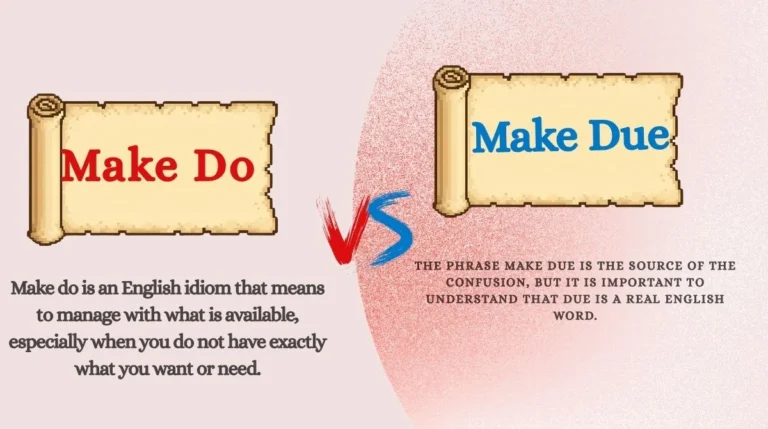
Make do is an English idiom that means to manage with what is available, especially when you do not have exactly what you want or need.
Think about this situation: You want a new phone, but you cannot buy one right now. Your old phone still works, even though the battery is weak. You decide to make do with your old phone.
You do not have the perfect thing, but you can still manage.
That is the basic idea behind make do.
Cambridge Dictionary gives the pattern make do with something, meaning to use or accept something that is different from what you really want. Merriam-Webster also explains make do as getting along with the means available.
The most common structure is:
make do with + noun
For example:
- We do not have enough chairs, so we will make do with the ones we have.
- I forgot my jacket, so I will make do with my sweater.
- There was no hotel nearby, so we made do with a small guesthouse.
- We are out of sugar, so we will make do with honey.
- She did not have a desk, so she made do with the kitchen table.
- We cannot buy a new car yet, so we will make do with the old one.
- He forgot his pen and had to make do with a pencil.
- The team had a small budget, but they made do with the equipment they had.
Notice something important: make do does not mean “make something.” It is an idiomatic expression. The word do here carries the idea of being good enough for a particular purpose.
For example:
This old computer will do.
This means the computer is not perfect, but it is good enough.
So:
We will make do with this old computer.
means:
We will manage by using this old computer.
Can “Make Do” Be Used in Different Tenses?
Yes. The expression changes mainly through the verb make.
Present:
I make do with what I have.
Past:
I made do with what I had.
Future:
I will make do with what I have.
Present perfect:
We have made do with a small kitchen for years.
With modal verbs:
You can make do with this for now.
We may have to make do without electricity tonight.
The word do does not become did or done inside this idiom just because the sentence changes tense. The verb that changes is make.
That is another useful point for learners.
What Does “Make Due” Mean?
The phrase make due is the source of the confusion, but it is important to understand that due is a real English word.
The problem is not that due is wrong. The problem is using make due as a replacement for the idiom make do, especially when you mean “manage with what you have.”
The word due has several common meanings.
It can mean something that is owed or expected:
My rent is due on Friday.
It can mean something that is supposed to happen:
The train is due at 8:00.
It can also mean appropriate or deserved:
She received due respect for her hard work.
Because due is a real and useful word, learners sometimes hear make do and imagine that the spelling should be make due.
But these are not the same expression.
Compare:
We had no chairs, so we made do with boxes.
Here, the meaning is “we managed with boxes.”
Writing:
We had no chairs, so we made due with boxes.
is not the standard spelling of that idiom.
You may occasionally see make due written in modern texts, especially online, but that does not make it the recommended choice when you mean “manage with what is available.” Grammarist also notes that make due occurs in actual usage, while make do remains the standard form of the idiom.
There are also situations in which the words make and due can appear next to each other for completely different grammatical reasons.
For example:
You should make due payment before the deadline.
Here, due describes payment. It is not the idiom make do.
Another example is:
The company must make due allowance for unexpected costs.
Again, due belongs with allowance. It does not mean “manage with what you have.”
So do not think that the words make and due can never appear together. The important point is that make due is not the standard idiom for coping with limited resources.
Difference Between Make Do and Make Due
The easiest way to understand the difference is to focus on meaning.
| Expression | Standard use | Meaning | Example |
|---|---|---|---|
| make do | Yes | Manage with what is available | We will make do with this old table. |
| make do with | Yes | Manage using something less than ideal | I can make do with this computer. |
| make do without | Yes | Manage despite not having something | We can make do without a car. |
| make due | Usually not for this idiom | Commonly a mistaken form of “make do” | Avoid “We made due with what we had.” |
| make due + noun | Possible in specific constructions | Here, “due” describes the noun | Make due payment by Friday. |
Usage Difference
Use make do when there is a problem, limitation, shortage, or less-than-perfect choice, but you decide that you can still manage.
For example:
The shop was closed, so we made do with what we had at home.
The speaker did not have everything they wanted. Still, they found a way to continue.
Do not use make due for that meaning:
Incorrect: We made due with what we had.
Correct: We made do with what we had.
Grammar Logic
The expression make do is an idiom. You should learn it as a fixed phrase instead of trying to create its meaning word by word.
English has many expressions like this.
For example:
take care
does not mean literally “take” something called care.
Similarly, make do has a special idiomatic meaning.
The word due, however, has its own meanings connected with something being owed, expected, suitable, or deserved.
Sentence Structure
The most useful patterns are:
Subject + make/made/will make + do
Example:
We will make do.
Or:
Subject + make/made/will make + do + with + noun
Example:
We will make do with this old laptop.
Or:
Subject + make/made/will make + do + without + noun
Example:
We can make do without a television.
This gives you a simple formula:
make do with = manage using
make do without = manage despite not having
Grammar Rules You Must Remember
Rule 1: Use “make do” when you mean “manage.”
This is the most important rule.
If you can replace the expression with manage, cope, or get by, you probably need make do.
We have little money, but we can make do.
You could also say:
We have little money, but we can manage.
Another example:
The restaurant was full, so we made do with sandwiches at home.
The meaning is that the people managed with a less convenient choice.
Rule 2: Use “make do with” before the thing you are using.
When you mention the available object, material, money, person, or resource, the common structure is:
make do with + noun
Examples:
I will make do with my old shoes.
She made do with a small room.
They are making do with limited supplies.
Can you make do with $20?
Cambridge specifically lists make do with something as a standard collocation for managing with something different or less suitable than desired.
Rule 3: Use “make do without” when something is missing.
Sometimes you do not have a replacement. You simply continue without something.
For example:
We can make do without a television.
She had to make do without her usual assistant.
I forgot my umbrella, but I can make do without it.
This pattern is very useful in daily conversation.
Remember:
with = you have something and use it.
without = you do not have something, but you continue anyway.
Rule 4: Do not change “do” to “due” because they sound alike.
This is a spelling and vocabulary problem, not simply a pronunciation problem.
Do and due can sound very similar in English, depending on the speaker and accent.
That is why the mistake is common.
But when you write the idiom, use:
make do
not:
make due
A good learner habit is to connect make do directly with the word manage.
Common Mistakes Students Make
One reason students make this mistake is that they try to understand the phrase by listening to it.
When someone says:
We will have to make do.
A learner may hear something close to:
We will have to make due.
Both forms may sound similar in ordinary speech, so the learner chooses the spelling that seems more familiar.
Another problem is the word due itself. Students already know expressions such as:
due date
payment due
due to
the train is due
Because “due” appears often, the spelling make due can look natural.
Mistake 1
Wrong: We don’t have enough plates, so we’ll make due with bowls.
Correct: We don’t have enough plates, so we’ll make do with bowls.
The correction is simple: you are talking about managing with available items.
Mistake 2
Wrong: I forgot my laptop, so I’ll make due with my phone.
Correct: I forgot my laptop, so I’ll make do with my phone.
The phone is not the ideal tool, but it is enough for the situation.
Mistake 3
Wrong: We made due without a car.
Correct: We made do without a car.
Here the phrase is followed by without, so the meaning is “we managed even though we did not have a car.”
Mistake 4
Wrong: Can you make due with this amount?
Correct: Can you make do with this amount?
Again, the speaker is asking whether the other person can manage.
Easy Correction Tip
Whenever you want to write make due, stop and ask yourself:
“Do I mean manage or get by?”
If the answer is yes, write:
make do
This one question can prevent most mistakes.
Easy Trick to Remember the Difference
Here is a simple memory trick:
Make DO = make it DO the job.
Imagine that you have an old chair.
It is not beautiful. It is not comfortable. It is not the chair you wanted.
But it still does the job.
You can say:
I will make do with this chair.
The chair is good enough for now.
Another easy connection is:
make do = manage
Whenever you see the idea of managing with limited choices, think DO.
You can also remember this short sentence:
“I don’t have the perfect thing, but I can make do.”
Now think about due.
Due is often connected with things such as:
money that is owed
a date
something expected
something deserved
Examples:
The payment is due tomorrow.
My homework is due on Monday.
The train is due at noon.
Those ideas are very different from “manage with what you have.”
So:
make do → manage
due → owed, expected, or appropriate
That contrast makes the difference much easier to remember.
Daily Life Examples
The expression is common in normal conversation, especially when people have to work with limited time, money, equipment, or choices.
1. At home
A: Where are the clean towels?
B: We’re doing laundry tonight, so make do with this one for now.
Here, the person is asking someone to manage with the available towel.
2. While cooking
A: We don’t have any milk.
B: That’s okay. We can make do with yogurt.
The yogurt is not the original choice, but it may work.
3. At school
Student: I forgot my blue pen.
Teacher: You can make do with a black one today.
The black pen is an acceptable replacement.
4. At work
Manager: We don’t have enough computers for everyone.
Employee: We can make do for a few days.
The team believes it can manage temporarily.
5. While traveling
A: The hotel lost our extra pillows.
B: We can make do with the ones we have.
They do not have exactly what they wanted, but they can continue.
6. With money
A: Do you need more cash?
B: No, I can make do with $20 until tomorrow.
The person believes $20 is enough to manage for the short period.
7. During an emergency
A: We don’t have electricity tonight.
B: We’ll have to make do without the lights.
This example uses make do without because the lights are unavailable.
8. With technology
A: When will you buy a new laptop?
B: Probably next month. I’ll make do with this one for now.
The current laptop is not ideal, but it still works.
9. At a party
A: We ran out of glasses.
B: We can make do with paper cups.
The paper cups are a practical replacement.
10. In everyday conversation
A: Is the guest room ready?
B: Not really, but our visitors can make do for one night.
The room is not perfect, but it is good enough temporarily.
These examples show an important part of the expression: make do often carries the idea of accepting a less-than-perfect situation and continuing anyway. It does not always mean the situation is terrible. Sometimes it simply means that something better is unavailable.
Practice Section
Choose make do or make due in each sentence.
1. We forgot the chairs, so we had to ______ with some wooden boxes.
2. Can you ______ with this old computer for another week?
3. We don’t have enough money, but we’ll ______.
4. She had no umbrella, so she had to ______ without one.
5. The team will ______ with the equipment they already have.
Answers
1. make do
Correct sentence:
We forgot the chairs, so we had to make do with some wooden boxes.
2. make do
Correct sentence:
Can you make do with this old computer for another week?
3. make do
Correct sentence:
We don’t have enough money, but we’ll make do.
4. make do
Correct sentence:
She had no umbrella, so she had to make do without one.
5. make do
Correct sentence:
The team will make do with the equipment they already have.
If you chose make due in these examples, remember that the clue is the meaning. Every sentence is about managing with limited resources, so the correct idiom is make do.
FAQs
What is the difference between “make do” and “make due”?
Make do is the standard English idiom meaning to manage with what is available, especially when you do not have what you really want. Make due is generally a mistaken version of this expression. Use make do when you mean “manage,” “cope,” or “get by.”
Can we use “make do” in questions?
Yes. Make do is perfectly natural in questions.
For example:
Can you make do with this chair?
Can we make do without a car?
Will you be able to make do until Friday?
These questions ask whether someone can manage with the available situation.
Is “make do” formal or informal?
Make do is especially common in everyday English, but it is not limited to casual speech. It can also appear in general nonfiction, journalism, and other types of standard writing. Merriam-Webster lists the expression as a normal English phrase meaning to manage with the means available.
Is “make due” ever correct?
The words make and due can appear together in a sentence, but make due is not the standard idiom meaning “manage with what you have.”
For example, make due payment is possible because due describes payment. That is grammatically different from saying make due with the old equipment.
When your intended meaning is “manage,” use make do.
Why do people write “make due”?
The main reason is pronunciation. Do and due are often pronounced the same or very similarly, so a writer may choose the familiar spelling due.
Another reason is that due is already a common English word. However, in the idiom about managing with limited resources, the established form is make do.
Is “make do with” the correct expression?
Yes. Make do with + noun is one of the most common and useful forms.
For example:
We don’t have a printer, so we’ll make do with our phones.
You can also use make do without + noun:
We can make do without a printer.
Cambridge specifically lists make do with something as a standard collocation.
Conclusion
The difference between make do and make due looks small, but it is important in correct English.
When you mean manage with what you have, the correct expression is make do. It is an idiom used when something is not perfect, something is missing, or you have fewer resources than you would like.
Remember these two useful patterns:
make do with + something
make do without + something
For example:
We don’t have a new printer, so we’ll make do with the old one.
We can make do without a printer for a few days.
The phrase make due often appears because do and due sound similar. However, you should not use make due as a replacement for make do when writing standard English.
The easiest memory trick is simple:
Make DO = manage.
When you can think of the words manage, cope, or get by, choose make do.
Once you start noticing this expression in everyday conversations, emails, books, and websites, the correct spelling will feel much more natural. A little practice is enough to make this common grammar confusion disappear.

Evan Rellmont is a writer who turns thoughtful ideas into meaningful words, creating stories and reflections that connect, inspire, and leave a lasting impression.
1 thought on “Make Due or Make Do? Correct Usage, Meaning, and Examples in 2026”