
Some English words sound exactly the same but have completely different meanings. Brake and break are two common examples.
When you hear them in a conversation, you may not know which word the speaker means.
That is because both words are pronounced almost the same, but they are spelled differently and used in different situations.
This can be confusing for beginners and English learners. You may know what you want to say, but when you write the sentence, you stop and wonder: “Should I use brake or break?” A small spelling mistake can change the meaning of your sentence.
Both words are very useful in everyday English. You may hear brake when someone is talking about a car, bicycle, bus, or motorcycle.
You will see break when people talk about stopping, damaging something, taking a rest, or separating something into parts.
So, learning the difference is not only useful for grammar tests. It also helps you communicate clearly in real life.
The good news is that the difference is easy once you connect each word with its main idea. Brake is mainly connected with stopping or slowing a vehicle.
Break has many meanings, including damage, rest, separation, and interruption.
By the end, you will know when to use each spelling, how their grammar works, and how to avoid the most common mistakes.
What Does “Brake” Mean?
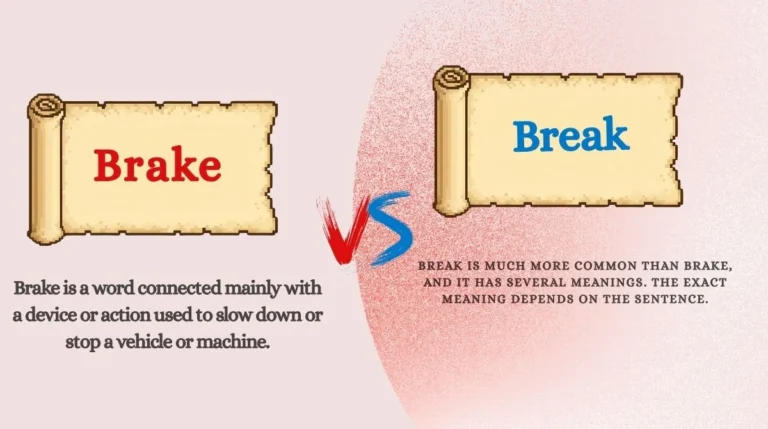
Brake is a word connected mainly with a device or action used to slow down or stop a vehicle or machine.
When you press the brake pedal in a car, the vehicle slows down or stops. A bicycle also has brakes. Motorcycles, buses, trains, and many other machines can have braking systems.
The word can work as both a noun and a verb.
As a noun, brake means the part of a vehicle that helps it slow down or stop.
- The car’s brakes are not working properly.
- Please check the brake before driving.
- The bicycle has a problem with its front brake.
- He pressed the brake suddenly.
As a verb, brake means to slow down or stop a vehicle by using the brakes.
- Please brake before the corner.
- She braked quickly when the dog ran onto the road.
- The driver braked to avoid the accident.
- You should brake slowly on a wet road.
Notice an important grammar point: the verb can change its form depending on the tense.
- Present: brake
- Past: braked
- Past participle: braked
- -ing form: braking
For example:
- I brake when the light turns red.
- Yesterday, I braked too late.
- He has braked suddenly several times.
- She is braking because a car is ahead.
One common learner mistake is using break when talking about a car. A learner may write, “Press the break.” That is incorrect when they mean the device that stops the vehicle. The correct sentence is, “Press the brake.”
A useful clue is simple: if you are talking about stopping a vehicle, choose brake.
More Examples with “Brake”
- The driver pressed the brake at the traffic light.
- My car needs new brakes.
- He braked hard when he saw the cyclist.
- Always brake before going downhill.
- The bus driver braked suddenly.
- My bike’s rear brake is loose.
- She was braking as she entered the parking area.
- The mechanic checked the brakes carefully.
What Does “Break” Mean?
Break is much more common than brake, and it has several meanings. The exact meaning depends on the sentence.
One common meaning is to damage or destroy something by hitting, dropping, bending, or using too much force.
- Be careful not to break the glass.
- I broke my phone yesterday.
- The child broke the toy.
- She accidentally broke the cup.
Another meaning is to separate something into pieces.
- Break the chocolate into small pieces.
- He broke the stick in half.
- The machine broke the material into smaller parts.
Break can also mean to stop working.
- My computer broke yesterday.
- The washing machine has broken again.
- The old fan suddenly broke down.
It can also mean to take a short rest.
- Let’s take a break.
- We have a ten-minute break after this lesson.
- I need a short break from work.
Another common meaning is to interrupt something.
- Don’t break my concentration.
- The noise broke the silence.
- His question broke the flow of the conversation.
Unlike brake, the word break is used in many areas of everyday English.
The grammar of break is also important because it is an irregular verb. Its forms are:
- Present: break
- Past: broke
- Past participle: broken
- -ing form: breaking
For example:
- I often break things when I am in a hurry.
- Yesterday, I broke a glass.
- She has broken her old phone.
- He is breaking the chocolate into pieces.
This is a key difference from brake. You say braked, not broke, when talking about the action of using a vehicle’s brakes.
More Examples with “Break”
- Don’t break that plate.
- I need to take a break.
- She broke her pencil.
- The chair broke under the heavy box.
- Be careful not to break the window.
- The computer has broken down.
- Please break the bread into two pieces.
- He broke the silence with a laugh.
Difference Between Brake and Break: Detailed Comparison
The easiest way to understand these words is to focus on their main meanings.
| Word | Main Meaning | Common Use | Part of Speech | Example |
|---|---|---|---|---|
| Brake | To slow or stop a vehicle | Cars, bikes, buses, motorcycles | Noun / Verb | Press the brake. |
| Break | To damage, separate, stop, rest, or interrupt | Objects, activities, work, machines, situations | Noun / Verb | Don’t break the glass. |
The biggest difference is meaning.
Brake has a narrow meaning. It is strongly connected to slowing or stopping a vehicle or machine.
Break has a wide range of meanings. You can break a cup, break a rule, break a promise, break the silence, break a habit, or take a break.
Here is the grammar difference in a simple way:
Brake as a verb
The pattern is often:
Subject + brake/braked + object or adverb
- The driver braked suddenly.
- She braked before the turn.
You can also use it with the brakes:
- He braked the car quickly.
Brake as a noun
The pattern may include an article, possessive, or adjective:
- The brake is broken.
- My brakes need checking.
- He pressed the brake pedal.
Break as a verb
The pattern is much broader:
Subject + break + object
- She broke the glass.
- He broke the promise.
- They broke the silence.
It can also appear without a direct object:
- The chair broke.
- My phone broke down.
Break as a noun
Common structures include:
take a break
have a break
a short break
lunch break
school break
Examples:
- I need a break.
- We are taking a short break.
- The students have a lunch break at noon.
The meanings can sometimes look similar in a sentence, but the spelling tells you what the word means.
For example:
- The driver pressed the brake.
- The driver took a break.
The first sentence is about stopping a vehicle. The second would mean the driver rested, which is a completely different idea.
Grammar Rules You Must Remember
Rule #1: Use “brake” for vehicles
When the meaning is slow down or stop a car, bike, bus, or other vehicle, use brake.
Correct: The driver braked quickly.
Incorrect: The driver breaked quickly.
Remember that the past form is braked.
Rule #2: Use “break” for damage or destruction
When something is damaged, cracked, split, or destroyed, use break.
Correct: I broke the glass.
Incorrect: I braked the glass.
You can also talk about breaking objects into pieces.
Example: Break the cookie into two pieces.
Rule #3: “Break” has many expressions
Many common English phrases use break.
For example:
- break a rule
- break a promise
- break a habit
- break the news
- break the silence
- break a record
- take a break
None of these use brake.
For example:
She broke the school record.
Here, broke does not mean anything related to vehicles.
Rule #4: Learn the past forms carefully
This is one of the most important grammar points.
Brake → braked → braked
Break → broke → broken
Compare:
- He braked the car.
- He broke the window.
- He has braked several times.
- He has broken several cups.
A learner who memorizes only the sounds may easily confuse these forms. Learning the verb forms together makes the difference much easier.
Common Mistakes Students Make
Many students make mistakes with these words because they are homophones. Homophones are words that sound the same or almost the same but have different meanings or spellings.
Mistake 1: “Press the break.”
This is one of the most common errors.
Wrong: Press the break.
Correct: Press the brake.
If the sentence is about stopping a vehicle, use brake.
Mistake 2: “The car breaked.”
The past form of brake is not breaked or broke.
Wrong: The driver breaked suddenly.
Correct: The driver braked suddenly.
This mistake happens because learners already know the irregular verb break → broke → broken.
Mistake 3: “I braked the glass.”
This sentence changes the meaning completely.
Wrong: I braked the glass.
Correct: I broke the glass.
A glass can be broken, but it cannot normally be braked.
Mistake 4: “I need a brake.”
If you mean that you need some rest, the correct word is break.
Wrong: I need a brake.
Correct: I need a break.
However, “I need a brake” is correct if you mean a mechanical part for a vehicle.
Mistake 5: Confusing “break down” and “brake”
These phrases sound similar, but they are different.
Break down can mean that a machine or vehicle stops working.
- My car broke down on the highway.
Brake means the system used to slow or stop the vehicle.
- The mechanic repaired the brakes.
A simple correction tip is to stop and ask yourself: Am I talking about stopping a vehicle, or am I talking about damage, rest, or another kind of interruption?
Easy Trick to Remember the Difference
Here is a simple memory trick that works well for many students:
Brake = car
Think of the word brake whenever you see a car, bicycle, motorcycle, or another vehicle.
You brake when you want to stop.
Car → brake
Break = almost everything else
Think of break for things that can be damaged, separated, interrupted, or paused.
Glass → break
Promise → break
Habit → break
Silence → break
Rest → break
There is another easy way to remember it.
The word brake contains the letter A, and you can connect A with automobile. It is not a perfect grammar rule, but it can help you remember the spelling when you are writing quickly.
You can also remember this sentence:
“Brake the car, but break the glass.”
Say it a few times. The contrast makes the difference stick in your mind.
Daily Life Examples
These words appear in ordinary conversations all the time. Read these examples aloud to hear how naturally they fit into real English.
Example 1: In a car
A: Why did you stop suddenly?
B: The traffic light changed, so I pressed the brake.
Example 2: Talking about a bicycle
A: Is your bike okay?
B: Yes, but I think the front brake needs repair.
Example 3: At work
A: You look tired.
B: I am. I need to take a short break.
Example 4: At home
A: Who broke this cup?
B: I did. I dropped it by accident.
Example 5: During a lesson
Teacher: Let’s take a five-minute break.
Student: Great! I need some water.
Example 6: On the road
A: Did you see that dog?
B: Yes, I braked immediately.
Example 7: Talking about a machine
A: Why isn’t the washing machine working?
B: It broke down this morning.
Example 8: Talking about rules
A: Why did the teacher punish him?
B: He broke the school rule.
Example 9: Talking about a promise
A: Can I trust him?
B: Yes. He never breaks his promises.
Example 10: During a long journey
A: Should we stop here?
B: Yes, let’s take a break and get some coffee.
Notice how brake appears mostly in driving situations, while break appears in many different situations.
Practice Section
Choose the correct word: brake or break.
1. Please press the ______ before the red light.
2. I dropped the plate and ______ it.
3. We need to take a short ______.
4. The driver ______ suddenly when a cat crossed the road.
5. Don’t ______ the window.
Answers
- brake
- broke
- break
- braked
- break
Here is a useful challenge. Try making two sentences of your own: one with brake and one with break. Make sure the meanings are clearly different.
For example:
- I pressed the brake when the car slowed down.
- I accidentally broke my glasses.
Writing your own examples is one of the fastest ways to remember confusing English words.
FAQs
What is the difference between brake and break?
Brake is mainly used for a device or action that slows or stops a vehicle. Break has many meanings, such as damaging something, taking a rest, separating something, or interrupting an activity.
For example, “Press the brake” is about a vehicle, while “Take a break” means to rest.
Can we use “brake” as a verb?
Yes. Brake can be both a noun and a verb. As a verb, it means to slow down or stop a vehicle.
For example: “She braked before the turn.” The past form is braked, not broke.
Is “break” an irregular verb?
Yes. Break is an irregular verb.
Its main forms are break – broke – broken.
Example: “I break things sometimes,” “I broke the cup yesterday,” and “I have broken two cups this month.”
Is “break” formal or informal?
Break is a normal everyday English word. It is used in both spoken and written English and is not limited to formal or informal situations.
You can use it at home, at school, at work, and in professional writing depending on the meaning.
Why do brake and break sound the same?
They are commonly treated as homophones because they have the same pronunciation in standard English, even though they have different spellings and meanings.
This is why English learners often confuse them when writing.
Do we say “take a brake” or “take a break”?
The correct phrase is take a break when you mean to rest for a short time.
Example: “I have been studying for two hours. I need to take a break.”
Brake is only correct when you mean the part or action used to slow or stop a vehicle.
Conclusion
The difference between brake and break becomes much easier when you connect each word with its main idea.
Use brake when you are talking about slowing down or stopping a vehicle. A car has brakes, a bicycle has brakes, and a driver can brake suddenly.
Use break for the many other meanings of the word. You can break a glass, break a promise, break a rule, break a habit, break the silence, or take a break.
The spelling may look like a small detail, but choosing the correct word can make your English much clearer. When you are unsure, think about the meaning before you write. Ask yourself, “Am I talking about a vehicle stopping?” If yes, choose brake. If you mean damage, rest, separation, or interruption, choose break.
Keep practicing with short, real-life sentences. After a little practice, these two confusing words will feel much more natural.

Evan Rellmont is a writer who turns thoughtful ideas into meaningful words, creating stories and reflections that connect, inspire, and leave a lasting impression.
1 thought on “Brake vs Break: Meaning, Difference, Rules, and Examples (2026)”