
Set or sit? These two small English verbs cause a surprising number of mistakes.
They sound different, but learners often mix them up because both can be connected with a chair, a place, or a person being in a certain position.
The problem becomes even bigger when we change them into the past tense. We say sit – sat – sat, but set – set – set. That can feel strange if English is not your first language.
Think about common situations. You may want to tell someone, “Please ___ here,” or explain, “I ___ on the sofa yesterday.” Which verb should you use? A small mistake can change the meaning of the sentence.
The easiest way to understand the difference is to focus on the action. Sit normally means to put your body in a seated position or to be in that position.
Set usually means to put or place something somewhere, often carefully or deliberately.
Merriam-Webster also lists set as a verb meaning “to cause to sit,” which helps explain why the two words are sometimes connected.
Once you understand what each verb does, the difference becomes much easier.
You will know which word to choose in everyday sentences, questions, past-tense statements, commands, and common expressions.
What Does “Set” Mean?
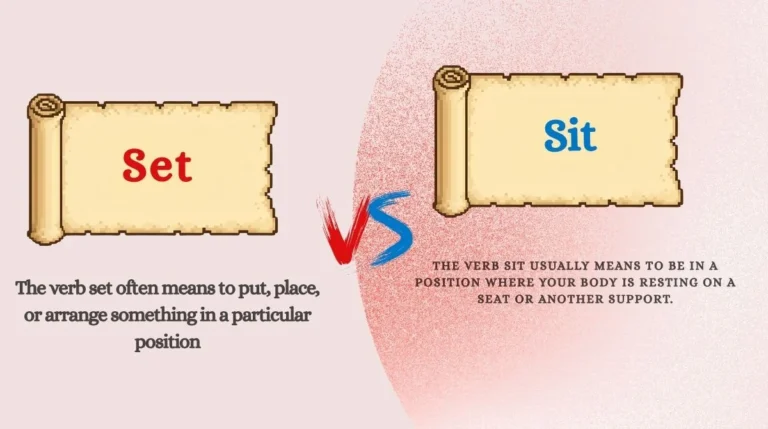
The verb set often means to put, place, or arrange something in a particular position. It is commonly used when one person moves an object to a place or makes something ready for a purpose.
For example, you can set a book on a desk, set a glass on the table, or set an alarm for 7:00. The exact meaning changes with the situation, but the central idea is often about putting, fixing, or arranging something. Merriam-Webster gives many related meanings, including placing something carefully, fixing a time, and making something ready for use.
When should you use “set”?
Use set when you are talking about placing, arranging, or fixing something.
You might use it when:
- You place an object somewhere.
- You arrange a table.
- You fix a time or date.
- You prepare something.
- You put something into a certain position.
The grammar pattern is often:
subject + set + object + place/position
Examples:
- I set the keys on the table.
- She set her phone beside the bed.
- Please set the plates on the table.
- He set the alarm for six o’clock.
- We set the bags near the door.
- Mom set the food on the kitchen counter.
- They set the chairs in a circle.
- I set the book back on the shelf.
Notice something important: in these examples, a person is doing something to an object. The object is being moved or arranged.
“Set” does not change in the past
One useful thing about set is that its basic form stays the same in the present and past.
- Present: I set the cup on the table.
- Past: I set the cup on the table yesterday.
- Past participle: I have set the cup on the table.
So you do not say setted. The correct form is always set.
This makes the verb easy in one way, but it can also confuse learners because the same word represents different tenses.
A common confusion with “set”
Many students learn the phrase sit down and then start using set down when they simply mean “take a seat.” The two are not always interchangeable.
Sit down normally tells a person to move into a sitting position:
Please sit down.
Set down means put something down:
Please set the box down.
That little difference matters. One action involves a person’s body. The other usually involves an object.
What Does “Sit” Mean?
The verb sit usually means to be in a position where your body is resting on a seat or another support. It can also mean moving yourself into that position. Cambridge defines it as being or causing someone to be in a seated position, and it gives common patterns such as sit at, sit in, and sit on.
For example, when you are tired, you may sit on the sofa. At school, you may sit in a chair. In a restaurant, you may sit at a table.
When should you use “sit”?
Use sit when the main idea is that a person or animal is seated, or is moving into a seated position.
The basic pattern is:
subject + sit + place
Examples:
- I sit on the sofa every evening.
- She sits near the window.
- Please sit here.
- We sat at the front of the classroom.
- He sat beside his friend.
- The children are sitting on the floor.
- My dog likes to sit by the door.
- I sat in the waiting room for twenty minutes.
Here, the focus is not on placing an object. The focus is on the person or animal being in a seated position.
The forms of “sit”
Unlike set, the verb sit changes in the past.
- Base form: sit
- Present third person: sits
- -ing form: sitting
- Past: sat
- Past participle: sat
Examples:
I sit here every day.
She sits here every day.
I am sitting here now.
I sat here yesterday.
I have sat here many times.
A very common mistake is saying sitted. That is incorrect in standard English. The correct past form is sat. Cambridge and Merriam-Webster both list sat as the past and past participle form of sit.
Another useful meaning of “sit”
In British English, sit can also mean take an exam.
For example:
I am going to sit my final exam next month.
She sat her English exam yesterday.
This meaning is especially common in British English. Cambridge lists it as a use of sit meaning to take an exam.
Difference Between Set and Sit
The simplest way to separate these verbs is to ask one question:
Are you talking about a person taking a seated position, or are you putting something somewhere?
If a person is becoming seated, sit is usually the right choice.
If someone is placing an object somewhere, set is usually the right choice.
| Point | Sit | Set |
|---|---|---|
| Main idea | Be or move into a seated position | Put, place, or arrange something |
| Common object? | Usually no object in basic use | Usually takes an object |
| Present form | sit | set |
| Past form | sat | set |
| -ing form | sitting | setting |
| Example | I sat on the chair. | I set the bag on the chair. |
| Common phrase | sit down | set the table |
Compare these sentences
Sit on the chair.
This tells someone to place their body on the chair.
Set the bag on the chair.
This tells someone to place the bag on the chair.
The chair is the location in both sentences, but the action is different.
Another pair:
She sat beside me.
She was in a seated position.
She set her purse beside me.
She placed her purse next to me.
This is the grammar logic that helps most learners. Ask yourself: What is being moved or placed?
If it is the person’s body moving into a seated position, think sit.
If it is an object being placed or arranged, think set.
Sentence structure matters
Compare:
I sat on the sofa.
Here, I am the person who sits.
Now compare:
I set the book on the sofa.
Here, I am placing the book.
A useful pattern is:
Sit + location
- sit on the chair
- sit in the room
- sit beside me
And:
Set + object + location
- set the cup on the table
- set the bag beside the door
- set the plates on the counter
This is not the only way these verbs are used, but it is a very helpful starting point for beginners.
Grammar Rules You Must Remember
Rule #1: Use “sit” for your own seated position
When the subject is sitting, use sit or one of its correct forms.
Correct: I sat on the bed.
Wrong: I set on the bed.
The word sat is the past form of sit, so it is the correct choice for something that happened in the past.
Rule #2: Use “set” when you place something
When you move an object into a position, set is often the correct verb.
Correct: I set my phone on the table.
Wrong: I sat my phone on the table.
The phone cannot normally perform the action of sitting. You are placing it somewhere.
Rule #3: Remember “sit – sat – sat”
This is one of the most important forms to memorize.
Today: I sit here.
Yesterday: I sat here.
This week: I have sat here several times.
Never use sitted in standard English.
Rule #4: Remember “set – set – set”
The forms of set stay the same.
Today: I set the alarm.
Yesterday: I set the alarm.
I have: I have set the alarm.
The sentence’s time words or helping verbs show the tense.
Rule #5: “Sitting” has double “t”
The -ing form of sit is:
sitting
Not siting when you mean being seated.
Examples:
The children are sitting quietly.
She is sitting near the door.
For set, the -ing form is:
setting
Example:
He is setting the table.
Common Mistakes Students Make
The confusion usually happens because both verbs can appear around chairs, tables, rooms, and people.
A student may think, “There is a chair, so I should use set.” But the object in the sentence matters more than the place.
Mistake 1: Using “set” instead of “sit”
Wrong: Please set down.
Correct: Please sit down.
Why? You are asking a person to move into a seated position.
Now compare:
Correct: Set the box down.
Here, the box is being placed on the floor or another surface.
Mistake 2: Saying “I set on the chair”
Wrong: I set on the chair yesterday.
Correct: I sat on the chair yesterday.
This mistake is especially common because some learners hear these words used differently in different accents or informal speech. For standard English learning, sat is the past form you should use for a person being seated.
Mistake 3: Saying “I sitted”
Wrong: I sitted near the window.
Correct: I sat near the window.
The past form of sit is irregular, so it must be memorized.
Mistake 4: Saying “setted”
Wrong: She setted the plates on the table.
Correct: She set the plates on the table.
There is no standard English verb form setted.
Mistake 5: Confusing “sit down” with “set down”
Sit down = move into a sitting position.
Set down = put something down.
For example:
Sit down and relax.
Set your keys down and come inside.
A simple correction tip is to look at the thing receiving the action. If it is a person becoming seated, think sit. If it is an item being placed, think set.
Easy Trick to Remember the Difference
Here is a simple memory trick:
Sit = person.
Set = thing.
This is not a rule for every single meaning of the two verbs, but it is an excellent beginner shortcut.
Imagine a classroom.
The teacher says:
“Sit in your chair.”
You move your body into the chair.
Then the teacher says:
“Set your books on the desk.”
Now you are putting objects on the desk.
So remember the picture:
Person → sit
Object → set
You can also remember the past forms with a small rhythm:
sit → sat
set → set
Try saying them aloud several times.
I sit today. I sat yesterday.
I set it today. I set it yesterday.
This kind of short practice helps the correct forms feel natural when you speak.
Daily Life Examples
These verbs appear all the time in normal conversation. Here are some situations you may hear at home, at school, at work, or with friends.
1. At home
“Please sit on the sofa.”
You are asking someone to take a seat.
“Set your bag by the door.”
You are asking them to place an object there.
2. At dinner
“Please sit at the table.”
The person needs to take a seat.
“I’ll set the plates on the table.”
The speaker is arranging the plates.
3. In a classroom
Teacher: “Everyone, sit down.”
Student: “Where should I set my notebook?”
These sentences sound natural because each verb has a different job.
4. At a friend’s house
“You can sit anywhere.”
This means any seat is fine.
“Just set your shoes over there.”
This means put the shoes in that place.
5. At work
“I sat in the meeting room for an hour.”
You were seated there.
“She set the documents on my desk.”
She placed the documents there.
6. While traveling
“We sat near the window on the train.”
The people were seated.
“He set his suitcase beside his seat.”
He placed the suitcase.
7. With children
“Please sit still for a minute.”
This asks a child not to move.
“Set your toys on the shelf.”
This asks the child to place the toys somewhere.
8. In a restaurant
Waiter: “Please sit wherever you like.”
Customer: “Where should I set my coat?”
Again, one sentence is about a person’s position, while the other is about placing an object.
9. During study time
“I sat at my desk all afternoon.”
You remained seated.
“I set my laptop on the desk.”
You placed the laptop there.
10. Before going to bed
“I sat on the bed and read for a while.”
You were seated.
“Then I set my glasses on the table.”
You placed your glasses there.
These examples show why the difference is worth learning. You do not need difficult grammar theory. You mainly need to recognize the action.
Practice Section
Choose sit or set. Pay attention to what is happening in each sentence.
- Please ___ down and relax.
- I ___ the keys on the kitchen table.
- We ___ on the floor during the movie.
- She ___ the alarm for 6:30 a.m.
- He ___ beside me at lunch.
Answers
- sit — Please sit down and relax.
- set — I set the keys on the kitchen table.
- sat — We sat on the floor during the movie.
- set — She set the alarm for 6:30 a.m.
- sat — He sat beside me at lunch.
Notice that numbers 3 and 5 are in the past. That is why sit changes to sat.
FAQs
What is the difference between “set” and “sit”?
Sit is usually about being or becoming seated. Set usually means putting, placing, or arranging something somewhere.
For example, “Sit on the chair” is about a person. “Set the bag on the chair” is about an object.
Can we use “sit” in questions?
Yes. Sit is common in everyday questions.
Examples include:
“Where should I sit?”
“Can I sit here?”
“Did you sit near the window?”
The past form is sat, so you can also ask, “Did you sit here yesterday?”
Is “set” formal or informal?
Set is neither especially formal nor informal. It is a normal everyday English verb.
You can use it at home, at school, at work, and in formal writing. Examples include set the table, set the alarm, set a date, and set a rule.
Is “sit down” the same as “set down”?
No. Sit down means move into a seated position. Set down usually means put something down.
For example:
“Sit down, please.”
“Set the box down, please.”
The first sentence is about a person. The second is about an object.
What is the past tense of “sit”?
The past tense of sit is sat.
Examples:
I sit here every morning.
I sat here yesterday.
She sat beside me during the meeting.
Do not say sitted in standard English. Cambridge and Merriam-Webster both give sat as the past form.
What is the past tense of “set”?
The past tense of set is also set.
For example:
I set the alarm last night.
She set the books on the desk yesterday.
The verb does not become setted. Its basic past form stays set.
Conclusion
The difference between set and sit becomes much easier when you stop trying to memorize long grammar definitions and focus on the action.
Sit is mainly about being in a seated position or moving into one. Its important forms are sit, sat, sitting.
Set is commonly about putting, placing, arranging, or fixing something. Its main forms stay simple: set, set, setting.
Remember the beginner-friendly trick:
Person → sit
Thing → set
So you sit on a chair, but you set a book on a chair. You sat on the sofa yesterday, but you set your phone on the table.
Practice these verbs in short daily sentences. Say them aloud, write a few examples, and pay attention to whether the action is about a person sitting or an object being placed. With a little practice, the difference will start to feel natural.

Evan Rellmont is a writer who turns thoughtful ideas into meaningful words, creating stories and reflections that connect, inspire, and leave a lasting impression.
1 thought on “Set or Sit? Easy Grammar Rules, Examples, and Differences in 2026”