
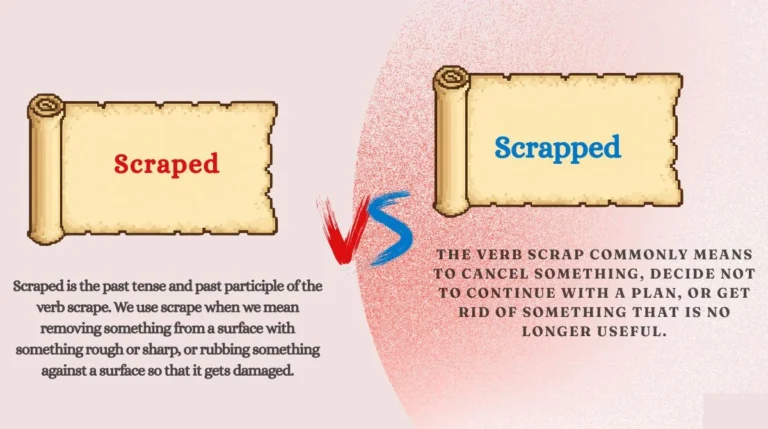
Scraped and scrapped look almost the same, but they do not mean the same thing.
The only visible difference is an extra p, yet that small spelling change can completely change the meaning of a sentence.
This is a common problem for English learners because both words come from verbs that start with scr-, and both can describe something happening in the past.
When people write quickly, they may choose scraped when they mean scrapped, or the other way around.
The confusion becomes even stronger because scrape and scrap have several meanings. For example, you can scrape ice off a car, while you can scrap an old plan.
You might also scrape your knee, but you can scrap an old machine. These actions are completely different.
Understanding the difference is useful in school writing, emails, conversations, news reports, and everyday English.
It also helps when you are talking about injuries, cleaning, machines, plans, projects, or even online data.
The good news is that the difference is easy to learn once you connect each word with its base verb. Scraped comes from scrape, while scrapped comes from scrap.
One usually involves rubbing or removing something from a surface. The other often means canceling, abandoning, or getting rid of something.
Let’s look at both words carefully and make the difference easy to remember.
What Does “Scraped” Mean?
Scraped is the past tense and past participle of the verb scrape. We use scrape when we mean removing something from a surface with something rough or sharp, or rubbing something against a surface so that it gets damaged.
In very simple English, scraped often means:
rubbed, scratched, or removed by rubbing or using something hard or sharp.
When do we use “scraped”?
We use scraped when an action happened in the past.
For example:
- Someone scraped the paint off the wall.
- She scraped her knee when she fell.
- I scraped the ice from the windshield.
- He scraped the mud off his shoes.
- The chair scraped the floor as we moved it.
The word can describe either removing something or damaging/rubbing against something. Cambridge explains scrape as removing an unwanted layer from a surface or rubbing against a surface in a way that may cause slight damage.
Grammar rule for “scraped”
The base verb is:
scrape → scraped
Because scrape ends in silent e, we normally add d, not -ed after keeping the full spelling.
Examples:
- scrape → scraped
- clean → cleaned
- close → closed
- bake → baked
So:
✅ I scraped the paint off the door.
❌ I scrapped the paint off the door.
In the first sentence, the person removed paint from the surface. That is exactly the idea of scrape.
8 example sentences with “scraped”
- I scraped my knee when I fell off my bicycle.
- She scraped the ice off the car window.
- He scraped the old paint from the wall.
- The boy scraped his hand on the rough fence.
- We scraped the mud off our boots.
- The metal box scraped the floor as I moved it.
- She scraped the burnt food from the bottom of the pan.
- The car scraped against the gate while backing up.
Notice that the action always has a physical connection to rubbing, scratching, or removing a layer.
Common learner confusion
Many learners think the extra p in scrapped is just a spelling variation of scraped. It is not.
Compare these:
- I scraped my knee. → I injured the skin by rubbing it against something.
- I scrapped my plan. → I canceled or abandoned the plan.
The first is about surface contact or removal. The second is about ending or getting rid of something.
Another important use is modern technology. Scraped data means data collected from websites or other digital sources through a process known as web scraping. In this case, scraped still comes from scrape, but the meaning is extended to collecting information.
For example:
The company scraped data from several public websites.
Here, nobody is scratching a physical surface. The word is being used for collecting information from a digital source.
What Does “Scrapped” Mean?
Scrapped is the past tense and past participle of the verb scrap.
The verb scrap commonly means to cancel something, decide not to continue with a plan, or get rid of something that is no longer useful. It can also mean to fight, although that meaning is less important for the scraped vs scrapped spelling question.
In simple English:
Scrapped = canceled, abandoned, or thrown away because it is no longer wanted or useful.
When do we use “scrapped”?
We use scrapped when something was canceled, abandoned, or removed from use.
For example:
- The school scrapped the old rule.
- They scrapped their travel plans.
- The factory scrapped the old machine.
- We scrapped the project because it was too expensive.
Cambridge gives scrap the sense of deciding not to continue with a plan or system and also getting rid of something that is no longer useful.
Grammar rule for “scrapped”
Here is the important spelling rule:
scrap → scrapped
The word scrap has a short vowel sound before the final consonant. When we add -ed, the final p is doubled:
scrap + ped = scrapped
The same pattern appears in words such as:
- stop → stopped
- plan → planned
- shop → shopped
- drop → dropped
So:
✅ They scrapped the old plan.
❌ They scraped the old plan.
The second sentence would not normally express the intended meaning of canceling a plan.
8 example sentences with “scrapped”
- The company scrapped the project after losing money.
- We scrapped our plans because of the storm.
- The government scrapped the old tax rule.
- She scrapped the idea after hearing everyone’s opinion.
- The factory scrapped the broken machine.
- They scrapped the proposal and started again.
- The school scrapped the old timetable.
- He scrapped his original plan and chose a simpler one.
In all of these examples, something is being canceled, abandoned, or removed from use.
Common learner confusion
The biggest mistake is choosing scraped because it sounds like the more familiar word.
For example:
❌ The manager scraped the meeting.
This sounds wrong because a meeting is not normally something you rub, scratch, or remove from a surface.
✅ The manager scrapped the meeting plan.
Even more naturally, depending on the meaning, you could say:
✅ The manager canceled the meeting.
This shows an important point: scrapped is often connected with plans, ideas, systems, projects, rules, and old things.
Difference Between Scraped and Scrapped
The easiest way to understand the difference is to focus on the base verbs.
Scraped comes from scrape.
Scrapped comes from scrap.
The meanings are different, the spelling rules are different, and the sentence structures can be different too.
Comparison Table
| Word | Base Verb | Main Meaning | Common Uses | Example |
|---|---|---|---|---|
| Scraped | scrape | Rubbed, scratched, or removed from a surface | skin, paint, ice, mud, data | She scraped the ice off the car. |
| Scrapped | scrap | Canceled, abandoned, or got rid of | plans, projects, rules, machines | They scrapped the old plan. |
Usage difference
Use scraped when you can imagine something touching a surface.
Think about:
- a knee
- a wall
- paint
- ice
- mud
- a floor
- a pan
- a rough surface
Examples:
I scraped my knee.
She scraped the mud off her shoes.
Use scrapped when the idea is canceling or getting rid of something.
Think about:
- a plan
- a project
- a rule
- an idea
- a system
- a machine
- an old vehicle
Examples:
We scrapped the plan.
The company scrapped the old system.
Grammar logic
Both words are past forms, but they come from different verbs.
Scrape → scraped
Scrap → scrapped
This difference is very important. You should not think of the two words as two spellings of the same verb.
The extra p in scrapped is there because of the spelling rule for words such as scrap. It is not added simply to make the word look different.
Sentence structure difference
Scraped is often used with an object that can be physically rubbed, damaged, or cleaned.
Common structures include:
Subject + scraped + object
He scraped his knee.
Subject + scraped + object + off + surface
She scraped the mud off her shoes.
Subject + scraped + against + object
The bike scraped against the wall.
With scrapped, the object is often a plan, system, project, rule, or unwanted item.
Subject + scrapped + object
They scrapped the project.
The company scrapped the old machine.
Meaning comparison
Compare these two sentences:
She scraped the paint off the wall.
This means she physically removed paint from the wall.
She scrapped the plan.
This means she decided not to continue with the plan.
The actions are completely different even though the words look nearly identical.
A useful mental picture is:
scraped = surface
scrapped = stopped
That one idea can help you choose the correct spelling quickly.
Grammar Rules You Must Remember
Rule 1: “Scraped” comes from “scrape”
When the base verb is scrape, the past form is scraped.
✅ He scraped his arm.
✅ We scraped the ice away.
Do not add another p.
❌ He scrapped his arm.
That would normally mean something very different.
Rule 2: “Scrapped” comes from “scrap”
When the base verb is scrap, the past form is scrapped.
✅ They scrapped the idea.
✅ The company scrapped the old machine.
Remember:
scrap + ed = scrapped
Rule 3: Use “scraped” for rubbing, scratching, or removing a layer
Ask yourself:
Did something rub against a surface, or did someone remove something from a surface?
If yes, scraped is usually the right choice.
Examples:
✅ The child scraped his knee.
✅ I scraped the burnt food from the pan.
Rule 4: Use “scrapped” for canceling or getting rid of something
Ask yourself:
Was a plan, project, rule, system, or old object canceled or thrown away?
If yes, choose scrapped.
Examples:
✅ The team scrapped the idea.
✅ The factory scrapped the machine.
A quick test is to replace the word with canceled or removed from use. If that meaning works, scrapped is probably correct.
Common Mistakes Students Make
These two words are often confused because they look so similar. Learners may remember the pronunciation but forget which verb they are using.
Mistake 1: Using “scraped” for a canceled plan
❌ We scraped the plan.
✅ We scrapped the plan.
The plan was canceled, not physically scratched.
Mistake 2: Using “scrapped” for a knee injury
❌ I scrapped my knee when I fell.
✅ I scraped my knee when I fell.
A knee can be scraped because the skin rubs against a rough surface.
Mistake 3: Forgetting the double “p”
❌ They scraped the old project.
✅ They scrapped the old project.
The base verb is scrap, so the past form is scrapped.
Mistake 4: Choosing by spelling instead of meaning
Some students look only at the letters.
That is risky because the words are visually similar.
Instead, look at the meaning first:
surface injury or removal → scraped
canceling or getting rid of → scrapped
Easy correction tip
Whenever you see one of these words, ask yourself:
“Am I talking about a surface, or am I talking about stopping something?”
Surface = scraped
Stopping = scrapped
This tiny question can prevent many spelling mistakes.
Easy Trick to Remember the Difference
Here is a simple memory trick that works well for beginners.
Think: “Scraped touches. Scrapped stops.”
Scraped touches a surface.
You scrape:
- your knee
- paint
- ice
- mud
- food from a pan
Something is being rubbed, scratched, or removed.
Scrapped stops something.
You scrap:
- a plan
- a project
- an idea
- a rule
- an old machine
Something is canceled or removed from use.
You can also remember the spelling through the base verbs:
SCRAPE → SCRAPED
SCRAP → SCRAPPED
Notice the shape of the words:
scrape has one p → scraped
scrap already has the short a pattern → double the final consonant → scrapped
A real-life example makes this easier:
Imagine you bought an old car.
First, you might scrape the mud off the tires.
Later, you may decide the car is too old, so you scrapped the car.
One action cleans or damages a surface. The other means getting rid of something.
Daily Life Examples
These examples show how native speakers may use the two words in everyday situations.
1. At home
A: Why are you outside with that tool?
B: I scraped the ice off the steps.
Here, ice is being removed from a surface, so scraped is correct.
2. After a fall
A: Are you okay?
B: Yes, I just scraped my knee.
The skin was damaged by rubbing against the ground.
3. Talking about plans
A: Are you still going on the trip?
B: No. We scrapped our plans because the weather is terrible.
The plan was canceled.
4. At work
A: What happened to the old project?
B: The manager scrapped it because it cost too much.
The project was abandoned.
5. Cleaning shoes
A: Why are you carrying that brush?
B: I need to scrape the mud off my shoes.
The mud is being removed from a surface.
6. Talking about an old car
A: What happened to your old car?
B: It was too expensive to repair, so we scrapped it.
The car was no longer useful, so it was discarded.
7. At school
Teacher: Why did you change the activity?
Student: We scrapped the original idea because we did not have enough time.
The original idea was abandoned.
8. In the kitchen
A: What’s that sound?
B: I’m scraping the burnt food from the pan.
Something is being removed from a surface.
9. Talking about a rule
A: Do we still have to follow that old rule?
B: No. The school scrapped it last month.
The rule was canceled.
10. About online information
A: How did they collect all those website details?
B: They scraped data from public web pages.
Here, scraped is used in the technology sense of collecting information electronically.
Practice Section: Scraped or Scrapped?
Choose the correct word in each sentence.
1.
I ______ my elbow when I fell off the chair.
scraped / scrapped
2.
The company ______ its old policy last year.
scraped / scrapped
3.
She ______ the paint off the wooden door.
scraped / scrapped
4.
They ______ the plan after realizing it was too expensive.
scraped / scrapped
5.
He ______ the mud from his shoes before entering the house.
scraped / scrapped
Answers
- scraped
- scrapped
- scraped
- scrapped
- scraped
A quick explanation can make the answers easier to remember:
- Knee, elbow, paint, mud, ice, food → scraped
- Plan, policy, project, system, machine → scrapped
FAQs
What is the difference between scraped and scrapped?
Scraped comes from scrape and usually means rubbed, scratched, or removed from a surface. Scrapped comes from scrap and usually means canceled, abandoned, or thrown away. Their meanings are different even though their spellings are very similar.
Can we use “scraped” in questions?
Yes. Scraped can be used in questions just like any other past-tense verb.
For example:
“Did you scrape your knee?”
“Who scraped the paint off the door?”
Is “scrapped” formal or informal?
Scrapped is a normal English word used in both everyday and formal writing. It is common when talking about plans, projects, policies, systems, and old equipment. In some formal contexts, words such as canceled or abandoned may sound more neutral.
Is it “scraped a plan” or “scrapped a plan”?
The correct choice for canceling a plan is scrapped a plan.
For example:
“We scrapped our plan because the weather was bad.”
Use scraped when you mean physically rubbing or removing something from a surface.
Is “scraped” the past tense of “scrape”?
Yes. The correct past tense and past participle are scraped.
scrape → scraped
For example:
“She scraped her knee.”
Is “scrapped” the past tense of “scrap”?
Yes. The correct past tense and past participle are scrapped.
scrap → scrapped
For example:
“They scrapped the old project.”
The final p is doubled in the past form.
Can “scraped” and “scrapped” mean “removed”?
Sometimes both can involve removing something, but the type of removal is different. Scraped usually means removing something from a surface, such as paint or ice. Scrapped usually means getting rid of something because it is no longer wanted or useful.
Conclusion
Scraped and scrapped are easy to confuse because they look almost identical, but their meanings are quite different. The key is to remember the verbs they come from.
Scraped comes from scrape. Use it when something is rubbed, scratched, or removed from a surface. You can scrape your knee, scrape ice off a car, or scrape paint from a wall.
Scrapped comes from scrap. Use it when something is canceled, abandoned, or thrown away because it is no longer wanted or useful. You can scrap a plan, scrap a project, or scrap an old machine.
The easiest memory trick is:
Scraped touches. Scrapped stops.
Once you connect each spelling with its meaning, the difference becomes much easier. Keep practicing with short real-life sentences, and soon you will choose the correct word naturally when speaking or writing.

Evan Rellmont is a writer who turns thoughtful ideas into meaningful words, creating stories and reflections that connect, inspire, and leave a lasting impression.