
Have you ever written cancelled in an English sentence and wondered whether you should have written canceled instead? You are not alone.
This is one of those spelling questions that can make even confident English learners stop and check a dictionary.
The good news is simple: both “cancelled” and “canceled” are correct spellings.
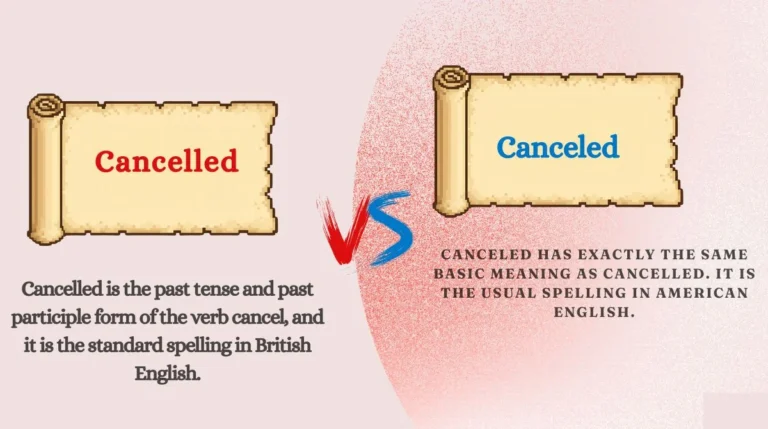
The main difference is regional English. Cancelled is the usual spelling in British English, while canceled is the usual spelling in American English.
Oxford and Cambridge both list this difference in their dictionaries.
You may see these words when talking about canceled flights, canceled meetings, canceled orders, canceled classes, or a canceled event.
That is why knowing the difference is useful in everyday English, school writing, emails, and professional communication.
Another reason learners become confused is that the difference continues with other forms of the verb. British English commonly uses cancelling, while American English uses canceling.
This guide will make the difference easy to understand. You will learn what each spelling means, where each form is normally used, how the grammar works, the common mistakes students make, and a simple trick for remembering which spelling belongs to British or American English.
What Does “Cancelled” Mean?
Cancelled is the past tense and past participle form of the verb cancel, and it is the standard spelling in British English.
The verb cancel means to decide that something planned or arranged will not happen. It can also mean stopping an agreement, order, service, or activity. Oxford gives examples involving meetings, shows, trips, travel plans, contracts, subscriptions, and orders.
For example:
- The school cancelled the sports day.
- Our flight was cancelled because of bad weather.
- She cancelled her appointment.
- They cancelled the meeting this morning.
- The company cancelled my order.
- We cancelled our trip because of the storm.
- The concert was cancelled at the last minute.
- He cancelled his subscription last week.
In all of these examples, something had already been planned, arranged, or expected, but it was stopped.
When Should You Use “Cancelled”?
Use cancelled when you are following British English spelling conventions. It is especially common in the United Kingdom and in many forms of English influenced by British usage.
For example:
The football match was cancelled because of heavy rain.
I cancelled my dentist appointment yesterday.
The manager has cancelled the meeting.
The meaning does not change when you use this spelling. It is simply the British-style spelling of the past form.
Grammar Rule for “Cancelled”
The base verb is:
cancel
Its common forms in British English are:
cancel → cancels → cancelled → cancelling
The important point is that British English commonly doubles the final l before adding -ed or -ing:
- cancel → cancelled
- cancel → cancelling
Cambridge also gives the British forms cancelled and cancelling.
A Common Learner Confusion
Some students think that cancelled has two meanings because it has two l letters. It does not. The extra l is simply part of the spelling convention.
Another common mistake is believing that canceled is always wrong because a teacher, website, or textbook uses cancelled. That is not true. The two forms are regional spelling variants.
So, if you are writing British English:
The match was cancelled.
This is correct.
What Does “Canceled” Mean?
Canceled has exactly the same basic meaning as cancelled. It is the usual spelling in American English.
It means that something planned, arranged, or expected has been stopped or will not happen.
For example:
- The flight was canceled because of bad weather.
- She canceled her appointment.
- The school canceled classes.
- They canceled the meeting.
- We canceled our hotel reservation.
- The company canceled the order.
- The concert was canceled yesterday.
- He canceled his subscription.
These sentences mean the same thing as their versions with cancelled.
When Should You Use “Canceled”?
Use canceled when you are following American English spelling.
It is very common in the United States, including American newspapers, websites, textbooks, business writing, and everyday communication. Oxford’s American English dictionary gives canceled as the past tense and past participle, and canceling as the -ing form.
For example:
The game was canceled due to rain.
I canceled my reservation yesterday.
The airline canceled the flight.
Grammar Rule for “Canceled”
The basic form is:
cancel
In American English, the usual forms are:
cancel → cancels → canceled → canceling
Notice the difference:
British English:
cancelled / cancelling
American English:
canceled / canceling
The meaning and pronunciation are essentially the same. The spelling convention is different.
A Common Learner Confusion
A learner may see canceled in an American website and assume that it is a spelling mistake because they learned cancelled in school.
It is not a mistake.
For example, these are both correct:
The flight was cancelled.
The flight was canceled.
The first follows British English. The second follows American English.
Difference Between Cancelled and Canceled
The biggest point to remember is this:
Cancelled and canceled have the same meaning. The difference is mainly spelling style based on the variety of English being used.
Both are forms of the verb cancel. The main difference is the number of l letters.
| Feature | Cancelled | Canceled |
|---|---|---|
| Meaning | Stop something planned or arranged | Stop something planned or arranged |
| Common spelling | British English | American English |
| Past tense | cancelled | canceled |
| Past participle | cancelled | canceled |
| -ing form | cancelling | canceling |
| Pronunciation | Same | Same |
| Meaning difference | None | None |
| Example | The event was cancelled. | The event was canceled. |
Usage Difference
The best spelling depends on your audience.
If you are writing for a British audience, cancelled is the safer choice.
If you are writing for an American audience, canceled is the usual choice.
For example:
British English:
The train has been cancelled.
American English:
The train has been canceled.
The meaning is identical.
Grammar Logic
Some learners wonder why British English uses -lled while American English uses -led.
This comes from different spelling conventions that developed between British and American English. American spelling often kept a simpler single l in words such as canceled, while British spelling commonly keeps the doubled consonant in cancelled.
This pattern also appears in the -ing form:
- British: cancelling
- American: canceling
Oxford specifically identifies the British forms as cancelled/cancelling and the American forms as canceled/canceling.
Sentence Structure
There is no difference in sentence structure between the two spellings.
You can use either form as a simple past verb:
Sarah cancelled the booking.
Sarah canceled the booking.
You can also use either form as a past participle in a passive sentence:
The meeting was cancelled.
The meeting was canceled.
The grammar stays the same. Only the spelling changes.
Meaning Comparison
There is no separate definition for each spelling.
Both can describe stopping:
- a meeting
- a flight
- a trip
- a class
- an appointment
- an order
- a subscription
- an event
- a reservation
- a contract
Oxford defines cancel as deciding that something arranged will not take place and also uses it for ending agreements, orders, and similar arrangements.
So do not think of cancelled and canceled as two different vocabulary words. They are simply two accepted spellings of the same word.
Grammar Rules You Must Remember
Rule 1: “Cancelled” is the usual British spelling
When writing British English, use cancelled for the past tense and past participle.
Example:
The teacher cancelled the class because she was ill.
The same style gives:
The teacher is cancelling the class.
Cambridge lists UK cancelling and UK cancelled as the British forms.
Rule 2: “Canceled” is the usual American spelling
When writing American English, use canceled.
Example:
The teacher canceled the class because she was sick.
For the continuous form, American English normally uses:
The teacher is canceling the class.
Oxford’s American English dictionary lists these forms directly.
Rule 3: Both spellings have the same meaning
Do not change the meaning depending on the spelling.
These two sentences mean the same thing:
The concert was cancelled.
The concert was canceled.
The difference is the variety of English, not the action.
Rule 4: Keep your spelling style consistent
If you choose British English, it is better to use British spelling consistently throughout your writing.
For example, a British-style document might use:
The meeting was cancelled.
A document written in American English would normally use:
The meeting was canceled.
Do not switch randomly between cancelled and canceled in the same piece of formal writing unless you are quoting another source or following a particular house style.
Consistency makes your writing look more polished.
Common Mistakes Students Make
The most common mistake is believing that one spelling is correct and the other is incorrect.
Mistake 1: Thinking “canceled” is wrong
Some learners write:
❌ The flight was canceled. This is wrong.
That is incorrect. Canceled is the standard American spelling.
Correct:
✅ The flight was canceled.
Also correct:
✅ The flight was cancelled.
The choice depends on the English variety.
Mistake 2: Thinking “cancelled” is a spelling error
You may see a student write:
❌ The meeting was cancelled. American English never uses this.
That is not correct. Cancelled is the standard British spelling, and it is also understood widely outside Britain.
Correct British form:
✅ The meeting was cancelled.
Mistake 3: Mixing “canceling” and “cancelling” without reason
Students sometimes learn the past tense but forget the -ing form.
Remember the pairs:
British English
- cancelled
- cancelling
American English
- canceled
- canceling
Oxford confirms both sets according to the relevant English variety.
Mistake 4: Using both forms randomly
A piece of writing might say:
The flight was canceled, but the meeting was cancelled.
There is nothing grammatically impossible about this sentence, but if both words are meant to follow the same spelling style, the switching looks inconsistent.
Choose one variety and stay with it.
Easy Correction Tip
Ask yourself one question:
“Am I writing British English or American English?”
If British:
cancelled
If American:
canceled
That one question solves most problems.
Easy Trick to Remember the Difference
Here is a simple memory trick:
British = Double L
Think:
British → cancelled → LL
American = One L
Think:
American → canceled → L
You can remember the two forms like this:
UK: cancel + led = cancelled
US: cancel + ed = canceled
The same trick works with the -ing form:
UK: cancelling
US: canceling
Try putting the words into two mental boxes:
British box: cancelled, cancelling
American box: canceled, canceling
Now imagine a real situation.
You are writing an email to a UK customer:
Your appointment has been cancelled.
You are writing an email for an American customer:
Your appointment has been canceled.
The customer understands both, but matching the spelling to the audience makes your writing look more natural.
One more useful point: the noun cancellation is normally spelled with one l before the ending in both major varieties. Oxford gives cancellation, while its American dictionary also lists cancellation.
So do not automatically write cancelllation with three l letters. That is not the normal spelling.
Daily Life Examples
The word cancel is very common in everyday English. Here are some simple conversation-style examples.
1. Talking about a flight
Ali: Are we still flying tonight?
Tom: No. The airline canceled the flight.
British spelling:
The airline cancelled the flight.
2. Talking about school
Student: Is there a math class today?
Friend: No. The teacher cancelled it.
In American English:
The teacher canceled it.
3. Talking about an appointment
Receptionist: Can I help you?
Customer: Yes. I’d like to cancel my appointment for Friday.
Here, cancel is the base form, so the British/American past-tense spelling difference does not appear.
4. Talking about a meeting
We had to cancel the meeting because the manager was away.
Past tense:
We cancelled the meeting.
American English:
We canceled the meeting.
5. Talking about a restaurant booking
I canceled our dinner reservation because my wife was sick.
British spelling:
I cancelled our dinner reservation because my wife was ill.
6. Talking about an event
The outdoor festival was cancelled because of heavy rain.
This is common in British English.
American version:
The outdoor festival was canceled because of heavy rain.
7. Talking about an order
I canceled my online order before it was shipped.
British version:
I cancelled my online order before it was shipped.
8. Talking about a subscription
She cancelled her gym membership last month.
American spelling:
She canceled her gym membership last month.
9. Talking about travel plans
We were going to visit Lahore, but we cancelled our trip.
In American English:
We were going to visit Chicago, but we canceled our trip.
10. Talking about bad weather
Sara: Is the match still happening?
John: No. It has been canceled because of the storm.
British English:
No. It has been cancelled because of the storm.
These examples show why this spelling comes up so often. We use cancel when something planned, booked, or arranged is stopped.
Practice Section
Choose the correct spelling for each sentence. Remember that the answer may depend on whether the sentence follows British or American English.
1. British English
The football match was ______ because of rain.
a) canceled
b) cancelled
2. American English
The company ______ my order yesterday.
a) cancelled
b) canceled
3. British English
They are ______ the event because of safety concerns.
a) canceling
b) cancelling
4. American English
She is ______ her subscription today.
a) canceling
b) cancelling
5. General English
Which statement is correct?
a) Only “cancelled” is correct.
b) Only “canceled” is correct.
c) Both are correct, depending on the English variety.
Answers
1. b) cancelled
British English normally uses cancelled.
2. b) canceled
American English normally uses canceled.
3. b) cancelling
British English normally uses cancelling.
4. a) canceling
American English normally uses canceling.
5. c) Both are correct.
The spelling changes by regional English style, but the meaning stays the same.
FAQs
What is the difference between cancelled and canceled?
There is no difference in basic meaning. Both are past forms of cancel and mean that something planned or arranged was stopped. Cancelled is the usual British spelling, while canceled is the usual American spelling.
Is cancelled British or American English?
Cancelled is the standard spelling in British English. It is also commonly seen in other varieties of English that follow British spelling conventions. American English normally uses canceled instead.
Is canceled correct English?
Yes. Canceled is completely correct English and is the standard American spelling. It is not a grammar mistake or a misspelling. For American writing, canceled is generally the expected form.
Which is correct: cancelled or canceled?
Both are correct. Choose cancelled for British English and canceled for American English. The meaning and grammar are the same, so the important thing is to use the spelling that matches your chosen style.
Is “canceling” or “cancelling” correct?
Both forms are correct. British English normally uses cancelling, while American English normally uses canceling.
Can I use cancelled in American English?
Yes, people will understand it, and it may appear in some American contexts. However, canceled is the standard American spelling, so it is usually the better choice when you are intentionally following US English style.
Conclusion
The confusion between cancelled and canceled is much easier once you know that both spellings are correct. They do not have different meanings, and neither one is a grammar mistake.
The key difference is regional spelling. Cancelled is the normal British English form, while canceled is the normal American English form. The same pattern appears in the -ing form: cancelling in British English and canceling in American English.
When you are writing, first decide which variety of English you want to follow. Then stay consistent. This is especially useful in school assignments, websites, business emails, and other formal writing.
So, the next time you see cancelled or canceled, do not worry about which one is “real.” They are both real English spellings. Just remember the simple rule: British English likes double L, while American English normally uses one L.
A little practice will make the difference feel natural. Once you learn the pattern, you will probably stop thinking twice before writing it.

Evan Rellmont is a writer who turns thoughtful ideas into meaningful words, creating stories and reflections that connect, inspire, and leave a lasting impression.