
“Affect” and “effect” are two of the most commonly confused words in English. They look and sound similar, and both are connected to the idea of change or influence.
That is why even strong English learners sometimes stop and wonder, “Which one should I use here?”
The good news is that the difference is easier than it first seems. In most everyday sentences, affect is used as a verb, while effect is used as a noun.
For example, “Lack of sleep can affect your mood” means lack of sleep can change your mood. “Lack of sleep can have an effect on your mood” uses effect as the thing or result caused by something.
Still, there are a few extra details that can make the topic confusing. Effect can also be a verb, especially in formal English, and affect can be a noun in psychology.
These special uses are real, but beginners do not need to memorize them first.
After learning the basic rule, looking at sentence patterns, and practicing common examples, you will be able to choose the right word much more quickly.
You will also understand why phrases such as “affect your health,” “effect on your health,” and “side effect” are written the way they are.
What Does “Affect” Mean?
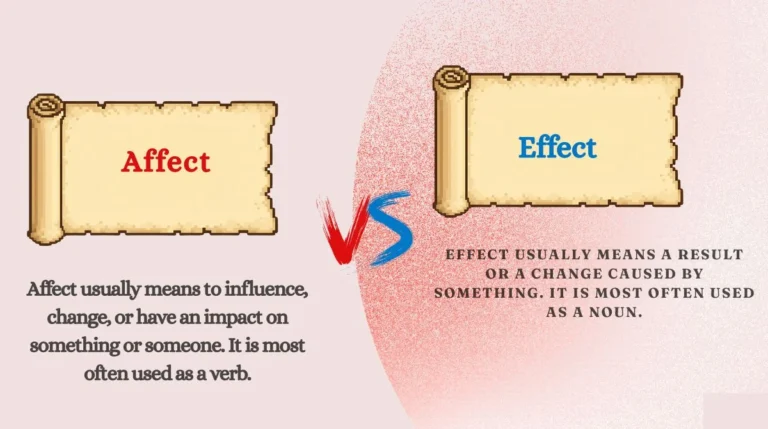
Affect usually means to influence, change, or have an impact on something or someone. It is most often used as a verb.
When one thing changes another thing in some way, we commonly use affect. The change may be positive, negative, small, or large. It does not have to be a complete change.
For example, if rain changes your travel plans, you can say, “The rain affected our plans.” The rain did not create the plans; it influenced what happened to them.
The basic grammar rule
Affect + object
The object is the person or thing that receives the influence.
- Noise can affect your concentration.
- Stress can affect your health.
- The weather affected our trip.
A common form is:
Subject + affect + object
You can also use different verb forms:
- Present: “Exercise affects my mood.”
- Past: “The news affected him deeply.”
- Present continuous: “The heat is affecting the plants.”
- Perfect: “The delay has affected our schedule.”
Examples with “affect”
- Too much sugar can affect your energy level.
- Loud music affects my ability to study.
- The storm affected thousands of families.
- Lack of sleep can affect your memory.
- His words affected me more than he expected.
- Cold weather often affects my skin.
- The price increase may affect small businesses.
- Your attitude can affect the way people treat you.
Notice that affect is doing the action in these sentences. It tells us that one thing is influencing another.
A common learner confusion
Many learners remember that both words relate to “change,” so they choose one based only on meaning. That can lead to mistakes.
Look at these two sentences:
- “The bad news affected Sarah.”
- “The bad news had an effect on Sarah.”
Both sentences express almost the same idea. The first uses affect as a verb. The second uses effect as a noun.
One helpful question is: Is the word showing an action or influence? If yes, affect is often the right choice.
There is also a less common noun use of affect in psychology. In that context, it refers to the way a person’s emotions appear outwardly, such as facial expression or tone. This meaning is more specialized, so everyday English learners should focus first on the common verb use.
What Does “Effect” Mean?
Effect usually means a result or a change caused by something. It is most often used as a noun.
Think of an effect as the result that happens after a cause.
For example:
“Exercise has a positive effect on your health.”
Here, exercise is the cause, and the improvement in health is the result. The word effect names that result.
The basic grammar rule
Effect + on + noun/pronoun
This is one of the most common patterns:
- an effect on health
- an effect on the environment
- an effect on students
- an effect on business
Another common pattern is:
have + an effect + on
Examples:
- “Stress can have an effect on your sleep.”
- “The change had a major effect on the company.”
You will also often see the effect of + noun:
- “What is the effect of exercise?”
- “The effect of the medicine was noticeable.”
Examples with “effect”
- The new law had a big effect on small businesses.
- Regular exercise has a positive effect on your heart.
- The medicine may cause side effects.
- The effect of the storm was serious.
- Her speech had a strong effect on the audience.
- Bright light can have an effect on your sleep.
- The teacher explained the effects of pollution.
- The decision had an unexpected effect on the team.
In each sentence, effect is the result, outcome, or impact.
“Effect” can also be a verb
This is one reason the topic becomes harder. In formal English, effect can be used as a verb meaning to bring about or make something happen.
For example:
- “The new policy effected major changes.”
- “The organization hopes to effect reform.”
This use is much less common in everyday conversation than the noun effect. Beginners should not use it simply because they remember “effect is a verb.” In normal daily English, affect is the verb you will usually need when you mean “influence.”
Difference Between Affect and Effect (Detailed)
The easiest way to understand the difference is to connect each word with its most common job.
| Word | Most common part of speech | Basic meaning | Common sentence pattern | Example |
|---|---|---|---|---|
| Affect | Verb | To influence or change | affect + object | Noise can affect your sleep. |
| Effect | Noun | A result or outcome | effect on + noun | Noise can have an effect on your sleep. |
| Effect | Verb, less common | To bring about | effect + change/reform | The plan effected major changes. |
| Affect | Noun, specialized | Emotional expression | Psychological use | The patient showed flat affect. |
Usage difference
The clearest everyday difference is:
Affect = influence something.
Effect = the result or impact.
Compare:
- “The heat affected the plants.”
- “The heat had an effect on the plants.”
The meaning is very similar, but the grammar is different.
Grammar logic
A simple way to think about the relationship is:
Cause → affects → result → effect
For example:
Poor sleep affects your concentration.
Poor sleep has an effect on your concentration.
The same cause can be described using either word, but the sentence structure changes.
Sentence structure difference
With affect, you usually need a direct object:
Something + affects + someone/something
Example:
- “The delay affected our plans.”
With effect, common structures include:
Something + has + an effect + on + something
Example:
- “The delay had an effect on our plans.”
You can also say:
the effect of + cause
Example:
- “The effect of the delay was frustrating.”
This difference in structure is often more useful than trying to memorize complicated definitions.
Meaning comparison
The two words are closely related, not opposite words.
If something affects you, it influences you.
The effect is the result of that influence.
For example:
“Social media can affect your sleep.”
Here, social media is influencing sleep.
“Social media can have a negative effect on your sleep.”
Here, the negative result is being named.
Grammar Rules You Must Remember
Rule 1: Use “affect” when you mean “influence”
When one thing changes, influences, or impacts another, affect is usually the correct verb.
Example:
“Lack of water can affect plant growth.”
A useful replacement test is to ask, “Can I replace this word with influence?” If the answer is yes, affect is probably right.
Rule 2: Use “effect” when you mean “result”
When you are talking about the result produced by a cause, use effect as a noun.
Example:
“The new schedule had a positive effect on productivity.”
You can often replace effect with “result” or “impact,” although the sentence may need a small grammar change.
Rule 3: Remember “effect on”
The phrase effect on is extremely common.
Example:
“Does caffeine have an effect on sleep?”
You can also say:
- “the effect of caffeine on sleep”
- “a harmful effect on the body”
- “a positive effect on learning”
A common mistake is to write “affect on” when the sentence needs the noun. The correct phrase is usually effect on.
Rule 4: Watch the phrase “side effect”
In medicine and health writing, side effect means an additional, often unwanted, result of a medicine or treatment.
Example:
“Headache is a common side effect of this medicine.”
You would not normally say “side affect.” The correct spelling is side effect because the word is a noun meaning a result.
Common Mistakes Students Make
The biggest reason students confuse these words is that their meanings are connected. Both words can be translated into similar words in other languages, and both can sound almost the same when spoken quickly.
Here are some common mistakes.
Mistake 1: Using “effect” as the normal verb
Wrong: “The weather will effect our plans.”
Correct: “The weather will affect our plans.”
Why? Because the meaning is “influence our plans.” That requires the common verb affect.
Mistake 2: Using “affect” after “an”
Wrong: “The change had an affect on sales.”
Correct: “The change had an effect on sales.”
Why? The structure “an ___ on” needs a noun. Effect is the noun here.
Mistake 3: Writing “affect on”
Wrong: “The drug had a strong affect on him.”
Correct: “The drug had a strong effect on him.”
A quick clue is the word had. The phrase “had an effect on” is a very common noun pattern.
Mistake 4: Choosing by sound
Affect and effect are pronounced differently in careful speech, but many learners still find them difficult to distinguish.
Do not rely only on pronunciation. Look at the grammar around the word.
Ask:
Is it an action? → usually affect
Is it a result? → usually effect
Mistake 5: Forgetting the word form
Sometimes the meaning is clear, but the form is wrong.
For example:
- “Stress affects my sleep.”
- “Stress has an effect on my sleep.”
The first sentence needs a verb. The second needs a noun.
This is why learning complete sentence patterns is better than memorizing the two spellings separately.
Easy Trick to Remember the Difference
Here is a simple memory trick that works well for beginners:
Affect = Action
Effect = End result
Both start with the letter A or E, so connect the letters with the job of the word:
A = Affect = Action
E = Effect = End result
It is not a perfect grammar rule because effect can sometimes be a verb and affect can sometimes be a noun. However, it is an excellent shortcut for everyday English.
You can also remember this mini-chain:
Affect → influence → Effect → result
Imagine a stone dropped into water.
The stone affects the water by disturbing it.
The waves are the effect.
Or think about studying:
“Lack of sleep affects my concentration.”
“Poor concentration is an effect of lack of sleep.”
When you build the habit of looking for the cause, action, and result, the choice becomes much faster.
Daily Life Examples
These examples show how the two words appear naturally in conversations.
1. At school
Student: “I could not sleep last night.”
Teacher: “That can affect your concentration today.”
Here, affect is a verb because sleep is influencing concentration.
2. Talking about weather
A: “Do you think the rain will affect the match?”
B: “Maybe. The field is already very wet.”
The rain may influence what happens at the match.
3. Talking about work
A: “Did the new schedule affect your routine?”
B: “Yes. I have to wake up earlier now.”
Again, affect means influence or change.
4. Talking about health
A: “Does coffee have an effect on your sleep?”
B: “Yes, especially when I drink it at night.”
Here, effect is a noun after “have an.”
5. Talking about technology
A: “Does too much screen time affect children?”
B: “It can affect their sleep and attention.”
The verb affect fits because screen time influences something.
6. Talking about medicine
A: “Did the doctor mention any side effects?”
B: “Yes. He said the medicine could cause a headache.”
Side effect is a fixed and very common noun phrase.
7. Talking about money
A: “Will the price increase affect your business?”
B: “Yes, it will probably have an effect on our sales.”
This short conversation shows both words in natural speech.
8. Talking about family
A: “The argument really affected him.”
B: “I noticed that. He has been quiet all day.”
The argument had an emotional influence on him.
9. Talking about the environment
A: “How does pollution affect our health?”
B: “It can have several harmful effects.”
Both words are connected: pollution affects health, and the harmful changes are its effects.
10. Talking about sleep
A: “What is the effect of using your phone before bed?”
B: “For me, it has a negative effect on my sleep.”
Here, effect names the result, so the noun is correct.
Practice Section
Choose affect or effect in each sentence.
1. The loud noise may ______ my ability to sleep.
A. affect
B. effect
2. The new rule had a big ______ on students.
A. affect
B. effect
3. How does stress ______ your health?
A. affect
B. effect
4. The medicine caused an unpleasant side ______.
A. affect
B. effect
5. Will this change ______ the final price?
A. affect
B. effect
Answers
1. Affect — “Affect” is the verb meaning influence.
2. Effect — “Have a big effect on” uses the noun.
3. Affect — Stress influences your health, so we need the verb.
4. Effect — “Side effect” is the standard expression.
5. Affect — The sentence means “Will this change influence the final price?”
FAQs
What is the difference between affect and effect?
Affect is usually a verb meaning to influence or change something. Effect is usually a noun meaning a result or outcome. For example, “Stress affects sleep” and “Stress has an effect on sleep.”
Can we use “affect” in questions?
Yes. Affect is commonly used in questions when you are asking whether something influences another thing. For example: “How does exercise affect your mood?” and “Will the weather affect our plans?”
Is “effect” formal or informal?
The noun effect is completely normal in both everyday and formal English. You use it in simple phrases such as “side effect,” “effect on,” and “have an effect.” The less common verb effect, meaning “bring about,” is more formal.
Is it “an affect” or “an effect”?
In most everyday situations, the correct phrase is an effect. For example, “The change had an effect on sales.” Affect can be a noun in specialized psychology, but that is a different meaning.
Is “side effect” correct?
Yes. Side effect is the correct expression. It means an additional result of a medicine, treatment, or action, especially an unwanted one. For example: “Drowsiness is a possible side effect.”
Can “effect” be a verb?
Yes, but this use is less common. As a verb, effect can mean “to bring about” or “to make happen,” as in “The new policy effected major changes.” In ordinary conversation, affect is usually the better choice when you mean “influence.”
Conclusion
The easiest way to remember the difference is to focus on the most common grammar jobs of the two words. Affect is usually a verb, and it means to influence or change something. Effect is usually a noun, and it means the result or impact of that change.
Compare these two sentences:
“Lack of sleep affects my concentration.”
“Lack of sleep has an effect on my concentration.”
The meaning is closely connected, but the grammar is different. One word performs the action; the other names the result.
Do not worry about the less common uses at first. Learn the everyday patterns, especially affect + object, have an effect on, the effect of, and side effect. Once these patterns become familiar, the spelling will feel much easier.
A few minutes of regular practice can make a big difference. Read examples, write your own sentences, and check the grammar around the word. Soon, choosing affect or effect will become a natural part of your English.

Evan Rellmont is a writer who turns thoughtful ideas into meaningful words, creating stories and reflections that connect, inspire, and leave a lasting impression.