
English has many words that sound the same but have completely different meanings. Your and you’re are two of the most common examples.
They sound exactly the same when we speak, so it is very easy to mix them up when writing.
This small spelling difference can change the meaning of a sentence. For example, “Your very kind” is incorrect, while “You’re very kind” is correct.
On the other hand, “You’re phone is ringing” is wrong, but “Your phone is ringing” is right.
The good news is that the difference is actually very simple once you understand the grammar behind each word.
Your is a possessive word. It tells us that something belongs to you or is connected with you. We use it before a noun, such as your book, your car, your name, or your idea.
You’re is a contraction of you are. We use it when we mean you are in a sentence, such as you’re happy, you’re late, you’re my friend, or you’re doing well.
After learning the simple rules in this guide, you should be able to choose the correct word quickly while writing emails, messages, school assignments, social media posts, and everyday English.
What Does “Your” Mean?
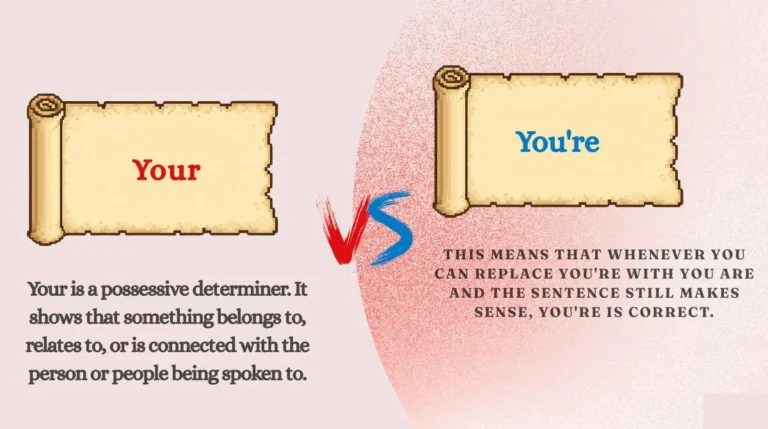
Your is a possessive determiner. It shows that something belongs to, relates to, or is connected with the person or people being spoken to.
In simple words, your means “belonging to you.”
For example:
- Your bag = the bag belongs to you.
- Your sister = your sister, not somebody else’s sister.
- Your idea = an idea that came from you.
- Your house = the house connected with you or owned by you.
The important thing to remember is that your normally comes before a noun.
Basic grammar rule for “your”
The usual structure is:
your + noun
Here, the noun can be a person, place, object, idea, or thing.
Examples:
- your book
- your teacher
- your phone
- your country
- your family
- your answer
- your birthday
- your opinion
You can also use adjectives between your and the noun.
For example:
- your new car
- your beautiful dress
- your old house
- your best friend
The word your does not mean you are. It simply shows possession or connection.
Examples of “your”
- Where is your phone?
The phone belongs to you. - I like your new shoes.
The shoes are yours. - Please bring your notebook to class.
The notebook belongs to you. - What is your name?
The name is connected with you. - Your answer is correct.
The answer you gave is correct. - Have you finished your homework?
The homework is assigned to you. - I met your brother yesterday.
The brother is related to you. - Your idea could solve the problem.
The idea belongs to you or came from you.
A common confusion with “your”
Many learners confuse your with you’re because they sound exactly the same in normal speech.
For example, when someone says:
“You’re very helpful.”
The listener hears the same sound as “your.”
However, when you write the sentence, you need to think about the meaning.
Ask yourself:
Am I showing that something belongs to someone?
If yes, you probably need your.
For example:
Your jacket is wet.
The jacket belongs to you, so your is correct.
A useful test is to look for a noun after the word. If your is followed by a noun, that is often a strong sign that you have chosen correctly.
What Does “You’re” Mean?
You’re is a contraction. It is the short form of:
you are
The apostrophe replaces the missing letters in are.
So:
you are → you’re
This means that whenever you can replace you’re with you are and the sentence still makes sense, you’re is correct.
For example:
You’re late.
Can we say:
You are late.
Yes. Therefore, you’re is correct.
Basic grammar rule for “you’re”
The word you’re can be used anywhere the full phrase you are would make sense.
It is often followed by:
- an adjective
- a noun
- a present participle (-ing form)
- a phrase describing a condition or action
Examples:
- You’re happy.
- You’re tired.
- You’re a good student.
- You’re very kind.
- You’re working hard.
- You’re going home.
- You’re ready.
- You’re responsible for this task.
Examples of “you’re”
- You’re very good at English.
This means You are very good at English. - You’re late for school.
This means You are late for school. - I think you’re right.
This means I think you are right. - You’re my best friend.
This means You are my best friend. - You’re doing a great job.
This means You are doing a great job. - Are you sure you’re ready?
This means Are you sure you are ready? - You’re going to love this movie.
This means You are going to love this movie. - I know you’re busy today.
This means I know you are busy today.
A common confusion with “you’re”
The apostrophe can make learners think that you’re is a possessive word. It is not.
Some students see the word and think:
you’re = something belongs to you
That is incorrect.
The apostrophe in you’re tells us that letters have been removed. It is not showing possession.
Compare these two sentences:
Your car is outside.
Here, your shows possession.
You’re outside.
Here, you’re means you are.
The difference becomes much easier when you focus on the full meaning rather than the spelling.
Difference Between Your and You’re
The easiest way to understand the difference is to remember one simple idea:
Your = belongs to you
You’re = you are
Although the two words sound alike, they perform different grammar jobs.
| Word | Meaning | Grammar Role | Example |
|---|---|---|---|
| Your | Belonging to you | Possessive determiner | Your bag is heavy. |
| You’re | You are | Contraction | You’re very kind. |
Usage difference
Use your when you are talking about something that belongs to, comes from, or is related to someone.
For example:
Your mother is calling.
The mother is related to you.
Use you’re when the meaning is you are.
For example:
You’re calling your mother.
Here, you’re means you are.
Notice that both words can appear in the same sentence:
You’re calling your mother.
The first word means you are, while your shows a relationship.
Grammar logic
This is where the real difference becomes clear.
Your is used with a noun.
For example:
your car
your teacher
your house
The word tells us whose car, teacher, or house we are talking about.
You’re, however, contains a verb.
It is short for you are.
For example:
You’re happy.
= You are happy.
You’re tired.
= You are tired.
You’re learning English.
= You are learning English.
Because you’re already contains the verb are, it does not work as a possessive word.
Sentence structure difference
A very useful pattern is:
Your + noun
Examples:
- Your book
- Your car
- Your question
- Your children
Another common pattern is:
You’re + description/action
Examples:
- You’re happy.
- You’re late.
- You’re ready.
- You’re studying.
- You’re very helpful.
This gives you a quick way to choose the right word.
Meaning comparison
Look at these pairs:
Your smart. ❌
You’re smart. ✅
Why? The sentence means You are smart, so you’re is needed.
Now look at:
You’re phone is new. ❌
Your phone is new. ✅
Why? The sentence talks about a phone that belongs to you, so your is correct.
Another pair:
Your doing well. ❌
You’re doing well. ✅
The meaning is You are doing well.
And:
You’re sister is here. ❌
Your sister is here. ✅
The sister is related to you, so your is needed.
Grammar Rules You Must Remember
Rule 1: Use “your” before a noun
When you are showing possession or connection, use your before a noun.
Example:
Please check your email.
Here, email is the noun, and your tells us that it belongs to or is connected with you.
More examples:
- your car
- your teacher
- your room
- your decision
A simple pattern to remember is:
Your + thing/person
Rule 2: Use “you’re” when you mean “you are”
This is the fastest grammar test.
Replace you’re with you are.
If the sentence still makes sense, you’re is correct.
Example:
You’re very patient.
Replace it:
You are very patient.
The sentence works, so you’re is correct.
Another example:
I think you’re ready.
Becomes:
I think you are ready.
Again, it works.
Rule 3: Do not use “your” when the meaning is “you are”
This is one of the most common mistakes in informal writing.
Incorrect:
Your doing a good job. ❌
Correct:
You’re doing a good job. ✅
Why? The meaning is:
You are doing a good job.
The word your cannot replace you are.
Rule 4: Do not use “you’re” to show possession
The opposite mistake is also very common.
Incorrect:
You’re car is beautiful. ❌
Correct:
Your car is beautiful. ✅
Why?
The car belongs to you. We are not saying you are car.
The correct form is:
Your + noun
So:
Your car ✅
not:
You’re car ❌
Common Mistakes Students Make
These mistakes are common because your and you’re have the same pronunciation. When people speak, there is no clear sound difference to guide you.
Writing is different. You have to understand the grammar.
Mistake 1: “Your welcome”
Many learners write:
Your welcome. ❌
The correct sentence is:
You’re welcome. ✅
Why?
The phrase means:
You are welcome.
So you’re is required.
Mistake 2: “Your right”
Incorrect:
Your right. ❌
Correct:
You’re right. ✅
The sentence means:
You are right.
This is a very common mistake in text messages and online comments.
Mistake 3: “You’re name”
Incorrect:
What is you’re name? ❌
Correct:
What is your name? ✅
Here, name is connected with you. We are not saying you are name.
So we need:
your name
Mistake 4: “You’re mother”
Incorrect:
You’re mother called me. ❌
Correct:
Your mother called me. ✅
The word mother is a noun connected with you.
Therefore:
your mother
is correct.
Mistake 5: “Your going”
Incorrect:
Your going to miss the bus. ❌
Correct:
You’re going to miss the bus. ✅
The sentence means:
You are going to miss the bus.
The easy correction is to expand you’re.
An easy correction tip
Whenever you are unsure, stop for one second and ask:
Can I replace this word with “you are”?
If yes → use you’re.
If no, and the word is showing possession before a noun → use your.
This tiny check can prevent many mistakes.
Easy Trick to Remember the Difference
Here is the simplest memory trick:
“You’re” has an apostrophe because letters are missing
Think:
You’re = You are
The apostrophe is a little sign that tells you something has been shortened.
For example:
you are → you’re
Other English contractions work in the same way:
- I am → I’m
- he is → he’s
- she is → she’s
- we are → we’re
- they are → they’re
So when you see you’re, think:
“This is the short form of you are.”
“Your” has no apostrophe because it is possessive
Think about ownership:
your + thing
For example:
your book
your phone
your house
A useful real-life memory trick is to imagine pointing at something and saying:
“That belongs to you.”
Then you need your.
For example:
your backpack
But when you are describing the person directly, think:
“You are…”
For example:
You’re carrying a backpack.
The two-second test
When writing quickly, use this test:
Step 1: Replace the word with you are.
Step 2: Read the sentence again.
Step 3: If it sounds correct, write you’re.
Step 4: If it does not work and you are talking about something connected with the person, write your.
This method is much safer than trying to remember the spelling alone.
Daily Life Examples
You will often see both forms in everyday conversation. Here are some natural examples.
Example 1
A: Is this your jacket?
B: Yes, that’s my jacket.
Here, your shows that the jacket belongs to the person.
Example 2
A: You’re looking tired.
B: I didn’t sleep well last night.
You’re means you are.
Example 3
A: Where is your brother?
B: He’s at work.
The brother is related to the person, so your is correct.
Example 4
A: You’re always late!
B: Sorry. There was a lot of traffic.
You’re means you are.
Example 5
A: Have you brought your passport?
B: Yes, it’s in my bag.
The passport belongs to the person, so we use your.
Example 6
A: I think you’re making the right choice.
B: Thanks. I hope so.
Again, you’re = you are.
Example 7
A: What is your favorite food?
B: I love pizza.
The question asks about something connected with the person.
Example 8
A: You’re really good at cooking.
B: Thank you!
We can replace you’re with you are.
Example 9
A: Don’t forget your keys.
B: Thanks for reminding me.
The keys belong to the person.
Example 10
A: You’re going to enjoy your vacation.
B: I can’t wait!
Notice that both words can appear naturally in one sentence.
You’re = you are
your = belonging to you
That is a perfect example of how the two words have different jobs.
Practice Section
Choose your or you’re to complete each sentence.
1. ______ very kind to everyone.
A. Your
B. You’re
2. Where did you put ______ wallet?
A. your
B. you’re
3. I think ______ making a mistake.
A. your
B. you’re
4. Is this ______ seat?
A. your
B. you’re
5. ______ going to enjoy this book.
A. Your
B. You’re
Answers
1. You’re — The meaning is You are very kind.
2. Your — The wallet belongs to you.
3. You’re — The meaning is You are making a mistake.
4. Your — The seat is connected with or assigned to you.
5. You’re — The meaning is You are going to enjoy this book.
A good way to improve is to explain the answer to yourself. Do not simply memorize which option is correct. Ask why it is correct.
FAQs
What is the difference between your and you’re?
Your shows possession or a connection with someone. It usually comes before a noun, such as your phone or your name.
You’re is the contraction of you are. For example, you’re happy means you are happy.
Is “you’re” the same as “you are”?
Yes. You’re is simply the shorter form of you are.
For example, You’re very helpful and You are very helpful have the same meaning. The contraction is especially common in everyday speech and informal writing.
Can “your” be used in a question?
Yes. Your can appear in many questions when you are asking about something belonging to or connected with the person.
For example:
What is your name?
Where is your car?
What is your favorite color?
Is “you’re” formal or informal?
You’re is normal and very common in everyday English. It is not incorrect or bad grammar.
In very formal writing, some writers may prefer the full form you are, but contractions are generally accepted in modern English writing.
Why do your and you’re sound the same?
They are homophones, which means they have the same pronunciation but different meanings and spellings.
Because they sound alike, you cannot always choose the correct form by listening. You need to understand the sentence and its grammar.
Is “your welcome” correct?
No. The standard expression is:
You’re welcome.
It means:
You are welcome.
The word your would be incorrect because the sentence is not showing possession.
Conclusion
The difference between your and you’re is small, but it is important in written English.
Remember the two core meanings:
Your = belonging to you
You’re = you are
Use your before a noun when you are showing possession or a connection. For example, your book, your teacher, and your idea.
Use you’re when you can replace it with you are. For example, you’re tired means you are tired, and you’re doing well means you are doing well.
Because both words sound the same, mistakes are very common. The best habit is to pause and use the “you are” test whenever you feel unsure.
With a little practice, this confusion becomes easy to avoid. Pay attention to these two words when reading, texting, or writing, and soon choosing the correct one will feel natural.

Evan Rellmont is a writer who turns thoughtful ideas into meaningful words, creating stories and reflections that connect, inspire, and leave a lasting impression.