
Have you ever written “learnt” and wondered whether it should be “learned” instead? Or perhaps you have seen both forms in books, websites, school lessons, and conversations and thought, “Which one is actually correct?”
You are not alone. This is a very common problem for English learners because both learnt and learned are forms of the verb learn, and both can be correct.
The main difference is often connected to the variety of English being used.
In British English, learnt is very common, especially in everyday writing and speech. Learned is also correct in British English, but it is often less common for the past tense of learn. In American English, learned is the usual form.
Oxford’s learner dictionaries list both learnt and learned as past forms, while their dictionary resources also recognize differences between British and American usage.
That means you do not need to worry when you see either spelling.
By the end of this guide, you will understand exactly when to use learnt and learned, why both exist, how they differ in British and American English, and how to avoid common mistakes.
You will also see simple examples that you can use in real conversations, schoolwork, emails, and everyday writing.
What Does “Learnt” Mean?
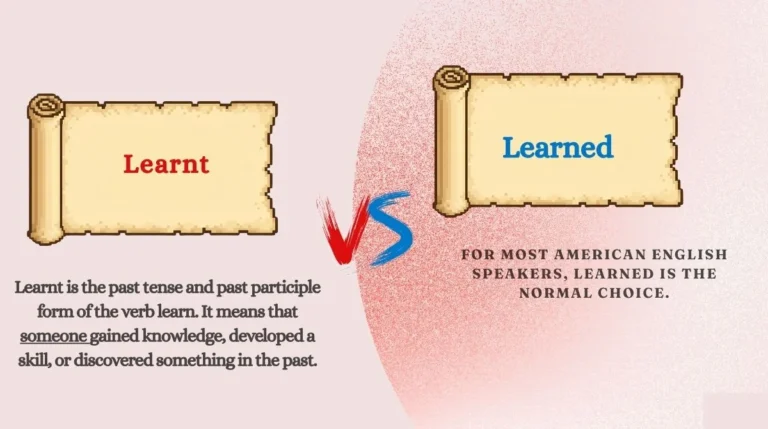
Learnt is the past tense and past participle form of the verb learn. It means that someone gained knowledge, developed a skill, or discovered something in the past.
For example:
- I learnt how to cook from my mother.
- She learnt English at school.
- We learnt an important lesson yesterday.
The meaning is exactly the same as learned when learnt is being used as the past form of learn. The difference is mainly about regional preference.
When should you use “learnt”?
Learnt is especially common in British English and other varieties influenced by British English. You may see it often in the United Kingdom and in some countries where British English is taught or traditionally used.
For instance:
I learnt a lot during my first year at university.
This sentence is completely natural in British English.
You can use learnt when talking about something you studied, discovered, experienced, or understood in the past.
Grammar rule for “learnt”
The basic forms are:
learn → learnt → learnt
The first form is the present form. The second form is the past simple. The third form is the past participle.
Examples:
- I learn quickly.
- I learnt something new yesterday.
- I have learnt a lot this year.
You can also use it after helping verbs in perfect constructions:
- She has learnt a valuable lesson.
- They had learnt the rules before the game started.
Examples with “learnt”
- I learnt how to ride a bicycle when I was six.
- She learnt the answer from her teacher.
- We learnt a lot from our mistakes.
- He learnt French while living in Paris.
- My brother learnt to swim last summer.
- They learnt an important lesson from the experience.
- I have learnt many useful words this week.
- She had learnt the song before the concert.
Common learner confusion
Many students believe that learnt is wrong because their school, teacher, or American English textbook uses learned.
That is not the right conclusion.
Learnt is a correct English word. It is simply preferred more strongly in some varieties of English.
Imagine two people saying:
- “I learnt the news yesterday.”
- “I learned the news yesterday.”
Both can be grammatically correct.
The important thing is to understand the English variety you are using and stay reasonably consistent, especially in formal writing.
What Does “Learned” Mean?
Learned can also be the past tense and past participle of learn.
For most American English speakers, learned is the normal choice.
Examples:
- I learned how to drive last year.
- She learned a new word today.
- We learned a lot from the training.
The meaning is the same as learnt when it is used as the verb form.
When should you use “learned”?
Use learned when you are writing or speaking in American English. It is also widely understood and accepted in British English.
For example:
I learned how to use this software at work.
This sounds completely natural in American English.
Oxford lists learned as one of the past forms of learn, alongside learnt.
Grammar rule for “learned”
The verb pattern is:
learn → learned → learned
Examples:
- I learn something new every day.
- I learned something new yesterday.
- I have learned something new this week.
Notice that learned can appear in both the simple past and the past participle.
Examples with “learned”
- I learned how to make bread from my grandmother.
- She learned English by watching movies.
- We learned the truth yesterday.
- He learned a valuable lesson from his mistake.
- They learned how to use the new computer system.
- I have learned a lot since starting this job.
- She had learned the rules before the test.
- We learned something interesting in class.
Another meaning of “learned”
There is one important detail that many learners miss.
Learned can also be an adjective, meaning highly educated or very knowledgeable.
For example:
She is a learned professor.
Here, learned does not mean simply “studied something.” It describes a person who has a lot of knowledge.
Oxford and Cambridge both distinguish this adjective use and give a pronunciation with two syllables, roughly like “LER-nid.”
Compare:
- I learned English at school.
Here, learned is a verb. - He is a learned professor.
Here, learned is an adjective.
There is also an adjective use meaning something developed through training or experience, as in learned behavior. Cambridge notes this pronunciation and meaning separately from the adjective referring to a highly educated person.
This special adjective use is one reason the word learned has more than one pronunciation depending on meaning.
Difference Between Learnt and Learned
The biggest point to remember is simple:
Learnt and learned are both correct past forms of “learn.”
The main difference is usually regional preference, not grammar.
Comparison table
| Point | Learnt | Learned |
|---|---|---|
| Base verb | learn | learn |
| Past tense | learnt | learned |
| Past participle | learnt | learned |
| Common in British English | Very common | Also correct |
| Common in American English | Less common | Very common |
| Meaning as a verb | Gained knowledge or skill | Gained knowledge or skill |
| Can be an adjective? | Normally no | Yes |
| Formal or informal? | Both can be used | Both can be used |
British English vs American English
This is the distinction that causes the most confusion.
In British English, you are likely to hear or read:
I learnt something new today.
You may also see:
I learned something new today.
Both are possible, but learnt is a traditional and very common British form.
In American English, the preferred form is usually:
I learned something new today.
That makes learned the safer choice when you are specifically following American English conventions.
Does one mean something different?
When they are past forms of learn, no.
These two sentences have essentially the same meaning:
I learnt how to use the camera.
I learned how to use the camera.
The difference is primarily the variety of English.
Sentence structure
Both forms fit the same grammar patterns.
Simple past:
Subject + learnt/learned + object
- I learnt the rule.
- I learned the rule.
Perfect tense:
Subject + have/has/had + learnt/learned
- She has learnt a lot.
- She has learned a lot.
Verb pattern:
learn to + verb
- He learnt to drive.
- He learned to drive.
So you do not need to change your sentence structure just because you choose one form over the other.
Which one should you choose?
If your school, workplace, or website follows British English, learnt may sound more natural.
If you use American English, learned is normally the best choice.
For international English, learned is often a practical choice because it is widely recognized, especially in American English. However, using learnt is not a mistake.
Grammar Rules You Must Remember
Rule #1: Both forms can be past forms of “learn”
Do not think that one is correct and the other is wrong.
Both are valid:
She learnt the answer.
She learned the answer.
The preferred form depends largely on regional usage.
Rule #2: “Learned” is especially common in American English
When you are following American English style, use learned for the past tense and past participle.
Example:
I learned a lot during my internship.
This is the normal American choice.
Rule #3: “Learnt” is especially common in British English
In British English, learnt is a very natural choice.
Example:
I learnt a lot during my internship.
That sentence sounds perfectly normal in British usage.
British and American English are both recognized varieties, and dictionary resources explicitly provide usage information to help learners understand these regional differences.
Rule #4: “Learned” can also be an adjective
This is where the two words are not completely interchangeable.
You can say:
He is a learned scholar.
But you would not normally replace this adjective with learnt.
Also notice the pronunciation:
- learned as a verb: one syllable, like “lernd”
- learned as the educated/knowledgeable adjective: two syllables, roughly “LER-nid”
That small pronunciation difference can help you identify the meaning.
Common Mistakes Students Make
Mistake 1: Thinking “learnt” is incorrect
A student may write:
❌ I learnt English last year, so my sentence is wrong.
That is not true.
Correct:
✅ I learnt English last year.
Also correct:
✅ I learned English last year.
The first sounds especially natural in British English, while the second is especially common in American English.
Mistake 2: Using both forms without understanding the variety
A learner may write:
I learnt the rules, and my friend learned the rules.
There is nothing grammatically wrong with the two sentences individually. But if you are writing a formal essay, it can be better to follow one regional style consistently.
For example, in British English:
I learnt the rules, and my friend learnt them too.
In American English:
I learned the rules, and my friend learned them too.
Mistake 3: Using “learned” as an adjective but saying it incorrectly
Consider:
He is a learned professor.
Some learners pronounce this exactly like the verb learned. In this adjective meaning, it is often pronounced with an extra syllable, approximately LER-nid.
So:
a learned professor
sounds different from:
I learned something.
Mistake 4: Forgetting the third form
Students sometimes know:
learn → learned
but then write:
❌ I have learn the lesson.
The correct structure is:
✅ I have learned the lesson.
Or, in British English:
✅ I have learnt the lesson.
After have, has, or had, you need the past participle.
Mistake #5: Changing the form after “did”
After did, use the base form learn, not learnt or learned.
Wrong:
❌ Did you learned anything?
Correct:
✅ Did you learn anything?
Wrong:
❌ Did she learnt the rules?
Correct:
✅ Did she learn the rules?
This rule has nothing to do with British or American preference. It is a general grammar rule.
Easy Trick to Remember the Difference
Here is the easiest way to remember it:
Think “UK = learnt, US = learned.”
This is not an absolute rule, but it is a useful memory trick for learners.
Imagine two classrooms.
In a British English classroom, the teacher says:
“What did you learnt?”
Actually, be careful! Because after did, the correct form is still learn, not learnt.
The better example is:
“I learnt this when I was young.”
Now imagine an American English classroom:
“I learned this when I was young.”
Both teachers are using correct English.
Another useful trick is to remember the basic pattern:
learn → learnt/learned → learnt/learned
Then ask yourself:
“Which English style am I using?”
If it is British English, learnt is a natural choice.
If it is American English, learned is the usual choice.
And remember one special point:
Learned = sometimes an adjective.
For example:
a learned professor
That extra meaning belongs to learned, not normally learnt.
Daily Life Examples
The following examples show how these forms can appear in natural conversations.
Example 1: Talking about school
A: What did you study today?
B: We learnt about the solar system.
In American English, B could say:
We learned about the solar system.
Example 2: Talking about cooking
A: Who taught you to make this?
B: I learnt it from my grandmother.
American English:
I learned it from my grandmother.
Example 3: Talking about a mistake
A: You forgot your keys again!
B: I know. I’ve learnt my lesson now.
American English speakers would usually say:
I’ve learned my lesson now.
Example 4: Talking about work
A: How was your first week?
B: Great. I learnt a lot about the new system.
Or:
I learned a lot about the new system.
Example 5: Learning a language
A: How did you become so good at Spanish?
B: I learnt it by talking to native speakers.
American English:
I learned it by talking to native speakers.
Example 6: Learning from experience
We learnt something important from that mistake.
The American version is:
We learned something important from that mistake.
Example 7: Talking about driving
She learnt to drive when she was seventeen.
Or:
She learned to drive when she was seventeen.
The meaning does not change.
Example 8: Talking about technology
I learnt how to use the software at work.
American English:
I learned how to use the software at work.
Example 9: Talking about life
He has learnt to be more patient.
American English:
He has learned to be more patient.
Example 10: Talking about an educated person
The university invited a learned professor to speak.
Here, learned means highly knowledgeable. It is an adjective, not simply the past tense of learn.
Practice Section
Choose the correct option in each sentence. Remember that in some questions, both choices may be grammatically possible because of British and American usage.
1. I have ______ a lot from this experience.
A. learnt
B. learned
2. Did you ______ anything useful at school today?
A. learnt
B. learn
3. She ______ how to swim when she was eight.
A. learnt
B. learned
4. He is a very ______ professor.
A. learnt
B. learned
5. We had ______ an important lesson before the final exam.
A. learnt
B. learned
Answers
1. A or B — Both are correct.
Learnt is especially common in British English, while learned is especially common in American English.
2. B — learn.
After did, use the base form of the verb.
3. A or B — Both are correct.
The choice depends mainly on regional preference.
4. B — learned.
Here, learned is an adjective meaning highly educated or knowledgeable.
5. A or B — Both are correct.
Both forms can be used as the past participle of learn.
FAQs
What is the difference between learnt and learned?
When they are forms of the verb learn, they have the same basic meaning. The main difference is regional preference. Learnt is especially common in British English, while learned is especially common in American English.
Is learnt grammatically correct?
Yes. Learnt is a correct English word and can be used as the past tense and past participle of learn. It is especially common in British English. You may see it in everyday speech, books, school materials, and formal writing.
Is learned more correct than learnt?
No. Neither form is automatically “more correct.” Learned is the usual past form in American English, while learnt is very common in British English. Choose according to the English variety you are following.
Can I use learnt in American English?
You can, and American readers will normally understand it. However, learned is much more typical in American English. If you are writing specifically for an American audience, learned will usually sound more natural.
Is learned formal or informal?
As the past form of learn, learned can be used in both casual and formal English. As an adjective meaning highly educated or knowledgeable, learned is more formal and is common in phrases such as a learned professor or a learned scholar.
Can learnt and learned be used in the same sentence?
They can, but normally there is no need to switch between them. Since both are forms of the same verb, it is usually clearer to choose the variety that matches your overall writing style. For example, use learnt consistently in British-style writing and learned in American-style writing.
Conclusion
So, learnt or learned — which one should you use?
The good news is that both are correct when they are used as the past tense or past participle of learn. The main difference is regional. Learnt is especially common in British English, while learned is the usual choice in American English.
For example:
I learnt a lot from that experience.
and
I learned a lot from that experience.
Both sentences are correct and mean the same thing.
There is one extra detail worth remembering: learned can also be an adjective meaning highly educated or knowledgeable, as in a learned professor. In that meaning, it is pronounced differently.
The best way to become comfortable with these forms is to read and listen to real English from the variety you use most. Once you understand the British and American difference, this word choice becomes much easier. Do not be afraid of learnt or learned—both belong to standard English.

Evan Rellmont is a writer who turns thoughtful ideas into meaningful words, creating stories and reflections that connect, inspire, and leave a lasting impression.