
Have you ever written analyze and wondered whether you should write analyse instead? You are not alone.
Many English learners notice both spellings in books, websites, school papers, and online dictionaries, so it is easy to think that one of them must be wrong.
The good news is much simpler than you may expect: analyze and analyse are both correct spellings.
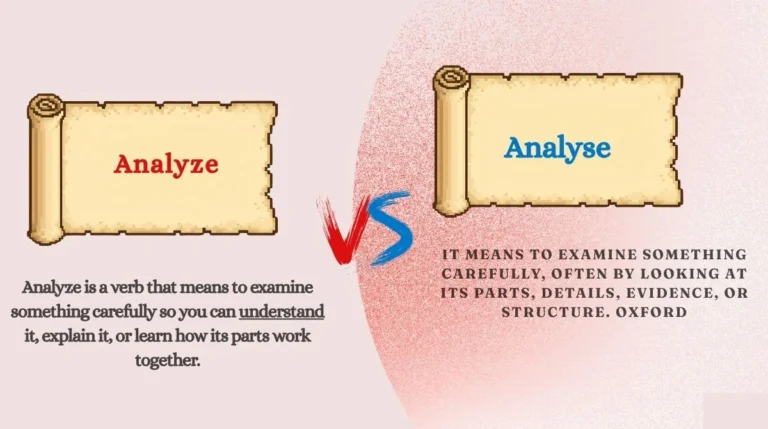
The main difference is the variety of English being used. Analyze is the standard spelling in American English, while analyse is the standard spelling in British English.
Cambridge and Oxford both identify this difference clearly.
Both words have the same basic meaning. They mean to study, examine, or break something into parts so that you can understand it better. You can analyze data, analyse a problem, analyze a poem, or analyse someone’s behavior.
The spelling changes, but the meaning does not.
This small spelling difference matters because English is used in many countries.
A student in the United States will normally see analyze, while a student in the United Kingdom will normally see analyse.
By the end, you will know when to use each spelling, how their verb forms work, which spelling fits different types of English, and how to avoid common mistakes.
What Does “Analyze” Mean?
Analyze is a verb that means to examine something carefully so you can understand it, explain it, or learn how its parts work together.
For example, when a teacher asks you to analyze a poem, the teacher does not simply want you to read the poem. You may need to look at its words, ideas, structure, images, and message.
Cambridge lists analyze as the US spelling of British analyse and defines it as studying or examining something in detail.
When do we use “analyze”?
You normally use analyze when writing in American English.
It is common in schoolwork, business writing, science, research, reports, news writing, and everyday conversation in the United States.
For example:
- Scientists analyze test results.
- Students analyze novels and poems.
- A company may analyze customer feedback.
- Doctors may analyze medical information.
- Managers analyze sales data.
- Police may analyze evidence.
- You can analyze a difficult situation before making a decision.
Grammar rule for “analyze”
Analyze is a regular verb.
Its main forms are:
| Verb form | American English |
|---|---|
| Base form | analyze |
| He/She/It | analyzes |
| Past simple | analyzed |
| Past participle | analyzed |
| -ing form | analyzing |
Notice an important point: the -e in analyze remains when we form the past tense and -ing form.
For example:
- She analyzes the report.
- She analyzed the report yesterday.
- She is analyzing the report now.
Example sentences with “analyze”
- We need to analyze the results before making a decision.
- The students will analyze the poem in class.
- Scientists analyze the water for signs of pollution.
- She likes to analyze every detail before starting a project.
- The manager analyzed last month’s sales figures.
- Can you analyze this sentence for me?
- The company is analyzing customer reviews.
- He carefully analyzed what went wrong.
The spelling analyze is especially useful when your audience follows American English.
Common learner confusion
Some learners think analyze and analyse have different meanings. They do not.
Another common mistake is believing that analyze is informal and analyse is formal. That is also incorrect. The difference is mainly regional spelling, not a difference in formality. Cambridge directly identifies analyze as the US spelling of analyse.
What Does “Analyse” Mean?
Analyse has exactly the same basic meaning as analyze.
It means to examine something carefully, often by looking at its parts, details, evidence, or structure. Oxford explains analyse as examining the nature or structure of something, especially by separating it into parts to understand or explain it.
When do we use “analyse”?
Use analyse when writing in British English.
This spelling is standard in the United Kingdom and is also commonly used in other English varieties that follow British spelling conventions.
You may see it in British schoolbooks, newspapers, university writing, research papers, websites, and official documents.
For example:
- Researchers analyse the data.
- Students analyse a short story.
- We need to analyse the problem.
- The team will analyse the evidence.
- She likes to analyse complex ideas.
Grammar rule for “analyse”
Just like analyze, analyse is a regular verb.
Its common forms are:
| Verb form | British English |
|---|---|
| Base form | analyse |
| He/She/It | analyses |
| Past simple | analysed |
| Past participle | analysed |
| -ing form | analysing |
Look closely at the forms:
- analyse
- analyses
- analysed
- analysing
The spelling changes according to the grammar, but the pronunciation is still based on the same verb. Oxford gives these verb forms and notes that the North American spelling is analyze.
Example sentences with “analyse”
- We need to analyse the results carefully.
- The students will analyse the poem tomorrow.
- The scientist analysed the samples in the laboratory.
- She is analysing the information now.
- The teacher asked us to analyse the argument.
- Researchers analyse data before drawing conclusions.
- The company analysed customer feedback last year.
- He tried to analyse why the plan failed.
Common learner confusion
A very common question is:
“Which one is the correct spelling: analyze or analyse?”
The answer is: both are correct.
The important thing is to know which form matches the type of English you are using.
British English usually prefers analyse. American English uses analyze. Oxford and Cambridge both make this distinction.
Difference Between Analyze and Analyse
The biggest difference is spelling, not meaning.
Both words are pronounced the same way, and both work as verbs. The main choice depends on English variety.
| Point | Analyze | Analyse |
|---|---|---|
| Main spelling | American English | British English |
| Meaning | Examine carefully | Examine carefully |
| Pronunciation | Same | Same |
| Base verb | analyze | analyse |
| Third-person form | analyzes | analyses |
| Past form | analyzed | analysed |
| -ing form | analyzing | analysing |
| Formality | Neutral | Neutral |
| Meaning difference | None | None |
1. Usage difference
The easiest rule is:
American English → analyze
British English → analyse
For an American audience:
The scientists will analyze the results.
For a British audience:
The scientists will analyse the results.
The message is exactly the same.
2. Grammar logic
The two forms belong to the same verb. You are not choosing between two separate verbs.
Think of them as two spelling systems for the same word.
It is similar to other British-American spelling differences such as:
- color / colour
- center / centre
- organize / organise
- realize / realise
The particular rules vary from word to word, so do not assume every word ending in -ize changes to -ise in exactly the same way. For this word, however, the standard distinction is clear: analyze in American English and analyse in British English.
3. Sentence structure
There is no special sentence structure for one spelling.
Both can be used in the same grammatical patterns.
For example:
We need to analyze the data.
or
We need to analyse the data.
The structure is:
Subject + need to + analyze/analyse + object
Another common structure is:
Subject + analyze/analyse + object + carefully
For example:
The researcher analyzed the results carefully.
The researcher analysed the results carefully.
You can also use the verb with question words:
We need to analyze what happened.
We need to analyse why the system failed.
Oxford specifically gives patterns such as analyse what, analyse how, and analyse the situation.
4. Meaning comparison
There is no difference in basic meaning.
Both can mean:
to study something carefully in order to understand it better
They can also be used when examining a substance by separating it into parts or determining what it contains. Cambridge gives this scientific sense as another use of the verb.
So these two sentences mean the same thing:
The lab will analyze the sample.
The lab will analyse the sample.
Only the spelling has changed.
Grammar Rules You Must Remember
Rule 1: Use “analyze” for American English
When your writing follows American spelling, choose analyze.
Example:
The researcher will analyze the data tonight.
This is the normal American spelling. Cambridge identifies analyze as the US spelling of analyse.
Rule 2: Use “analyse” for British English
When your writing follows British spelling, use analyse.
Example:
The researcher will analyse the data tonight.
Oxford lists analyse as British English and gives analyze as the North American form.
Rule 3: Keep your spelling style consistent
Do not switch styles randomly in the same piece of writing.
For example, an essay written for an American university would normally use:
analyze
analyzed
analyzing
It would be strange to use analyzed in one paragraph and suddenly change to analysed in another without a reason.
The same applies to British English.
Consistency makes your writing look careful and professional.
Rule 4: Do not change the spelling because of the meaning
Do not think that analyze is for science while analyse is for literature.
Both spellings can be used for science, business, literature, data, people, situations, and ideas.
For example:
We need to analyze the poem.
We need to analyze the data.
In British English:
We need to analyse the poem.
We need to analyse the data.
The subject does not decide the spelling. The variety of English does.
Common Mistakes Students Make
Many mistakes happen because learners see both versions online and assume they represent different rules.
Mistake 1: Thinking one spelling is wrong
Wrong idea:
“Analyse is incorrect because my American dictionary uses analyze.”
That conclusion is too broad.
Correct understanding:
Analyze is standard American spelling, while analyse is standard British spelling.
Mistake 2: Mixing the verb forms
A learner might write:
She analyses the data every day.
This is correct in British English.
But in American English, the standard form is:
She analyzes the data every day.
Similarly:
They analysed the report yesterday.
is British English, while:
They analyzed the report yesterday.
is American English.
Mistake 3: Writing “analize”
Some learners remember the sound but not the spelling and create analize.
That is not the standard spelling.
Use:
analyze
or:
analyse
There is no standard English spelling analize.
Mistake 4: Using one spelling because it “looks more educated”
Neither spelling is more intelligent or more formal.
A British university student may write analyse, while an American university student may write analyze. Both are perfectly appropriate in their own spelling systems.
Mistake 5: Changing every “-ize” word automatically
Learners sometimes make a rule such as:
“British English always changes -ize to -ise.”
That is too simple and can cause errors because British spelling has variation in some words.
For analyse/analyze, however, the dictionary guidance is straightforward.
An easy correction tip
Before submitting an essay, report, or website page, ask yourself:
“Am I writing mainly for British English or American English readers?”
Once you know the answer, keep your spelling consistent.
Easy Trick to Remember the Difference
Here is a very simple memory trick:
US = Z → analyze
Think:
American → analyze
The American spelling uses z.
UK = S → analyse
Think:
British → analyse
The British spelling uses s.
You can remember it like this:
America uses Z: analyZe
Britain uses S: analySe
The letters Z and S can act as your quick memory clues.
Another useful trick is to connect the word with other spellings you may already know:
American: organize, realize, analyze
British: organise, realise, analyse
This gives you a spelling pattern to remember, although individual words should always be checked when you are unsure.
The best habit is not to memorize hundreds of isolated spellings. Instead, decide which English variety you are using and learn its common patterns.
Daily Life Examples
You will hear and read this verb in many normal situations. Here are some simple examples.
Example 1: At school
Teacher: What are you doing for homework?
Student: I have to analyze a poem.
A British student would normally say:
I have to analyse a poem.
Example 2: At work
Manager: Why are sales lower this month?
Employee: We need to analyze the customer data.
In British English:
We need to analyse the customer data.
Example 3: In science
Scientist: What happens next?
Assistant: We analyze the sample in the laboratory.
British spelling:
We analyse the sample in the laboratory.
Cambridge specifically gives the scientific use of the word for examining substances.
Example 4: Talking about a problem
Friend: Why do you think the plan failed?
You: I’m trying to analyze what went wrong.
British English:
I’m trying to analyse what went wrong.
Example 5: Checking a report
Coworker: Have you looked at the report?
You: Yes. I’m analyzing the results now.
British:
Yes. I’m analysing the results now.
Example 6: Sports
Coach: What are you doing after the game?
Player: We are going to analyze our performance.
British:
We are going to analyse our performance.
Example 7: Business
Manager: Why are customers leaving?
Team member: We should analyze their feedback.
British:
We should analyse their feedback.
Example 8: Personal thinking
Friend: Why are you so quiet?
You: I’m trying to analyze the situation before I respond.
British:
I’m trying to analyse the situation before I respond.
Example 9: News and research
Journalists may analyze the latest figures before writing a report.
British English:
Journalists may analyse the latest figures before writing a report.
Example 10: Everyday decision-making
Before buying the car, I want to analyze the costs.
British English:
Before buying the car, I want to analyse the costs.
These examples show something important: the verb fits naturally into school, work, science, business, conversation, and research. It is not a word limited to formal academic writing.
Practice Section
Choose analyze or analyse in each sentence.
1. American English
The researchers will ______ the data tomorrow.
Answer: analyze
2. British English
The students need to ______ the poem carefully.
Answer: analyse
3. American English
She ______ the report yesterday.
Answer: analyzed
4. British English
The scientist is ______ the samples now.
Answer: analysing
5. American English
Can you ______ this problem for me?
Answer: analyze
Quick review
Remember:
American English → analyze
British English → analyse
The forms also change according to grammar:
American: analyze → analyzes → analyzed → analyzing
British: analyse → analyses → analysed → analysing
FAQs
What is the difference between analyze and analyse?
There is no basic difference in meaning. Both mean to examine or study something carefully. Analyze is the standard American spelling, while analyse is the standard British spelling.
Is analyze American or British?
Analyze is the standard American English spelling. American dictionaries use this form, and Cambridge identifies it as the US spelling of British analyse.
Is analyse British English?
Yes. Analyse is the standard British English spelling. Oxford lists analyse as British English and gives analyze as the North American form.
Can I use analyze in British English?
You may sometimes see analyze in British contexts, particularly because English spelling can vary by writer, publication, or style guide. However, analyse is the traditional standard spelling used for British English, so it is the safer choice when following British spelling conventions.
Can I use analyse in American English?
American readers will understand analyse, but analyze is the normal American spelling. For American schoolwork, professional writing, or websites aimed at US readers, analyze is generally the better choice.
Are analyze and analyse pronounced differently?
No. The two spellings normally have the same pronunciation. Oxford gives the pronunciation as /ˈænəlaɪz/, and Cambridge gives matching pronunciation information for the two regional spellings.
Conclusion
So, analyze or analyse? The answer depends on the English variety you are using.
Analyze is the standard American spelling, while analyse is the standard British spelling. Both words have the same meaning, the same basic grammar, and the same pronunciation. You can use either one to talk about studying something carefully, examining evidence, understanding data, or looking at the parts of a problem.
The most important habit is consistency. If you are writing in American English, choose analyze, analyzed, analyzing, analyzes. If you are writing in British English, choose analyse, analysed, analysing, analyses.
Do not worry when you see the other spelling in a book or online. It does not mean the writer made a mistake.
Once you connect Z with American English and S with British English, this confusing spelling choice becomes much easier. Keep practicing, pay attention to the English variety around you, and soon you will choose the right form without stopping to think about it.

Evan Rellmont is a writer who turns thoughtful ideas into meaningful words, creating stories and reflections that connect, inspire, and leave a lasting impression.