
Have you ever typed contractor and suddenly wondered, “Wait, is it contractor or contracter?” You are not alone.
This is a very common spelling problem, especially for English learners.
The two words look almost the same, and when people say them aloud, the difference can be hard to notice.
That makes the mistake easy to repeat. The confusion also makes sense because English has many job words that end in -er, such as teacher, writer, worker, and builder. So, it is natural for a learner to think that someone who works under a contract should be a contracter.
However, standard modern English uses contractor.
A contractor is a person or company that agrees to do a job or provide a service under a contract.
The word is common in construction, business, technology, government work, consulting, repairs, and many other fields.
Cambridge defines a contractor as a person or company that signs a contract to provide materials or workers for a service or job.
It also uses the word for someone who works for a company for a limited period without being a regular employee.
Once you understand the spelling and meaning, this becomes a very easy choice. Contractor is the correct word for normal modern English. The spelling contracter is generally not the form you should use.
Let’s look at both forms carefully so you can use the right one with confidence.
What Does “Contractor” Mean?
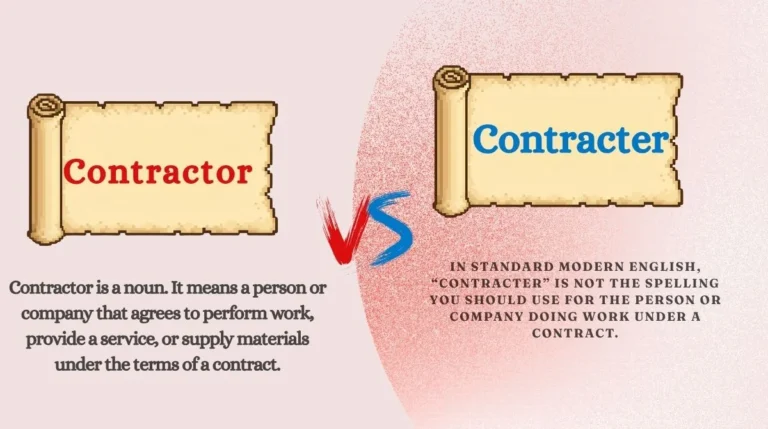
Contractor is a noun. It means a person or company that agrees to perform work, provide a service, or supply materials under the terms of a contract.
The word is especially common when a customer, company, or organization hires someone for a specific project or period of time.
For example, imagine that you want to build a new house. You may hire a building contractor to organize the work, provide workers, and handle different parts of the project. In another situation, a company may hire an IT contractor for six months to work on a software project.
Cambridge and Oxford both list contractor as a standard English noun. Oxford describes a contractor as a person or company that has a contract to do work or provide goods or services for another company.
When should you use “contractor”?
Use contractor when you are talking about a person or company working under a contract or agreement.
It can be used in many areas:
- building and construction
- plumbing
- electrical work
- software and technology
- consulting
- cleaning services
- government projects
- security
- repairs
- freelance and temporary work
The word is not limited to people who build houses. That is an important point for learners.
Grammar rule for “contractor”
Contractor is a countable noun.
You can say:
- a contractor
- one contractor
- two contractors
- many contractors
- the contractor
- our contractor
Because it is a noun, it can be the subject or object of a sentence.
For example:
- The contractor finished the roof yesterday.
- We hired a contractor to repair the kitchen.
- Our contractor gave us a new estimate.
- The contractor will start work next Monday.
- They are looking for a reliable contractor.
- The company hired three contractors for the project.
- She works as an independent contractor.
- We spoke to the contractor about the cost.
Notice that contractor names the person or company doing the work. The sentence does not use contractor as a verb.
A common learner confusion
Some learners think contractor only means a construction worker. That is too narrow.
A contractor can work in construction, but the word has a much wider meaning. An IT specialist, consultant, designer, security worker, or other professional may also be a contractor when they work under a contract.
For example:
Maria is a software contractor.
This does not mean Maria builds houses. It means she provides software-related services under a contract.
Another useful phrase is independent contractor. This usually means someone who works independently for clients or companies instead of being a regular employee. Cambridge gives this as a common business use of the word.
What Does “Contracter” Mean?
This is where the confusion starts.
In standard modern English, “contracter” is not the spelling you should use for the person or company doing work under a contract. The correct form is contractor.
So, if you want to write:
We hired a contractor.
do not write:
We hired a contracter.
The second spelling is generally treated as a misspelling of contractor in modern English.
There is one small historical detail worth knowing. Wiktionary records contracter as an obsolete historical form of contractor. That means you may occasionally find the spelling in very old texts, but this does not make it the normal spelling for present-day English.
For everyday writing, school assignments, websites, emails, business documents, job advertisements, and professional communication, use contractor.
When should you use “contracter”?
For normal modern English, you should not use “contracter” when you mean a person or company working under a contract.
Most of the time, seeing contracter means the writer has accidentally chosen the wrong spelling.
For example:
Incorrect: We need a skilled contracter.
Correct: We need a skilled contractor.
Grammar rule for “contracter”
Because contracter is not the standard modern spelling for this meaning, you should not treat it as a normal noun in your own writing.
Do not build sentences around it as if it were an accepted alternative.
Here are some common mistakes:
- ❌ The contracter arrived early.
- ✅ The contractor arrived early.
- ❌ We called a contracter for the repairs.
- ✅ We called a contractor for the repairs.
- ❌ The contracter sent an invoice.
- ✅ The contractor sent an invoice.
- ❌ They are looking for an electrical contracter.
- ✅ They are looking for an electrical contractor.
Why does “contracter” look correct?
The main reason is spelling logic.
English has many nouns ending in -er that describe people who do things. Think about:
- teach → teacher
- write → writer
- work → worker
- build → builder
- drive → driver
So, a learner may naturally think:
contract → contracter
But English does not create every professional noun by using -er. Some words use -or, and contractor is one of them.
That is why you cannot always guess the spelling from a general suffix rule.
Difference Between Contractor and Contracter
The biggest difference is simple: contractor is the standard modern English word; contracter is generally an incorrect spelling in this context.
| Point | Contractor | Contracter |
|---|---|---|
| Spelling | Correct | Generally incorrect |
| Modern standard English | Yes | No |
| Part of speech | Noun | Not normally used as this noun |
| Meaning | Person or company working under a contract | Usually intended as a misspelling of contractor |
| Professional writing | Appropriate | Avoid |
| Business use | Very common | Not standard |
| Construction use | Yes | No |
| IT and freelance use | Yes | No |
Usage difference
There is actually very little meaning difference because the two forms are not equal alternatives.
When someone writes contracter, they usually mean contractor.
For example:
The contractor repaired the office roof.
This sentence is correct.
Changing contractor to contracter does not create a new meaning. It simply creates a spelling problem.
Grammar logic
Contractor is a noun formed from the word contract, but English word formation does not always work like a simple formula.
It is tempting to think:
contract + er = contracter
but that is not how the standard word developed.
Oxford gives the word origin as coming through Latin and notes that contractor is an old English word formation connected with contract.
The important lesson for learners is this:
Do not assume every person-noun ends in -er. Learn common words as complete vocabulary items.
Sentence structure
The word contractor behaves like an ordinary noun in a sentence.
Subject + verb + contractor
- The contractor arrived.
Subject + verb + object
- We hired a contractor.
Possessive form
- The contractor’s tools are outside.
Plural form
- The contractors finished the job.
With contracter, these structures are not recommended because the spelling itself is not standard for the intended meaning.
Meaning comparison
Think of it this way:
Contractor = the correct word
Contracter = the spelling mistake you should correct
That is the main answer most learners need.
Grammar Rules You Must Remember
Rule #1: Use “contractor” for a person or company working under a contract
This is the most important rule.
Correct: The contractor will begin the project tomorrow.
Incorrect: The contracter will begin the project tomorrow.
Cambridge and Oxford both recognize contractor as the standard noun.
Rule #2: “Contractor” is countable
You can make it plural.
Singular: We hired a contractor.
Plural: We hired three contractors.
You can also use articles and possessives:
- a contractor
- the contractor
- our contractor
- their contractor
- several contractors
This is useful in everyday English because you will often talk about more than one person or business involved in a project.
Rule #3: Do not use “contracter” just because other people-nouns end in “-er”
English spelling is full of words that do not follow the pattern you expect.
For example:
- actor, not acter
- editor, not editer
- operator, not operater
- contractor, not contracter
You do not need to create a giant spelling rule for every word. It is better to learn contractor as the standard form.
Rule #4: “Contractor” is not limited to construction
A contractor can work in many professional areas.
Examples:
- an electrical contractor
- a building contractor
- an independent contractor
- an IT contractor
- a security contractor
- a government contractor
Oxford and Cambridge both show professional and business uses beyond one simple type of job.
Common Mistakes Students Make
The first mistake is simply spelling the word as contracter.
Wrong: We hired a contracter.
Right: We hired a contractor.
A second mistake happens when students think contractor must be a construction worker.
Wrong idea: A contractor only builds houses.
Better understanding: A contractor is someone who works under a contract or provides contracted goods or services.
A third mistake is using the word when the person is actually a regular employee.
For example, these two sentences are not always the same:
Sara is an employee of the company.
Sara is an independent contractor for the company.
The exact legal difference between an employee and an independent contractor depends on the situation and local rules, but in everyday English the words describe different working relationships. Cambridge specifically includes people who work for a company for a limited period but are not employees within its definition of contractor.
Another common mistake is forgetting the final -or.
Students may write:
- contracter ❌
- contracter company ❌
- contracter worker ❌
Use:
- contractor ✅
- contractor company ✅
- contractor ✅
Easy correction tip
Whenever you type contracter, stop for one second and look at the ending.
Ask yourself:
“Is the ending -or?”
If you are talking about the person or business that works under a contract, the answer is yes.
Easy Trick to Remember the Difference
Here is a simple memory trick:
Contract = Agreement → Contractor = person/company connected to the agreement
Notice the spelling:
CONTRACT + OR = CONTRACTOR
The easiest way to remember it is to focus on the final two letters:
OR
You can connect OR with official role in your memory.
So:
contract + or = contractor
Try saying it slowly while spelling it:
con-tract-or
Then write:
CONTRACTOR
Another useful trick is to compare it with these common words:
- actor
- editor
- operator
- instructor
- contractor
They all end in -or.
Do not use this as a universal grammar rule. It is simply a memory aid for this particular word.
And remember one more thing: the pronunciation does not make the spelling obvious. When people speak quickly, the final sound can be easy to miss. Spelling is something you need to learn separately.
Daily Life Examples
Here are some natural examples you may hear at work, at home, or in everyday conversations.
1. At home
A: Who is fixing the bathroom?
B: We hired a contractor.
2. At the office
A: Is David part of our full-time staff?
B: No, he is an independent contractor.
3. During construction
A: When will the building contractor start?
B: He said Monday morning.
4. Talking about repairs
A: Did you call someone about the leaking pipe?
B: Yes, the contractor is coming this afternoon.
5. At work
A: Who is working on the new website?
B: We hired an IT contractor for the project.
6. Talking about a project
A: Has the contractor finished the work?
B: Not yet. He needs another two days.
7. Asking for a recommendation
A: Do you know a good contractor?
B: Yes. My brother used one last year.
8. Talking about cost
A: How much will the contractor charge?
B: He said he would send us an estimate.
9. In a meeting
Manager: The contractor will explain the repair plan.
Worker: Okay, I’ll take notes.
10. In an email
We contacted the contractor about the delayed delivery.
Notice that contractor works naturally in many different settings. It can describe a building professional, a technology specialist, a consultant, or another person or company doing work under an agreement.
Practice Section
Choose the correct word: contractor or contracter.
1.
We need to hire a ________ to repair the roof.
2.
The ________ sent us the final bill.
3.
She works as an independent ________.
4.
The company is looking for an IT ________.
5.
He wrote “contracter” in the email, but the correct spelling is ________.
Answers
- contractor
- contractor
- contractor
- contractor
- contractor
The answer is the same every time because contractor is the standard modern spelling for the meaning discussed here.
FAQs
What is the difference between contractor and contracter?
Contractor is the correct standard English word for a person or company that performs work or provides services under a contract. Contracter is generally a misspelling in modern English. Use contractor in school, business, professional, and everyday writing.
Can we use contractor in questions?
Yes. Contractor is a normal noun, so you can use it in questions.
For example:
Who is the contractor?
Did you speak to the contractor?
Can we hire a contractor for this job?
The word works just like other countable nouns.
Is contractor formal or informal?
Contractor is suitable in both everyday and professional English. You can use it in casual conversation, emails, business documents, job descriptions, and workplace discussions. It is especially common in business and professional contexts.
Is contracter ever correct?
For modern standard English, you should normally avoid contracter when you mean a person or company working under a contract. There is a historical, obsolete use recorded in Wiktionary, but it is not the spelling learners should use today.
Why do people spell contractor as contracter?
The mistake probably feels natural because many English nouns for people end in -er, such as teacher, worker, and writer. Learners may apply that pattern to contract. However, the standard word is contractor, not contracter.
Does contractor only mean a construction worker?
No. A contractor can work in construction, but the word is much broader. English speakers also use contractor for IT professionals, consultants, security workers, government suppliers, and other people or companies that work under contracts.
Final Conclusion
The difference between contractor and contracter is much easier once you stop thinking of them as two equal words.
For modern standard English, contractor is the correct spelling. It is a noun for a person or company that agrees to provide work, services, or materials under a contract. You can use it in construction, business, technology, consulting, repairs, government work, and many other situations.
Contracter, on the other hand, is generally a spelling mistake when used with this meaning. Although a historical obsolete form can be found, it is not the normal word used by modern English speakers.
The easiest spelling trick is to remember:
CONTRACT + OR = CONTRACTOR
When you are writing an email, application, school assignment, website, or business document, choose contractor.
A little practice is enough to make this spelling automatic. The next time you hesitate between contractor and contracter, remember the final -or and move on with confidence.

Evan Rellmont is a writer who turns thoughtful ideas into meaningful words, creating stories and reflections that connect, inspire, and leave a lasting impression.
1 thought on “Contractor vs Contracter (2026): Which Spelling Is Correct and Why?”