
Have you ever typed “hussle” and then stopped to wonder whether it should be “hustle”? You are not alone.
This is a very common spelling problem, especially because the two forms look almost identical and sound very similar when spoken.
The good news is that the answer is simple: hustle is the standard English spelling.
The form hussle is generally a misspelling when you are trying to use the English word. Major dictionaries such as Oxford and Cambridge list hustle and give it several meanings and grammatical uses.
This small spelling difference matters more than it may seem. You may need the word in a school assignment, email, social media post, business article, job application, or everyday conversation.
Using the standard spelling helps your writing look clear and professional.
There is also a second reason for the confusion. Hustle has many meanings. It can mean moving quickly, working with energy, pushing someone to move, or, in informal American English, making money in an active or sometimes dishonest way.
It is also common in expressions such as side hustle and hustle and bustle.
By the end of this guide, you will know exactly when to use hustle, why hussle is usually wrong, how the word works as a noun and verb, and how to remember the correct spelling without checking a dictionary every time.
What Does “Hustle” Mean?
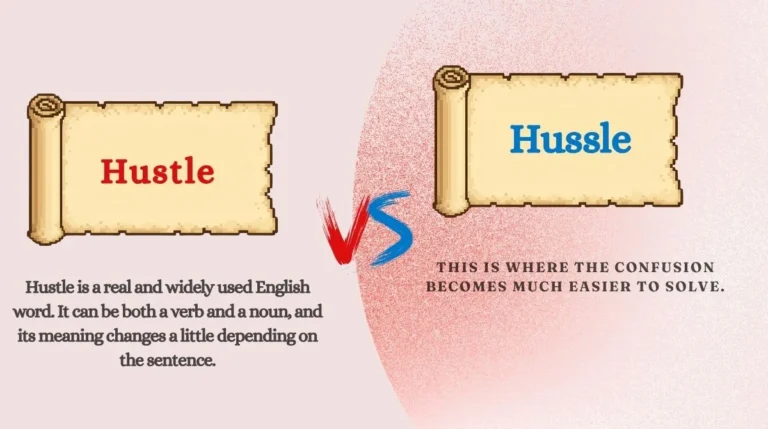
Hustle is a real and widely used English word. It can be both a verb and a noun, and its meaning changes a little depending on the sentence.
As a verb, hustle can mean to move quickly, work quickly, or act with energy. It can also mean to push or force someone to move. In informal American English, it can describe trying hard to earn money or selling something, sometimes dishonestly.
As a noun, hustle can describe busy activity, energetic effort, or a way of making money, depending on context. Oxford also gives hustle as the word used in the common expression “hustle and bustle,” meaning the busy, noisy activity of a place.
Hustle as a verb
Use hustle when you want to show quick movement or energetic action.
Here are some simple examples:
- We need to hustle if we want to catch the bus.
- She hustled to finish her homework before dinner.
- Hustle! We are already late.
- He hustled across the station to catch his train.
- The workers hustled to prepare the room for the meeting.
- The coach told the players to hustle back onto the field.
- They hustled the guests out of the building after the alarm.
- I had to hustle all morning to finish everything on time.
Notice that the word often carries an idea of speed plus effort. It is not simply about moving. It often suggests that you are moving or working because you need to get something done.
Hustle as a noun
As a noun, hustle can describe active effort or a busy environment.
For example:
- I love the hustle of city life.
- The hustle and bustle of the market was exciting.
- Her daily hustle takes a lot of energy.
- He has a lot of hustle and determination.
- The team won because of their hustle.
- Starting a small business takes patience and hustle.
- His side hustle brings in extra money.
- There was a lot of hustle around the station.
In modern informal English, hustle is often connected with hard work and earning money. For example, side hustle means an additional job or activity that a person does to earn extra income. The word can sound positive in this context, suggesting ambition and effort.
However, be careful with context. The word can also have a negative meaning. Cambridge lists hustle as a noun for a dishonest way of making money, while Oxford includes the idea of dishonest or illegal methods in some uses.
Common learner confusion about “hustle”
Many students think hustle means only “work hard.” That is not always true.
Compare these sentences:
We hustled to the airport.
Here, hustled means moved quickly.
She has a successful side hustle.
Here, hustle refers to an extra income-producing activity.
The hustle and bustle of downtown can be tiring.
Here, it describes busy activity.
So, the exact meaning comes from the sentence around it.
What Does “Hussle” Mean?
This is where the confusion becomes much easier to solve.
When “hussle” is intended as the ordinary English word, it is generally a misspelling of “hustle.” Standard dictionaries such as Oxford and Cambridge give the standard word as hustle, not hussle. Spelling references also identify hussle as the incorrect form in ordinary English usage.
So, if you are writing a sentence such as:
❌ We need to hussle to finish the work.
the correct spelling is:
✅ We need to hustle to finish the work.
Another example:
❌ She started a new hussle online.
Correct:
✅ She started a new hustle online.
Why does “hussle” look correct?
This spelling mistake is understandable.
When people hear hustle, the middle sound is strong enough that they may imagine two s letters. English has many words with doubled consonants, so the extra s can feel natural.
Fast typing also plays a role. A person who already knows the word may type the wrong spelling without noticing. Once an incorrect spelling appears repeatedly online, learners may see it often enough to assume it is correct.
Another source of confusion is that Hussle can sometimes appear as a name, artistic spelling, or brand-style form. A name does not automatically follow normal dictionary spelling rules. That is different from saying that hussle is the standard spelling of the English word.
For ordinary writing, essays, emails, websites, schoolwork, and professional communication, use hustle.
Examples showing the correction
- ❌ He had to hussle to meet the deadline.
- ✅ He had to hustle to meet the deadline.
- ❌ The city hussle never seems to stop.
- ✅ The city hustle never seems to stop.
- ❌ She is building a small hussle after work.
- ✅ She is building a small hustle after work.
- ❌ You need to hussle if you are already late.
- ✅ You need to hustle if you are already late.
The key point is simple: do not treat “hussle” as another spelling of the same standard word.
Difference Between Hustle and Hussle
The difference between these two forms is mainly about correct spelling and standard usage.
| Feature | Hustle | Hussle |
|---|---|---|
| Standard English spelling | ✅ Yes | ❌ No |
| Standard dictionary word | ✅ Yes | Generally no |
| Can be a verb | ✅ Yes | ❌ No in standard English |
| Can be a noun | ✅ Yes | ❌ No in standard English |
| Used in “hustle and bustle” | ✅ Yes | ❌ No |
| Used in “side hustle” | ✅ Yes | ❌ No |
| Suitable for school or formal writing | ✅ Yes | ❌ No |
| May appear as a name or stylized form | Possible | Possible |
| Recommended spelling | Hustle | Avoid |
Usage difference
There is not really a normal meaning difference between hustle and hussle when a writer is trying to express the English word.
Instead:
Hustle = correct standard word
Hussle = common misspelling or intentional name/stylization
That is why you should not think of them as two vocabulary words like accept and except. They are not two standard English words with separate meanings.
Grammar logic
Hustle has normal English grammar forms:
- hustle — base form
- hustles — third-person singular present
- hustled — past tense
- hustling — -ing form
For example:
I hustle every morning.
She hustles every morning.
They hustled to the station.
He is hustling to complete the project.
The spelling remains based on hustle.
You should not create forms such as hussled or hussling from the misspelling.
Sentence structure
As a verb, hustle can be used with a subject and sometimes a prepositional phrase or another element:
We hustled to the bus stop.
She hustled across the street.
They hustled the players into the room.
As a noun, it can follow an article, adjective, or possessive word:
the hustle
a hustle
her hustle
city hustle
His hustle impressed the team.
This grammatical flexibility is another reason the correct spelling is worth learning well.
Grammar Rules You Must Remember
Rule #1: Use “hustle” as the standard spelling
Whenever you mean the normal English word, choose hustle.
Correct:
We need to hustle.
Incorrect:
We need to hussle.
This is the most important rule.
Rule #2: “Hustle” can be a verb
Use it to describe quick movement, energetic action, or effort.
Example:
I had to hustle to catch my train.
Here, hustle is an action word.
You can change the form according to the tense:
Present: She hustles every morning.
Past: She hustled yesterday.
Continuous: She is hustling right now.
Rule #3: “Hustle” can also be a noun
A noun names a thing, idea, activity, or situation.
Example:
The hustle of the city can be exciting.
Here, hustle is not an action being performed by the subject. It is a noun describing busy activity.
You may also see:
side hustle
hustle and bustle
business hustle
Rule #4: Do not add an extra “s”
The spelling is:
H-U-S-T-L-E
Not:
H-U-S-S-L-E
The t is important. When you write hussle, you have removed the t and added another s.
A useful visual check is:
HUS + TLE
Think of the T as part of the word that must stay there.
Common Mistakes Students Make
Students usually make this mistake for one of three reasons: pronunciation, memory, or repeated exposure to incorrect spelling.
Mistake 1: Writing “hussle” because it sounds right
A learner may hear:
“huh-suhl”
and then guess the spelling.
But English spelling cannot always be predicted perfectly from pronunciation. The correct spelling still has the t:
hustle
A good habit is to learn common words as complete visual patterns instead of trying to spell every word only from sound.
Mistake 2: Adding a second “s”
Some learners remember hustle correctly at first but then write hussle when typing quickly.
Here is the difference:
✅ hustle
❌ hussle
Only one s appears before the t.
Mistake 3: Trusting everything you see online
The internet contains usernames, comments, advertisements, creative spellings, and typing mistakes. Seeing hussle online does not mean it is standard English.
For school, work, and careful writing, check the established spelling rather than copying a random post or username.
A simple correction method
When you are unsure, stop and look at the middle:
hus-tle
The t is the little letter that prevents the spelling from becoming hussle.
Try writing the word slowly:
H-U-S-T-L-E
Then write it again at normal speed.
This small habit can make the correct spelling stick.
Easy Trick to Remember the Difference
Here is a classroom trick that many learners find useful:
Think: “Hustle has T for Tired but still working.”
The word hustle is often connected with speed, effort, movement, and hard work.
So picture this:
HUSTLE = HUS + T + LE
The T can remind you of tireless effort.
Another simple trick is to connect hustle with hustle and bustle.
The phrase has busy movement and activity:
hustle and bustle
You would never write:
❌ hussle and bustle
Seeing the correct phrase in your mind can help you remember the spelling of the whole word.
One more memory trick
Say this to yourself:
“Hustle has one S and one T.”
That is short enough to remember during a test or while writing quickly.
You do not need a complicated spelling rule here. You just need to remember the shape of the word.
Daily Life Examples
The word hustle appears in many real situations. Here are examples you might actually hear or use.
At school
“Hustle, everyone. The teacher is coming.”
This means everyone should move quickly or get ready quickly.
At work
“We need to hustle if we want to finish this project today.”
Here, hustle means work quickly and with energy.
While traveling
“I had to hustle through the airport because my flight was boarding.”
The speaker had to move quickly.
Talking about money
“She has a small side hustle after work.”
Here, side hustle means an additional activity or job that brings in extra income.
Talking about a city
“I enjoy the hustle and bustle of a busy market.”
This describes a place full of activity, noise, and movement.
Talking to a friend
“Come on, hustle! We are going to be late.”
This is casual spoken English.
Talking about a team
“The team won because they showed a lot of hustle.”
Here, the noun means energetic effort and determination.
Talking about a busy day
“There has been so much hustle today.”
The speaker means there has been a lot of activity and movement.
Giving advice
“If you want to reach your goal, you may need to hustle and stay focused.”
Here, the word suggests energetic effort.
Correcting a spelling mistake
A teacher might say:
“Remember, it is hustle, not hussle.”
That is exactly the kind of correction a learner may need when writing.
Practice Section
Choose the correct option in each sentence.
1. We need to ______ if we want to catch the train.
A. hustle
B. hussle
2. Her ______ helps her earn extra money.
A. hustle
B. hussle
3. The streets were full of the ______ and bustle.
A. hustle
B. hussle
4. He had to ______ across the room before the door closed.
A. hustle
B. hussle
5. The correct spelling in formal English is ______.
A. hustle
B. hussle
Answers
- A — hustle
- A — hustle
- A — hustle
- A — hustle
- A — hustle
There is an easy pattern here: when you mean the normal English word, hustle is the form to choose.
FAQs
What is the difference between hustle and hussle?
Hustle is the standard English spelling. Hussle is generally a misspelling when someone intends to write the English word. Hustle can be a noun or a verb and has several meanings, including moving quickly, working energetically, or describing busy activity.
Is “hussle” a correct English word?
Generally, no. Hussle is not the standard spelling of the English word hustle. You may see it in usernames, names, brands, or creative spellings, but for ordinary English writing, use hustle. Spelling references identify hussle as an incorrect form.
What does hustle mean?
Hustle has several related meanings. As a verb, it can mean to move quickly, act with energy, or push someone to move. As a noun, it can mean energetic activity or a way of making money. The exact meaning depends on the sentence and context.
Can “hustle” be a noun and a verb?
Yes. This is one reason the word appears so often in English. As a verb, you can say, “We hustled to the station.” As a noun, you can say, “The hustle of the city was exciting.” It is also common in phrases such as “side hustle” and “hustle and bustle.”
Is hustle formal or informal?
It depends on the meaning and sentence. Hustle is a standard English word, so using the word itself is not a spelling problem in formal writing. However, some meanings are marked as informal, especially certain American uses related to money or aggressive action. In a formal document, choose the meaning carefully and consider whether a more precise word would sound better.
How can I remember whether to write hustle or hussle?
Remember that the correct spelling is H-U-S-T-L-E. Think of the sentence: “Hustle has one S and one T.” You can also connect it with the familiar phrase “hustle and bustle.” The easiest habit is simply to memorize the standard spelling and avoid adding the extra s.
Conclusion
The hustle or hussle question looks complicated at first, but the answer is actually very simple.
When you mean the normal English word, the correct spelling is hustle. It can work as both a noun and a verb, and its meaning depends on context. You may use it for quick movement, energetic work, busy activity, or certain informal ways of earning money. It also appears in familiar expressions such as side hustle and hustle and bustle.
Hussle is generally a spelling mistake, although you may occasionally see that form used intentionally in a name, brand, or other stylized context.
The easiest thing to remember is:
✅ Hustle = correct standard English
❌ Hussle = generally incorrect spelling
Whenever you are writing an email, essay, article, school assignment, or professional message, choose hustle.
A little practice goes a long way. Write the word a few times, use it in your own sentences, and pay attention to the t in the middle. Soon, choosing the right spelling will feel completely natural.

Evan Rellmont is a writer who turns thoughtful ideas into meaningful words, creating stories and reflections that connect, inspire, and leave a lasting impression.