
Have you ever written “cacoon” when you meant the protective covering around a developing insect? You are not alone.
This spelling is an easy mistake because cacoon and cocoon look and sound quite similar, especially when you hear the word before you see it written.
The good news is that the difference becomes simple once you know what each word actually means.
For the insect covering, the correct word is cocoon.
A cocoon is a protective covering made by the larvae of certain insects, especially moths, while they develop into adults. Major dictionaries such as Cambridge and Oxford list cocoon with this meaning.
But there is an interesting twist: cacoon is not simply a “wrong spelling” in every possible situation.
It is a real dictionary word, but it has a completely different meaning. Collins and Merriam-Webster use cacoon for a tropical plant or its large bean, including the so-called snuffbox bean.
So, when you are talking about a caterpillar, moth, silk, or insect development, remember cocoon.
After reading this guide, you will understand the meaning of both words, know when each one is appropriate, recognize common mistakes, and be able to choose the right spelling quickly in everyday English.
What Does “Cacoon” Mean?
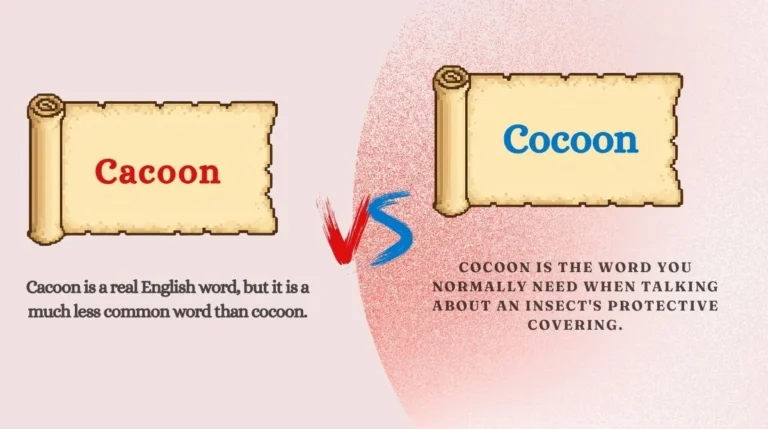
Cacoon is a real English word, but it is a much less common word than cocoon.
According to Collins, cacoon refers to the large bean of a tropical climbing plant, Entada scandens, which has traditionally been used for making objects such as purses, spoons, and snuffboxes. Merriam-Webster also records cacoon as a noun connected with the West Indies and a tropical American plant.
So, technically, you cannot say that cacoon never exists. It does exist. The important point is that its meaning has nothing to do with the familiar insect covering.
When should you use “cacoon”?
Use cacoon only when you are referring to this specific tropical plant or its bean.
This is an uncommon word in normal daily English. Most beginners will rarely need to write it unless they are reading about botany, tropical plants, natural history, or older descriptions of plants and seeds.
For ordinary writing, spelling cacoon when you mean an insect covering will be considered a spelling or word-choice error.
Example sentences with “cacoon”
- The book described the cacoon as a large bean from a tropical climbing plant.
- The museum displayed a dried cacoon from the region.
- A traditional craft item had been made from a cacoon seed.
- The researcher collected a cacoon for further study.
- The old text mentioned the cacoon plant found in tropical areas.
- The guide explained how the cacoon bean was once used to make small containers.
- The botanical collection included a specimen of cacoon.
These examples use the word in its specialized botanical sense.
Why do learners confuse “cacoon” with “cocoon”?
The biggest reason is simple: the two words are very similar in appearance and pronunciation.
When students hear the word /kəˈkuːn/, they may remember it as beginning with either ca- or co-. This is especially easy when English is not your first language.
There is another reason, too. The word cocoon is familiar because people often learn it in connection with butterflies, moths, caterpillars, and metamorphosis. When trying to spell a word from memory, learners sometimes use the letter pattern that feels natural to them.
However, there is an important vocabulary lesson here: similar-looking words do not always have similar meanings.
Cacoon and cocoon are a good example. They are close in spelling, but they describe very different things.
What Does “Cocoon” Mean?
Cocoon is the word you normally need when talking about an insect’s protective covering.
Cambridge defines a cocoon as a covering made from soft, smooth threads that surrounds and protects certain insects during the pupa stage as they develop into adults. Oxford similarly describes it as a cover or case of silk threads made by some insects, especially moths.
When should you use “cocoon”?
Use cocoon when you are talking about:
- an insect’s protective covering
- a moth developing into an adult
- silk made by silkworms
- a protective covering around something
- a figurative safe or protected environment
For example:
The caterpillar disappeared inside its cocoon.
Here, cocoon is a noun.
The word can also be used figuratively. Cambridge gives the idea of a safe, quiet place, such as “the warm, safe cocoon of childhood.”
“Cocoon” as a noun
As a noun, cocoon names the covering or protective environment.
Examples:
- The moth stayed inside its cocoon for several days.
- We found a small cocoon hanging from a branch.
- The silkworm spun a cocoon around itself.
- The child watched the insect emerge from its cocoon.
- Several cocoons were attached to the leaves.
- The warm blanket felt like a comfortable cocoon.
- Her quiet room became a cocoon where she could relax.
- The plant was surrounded by a cocoon of protective material.
Notice that the word can have both a literal and a figurative meaning.
“Cocoon” as a verb
Cocoon can also be a verb.
Oxford explains that the verb can mean to protect someone or something by surrounding it completely with something. It can also mean staying at home and spending less time going out in some varieties of English.
Examples:
- The baby was cocooned in a soft blanket.
- She was cocooned from the outside world.
- We were cocooned in warm sleeping bags.
- The small animal was cocooned in layers of leaves.
- During winter, he likes to cocoon at home with a book.
- The family felt cocooned in the quiet mountain house.
This gives you several useful forms:
- cocoon — base form
- cocoons — third-person singular or plural noun
- cocooned — past tense/past participle
- cocooning — -ing form
The pronunciation of “cocoon”
Cambridge gives the pronunciation as /kəˈkuːn/ in both British and American English.
The stress falls on the second syllable:
cuh-COON
That can help you remember the spelling.
Difference Between Cacoon and Cocoon
The easiest way to understand the difference is to focus on meaning first, not just spelling.
| Word | Meaning | Part of speech | Common use |
|---|---|---|---|
| cacoon | A tropical plant or its large bean | Noun | Specialized botanical writing |
| cocoon | A protective covering made by certain insects | Noun | Everyday and scientific English |
| cocoon | A protective or comfortable enclosure | Noun | Figurative English |
| cocoon | To surround or protect completely | Verb | Everyday and formal writing |
Meaning difference
This is the main rule:
Cacoon = a tropical plant/bean.
Cocoon = an insect covering or protective enclosure.
If you are writing about a moth, caterpillar, silkworm, or metamorphosis, use cocoon.
If you are writing about the tropical plant or its bean called a cacoon, use cacoon.
Usage difference
The two words also differ greatly in frequency.
Cocoon is a normal vocabulary word that students may encounter in school, nature books, science lessons, novels, and everyday conversation.
Cacoon is much more specialized. Most people do not use it in ordinary conversation.
That means a learner writing:
The butterfly came out of its cacoon.
has almost certainly chosen the wrong word.
The correct sentence is:
The butterfly came out of its cocoon.
There is a small science point worth knowing here. People often say “butterfly cocoon,” but butterflies are generally associated with a chrysalis, while many moths make true silk cocoons. The words can be used loosely in everyday speech, but the biological distinction is useful.
Grammar and sentence structure
Cacoon and cocoon are both nouns when they refer to the plant/bean and the insect covering.
The usual sentence structures are therefore similar:
Subject + verb + noun
The moth made a cocoon.
Determiner + noun
a cocoon
the cocoon
several cocoons
For cacoon:
a cacoon
the cacoon
several cacoons
The grammar is not the difficult part. Vocabulary choice is the difficult part.
Spelling comparison
Look closely:
cacoon
cocoon
Only the second letter changes:
a → o
That tiny difference completely changes the word.
This is why proofreading matters. A spell-checker may not always catch a mistaken word when the word itself exists in a dictionary. Because cacoon is a real word, a computer might not automatically treat it as an error in every context.
Grammar Rules You Must Remember
Although this is mainly a spelling and vocabulary issue, there are some useful grammar rules to keep in mind.
Rule #1: Use “cocoon” for an insect’s protective covering
When the meaning is the silk or protective covering around an insect, write cocoon.
The moth is inside its cocoon.
Not:
The moth is inside its cacoon.
This is the most important rule.
Rule #2: “Cocoon” can be a noun or a verb
As a noun:
The cocoon was attached to a branch.
As a verb:
The blanket cocooned the baby.
Oxford records both literal and figurative verb uses.
Rule #3: Use “cacoons” as the plural of “cacoon”
When you genuinely mean the tropical bean or plant term, the plural can be cacoons.
The researcher examined several cacoons.
Do not use cacoons when you mean insect coverings. The plural of cocoon is cocoons.
Several cocoons were hanging from the branch.
Rule #4: Context should decide the word
Ask yourself one simple question:
Am I talking about an insect covering or a tropical plant/bean?
If it is an insect covering, choose cocoon.
If it is the specialized botanical word, choose cacoon.
This is much safer than trying to guess the spelling from pronunciation alone.
Common Mistakes Students Make
Mistake 1: Writing “cacoon” for an insect
Wrong:
The caterpillar made a cacoon.
Correct:
The caterpillar made a cocoon.
The learner has chosen a real word, but it is the wrong word for the meaning.
Mistake 2: Thinking “cacoon” is simply an alternative spelling
This is a very common misunderstanding.
Because dictionaries do contain cacoon, you may see websites saying that it is “wrong.” That statement is too broad.
A better explanation is:
Cacoon is a real word, but it does not mean the same thing as cocoon.
That distinction is important for accurate English learning. Collins and Merriam-Webster both recognize cacoon as a noun with a botanical meaning.
Mistake 3: Choosing based only on sound
When spoken quickly, cacoon and cocoon can sound close.
Do not rely only on what you hear. Think about the meaning.
The moth is inside a ______.
The answer must be cocoon.
Mistake 4: Assuming every dictionary word is common
English contains thousands of rare, regional, technical, and historical words.
Just because a word appears in a dictionary does not mean it is a common choice in everyday English.
Cacoon is a good example. It is valid in its specialized sense but much less common than cocoon.
Mistake 5: Mixing up “cocoon” and “chrysalis”
This is slightly different, but it often appears in the same discussion.
A cocoon is a protective covering made by certain insects, particularly moths. A chrysalis is the pupa stage of a butterfly and is not simply another spelling of cocoon.
So these words should not automatically be treated as exact synonyms.
Easy Trick to Remember the Difference
Here is a simple memory trick:
COcoon = COmes with the insect
Think:
C O C O O N
The first two letters are CO.
Picture a caterpillar going into a cocoon.
You can remember:
COcoon → Caterpillar → Covering
You do not need a complicated rule.
For cacoon, think of the unusual A as standing apart from the familiar insect word.
Another useful trick is to build a tiny mental picture.
Imagine a moth hanging from a branch.
Ask:
“What is around the moth?”
The answer is:
A cocoon.
Now imagine a large tropical bean.
Ask:
“What is this unusual botanical word?”
The answer:
Cacoon.
When two words are confusing, connecting each word to a picture can be more effective than memorizing a spelling list.
Daily Life Examples
Here are some natural examples showing how cocoon is normally used.
Example 1
A: What happened to the caterpillar?
B: It disappeared into its cocoon.
Example 2
A: Did you see the insect on the tree?
B: Yes. There was a small cocoon hanging from a branch.
Example 3
A: Why is the moth staying inside?
B: It is still developing inside the cocoon.
Example 4
A: I found this in the garden.
B: That looks like an insect cocoon.
Example 5
A: Why do you love your room so much?
B: It feels like a little cocoon where I can relax.
Example 6
After a long day at work, I like to cocoon myself in a blanket and watch a movie.
Here, cocoon is a verb used in a figurative way.
Example 7
The newborn was cocooned in a warm blanket.
The verb means surrounded or wrapped in a protective way.
Example 8
The children watched the moth emerge from its cocoon.
This is a natural science-related use.
Example 9
Several cocoons were attached to the underside of the leaf.
Remember the plural spelling: cocoons, not cacoons.
Example 10
She stayed in a quiet cocoon of books, music, and warm lights.
This is a figurative use. The speaker is not talking about an insect at all.
A rare “cacoon” example
The botanical museum displayed a cacoon bean from a tropical plant.
This is correct because the word has its specialized botanical meaning.
Practice Section
Choose the correct word: cacoon or cocoon.
1. The moth remained inside its ______ until it was ready to emerge.
2. We found several ______ hanging from the tree.
3. The botanical guide described a tropical ______ bean.
4. She felt safe inside her quiet little ______ at home.
5. The researcher examined the insect’s ______ under a microscope.
Answers
1. cocoon
The insect covering is called a cocoon.
2. cocoons
The plural of cocoon is cocoons.
3. cacoon
Here, the sentence refers to the tropical plant or bean.
4. cocoon
This is a figurative use meaning a safe, protected place.
5. cocoon
Again, the subject is an insect covering.
A useful habit is to explain your answer, not just choose it. Ask yourself, “What does this word mean here?” That extra step helps prevent similar spelling mistakes later.
FAQs About Cacoon or Cocoon
What is the difference between cacoon and cocoon?
Cocoon is the common word for the protective covering made by certain insects, especially moths. Cacoon is a separate, uncommon word for a tropical plant or its large bean.
So, when talking about insects, use cocoon.
Is “cacoon” a correct spelling?
Yes, but only in its specific botanical sense. Dictionaries such as Collins and Merriam-Webster list cacoon as a word related to a tropical plant or bean. It is not the normal spelling for an insect covering.
Is “cacoon” a misspelling of “cocoon”?
It can be a misspelling when someone writes cacoon but means the insect covering. However, saying that cacoon is always incorrect is not technically accurate because it has its own dictionary meaning.
How do you spell the insect covering: cacoon or cocoon?
The correct spelling is cocoon.
The caterpillar is inside a cocoon.
The spelling starts with co-, not ca-.
Can “cocoon” be used as a verb?
Yes. Cocoon can be a verb meaning to surround or protect someone or something. It can also describe staying at home in a protected or comfortable environment.
For example:
The baby was cocooned in a soft blanket.
What is the plural of cocoon?
The plural is cocoons.
We found three cocoons on the branch.
The plural of cacoon, when used in its botanical sense, is cacoons, as Merriam-Webster records.
Final Conclusion
The confusion between cacoon and cocoon is mostly a vocabulary and spelling problem, not a difficult grammar problem.
For normal English, the word you will usually need is cocoon. It describes the protective covering made by certain insects and can also be used figuratively for a safe, comfortable, or protected place. The word can even work as a verb, as in cocooned in a warm blanket.
Cacoon is different. It is a genuine but uncommon word connected with a tropical plant or its large bean.
So, when writing about moths, caterpillars, silkworms, or insect development, remember:
✅ cocoon
❌ cacoon
A simple memory trick is “COcoon for the insect covering.” Once you connect the spelling with the meaning, this confusing pair becomes much easier to remember.
Keep an eye on small spelling differences like this. A single letter can change the meaning of an English word completely.

Evan Rellmont is a writer who turns thoughtful ideas into meaningful words, creating stories and reflections that connect, inspire, and leave a lasting impression.
1 thought on “Cacoon or Cocoon: Which Spelling Is Correct in 2026?”