
Have you ever written “sueing” and then wondered whether it should be “suing” instead? This is a very common spelling problem, especially for English learners.
Both forms look as if they could be correct because many English verbs add -ing to make their present participle.
For example, play becomes playing, work becomes working, and help becomes helping. So it may seem natural to write sueing.
However, English spelling has a few special rules.
The verb sue is one of those words that can cause trouble because its final letters do not behave exactly as beginners may expect.
The good news is that the correct spelling is easy to learn once you understand the pattern. Suing is the standard spelling, while sueing is generally considered incorrect in modern standard English.
Knowing the difference matters because sue is used in news reports, business writing, legal discussions, school assignments, and everyday conversations.
You may hear sentences such as “She is suing the company” or “The customer sued the store.” Using the correct spelling helps your writing look clear and professional.
By the end of this guide, you will understand why suing is correct, how the verb changes when -ing is added, what mistakes learners commonly make, and how to remember the spelling without memorizing a difficult rule.
What Does “Sueing” Mean?
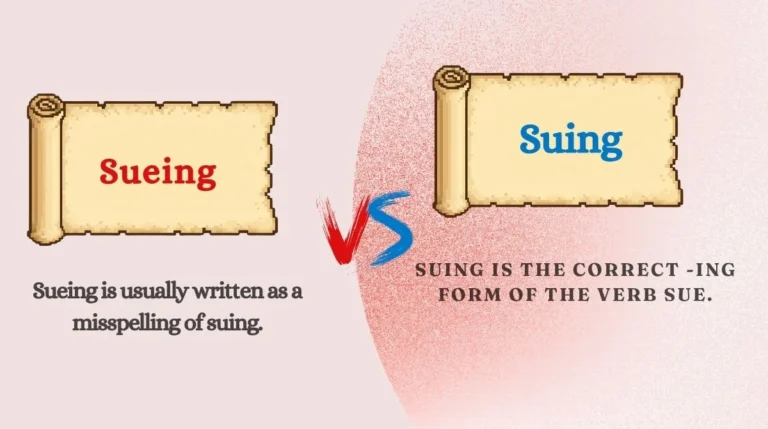
Sueing is usually written as a misspelling of suing.
The problem is that sueing looks like it follows a normal English spelling pattern. A learner may take the verb sue and simply add -ing:
sue + ing = sueing
That seems logical, but standard English does not normally use this form.
The correct spelling is:
sue + ing = suing
The verb sue means to take legal action against a person, company, or organization in a court of law. It can also mean to make a legal claim against someone for something such as damage, injury, or money.
Because sueing is not the standard spelling, it should not normally be used in formal writing, schoolwork, professional communication, or published content.
When might learners write “sueing”?
Learners often write this form because they see the base word sue and apply the simple rule of adding -ing. This is understandable, especially when they are still learning English spelling patterns.
For example, they may think:
- agree → agreeing
- free → freeing
- see → seeing
- sue → sueing
But the last example does not follow the same spelling pattern.
Examples of the incorrect form
Here are some examples showing how sueing may appear in writing, but why you should replace it:
- Incorrect: The customer is sueing the company.
- Correct: The customer is suing the company.
- Incorrect: She threatened to start sueing her former employer.
- Correct: She threatened to start suing her former employer.
- Incorrect: The actor is sueing the newspaper.
- Correct: The actor is suing the newspaper.
- Incorrect: They are sueing the manufacturer for damages.
- Correct: They are suing the manufacturer for damages.
The main lesson is simple: when you need the -ing form of sue, do not keep the e before -ing.
Common learner confusion
Many learners know the rule that a final silent e is often removed before -ing:
- make → making
- write → writing
- use → using
- take → taking
That rule actually helps us understand this problem. The word sue ends in e, so the final e is removed before -ing.
That gives us:
sue → suing
not:
sue → sueing
So, although sueing may look reasonable at first, it does not follow the standard spelling rule used here.
What Does “Suing” Mean?
Suing is the correct -ing form of the verb sue.
The word suing means taking legal action against someone or something. It is the present participle and gerund form of sue.
For example:
The woman is suing the company.
This means the woman has started or is involved in legal action against the company.
When should you use “suing”?
Use suing when the verb sue is needed in an -ing form.
You commonly see it after forms of be:
- am suing
- is suing
- are suing
- was suing
- were suing
- has been suing
- have been suing
You can also use it as a gerund, where the word acts more like a noun.
For example:
Suing someone can be expensive.
Here, suing is the subject of the sentence.
Examples of “suing”
- The company is suing its former partner.
- She is suing the airline for compensation.
- They are suing the landlord over the dispute.
- He threatened to start suing the newspaper.
- The family is suing the hospital.
- Suing a business can take a long time.
- The customer is considering suing the manufacturer.
- The lawyer advised her against suing without strong evidence.
Notice that the spelling remains suing in every example.
The grammar behind the word
The base verb is:
sue
When we form the -ing form, the final e is removed:
sue + ing → suing
The change is about spelling, not meaning. The verb still means the same basic thing: taking someone to court or bringing a legal claim.
This same spelling idea appears in many other English verbs.
Compare:
- come → coming
- hope → hoping
- live → living
- move → moving
- sue → suing
The final e disappears before -ing.
Is “suing” a verb or a noun?
It can function in both ways.
As a verb:
The company is suing the supplier.
As a gerund:
Suing the supplier may take months.
This can seem strange at first, but English often uses -ing forms as verbs and noun-like words.
Difference Between Sueing and Suing
The biggest difference is that suing is the standard correct spelling, while sueing is a common spelling error.
| Feature | Sueing | Suing |
|---|---|---|
| Standard spelling | No | Yes |
| Base verb | sue | sue |
| Meaning | Intended to mean taking legal action | Taking legal action |
| Used in formal English | No | Yes |
| Used in standard dictionaries | Generally not as the standard form | Yes |
| Correct -ing form | No | Yes |
| Example | The company is sueing him. ❌ | The company is suing him. ✅ |
Why is “suing” correct?
The reason comes from the spelling of the base verb sue.
When many English verbs ending in silent e take -ing, the final e is removed.
For example:
write → writing
drive → driving
make → making
sue → suing
The word does not become sueing because the final e is dropped.
Meaning comparison
There is no real difference in meaning between the two forms in everyday learner writing because sueing is normally intended as a misspelling of suing.
A reader may understand sueing, but understanding a misspelled word does not make the spelling correct.
This is especially important in professional or academic English. A legal sentence such as:
The customer is suing the company.
looks polished and standard.
The version:
The customer is sueing the company.
contains a spelling error that can make the writer appear less careful.
Sentence structure
Both forms are supposed to represent the -ing form of the same verb, so the sentence structure does not change because of the spelling mistake.
For example:
The family is suing the company.
Here:
- The family = subject
- is = helping verb
- suing = present participle
- the company = object
The correct spelling is therefore not just a small detail. It is part of using the verb correctly.
Grammar Rules You Must Remember
Rule 1: Remove the final “e” before adding “-ing”
This is the main rule you need.
When many verbs end in a silent e, the final e is removed before -ing.
Examples:
- bake → baking
- dance → dancing
- hope → hoping
- ride → riding
- sue → suing
So:
sue + ing = suing
not:
sue + ing = sueing
This is the easiest rule to remember for this word.
Rule 2: “Suing” is the -ing form of “sue”
The base verb is sue.
The continuous form uses suing:
I am suing.
She is suing.
They are suing.
The same form can appear after another verb:
He considered suing the company.
The spelling does not change based on the subject.
Rule 3: Do not keep the silent “e”
The e in sue is part of the spelling of the base form, but it is not kept when the word takes -ing.
This is similar to:
use → using
not:
useing
and:
argue → arguing
not:
argueing
This shows why the spelling suing is not unusual. It belongs to a larger English spelling pattern.
Rule 4: Be careful with other word forms
Not every form of sue uses suing.
Here are some important forms:
| Verb form | Example |
|---|---|
| Base form | sue |
| Third-person singular | sues |
| Past tense | sued |
| Past participle | sued |
| -ing form | suing |
Examples:
I sue the company.
She sues the company.
He sued the company last year.
They have sued the manufacturer.
The customer is suing the retailer.
Learning the complete set can help you avoid spelling errors later.
Common Mistakes Students Make
English learners often make this mistake for a very reasonable reason: they use a spelling rule they already know, but they apply it incorrectly.
Mistake 1: Adding “-ing” without removing “e”
Wrong:
She is sueing her employer.
Correct:
She is suing her employer.
The fix is simple. Remove the final e before adding -ing.
Mistake 2: Thinking every verb ending in “e” behaves differently
Some students become unsure because English has many exceptions and special patterns.
It is true that English spelling has exceptions, but with sue, the standard form is clear:
sue → suing
You do not need to invent an extra vowel.
Mistake 3: Confusing “suing” with another spelling
Some learners may think the word should contain a double e, while others add extra letters because the pronunciation is unfamiliar.
The correct spelling is only five letters:
S-U-I-N-G
The pronunciation does not need to match the spelling perfectly.
Mistake 4: Using the wrong form after “is,” “are,” or “was”
After is, are, was, and were, an -ing form is often needed when talking about an action in progress.
For example:
She is suing the company.
Not:
She is sued the company.
And not:
She is sueing the company.
The first sentence is correct.
Easy correction tip
Whenever you see sue + ing, stop for one second and ask:
“Does the base verb end in silent e?”
Yes.
Then remove the e:
sue → suing
This tiny pause can prevent the mistake.
Easy Trick to Remember the Difference
Here is a simple memory trick:
“Sue loses her e when she starts -ing.”
Think of the base word:
SUE
Now imagine adding -ING.
The final e quietly disappears:
SUE → SUING
You can also compare it with familiar words:
make → making
take → taking
write → writing
sue → suing
All of these drop the final e before -ing.
Another useful trick is to remember that “sueing” looks too crowded. Once you see s-u-e-i-n-g, the extra e feels unnecessary. The standard form is smoother:
suing
A real-life way to remember it
Imagine reading a news headline:
Company Suing Former Partner
You would naturally see the shorter form suing.
Picture the sentence:
The customer is suing the airline.
Now repeat it aloud:
“Sue becomes suing.”
That simple phrase can make the spelling stick.
Daily Life Examples
The word suing often appears in legal news, workplace discussions, business stories, and conversations about disputes. Here are some natural examples.
Example 1
A: Why is that customer so upset?
B: He is suing the company over the damage.
The action is happening now or is currently in progress.
Example 2
A: Did she really start legal action?
B: Yes. She is suing the landlord.
Here, suing means taking the landlord to court or bringing a legal claim.
Example 3
A: What happened to the restaurant?
B: A former employee is suing the owner.
The present continuous form is used because the legal action is current.
Example 4
The family is suing the manufacturer after the accident.
This is a common structure in news-style English.
Example 5
He is thinking about suing his former business partner.
Here, suing comes after the phrase thinking about.
This is useful to remember because some verbs and prepositions are naturally followed by an -ing form.
Example 6
A: Can they take legal action?
B: Yes, they are considering suing the company.
Again, the correct spelling is suing.
Example 7
Suing someone can be expensive and stressful.
Here, suing acts as the subject of the sentence.
Example 8
The newspaper reported that the actor is suing the publisher.
This kind of sentence is common in formal and journalistic writing.
Example 9
A: Why did he hire a lawyer?
B: He plans to sue the contractor.
Notice that we use sue, not suing, after plans to.
This is an important grammar point:
He plans to sue the contractor.
not:
He plans to suing the contractor.
Example 10
They have been suing the company for several months.
This uses the present perfect continuous structure:
have been + suing
The action started in the past and has continued for some time.
Practice Section
Choose the correct word in each sentence: sueing or suing.
1. The customer is ______ the airline.
2. She threatened to start ______ the company.
3. The family is ______ the hospital for damages.
4. They have been ______ their former business partner.
5. ______ a company can take a lot of time and money.
Answers
- suing
- suing
- suing
- suing
- Suing
Here is the rule behind every answer:
sue → suing
The final e is removed before -ing.
FAQs
What is the difference between sueing and suing?
Suing is the correct standard spelling. It is the -ing form of the verb sue, which means to take legal action against someone. Sueing is a common misspelling and should be avoided in standard English.
Is “sueing” a correct spelling?
No. Sueing is generally considered an incorrect spelling in standard modern English. The correct form is suing. When sue takes -ing, the final e is removed.
Why is it “suing” and not “sueing”?
English commonly removes a final silent e before adding -ing. For example, make becomes making and write becomes writing. In the same way, sue becomes suing.
Can I use “suing” in a question?
Yes. You can use suing in questions whenever the grammar requires the -ing form.
For example:
Is she suing the company?
Or:
Why are they suing the manufacturer?
The spelling remains suing.
Is “suing” formal or informal?
Suing is neither especially formal nor informal. It is the normal -ing form of sue and can be used in everyday speech, professional writing, news reports, academic writing, and legal discussions.
What are the other forms of the verb “sue”?
The main forms are sue, sues, sued, and suing.
For example:
I sue.
She sues.
They sued.
He is suing.
Remember that the -ing form is suing, not sueing.
Conclusion
The spelling question “sueing or suing” becomes much easier once you understand one basic English rule. The correct form is suing.
The verb sue means to take legal action against a person, company, or organization. When we add -ing, we remove the final e:
sue → suing
So, sueing is not the standard spelling. You may see it in casual writing or learner mistakes, but it should be replaced with suing in correct English.
This pattern is similar to many other verbs:
make → making
write → writing
use → using
sue → suing
Try to remember the simple idea that the final e disappears before -ing. A few examples and a little practice will make the spelling feel natural.
Whenever you need to say that someone is taking legal action, write suing confidently. Once you learn the pattern, this spelling mistake is one you probably will not make again.

Evan Rellmont is a writer who turns thoughtful ideas into meaningful words, creating stories and reflections that connect, inspire, and leave a lasting impression.